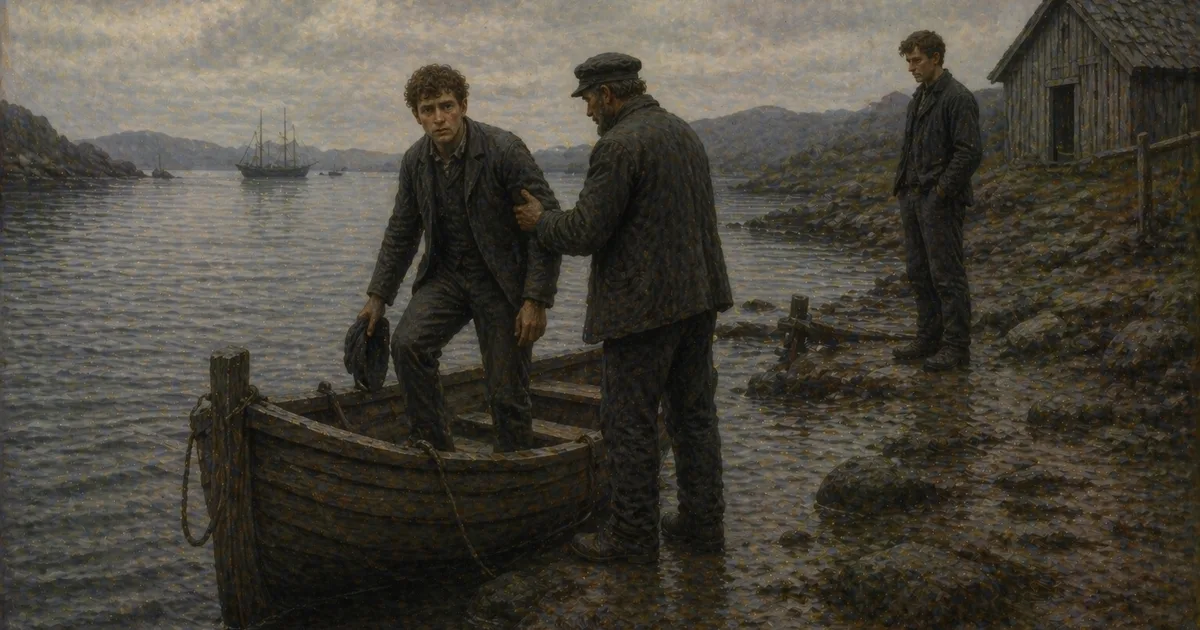
Lars came in before the light.
Olav heard the boat on the stones at the landing the way a man hears a familiar door, and he was up and dressed and at the window before the sound had finished. The morning was the color of old tin. The wind was out of the northwest and had the weight of a wind that would hold for the run down to Stavanger and perhaps the run out past Tungenes after it. Olav stood at the window for a long moment. Then he went down.
Jens was at the stove. The kettle had begun to boil; Jens had got up earlier than Olav had got up, which was the way of a man who had been dressed at first light for forty years. Peder came down the stair a moment after Olav. There was no coffee made yet, and Peder went to the stove and made it, and the three of them sat at the table together for the quarter of an hour it took to eat the bread and the cheese and drink the cup. They did not speak during the breakfast. The breakfast had been eaten at this table by these three men on a morning before a voyage only once before.
Lars came up to the door at the end of the quarter of an hour. He did not knock. He put his head in and said the tide was at the three-quarters flood and the wind was steady from the northwest and they would do well to be under way before the half hour.
Jens nodded. “We are ready.”
“The chest?”
“In the shed.”
“I will take her down.”
He went down to the shed without waiting for an answer. Peder got up to follow him, and Jens said without turning his head from the window, “He will take her down alone.”
Peder sat back down. He sat for a moment with his hands flat on the table, in the place at the edge where the cloth was worn thin. Then he lifted his hands off and went out to put on his boots.
They walked down together. The light had come up a little. The path was dry in the places the sun had dried it and wet in the places it had not. Lars was at the boat with the chest already in amidships under the tarpaulin, the way it had sat in June. The difference between this morning and the June morning was a difference Olav could not name at the landing. He would find it at sea.
Peder came down to the boat with them. He carried no cap because he had not put one on, and the wind off the water picked at his hair in a way it had not the year before. He stood at the boat and he did not speak, and he did not lift a hand, because this was a departure that wanted its hands kept at their sides. Olav stepped into the boat. Jens stepped in after him. Lars cast off. The boat moved from the stones, and the stones were behind them, and Peder stood at the landing in the low light, and Olav did not look back at the landing for as long as Lars was rowing them out of the cove, because he had learned in six months how a man left a place he meant to come back to.
The crossing to Stavanger took the whole forenoon.
The wind held. Lars did not need to tack. Olav sat in the stern with his hand beside Lars’s on the tiller, not because Lars had said that a boy going out again wanted the tiller under his hand for an hour, but because the tiller was where a man sat in this boat, and Olav was by now one of the men in this boat. Jens stood amidships with his cane. He did not point at anything. He had not, on the Tuesday before the signing, pointed at anything either. He would not, Olav thought, ever point at anything from Lars’s boat again.
Halfway across, Jens said, not to Lars and not to Olav but to the space between them in the boat, that he had, as a younger man, once seen a three-masted schoonership of the kind the Asta was put about in a strong wind past Tungenes by a crew that had been at sea three days, and that the putting-about had been clean and had taken not more than four minutes from the order to the new heading, and that the captain had been a man he did not remember the name of. Lars nodded without looking. Olav did not say yes. He looked at Lars’s hand on the tiller beside his own.
Stavanger came up out of the water the way it had come up in March. The mast-forest had shifted; three brigs that had been at the inner pier on the Tuesday had gone out, and two bark-ships that had not been at anchor then were at anchor now. Olav counted the three and counted the two. He did not count the rest.
Lars set them down at the inner pier. A boy who was standing there took the painter, and this boy was a different boy from the boy in March, and the difference between them would have interested Olav for a moment in June and did not interest him now. Jens and Olav went up the plank with the chest between them, Olav at the upper end this time and Jens at the lower, because Jens was not going aboard and Olav was, and the order at the plank was different from the order at the plank in June.
They walked along the pier toward the herring quay. The Asta was at the stones where she had been in March. The tide was at three-quarters flood. Her yards had been crossed; on her decks men were running coils to the pinrail and a boy was at the foreyard with the gaskets. Olav set his chest down on the quay. He shook his father’s hand carefully, the way he had watched his father shake hands with John Stensøy in March, and his father held the clasp a moment longer than a stranger’s clasp, and his father did not speak. Then his father stepped back and Olav picked up the chest alone and walked to the gangway and went up.
At the top of the gangway the first mate was standing. He was the man who had come into the office of registry in March and had stood at the far end of the counter without being introduced. His face had a cold in it. He looked at Olav and at the chest, and he nodded once and jerked his head toward the forecastle.
“You are the Finnøybu.”
“I am, sir.”
“You know where the forecastle is.”
“I know where it is.”
“Your bunk is the upper one on the larboard side aft of the stove. Stow your chest. Be back on deck in five.”
“Yes, sir.”
Olav went below. It was the forecastle the captain had shown him in March. The stove had been lit; someone had put a fresh billet in it. Four men were at their bunks, stowing their gear, and a fifth man was sitting on the edge of the lower larboard bunk pulling on a heavy boot. Two of the four were rolling hammock-cloths into tight coils at their locker-doors; the third was stacking a folded set of shore-clothes at the head of his bunk; the fourth had opened a small wooden box at his feet and was sorting through it without looking at it, the way a man sorts a box he has sorted a thousand times. None of them looked up when Olav came into the forecastle. He did not introduce himself. The introductions of a forecastle were made at the first full watch on the second day out, and not earlier. He stowed his chest in the locker beneath the upper larboard bunk. He climbed up into the bunk for a moment to lay a hand on the straw and the blanket, because a man who had learned to sleep in a top bunk through the full range of a ship’s motion did not take a top bunk on faith on the first day. The straw was new. The blanket was grey wool and smelled of camphor. He came down.
On deck the crew were rigging the cat-falls for the anchor, and at the starboard rail the boatswain was standing over a coil of four-inch line, looking down at it with one foot on the coil, sorting the fall with his hand. He was shorter than Olav had expected a boatswain to be. He had his sleeves rolled past the elbow; the forearm that held the line was a forearm that had done a man’s work for a long time, and the hand at the end of it was a hand that had been cut in a way a hand is cut when a rope has gone through it in a blow. Olav saw the boatswain and he saw the hand and the forearm and the coil and the sleeve. He did not know who the boatswain was by name, because there had been eleven names in Captain Gjermund’s voice over the dinner-table in March and none of the forward names had lodged, but he understood, across the small distance of the starboard rail, that this boatswain was the man from Hogganvik who had sailed with the captain before.
The boatswain looked up and saw Olav across the deck and nodded once. The nod was not a man’s nod to a stranger. The nod was a man’s nod to a youngman who had arrived on the deck of a ship on which the boatswain had been standing since the first grey. Olav returned the nod, and went to the captain, who was at the break of the quarterdeck and had seen him come up.
Captain Gjermund was in the same coat he had worn to the dinner. The coat had been brushed with the same care. He did not come down to the main deck. He lifted a hand in the air in a gesture that was half a wave and half a come-here, and Olav crossed the deck and stood at the foot of the short ladder that went up to the quarterdeck.
“Finnøybu.”
“Sir.”
“You are aboard.”
“I am aboard, sir.”
“You are in the top bunk on the larboard side because the top bunk on the larboard side is the bunk for a boy who has cooked on a brig and who does not need to be told how to make a bunk hold in a cross-sea. Do you need to be told how to make a bunk hold in a cross-sea?”
“I do not, sir.”
“Then you are in the correct bunk. Go and be where the boatswain sends you.”
“Yes, sir.”
Olav turned away. He saw, as he turned, that the captain’s wife had not come to the quay and would not come. He had not expected her. He crossed the deck again to the starboard rail.
The boatswain did not raise his head when Olav came up. His hand moved on the coil as he spoke, laying the fall in a figure-eight without looking, the way a man could set a rope to coil when he was not thinking about the rope. “Finnøybu. The fore-topsail wants loosing when the anchor is at short stay. You will go up with Nils and with Thompson. Nils is the boy with the fair beard at the foremast pin-rail. Thompson is the tall man beside him. You will do the starboard station. Nils has the port and Thompson has the bunt.”
“Yes, sir.”
“I am not a sir. I am the boatswain. You will call me Haakon when the captain is not on deck and by nothing when he is.”
“Haakon.”
“Up you go.”
Olav went forward along the starboard rail. Nils and Thompson were at the foremast pin-rail. Nils was about Olav’s age—half a head shorter than Olav, with a fair beard beginning at the jaw and with eyes that were the brown of wet bog in October. Thompson was a tall man of perhaps thirty-five with a long face and a long jaw and hair that had gone grey at the temples. Thompson nodded. Nils lifted a hand. The three of them stood at the pin-rail for the minute before the order came, and in that minute Nils said, so that Thompson could hear but that only Olav needed to hear, that Haakon from Hogganvik was a boatswain a man could work under, and that Thompson agreed with him on this, and that Olav was not to worry about the first day.
“I am not worried,” Olav said.
“That is well,” Nils said. “A man who says he is not worried on the first day is a man who will not be worried on the second day either.”
Thompson said nothing. The order came from the quarterdeck. The three of them went up the ratlines.
The sail fell at the yard in the wind. Olav cast off the gasket at his station when the gaskets were cast off at the other two stations, and the canvas broke out and took its first shape against the mast, and the men on the main deck sheeted the corners home with a hand-over-hand that he heard through his boots on the foot-rope. He stood on the yard for a long breath after the work was done and looked down at the deck, because a boy who had worked on deck in June could stand on a yard now and see what a man saw from it. The deck was forty feet below and full of the business of a ship that was about to take the wind. The captain’s coat was at the quarterdeck, dark against the grey sky. The boatswain was at the starboard rail. Jens was not on the quay. Jens had gone.
Olav came down.
Haakon was at the starboard rail where he had been, with the coil laid down clean for the cat-falls. He looked up once at Olav and nodded. It was the second time he had nodded at Olav. Olav went to the capstan.
The capstan had been turned by six men for a half-hour and the anchor had come up on the port hawse. The opsang had been the opsang of men who had sung together before; the boatswain had led it, and the voice that led it was a voice that had carried across a deck for years, and the men had answered it the way men answer a voice they know. The song was Jeg vil meg Herren love, which was the opsang a Stavanger crew sang when the tide was right and the captain was a captain they did not yet hate. The first verse came and went. The second verse came in men’s voices that had learned the verse on other ships in other years. The third verse came in the boatswain’s voice alone for the first line and in all the voices together for the second, the way a Stavanger opsang was sung when the capstan was at the full turn. Olav knew the song. He had sung it on the Sigrid’s windlass in June and he sang it now, standing at the foremast pin-rail, and the men on the deck could not hear him over the work, but he sang it anyway.
By eleven o’clock the Asta was past the outer pier and under courses and topsails, and the pilot was aboard, and by a quarter past the hour the pilot had taken her out by the channel he had taken a hundred ships out by. The wind held steady from the northwest. Finnøy rose over the larboard quarter and did not pass below the horizon until they were past the outer roadstead and the pilot had gone back down into the pilot-boat with a wave to the captain and a hard look at the first mate. Tungenes light was off the larboard bow for ten minutes and then astern.
The Asta took the wind and turned south.
Olav was at the foremast. He had been sent up again to overhaul the gaskets on the fore-royal, and from the fore-royal yard he had again the view from the Sigrid’s fore-royal yard in June: nothing but grey water and grey sky and a line between them that was neither a color nor a line but a fact a sailor learned to set his eye on. He set his eye on it. He could see, off the larboard quarter, the pilot-boat going back under jib and mainsail, a small white shape against a sea that was the color of wet slate. He could see, astern, the coast of Norway as a line of blue-grey hills that had not yet begun to diminish with distance; Finnøy was not distinguishable from the others at this range and would not be distinguishable for another hour, and then the island would be a shape and the shape would be smaller and the shape would be gone.
He stayed at the yard until the boatswain called him down. The voice came up from below—Finnøybu, come down—and Olav came down the ratlines the way he had learned to come down them on the Sigrid, and when he was on the deck Haakon said only, “Good. Now the main-royal,” and Olav crossed to the main and went up again. The deck was full of the business of a ship that had taken her wind and would take it south to Shields for a week and then east to Lisbon for longer and then home in high summer, and whatever would come between now and high summer would come to him on this ship under this captain in the company of this crew.
He did not think, at the main-royal yard, about any of it. He set his eye on the line. That was all.