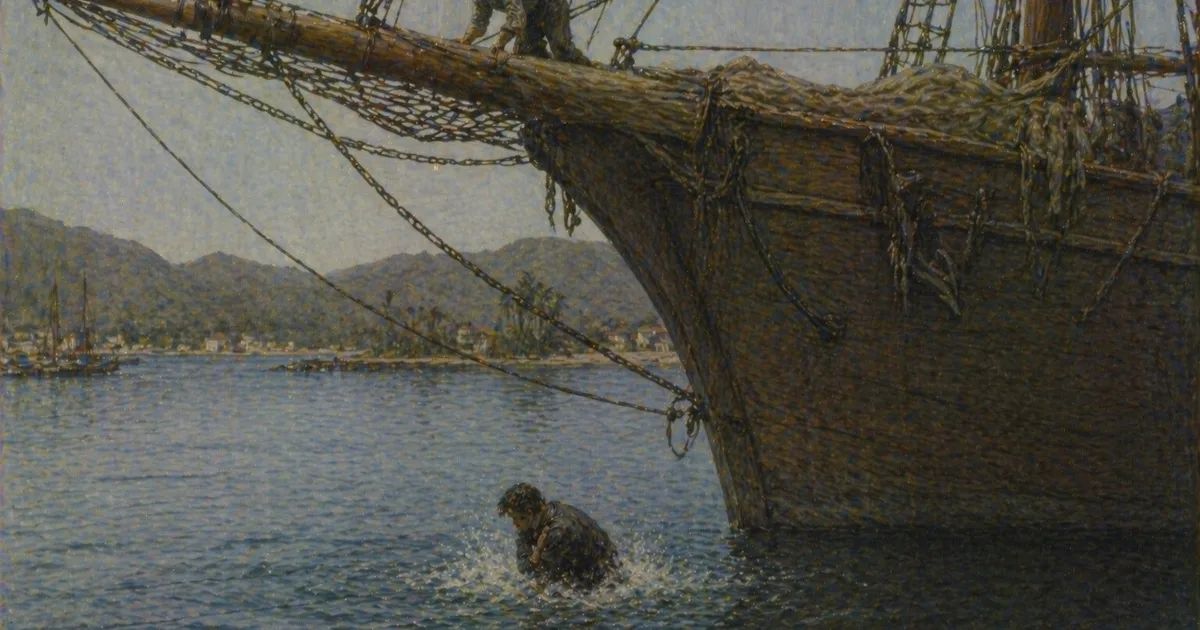
The Christmas Eve at the O’Briens’ house at Wilmington began at the noon of the twenty-fourth of December.
Mary baked at the morning. Patrick had brought home a dark goose from the market on the Monday and had hung it at the cool back of the kitchen, and Mary roasted the goose at the afternoon with the pan of root-vegetables at the side. Margit set the table at five o’clock with the white linen Mary kept for the Christmas Eve and the December Sundays. Patrick lit the lamp at the front room. The younger brother of Margit, who was twelve and was named Daniel, came in from the alley behind the house with the wood for the kitchen stove. Thomas was at the kitchen at the bench at the wall.
Olav came down at half past five.
He had put on the spare shirt the eldest son had left at the chest of drawers when he had gone to Charleston, which Mary had given Olav at the third week with the saying that the eldest son would not be wanting it back at Charleston for a while. The shirt was a clean shirt of a working man at Wilmington that fit Olav at the shoulders the way a shirt of a man who was not Olav fit Olav at the shoulders, which was a thing Olav had got used to in the four weeks of being at the back room. He sat at the bench beside Thomas.
It was the dinner of a Catholic family of the parish at Saint Mary’s at Wilmington at the Christmas Eve of 1877.
Patrick said grace at the head of the table in the slow English of a man who had been at Wilmington since 1862 and had said the same grace at the same table for fifteen years. Mary brought the goose. The goose was carved at the side. Margit served. Daniel ate quickly. Thomas ate at the rate of a man from Stjernarøy at a Catholic table at the Christmas Eve. Olav ate the goose and the root-vegetables and a piece of dark bread. He drank the glass of red wine Patrick had poured at the head of the table.
After the dinner Patrick said the family would walk to the midnight mass at Saint Mary’s at half past eleven and that the two sailors were welcome to walk with them or to stay at the house if they preferred to stay. Thomas said he would stay at the house. Olav said he would walk with them.
He walked with them at half past eleven.
The night at Wilmington at the Christmas Eve was a cold night of late December at the upper end of the city, and the lamps at the corners were lit and the streets were quiet and the frame houses had candles at the windows the kind a Catholic household at Wilmington kept at the windows at the Christmas Eve. The five of them walked down the side street from the O’Briens’ house to the Catholic mission at the upper end of Front Street, which was the Saint Mary’s where Father Donovan had been at the porch on the morning of the eighth of November. The mission was lit at all the windows. The bells at the steeple began at the quarter to twelve.
Olav stood at the back of the church through the mass.
He did not understand the Latin. He stood when the parish stood. He sat when the parish sat. He did not kneel when the parish knelt because he did not know whether a Norwegian Lutheran at the back of a Catholic mission at Wilmington at the Christmas midnight knelt with the parish or did not, and he stood when others knelt with the stillness of a man who did not know. Margit at the bench at the side did not look back at him at the standing. Father Donovan at the altar said the mass in the slow Latin of a Wilmington mission priest at the Christmas midnight in 1877.
The mass ended at half past one.
The five of them walked back to the O’Briens’ house at the upper end at half past one. The cold night at the upper end was the cold of a Wilmington December after midnight. The candles at the windows of the frame houses were still burning. The streets were quieter than they had been at the walking down. They came to the house at quarter to two. Patrick lit the lamp at the front room. Mary said good night to the two sailors. Margit said good night. Olav said good night. He went up to the back room and Thomas went to the folding-cot at the side that Thomas had been at again for the four nights of the second week of December.
Olav sat at the bed for some minutes before he lay down.
He looked at the wooden cross at the window. He looked at the chair at the foot of the bed where the working coat was at the chair-back with the four objects at the pockets. He laid his hand at the breast-pocket once and left Olava’s letters there. He laid his hand at the side-pocket and left the thing wrapped in brown paper there too. He sat at the bed for a few minutes and then lay down.
He slept.
The morning of the Christmas Day of 1877 came at the back room at half past six.
Mary brought a cup of warm milk and a piece of dark bread to the back room at seven. She said the Kvik was sailing at the noon tide and the noon tide would be at half past twelve. She said Patrick had been to the mass at six and was at the kitchen now. Olav thanked her. Mary set the cup at the chest of drawers and went out.
He dressed at the bed.
He put on the spare shirt of the eldest son and his own working trousers and his own coat. He laid the four objects at the pockets of the coat the way they had been through the seven weeks at the back room. He took the bone-handled knife and laid it at the coat-pocket the way Peder had laid it at the leather roll for him in March of 1876. He put on his shoes. He went down to the kitchen.
Patrick was at the kitchen at the table. Mary was at the kitchen at the stove. Margit was at the kitchen at the side. Daniel was at the kitchen at the bench. Thomas was at the kitchen at the door with his canvas bag at his shoulder.
Patrick said: “It is the day.”
Olav said yes.
Mary set the cup of milk at the table for him. She set a piece of dark bread at the side. She set a wax-paper packet at the side of the bread. She said the packet was a piece of the goose from the night before and a piece of the dark bread for the noon, and that the Kvik would not have the noon meal at the wharf-edge before sailing, and that the packet was for the wharf-edge before the noon. Olav thanked her.
Margit stood at the side of the kitchen.
She had an object at her hand. She came up to the table at the side. She set the object at the table beside the cup of milk. The object was a small wooden rosary the size of a man’s hand, made of dark wooden beads with a small wooden cross at the end. She did not say anything at the setting. Olav looked at the rosary at the table. He looked at her.
“For the voyage,” she said.
She said it in her English.
Olav took the rosary at his hand. He laid it at the inside-pocket of the coat where the spare shirt’s button-pocket was at the side. He thanked her at the saying. She said the parish at Saint Mary’s prayed for the men at sea at the second Sunday of every month, and that the prayer at the second Sunday would carry. Olav said he would remember. He did not say more. She did not say more either.
Patrick said it was time.
Olav and Thomas walked to the wharf with Patrick at their side. The walk took them from the upper end of Wilmington to the lower end, the same way Olav had done in the reverse at half past two of the Saturday morning of the eighth of November and was now doing forward at half past ten of the Christmas Day morning of the twenty-fifth of December. The streets were quiet because the morning of the Christmas Day at Wilmington was a morning when most of the city was at home. The lower end at the wharves was not at home. The wharf-men were at the wharves at the loading of the ships that were sailing at the noon tide of the Christmas Day, as they were at the noon tide of any sailing day.
The Kvik of Drammen was at the inner wharf three berths down from where the Dronningen had been.
The Dronningen had sailed for Goole on the fifteenth of November, which was a week after Olav and Thomas had gone over the larboard rail. The wharf where the Dronningen had been now held a Norwegian schooner from Stavanger that Olav did not know the name of. The Kvik at the inner wharf was the bark Thomas had described—a fifteen-year soft-wood bark that had not been a clean ship for some years and was not a clean ship now, with the balance of a pine-board cargo at her foredeck-cargo lashings and the loading-fall at her side coming up with the last of it.
Captain Salvesen of Drammen was at the deck.
He was a man of about fifty in a dark coat and a captain’s cap of a kind that had been a captain’s cap fifteen years before, and he had grey at his beard and a ledger at his hand. Patrick walked Olav and Thomas up to the gangway. Patrick said good day to the captain in the slow English of a Wilmington Irishman and said the two sailors were the two sailors who were wanting to sign on. The captain looked at Olav and Thomas. The captain said yes. Patrick said good day to the captain again and stepped back.
Patrick turned to Olav at the gangway.
Patrick did not say much. He said the parish at Saint Mary’s would pray for the Kvik at the second Sunday of January, and that Olav was welcome at the O’Briens’ house at any future Wilmington that brought him back, and that Olav should write to Patrick at the parish address that Patrick had given him on the slip of paper at the front room two weeks before. Olav said yes. Patrick laid his hand at Olav’s shoulder for a moment. Patrick took his hand off the shoulder. Patrick said good-bye and walked off down the wharf toward the upper city.
Olav signed the articles at the office at the wharf-end at the half past eleven.
Captain Salvesen at the office said the wages were the wages of a Kvik hand for the run to Hamburg. Olav said yes. The captain said the bunk was the upper bunk on the larboard side aft of the stove. Olav said he understood. The articles were the articles of a Drammen bark on the run to Hamburg in the December of 1877, and Olav signed them with his Norwegian name in the hand that had a small flourish at the y of Hestby. Thomas signed after.
The Kvik sailed at the noon tide.
The pilot took her out of the inner harbor at the noon tide under topsails and the trade for the run down to the open Atlantic. The wharf at the inner port fell behind at the larboard quarter. The wharves of Wilmington fell behind. The lighthouse at the entrance to the river fell behind at the eight bells of the afternoon watch. The bark went down to the open Atlantic at the change of the four bells of the second dog-watch.
Olav was at the foremast pin-rail at the change.
The bark was not a bark like the Dronningen. The pin-rail had a splintering at the upper end where the splice had been wanting attention for some years. The cat-falls had a fraying at the eye that the Kvik’s boatswain—a man of about thirty-five who had been at the Kvik for two voyages—had registered without setting the time for the re-laying. The figure-eight at the cat-falls was the one Olav had been laying at the cat-falls of every ship he had been at since the Asta in March of 1876. He laid it at the cat-falls of the Kvik. The man who had taught him the figure-eight was a man whose name he did not name to himself.
He had Olava’s two letters at the breast-pocket.
He had the thing wrapped in a piece of brown paper at the side-pocket. He had the carte-de-visite at the wallet at the other side-pocket. He had the bone-handled knife at the coat-pocket. He had the wooden rosary Margit O’Brien had given him at the inside-pocket of the coat where the spare shirt’s button-pocket had been at the side.
He had not the chest.
The chest was at Goole on the Dronningen with the spare blanket and the second pair of trousers and the spare shirt and the tin of tobacco from Isaksen at Judaberg and the writing-paper, and the chest would come to Stavanger from Goole when the Dronningen came home in the spring and the chest would go to Vestbø by way of John Stensøy at Stavanger and would be at Vestbø waiting for him at the foot of the bed in the small back room at Vestbø where his mother had read to him from the gospel of John in the spring before she had died.
The wind at the foremast pin-rail was the southwest at twelve knots.
The bark went down to the Atlantic at six knots with the trade on her quarter. The Christmas Day evening came down at the rail at half past five with the long red light of a December sunset at the western horizon and the dark coming on at the eastern horizon, and Olav stood at the rail and watched the western horizon at the dark coming on. He had carried what he had carried out of the Dronningen’s wharf to the upper city to the back room at the O’Briens’ house at the second street to the south to the kitchen at the Christmas Eve to the Catholic mission at the upper end of Front Street to the wharf at the noon tide of the twenty-fifth of December to the foremast pin-rail of the Kvik of Drammen on the southerly Atlantic at the change of the four bells of the second dog-watch.
The Christmas Day evening went to the night. The Kvik went down to the open water. The lighthouse at the river-mouth showed at the larboard quarter and then did not. The dark of the Atlantic at the Christmas night of 1877 came down.
He stood at the rail.
He did not know what was at the bottom of the chest at the foot of the bed at the back room at Vestbø where the chest was not now and would be in the spring. He did not know what was wrapped in the piece of brown paper at his side-pocket. He did not know what was in Olava’s hand at the long blue light at her upper window at Lindøy on the same Christmas Day at six hours’ difference of longitude. He did not know what the Kvik of Drammen would do at the run to Hamburg.
He carried what he was carrying.
The Kvik of Drammen went south by east at six knots into the Atlantic at the Christmas night of 1877.