Haakon Berg had been at Bristol for three weeks before he saw the Dronningen come up to the inner wharf.
He had paid off the Hellig Olav at the Bristol Roads on the eighteenth of January and had taken the upper room at the boardinghouse at Queen Square that the Norwegian agent at Bristol kept for the Norwegian sailors between berths, and he had been at the room for three weeks waiting for the Helena of Stavanger to come up from Cardiff with a berth she had told the agent she would have for a Hogganvik boatswain. The Helena was a week late. Haakon had been at his own time at Bristol for the eight days before the Dronningen came up, and he had filled the eight days the way a man between berths at a foreign port filled his time: at the public reading-room at the Sailor’s Bethel and at the wharves and at the chapel for the Scandinavian sailors at College Green, and at the upper room at Queen Square in the evenings.
The nine months from Stavanger to Bristol had been the nine months of a Hogganvik boatswain who had been at sea for eight of the nine months. He had been on the Asta—the same Asta Olav had been on in the spring of 1876 under Captain Gjermund—for the second voyage under a new captain who was not Gjermund, because the Asta’s owners had taken Gjermund off the deck at the second voyage and had set a man named Halvorsen at the wheel. Halvorsen was not Tollefson and was not Gjermund. He was a man at the wheel. He gave the orders the Asta’s owners had given him to give, and he took the Asta on the runs the Asta’s owners had set, and he did not stand at the foremast pin-rail at the noon and look at the deck-work the way Gjermund had stood at the rail. Haakon had done the boatswain’s work for him for the run to the Bay of Biscay and back through the autumn of 1876, and had paid off the Asta at Stavanger at the end of November, and had taken the Hellig Olav at the second of December for the run down to Bristol with a winter cargo of Stavanger-cured fish. He had been at sea on the Hellig Olav through Christmas. The Hellig Olav had been a clean ship under a fair captain, and the run had been the run of a winter timber-hand on a Stavanger-Bristol passage: a man doing the work of his rating and not looking for a thing past the work. He had thought about the boy from Vestbø at certain hours of certain nights through the autumn and the winter, as a man at sea thinks about a man he has parted from at a foremast in Stavanger in May.
He had not written.
He saw the Dronningen come up the river at the noon of the second Tuesday of February, and he was at the inner Bristol wharf at the time the bark came up because he had been at the wharf to look at the Helena’s berth. He read her name at the stern when she came up to the anchorage, and he read it twice. He stood at the wharf for some minutes and watched the bark drop her anchor at the inner roads. He did not go down to the wharf-edge where the lines would go out at the morning tide of the next day. He went back to Queen Square at half past noon.
He had heard about the Dronningen the week before from the Norwegian agent at Bristol, who had said the Dronningen under Tollefson was due in from Wilmington with a coal cargo and had come through a hurricane at the second week of January, which the agent had read at the Stavanger papers that had come up at the steamer of the previous Saturday. Haakon had registered the name at the agent’s office without saying he knew the name. The agent had said the Dronningen was at nine months on a twenty-month run from Stavanger and would be at Bristol for the unloading of the coal and would go to Cardiff after for a Welsh-coal return cargo to the Baltic.
He did not go to the Dronningen’s wharf at the unloading.
He went to the Sailor’s Bethel at the noon of the Friday of the first week, because the Friday of the first week was the day he had been going to the Sailor’s Bethel through the three weeks before the Dronningen came up, and going at the noon of the Friday was the time at which a Hogganvik boatswain between berths went to a reading-room at a foreign port. He sat at the long oak table at the reading-room with the Aftenbladet of Stavanger in his hand. The reading-room was the long room at the second floor of the Bethel with the windows at the south wall and the wood-stove at the north wall and a framed engraving of a Stavanger schooner above the wood-stove. He read the Aftenbladet slowly, with the attention of a Hogganvik boatswain reading a Stavanger newspaper at a Bristol Bethel reading-room.
Olav came in at the change of the half hour.
He came in alone with his cap in his hand. He had a small paper packet at his coat-pocket the way a man at a Bristol port might have a small paper packet—a tract from Old Man James, perhaps, or a writing-paper bought at a Bristol stationer for a letter not yet written, or a letter folded for an outgoing bag. Haakon saw the packet at the coat-pocket and registered the packet without naming what was in the packet. Olav came up to the long oak table and looked for the Aftenbladet. The Aftenbladet was at Haakon’s hand.
Olav saw Haakon.
He stopped at the corner of the table at the south end. He did not say anything. He did not lift his cap or set it down. He looked at Haakon at the table with the Aftenbladet in his hand, and he held the look for the few seconds a man at a Bristol Bethel reading-room held the look at another man he had not seen since a Stavanger May.
Haakon set down the Aftenbladet.
He did not say anything either. He did not need to. Olav at the corner of the table was Olav at the corner of the table, and the small paper packet at Olav’s coat-pocket was the paper packet at Olav’s coat-pocket, and the Aftenbladet at Haakon’s hand was the Aftenbladet at Haakon’s hand, and the nine months from May 1876 to February 1877 had brought both men to this room at this hour. Haakon stood up.
The two of them went down the stairs of the Bethel. They did not speak on the stairs. They did not speak at the door of the Bethel. They came out onto Prince Street and walked along Prince Street to Marsh Street and along Marsh Street to Queen Square, and Haakon took Olav up the steps of the boardinghouse at Queen Square and up the stairs of the boardinghouse to the small upper room at the third floor that he had been in for the three weeks before, and they did not speak through any of the walking or any of the climbing. The rain at Marsh Street had stopped at some hour of the morning. The cobbles were wet. The wind was at the southwest at four knots. The light at the upper window when Haakon opened the door of the room was the light of a Bristol Friday afternoon at the end of the first week of February.
Haakon closed the door.
There were the things they had not done at the figurehead at Stavanger and at the foretop at Lisbon and at the after watches of the Asta in the summer of 1876 when the boy had been at the foretop in Olav’s place because Olav was on the Dronningen and not on the Asta. There were the words they had not said at the foot of the foremast at Stavanger in May. There was the look that had been at Lisbon at Olav’s hand on the foreyard and that had been at the cabin at Stavanger when the captain had been ashore and the boy had been at the steward’s locker. The nine months had not made the things smaller. The nine months had made the things wait.
The boy was not the boy from Vestbø who had been at the Asta’s rail in March 1876. The boy was a man who had been at sea for nine months under a captain who was not Gjermund and had come through a hurricane in January and had a paper packet at his coat-pocket that was a packet for a young woman at Lindøy Haakon had not been told the name of and that he did not need to know the name of for the next hour to be the hour the next hour was going to be.
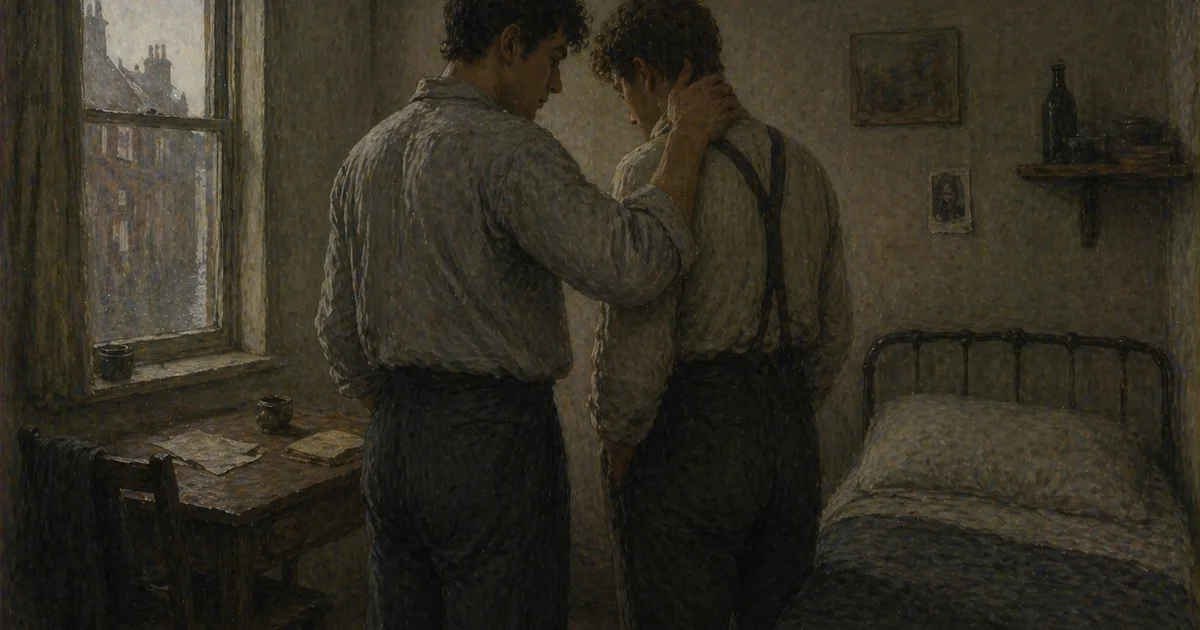
Haakon laid his hand at the back of Olav’s neck.
The hair at the back of the neck was the hair the back of the neck had at nineteen under a sailor’s cap that had been off in the room and that Haakon was not going to put back on the head. He laid his hand at it. Olav did not step back. Olav’s hand came up at Haakon’s coat at the front, and Haakon’s coat came off at his shoulders, and the coat was at the chair at the foot of the bed. Haakon’s shirt was at the bed. The boy’s shirt was at the bed beside it. The two shirts were a sailor’s shirt and a sailor’s shirt at a bed in an upper room at a Bristol boardinghouse on the Friday afternoon of the first week of February in 1877.
The bed was a bed for one man.
Two men at a bed for one man at a Bristol boardinghouse upper room in the first week of February did the thing that two men at a bed for one man did when neither of them had spoken at the stairs or at the door and when both of them had carried what they were carrying for nine months. The thing was not a thing the years of voyages Haakon had been on had given him a way to render. The thing was of the body. Olav’s mouth at Haakon’s mouth. Haakon’s hand at Olav’s back. Haakon’s other hand at the back of Olav’s neck. Olav’s hand at Haakon’s chest at the place over the heart where the heart was at twenty-three under the chest of a Hogganvik boatswain who had been at the figurehead with a man who was now at his bed. The skin at the back of Olav’s neck was the skin of a man who had been at sea for nine months and was warm under the cap. The skin at his back was the skin of a man who had been at the rail at the watches of the Atlantic and was warm under the shirt. The breath at the place between Haakon’s shoulder and Haakon’s throat was the breath of a man who had come up the stairs to the upper room without having said what he had come up the stairs for, because both men had known what he had come up the stairs for. Haakon kept his eyes open at the moment the moment came, because keeping his eyes open at that moment was the only thing he had not been allowed to do in the nine months since Stavanger and was the thing he had decided he would do if the moment ever came. Olav kept his eyes open too. They saw each other.
The afternoon went on at the upper room.
It went on by the afternoon’s own measure. Haakon did not look at the clock at the writing-table at the wall. The light at the upper window was the light of the Bristol Friday afternoon. The fire at the grate had gone to embers at some hour Haakon had not noticed. The bed for one man held the two of them with the narrow space at the side that the body not at the wall had to keep his shoulder at the edge of, and Haakon was at the wall side because he was at his own bed, and Olav was at the side because he was the man who would leave.
He left at the change of the late afternoon.
Olav put on his shirt at the bed and his coat at the chair. He laid the paper packet that had been at his coat-pocket at the writing-table at the wall and looked at it for a moment and put it back at his coat-pocket. He did not say what was in the packet. Haakon did not ask. The two of them stood at the door of the upper room. Olav looked at Haakon. Haakon looked at Olav. They had spoken twelve words at the rail of the Asta in March 1876 and twenty-six words at the foot of the foremast at Stavanger in May 1876, and they did not speak any words at the door of the upper room at Queen Square in February 1877.
Olav opened the door. He went down the stairs.
Haakon stood at the door of the room for some minutes after Olav had gone. He went back into the room and closed the door. The two shirts had been at the bed and now there was one shirt at the chair at the foot of the bed, which was Haakon’s shirt. The fire at the grate had gone out. The light at the upper window was the light of a Bristol Friday afternoon going to the Bristol Friday evening. The Aftenbladet he had laid down at the long oak table at the reading-room of the Sailor’s Bethel was still at the table at the reading-room. He had not gone back to get it.
He sat at the bed for some hours and did not light the lamp.
He thought about the boy from Vestbø who had been a man at his bed for the afternoon of the Friday of the first week of February in 1877 at Bristol. He thought about the nine months from May 1876 to February 1877. He thought about the Asta at the second voyage under Halvorsen and about the Hellig Olav at the run down to Bristol, and about the figurehead at Stavanger that he had stood at with the boy in March 1876, and about the foot of the foremast at Stavanger where they had said the twenty-six words at the parting in May. He thought about the small paper packet at the boy’s coat-pocket that the boy had laid at the writing-table for a moment and had put back at the coat-pocket without saying what was in the packet. He thought about the young woman at Lindøy whom he had not been told the name of and who was at Lindøy now waiting for the boy to come home from a voyage that had eleven months left of the twenty-month term Haakon had heard from the Dronningen’s agent at the wharf.
He thought about the look at the corner of the long oak table at the Bethel reading-room, which had been the look of a man who had not seen the man at the table for nine months and which had been the look that had not lifted the cap or set it down. He thought about the back of Olav’s neck under the cap that had been off in the room. The breath had gone out of his own throat at the foot of the stairs of the boardinghouse when Olav had come up the stairs after him, and that too came back at the bed. He thought about the two shirts at the bed and about the shirt that was at the chair at the foot of the bed now that there was one shirt at the chair and not two.
He thought about the once.
He had decided, when the boy had come up the stairs of the boardinghouse at Queen Square at the noon of the Friday, that the afternoon at the upper room at the third floor was the afternoon he would have once and would not have a second time.
He decided again, at the bed in the dark of the Bristol Friday evening, that once would have to be enough.
The Helena of Stavanger came up the river to the inner Bristol wharf at the morning tide of the Saturday. Haakon went down to the wharf at half past seven and signed the articles at the office at the wharf-end and was a boatswain on the Helena by nine o’clock. The Helena would sail for Cardiff at the noon tide of the Tuesday and from Cardiff to Reykjavík with a hardware cargo on the run that the Helena’s owners had been doing for six years.
He took his sea-chest from the boardinghouse at Queen Square at noon on the Saturday.
The bed had been made by the keeper of the boardinghouse on the Saturday morning and was the made bed of an upper room a sailor had been in for three weeks and was not going to be in for a fourth. Haakon took his chest down the stairs and out the door of the boardinghouse and along Marsh Street and down to the wharf where the Helena was tied at the second wharf below the Dronningen. He passed the Dronningen at the wharf-edge. He kept his eyes from the bark and from the places where the boy from Vestbø might have been: the rail, the foretop, the after rail. The not-looking was a thing he set himself to in the way a man at twenty-three set himself to a thing he had decided at the bed in the dark of the Bristol Friday evening, which was the deciding that once would have to be enough and that the not-looking at the Dronningen at the wharf-edge at the Bristol Saturday noon was the form the once took at the wharf-edge. He kept the chest at his shoulder. He kept his eyes at the cobbles of the wharf and at the bollards of the Helena’s wharf ahead. He carried the chest along the wharf to the Helena and set it on the deck at the foot of the gangway.
The Helena’s boatswain’s-mate said the bunk was the upper bunk on the larboard side aft of the stove. Haakon said yes. He went below with the chest. He set the chest at the foot of the bunk and laid the bedding the Helena’s steward had set out at the upper bunk and went up to the deck for the next of the boatswain’s work.
The Helena sailed for Cardiff at the noon tide of the Tuesday.
Haakon was at the foremast pin-rail at the run down the river. The Dronningen was at the inner wharf as the Helena passed. He did not look up at her. He laid the coil at the cat-falls in the figure-eight he had been laying at every Norwegian-flagged ship since 1858. He set it. He went forward to the work the Helena’s boatswain had next.
The afternoon at the upper room at Queen Square in the first week of February 1877 was a thing he carried at the place a man carries the things he has done that he has decided he will do once.
He did not write to the boy from Vestbø.