Twelve days.
For twelve days the freshwater tank in the after hold was leaking seawater and no man on the Asta knew it until the steward drew off a half-bucket on the morning of the thirteenth day to make coffee for the watch and the bucket smelled of the sea. The steward brought the bucket to Lønning. Lønning brought it to the captain. The captain came below with the steward and the carpenter and they looked at the tank, and the carpenter said the tank had a seam open in its forward bulkhead at the bottom, and the captain said a word and went back up to the deck. The watch was put on half-rations of water from the deck barrel and the after tank was sealed and the Asta held her course for Shields, and the wind backed and held southwest, and on the second night of the half-ration a sea took the carpenter’s hat off his head while he was at the wheel and he laughed about it the next morning at breakfast and Pål laughed with him.
It was the only laughing on the deck of the Asta in the days between the burial and the night of the schoonership. The ship had not become a quiet ship—the work went on, the bells were rung, the orders were given—but the speech between men had thinned in the way the water in the deck barrel thinned. Eliasson’s bunk in the forecastle was empty and stayed empty. The Flekkefjord steward laid six plates at supper for nine nights after the burial. He laid five from the morning of the thirteenth day, and no one said anything about the change. Nils ate at his place. The bruise on his cheek had darkened to the color of a plum at first and then had begun to yellow at the edges.
Olav had not been beaten. He had been shouted at. There was a difference and there was not a difference, and on the watches between the burial and the night of the schoonership he turned the difference over in his hands the way a man turns a piece of work over. Haakon was the same Haakon. Haakon worked beside him at the foretop on the second day and on the fourth day, and Haakon spoke to him in the working voice that did not change between fair weather and the after-burial ship, and Olav was grateful for the working voice without having a word for what he was grateful for.
The fifth night of the voyage was a Sunday.
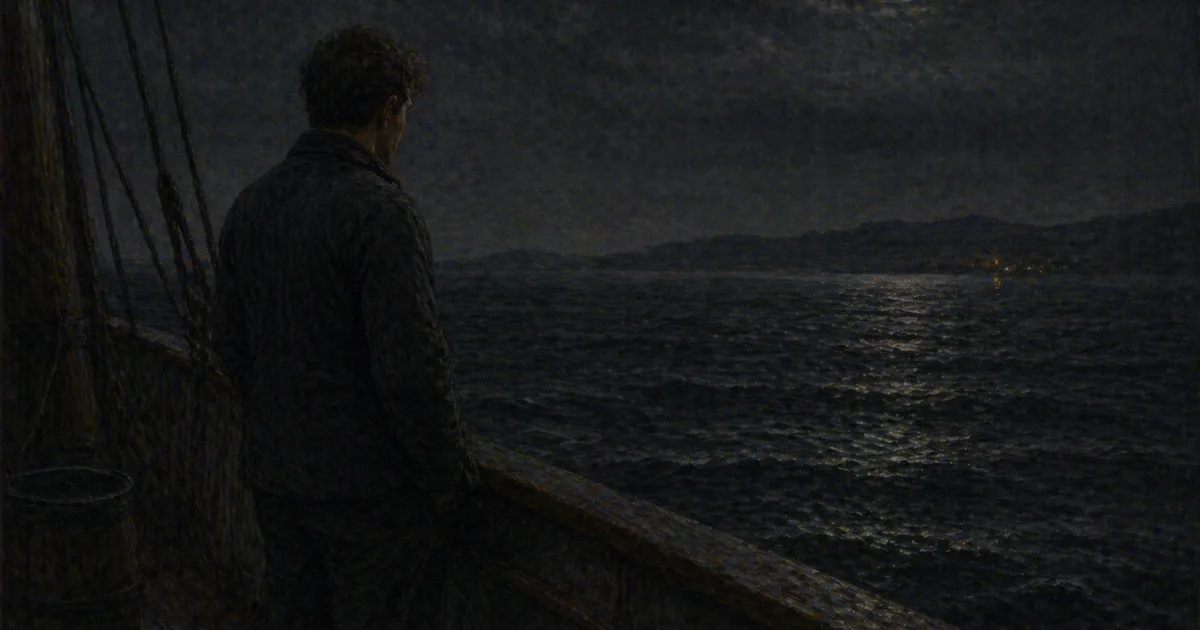
He knew it was a Sunday because he had counted the days from the departure on the morning he had counted them, which had been the morning of the burial, and he had not stopped counting since. The aunt at Vestbø would have lit the lamp at the kitchen window before the supper and would have left it on the sill through the night, because she had said in the kitchen on the Saturday before he left that she would do it on the Sunday nights until he came back. He stood at the foremast pin-rail in the second watch with the wind cold on his cheek and the ship under him making her seven knots in the dark and he thought of the lamp on the sill of the kitchen window at Vestbø in the same minute that the lamp would be there. Then the bell sounded and he turned to the work that came at the bell, and the work took him from the thought of the kitchen, and he was grateful for the work, which was a different gratitude from the one he had for Haakon’s working voice but was in the same family.
On the eighth day Haakon sent him forward to look at the bowsprit-shrouds, which had taken a chafe at a place where the chafe could become a parting if the chafe were not seen and tended to. Haakon went forward with him. They went out along the bowsprit one at a time, with Olav going first and Haakon coming after, and they sat at the cap with their feet on the footrope and their hands on the gear and looked at the chafe. The chafe was not yet a parting. Haakon showed Olav the place to put the parcelling and the place to put the service over the parcelling, and Olav did the work with Haakon’s hands beside his at the place, not on his hands but beside them. Haakon did not look at him while they worked. Haakon looked at the work. When the parcelling was on and the service was clean over the parcelling, Haakon said, “Good. We will check it again at the end of the watch.” Then he went back along the bowsprit and Olav came after.
Olav did not think, on the way back, about the place where the parcelling had been put. He thought about the work.
The night of the half-rations was the night they almost ran down the schoonership.
She was south-south-east of them and was running on the larboard tack with no light at her bow and no light at her stern that the Asta’s watch could see. The Asta was on the starboard tack and Karl Oberg had the deck. Karl Oberg saw the shape of her at the last instant of the last minute of the last watch of the night, and he put the helm down with both hands, and the Asta came up into the wind and lost her way in three lengths, and a sea—the kind of sea that comes in three or four times a night in the North Sea without any reason a man can name—lifted both ships at once and carried them apart by the breadth of a deck. The other ship passed close enough that Olav, who had come on deck for his watch and was at the foremast pin-rail, could have spat on her stern if he had had the spit. She showed her stern light when she was past.
Karl Oberg stood at the wheel with his hands still on it. He did not say anything for a long time. After a long time he said, “That was not me.”
Lønning, who had come up from below at the change of the helm, said, “It was not anyone. We will not speak of it again.”
The other ship’s stern light grew small at the larboard quarter and then was a small pale point in the dark and then was gone. The Asta settled back onto her course south-southwest. The wind held southwest and freshening. Karl Oberg gave the wheel to Sørli at the change. Lønning stood beside Sørli at the wheel-box for the rest of the watch and did not say anything else. The captain did not come up.
In the morning the wind came round to the west and held, and the Asta was making her eight knots on a beam reach by the forenoon, and the work on the deck was the work of a ship under fair wind in the last days of a passage. The carpenter spent the afternoon on the after deck with the tools out, looking at a place on the rail that Olav could not see was a place that needed looking at, but the carpenter was a man who had sailed with the Asta a long time and who had decided when a piece of teak rail wanted attention. The steward came up at four bells of the afternoon watch with a basin and a bar of yellow soap and gave them out to the men of the watch in turn so they could wash. Olav washed his face and his hands and the back of his neck. The water in the basin was a small thing and the bar of yellow soap was the smallest, but it was the steward’s small thing and the men of the watch took it without saying about it.
The land was sighted at six bells of the morning watch on the fifteenth day.
Pål was at the foremast head and he called it down. The land was a long low blue line on the larboard quarter that became, in the next half-hour, the long low blue line of the English coast that ran south from the mouth of the Tyne. Olav was at the deck when the call came. He looked up at the land the way he had looked at it from the deck of the Sigrid in the autumn, which was the way of a man looking at a thing he had seen once before and had not been certain he would see again. The light at Souter was the light at Souter. He had not been certain, on his second voyage, that he would see it again.
The pilot-boat came out at noon. The pilot was an older man than the pilot at Stavanger had been; he had a beard that was grey at the chin and a coat that had been blue once and was the color of slate now. He stepped aboard at the rail and shook Lønning’s hand and went aft to the captain. The captain had come up at the call of the land. He was in his coat. He was sober. He stood at the wheel-box and shook the pilot’s hand the way a captain shook a pilot’s hand in the harbors where the pilot had taken him in before. The pilot took the deck. The Asta came up the Tyne under courses and topsails with the pilot at the wheel, and the river opened to the south as it had opened in October, and the staithes appeared on the north bank as they had appeared then, and the slips of Hebburn on the south bank were where they had been.
Olav was at the foremast pin-rail. He saw, across the river, slip three of Rutherford & Co. He saw the staging. He could not see, from the deck, whether the man at the staging was a man he had spoken to before—the foreman with the red beard, who had told him a thing about the year his father had taken the plank to the knee—and he could not make out, at this distance, whether the staging on the second tier was the staging from which a plank had been dropped in the autumn of 1856. He looked across the water at the slip for the length of time it took the Asta to pass it. Then the Asta was past, and the slip was astern, and the river opened ahead to the staithes where the Asta would lie.
She was made fast at four o’clock. The pilot took his money and went over the side. The captain went below to his cabin. Lønning gave the watch the rest of the day. Haakon was at the rail amidships. He looked at Olav and he said, “Ashore.”
Olav went ashore.
He stood on the stones of the quay at Hebburn for a moment before he walked. He had stood on these stones in October, six months and one death ago. The stones were the same stones. He was not the same man.