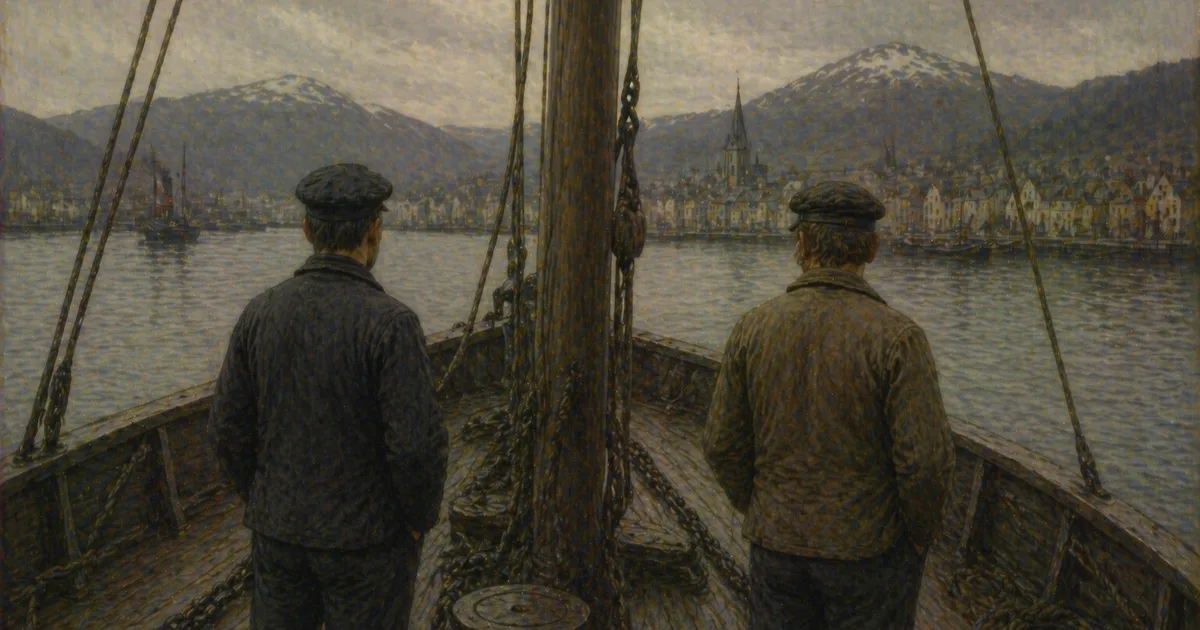
The Asta came out from Setúbal on the twenty-fourth of April with the tide at four in the afternoon and the wind out of the southwest at a force that wanted reefing in her topgallants by the second day at sea, and she made the run north up the Iberian coast and across the bay in fourteen days that ran from the warm haze of the Portuguese coast through the colder rain of Biscay to the grey weather of the Channel and the still colder grey weather of the North Sea, and through the fourteen days the captain came up at the morning watch and at the afternoon watch and at no other watch, and Lønning had the deck for the rest of the day and most of the night, and Haakon had the foredeck under Lønning, and the Asta worked herself north under a system of orders that did not pass through the captain’s cabin door because the orders did not need to.
The captain was a different man on the homeward leg from the man he had been on the leg out. He did not drink at the morning watch. He drank at the afternoon and into the dog-watches, and the steward’s locker had been moved twice since Setúbal—once to the locker forward of the carpenter’s bench because Lønning had asked the steward to move it, and once back to the locker aft of the steward’s pantry because the captain had asked the steward to move it back—and the steward had moved it without comment in either direction. The captain came up at his two watches in his coat with the wrong button now sometimes on the right hole and sometimes on the wrong, and he stood at the wheel-box and he gave one or two orders that were not orders Lønning had not already given, and he went below.
Olav was at the work the work needed. He was at the foretop in the mornings. He was at the wheel sometimes. He was at the pin-rail. He was at the wash-bucket. He was at the supper at the forecastle table with Nils across from him, and Nils was eating again, and the bandage on Nils’s head had come off in the second week at sea. The place above the captain’s eye where the chain had taken him on Palm Sunday morning had healed at a different rate than the place at Nils’s cheek where the captain’s fist had taken him in March and again in April. The captain’s wrist had healed too, mostly. The captain held the wrist in his left hand at the wheel-box when he came up, in the way a man held a wrist when the wrist was not yet sure of itself.
In the second week the wind came round to the east and held, and the Asta tacked north against it for three days and made fifty miles a day, and on the fourth day of the easterly the captain came up at six bells of the morning watch in his coat with the button on the right hole and gave the order for a new course that was a course no man on the deck believed.
Lønning, who had the deck, asked the captain whether the new course was the captain’s reading of the dead reckoning. The captain said it was. Lønning said “Yes,” and gave the order forward, and the wheel went over, and the Asta came onto the new course, and Lønning went aft with the captain to the cabin and stayed there for a quarter of an hour. He came up. The captain did not come up after him.
The new course did not last the watch.
Lønning gave the order at the change of the watch to come back onto the previous course—the course the Asta had been making before the captain’s order—and the wheel went over, and the Asta came back to her north-and-easting, and the day went on as the day had been going. The captain did not come up at the change of the watch.
In the night, when Olav came on deck for the middle watch and went aft to the binnacle to take the heading, the binnacle-lamp was lit and the chart was on the small folding desk Lønning had brought up from his own cabin and set against the after bulkhead. Lønning was at the desk with a pencil and a pair of dividers and a chart of the North Sea that had Lønning’s own corrections at the south margin in a hand Olav had not seen on a chart before but understood, in the moment of seeing it, was the hand of a first mate who had been correcting the dead reckoning of his own ship for as many weeks as the dead reckoning of his own ship had needed correcting. Lønning did not look up when Olav came aft. Olav did not say anything. He took the heading from the binnacle and went forward to the wheel and said the heading to Sørli, and Sørli said good, and the wheel went on its small adjustments through the watch, and Lønning was at the desk for the rest of the watch with the dividers in his hand. He came up at four bells of the afternoon and stood at the wheel-box and looked at the compass and at the binnacle, and he did not say anything about the course that was not the course he had given. He went below.
Haakon was at the foredeck at the change of the watch on the fifth day of the easterly. Olav was at the foretop coming down from the morning’s overhauling at the gantline-blocks. Haakon stood at the foot of the foremast with his hands at his sides and waited for Olav to come down. Olav came down. Haakon said, “He has us thirty miles inland.”
“What?”
“His dead reckoning. He has the Asta thirty miles up in the Norwegian mountains. Lønning saw the working in his cabin yesterday.”
Olav looked at Haakon. Haakon looked at the deck. Then Haakon said, “We will be in the bay in three days. The current is doing what the current does this time of year, and Lønning has been correcting since the second day. We will be in the bay.”
“Yes.”
Haakon went aft. Olav stood at the foot of the foremast for the length of time it took a man to register a fact about a ship that explained the way the ship had been working for the last three weeks. The captain had not been navigating since Lisbon. The captain might not have been navigating since Hebburn. Lønning had been navigating, and Haakon had been doing what a boatswain did when the first mate was navigating the ship past the captain who was supposed to be navigating it, and the Asta had been making her course north at the rate she had been making it because the men who were not the captain had been making her make it.
Olav went forward to the work.
The fourth day of the easterly was a day of fog at the morning watch and a clear afternoon and a wind that backed into the south by sundown. The fifth day was a day of a fair wind and a sky that ran from grey to a flat blue at noon and back to grey by the change of the watch. On the morning of the sixth day the lookout at the foremast head called land at the larboard bow, and the land was the line of the coast at Egersund a half-day’s sail south of Stavanger, and the Asta had her course corrected by Lønning at the wheel without going aft to the captain’s cabin, and the Asta came north along the coast through the day with the land on the larboard at a distance that closed slowly and the bell ringing the watches at the watches.
The captain came up at the change of the afternoon watch. He stood at the wheel-box and looked at the coast. He did not ask Lønning where they were. He did not need to ask. He had known this coast for forty years; he had taken the Asta out of the bay at Stavanger in March; the line of approach was the line any ship took into the bay from the south. He stood at the wheel-box for the length of the change of the watch and went below. He came back up at the supper. He stood at the wheel-box again. He went below.
By the morning of the seventh day the Asta was off the outer roadstead at Stavanger.
The captain came up at four bells of the morning watch in his coat. The coat was buttoned right. He gave the order to take in the courses and to come up to the bay under topsails and a jib. He gave it cleanly. Lønning said “Yes.” The watch went up.
Olav was at the foretop with Haakon to take in the fore-course. They stood at the yard with the lifts and the buntlines and the clew-garnets, and they brought the canvas up to the yard in the way they had brought it up at the foretop for seven weeks, and they passed the gaskets, and they came down. Haakon came down after Olav. At the foot of the mast Haakon stood for a moment with his hand on the lower shroud and looked aft at the city coming up on the larboard quarter.
“Stavanger.”
“Yes.”
“You will go home to Vestbø.”
“Yes.”
“I will be at Hogganvik by the end of the week.”
Olav did not say anything. There was a thing he might have said and there was a thing he might have asked and there was a thing he might have done that was none of the three, and he did not say or ask or do any of them, because he was at the foot of the foremast on a ship that was coming in to her own bay at the end of a voyage that had finished being a voyage, and the boatswain beside him had been the boatswain of that voyage and would be the boatswain of no further voyage with him, and there was no thing a youngman on the deck of a ship at the end of such a voyage could say to such a boatswain that the moment of the saying could carry. Haakon did not look at him. Haakon looked at the city. Then Haakon said, “Get the gaskets right at the main when you go up next. The starboard gasket on the main-course took a chafe at Setúbal.”
“I will get it right.”
“Good.”
Haakon went aft. Olav watched him go for the few steps it took the boatswain to cross the deck to the after fife-rail, and the steps were the steps of a man who walked aft on a deck he had built. Haakon at the after fife-rail stopped, and looked at the city for a moment longer, and went on. Olav did not call after him.
Olav stood at the foot of the foremast for the length of a half-minute and then went forward to the bow and stood at the rail with the wind on his face and Stavanger coming up off the larboard at half a mile and closing. The roofs of the city were the same roofs he had seen come up out of the morning shadow on a December morning five months ago when the Sigrid had come in from Hebburn. The harbor-pilot came out at five bells. The pilot was a man Olav had not seen before. The pilot took the wheel and ran the Asta in past the inner mole and brought her up to her anchor at the same place she had been at her anchor in March, off the outer pier, with her bow to the south and the city ranged along her larboard side from the wharves to the headland.
The captain went ashore in the boat at noon with the agent’s papers under his arm. He did not look back at the Asta.
Lønning gave the watch the rest of the day. The crew did the work of a ship that had come to her anchor at the end of a voyage and had not yet been mustered out, which was the work of stowing what wanted stowing and of cleaning what wanted cleaning before the unloading of the cargo at the customhouse the next morning. Olav was at the foredeck in the afternoon overhauling the gear at the cathead with Pål. The work at the cathead was the rebending of the cat-stopper to the chain, which was the work that had wanted doing since Lisbon and which Pål had decided would do itself in the afternoon hours of the day of the Asta’s coming home. Pål did not say much. Pål gave the order at the parts of the work that wanted an order and did not give one at the parts that did not, and Olav did the work at the place Pål pointed, and the cat-stopper was rebent by half past four. He worked through the rest of the afternoon at the smaller things at the bow that no man had asked him to do but that he could see wanted doing. He did not go aft to look at where Haakon was. He knew where Haakon was. Haakon was at the after deck doing the boatswain’s work of the day a ship has come to her anchor—a piece of work that took up the boatswain through the afternoon and into the evening and that no boatswain on any ship would interrupt for a youngman of eighteen who had nothing to say to him.
The supper at the forecastle table was a quiet one. The steward had bought fresh bread and fresh fish at the Stavanger market in the afternoon while Olav and Pål had been at the cathead, and the bread had come out of a Stavanger oven Olav had not tasted the bread of since December, and the fish had come up out of the Stavanger fjord that morning, and the men ate without speaking of where they had been or where they were now. Nils sat across from Olav. Nils ate slowly. Nils did not say anything either. After the supper the men went forward to their bunks. The watch was set for the night at three men, with the carpenter and Sørli and one of the deck-hands at the rotation. Olav was not on the watch.
He went out onto the deck before he went to his bunk.
The deck of the Asta at her anchor at Stavanger at midnight had the quiet of a ship at the end of a voyage. The riding-lamp burned at the bow. The lamp at the stern burned. The captain’s cabin door was shut and there was no light at the captain’s cabin window. The lights of the city were yellow at the wharves and dark at the houses on the rise, and a single church bell rang once at midnight from a tower Olav could not see from the deck. He stood at the foremast pin-rail and listened to the bell ring once, and to the small sound the water made at the Asta’s side at her anchor at Stavanger at midnight, and to the silence of the city at the end of a Sunday night that had been the seventh Sunday since the Asta had taken the wind in March.
The aunt’s lamp at Vestbø would have gone out at the end of the evening. The lamp had been lit on every Sunday night since March. It had been lit at the kitchen window at the supper and had stayed at the window through the night, and the aunt had blown it out at her own bedtime, which was an hour before midnight, and the lamp would have been out for an hour now. Olav was at Stavanger. He was on a ship at her anchor. He was four hours by Lars’s boat from the lamp.
Tomorrow would be the day of the customhouse and the day of the muster-out, and the day after the customhouse would be the day of the boat back to Vestbø with Lars at the oars in the morning and Jens at the landing and Peder at the path and the kitchen with the table and the cloth on it. In the second week of May the aunt would have put out the spring cloth—the lighter one his mother had woven in the year before her death—and that cloth would be on the table when Olav came in the door from the path. He thought about how many things he was bringing back to that kitchen that he had not had on the morning he had left it in March. He stood at the foremast pin-rail and looked across the dark water at the dark of the houses on the rise.
In the morning the captain would go to the customhouse with the agent’s papers and the crew would be paid off and the voyage would end, and what came after the customhouse was a thing that was not yet of the voyage but of what would happen between the captain and the men on the wharf and between the captain and the agent and between the captain and Cousin John Stensøy who had put Olav into the Asta in March. Olav did not know what would happen at the customhouse. He stood at the pin-rail and waited for what he did not know to come.