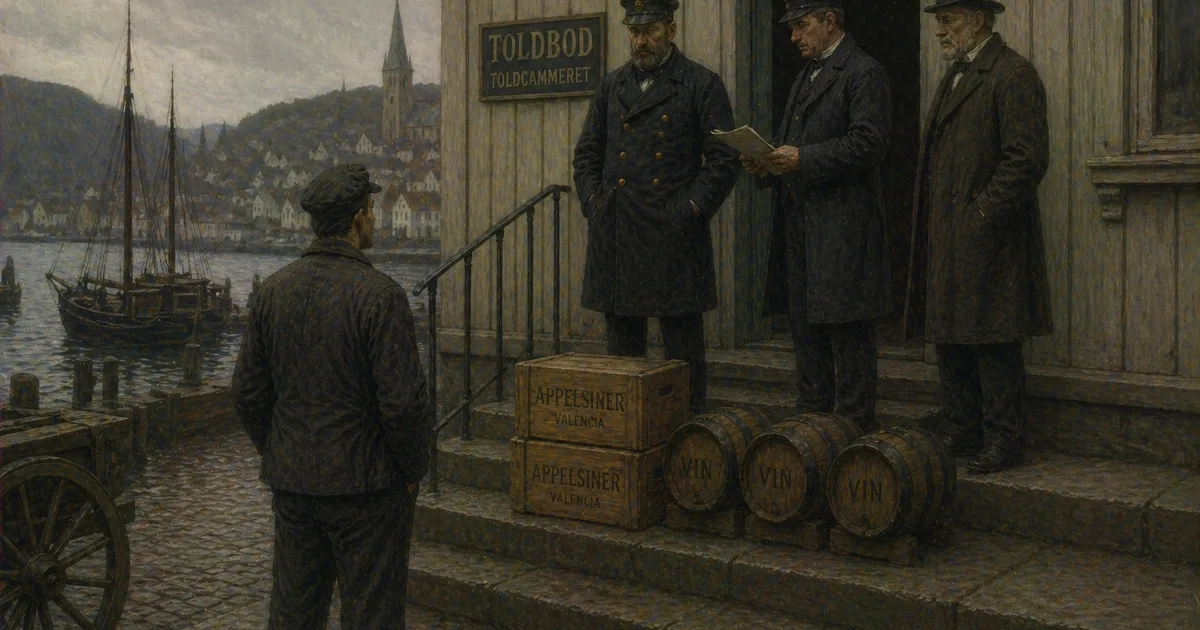
He came down from the pin-rail at half past midnight and walked aft along the larboard rail to go below by the after scuttle, and at the after scuttle he stopped because there was light under the captain’s cabin door and the captain was ashore. It was the steady light of the captain’s own lamp on the captain’s own desk in the captain’s own cabin. Olav stood at the after scuttle for a moment with his hand on the rail. Then the captain’s cabin door opened and the carpenter put his head out and saw Olav, and the carpenter said, in the voice a man uses when he has already had a glass of a thing he should not have had a glass of, “Come in. The steward has the cork out of the second bottle.”
Olav went in.
The captain’s cabin was a small panelled room with a built-in bunk against the after bulkhead and a desk against the larboard side and a small folding table against the starboard. On the table was a wooden tray, and on the tray were three glasses, two of them with a finger of red wine in them and the third empty, and beside the tray was a bottle that the steward had got from the locker at the captain’s own forward bulkhead and that was three-quarters full of a port wine the captain had been bringing up from Setúbal under a cargo manifest that did not list it. The steward was at the chair at the desk. The carpenter had taken the chair at the foot of the bunk and was returning to it as Olav came in. The steward poured the third glass and gave it to Olav.
It was the wine the captain had served at the dinner at his own house in Stavanger in March, when Jens had sat at the captain’s table and had not laughed at the sentence the wife had cut. Olav drank a swallow of it. He sat on the deck against the larboard bulkhead with the glass in his hand because the only two chairs in the cabin were taken. The carpenter raised his glass. The steward raised his glass. Olav raised his glass. They did not say what they were drinking to. They drank.
The bottle went to the bottom by two o’clock, and the steward got a second from the locker, and the second went to the bottom by half past three, and at four o’clock the steward closed the locker and did not get a third because, as the steward said, in the voice of a man who could draw the line between drinking the captain’s wine for an honest reason and drinking the captain’s wine for the sake of finishing his cellar, three bottles was the number it was reasonable to drink off a man who would not be there to ask about it tomorrow. The carpenter agreed. Olav did not say anything. The three of them sat in the cabin with the empty bottles and the empty glasses and the captain’s lamp burning on the captain’s desk and they did not get up because there was no good reason to get up at four in the morning and several reasons to stay where they were, and at five the steward fell asleep in the chair at the desk and the carpenter fell asleep on the deck against the starboard bulkhead, and Olav fell asleep on the deck against the larboard bulkhead with the empty glass on the deck beside his hand.
Lønning came in at eight o’clock.
He came in without knocking because he was the first mate and the captain was not aboard, and he stood for a moment at the door and looked at the three of them—the steward asleep in the chair, the carpenter asleep on the deck, Olav asleep on the deck—and he closed the door and stood inside the closed door and said, “Up. The customhouse wants the orange crates and the kegs of wine on the wharf at half past nine, and the captain wants you three to take them up. He has agreed to two crowns extra each.”
The carpenter came awake first. The carpenter said something the carpenter did not finish. The steward came awake at the carpenter’s voice and saw Lønning at the door and stood up out of the chair without speaking. Olav opened his eyes and saw the captain’s lamp still burning on the captain’s desk and the daylight at the small porthole at the after bulkhead. He sat up. His head, when he sat up, ached as a man’s head aches who has drunk three bottles of port wine between three of them through the small hours and slept on a wooden deck for three more.
“Two crowns each,” Lønning said. “He needs the crates off the ship and through the customhouse before noon and he has agreed to the two crowns to get them off.”
“Yes,” the carpenter said.
“Get to the wharf. The boat is at the larboard side.”
Lønning went out.
They got the orange crates and the kegs of port wine up out of the after hold by half past nine. There were eighteen orange crates and four kegs of wine and the orange crates were heavier than the steward had said they would be, and the four of them—Olav, the steward, the carpenter, and Pål, who had come aft when the carpenter had asked Lønning for a fourth man—got the crates and the kegs into the boat by ten and rowed them across to the wharf and got them up onto the wharf by half past ten and then up the cobbled path from the wharf to the customhouse by half past eleven. The path was a short path but a steep one and the orange crates were heavy. The captain met them at the customhouse door.
The captain was sober. He was in his coat with the right button. He had Cousin John Stensøy beside him and the customhouse officer beside John Stensøy, and the customhouse officer was a man in a uniform coat with brass buttons whom Olav had not seen before, and the customhouse officer was holding a paper and a pencil and was making marks on the paper as the crates and the kegs came off the path.
The captain spoke to the customhouse officer in the voice the captain used for customhouse officers and stevedore foremen and the agents of consignors of cargoes that had not been declared on manifests. It was the voice of a man who had been moving cargo through customhouses since he had been first mate of the Elida in 1849, and the customhouse officer answered in the voice of a man who had heard it at this customhouse before. The orange crates went onto the customhouse stoop. The kegs went onto the customhouse stoop. The customhouse officer made his marks on his paper. The captain spoke to John Stensøy at intervals about the price of port wine in Setúbal in the spring of 1876 and about the agent’s commission on a cargo that had not been on the manifest. John Stensøy did not say much.
When the last of the orange crates had been put on the customhouse stoop and Olav was at the bottom of the stoop with his hands at his hips and his back aching as a man’s back aches when he has carried eighteen crates up a steep path on the morning after three bottles of port wine, the captain came down the stoop and looked at Olav and said, in the voice he had used at the Asta’s burial of Eliasson when he had said it from the wheel, that Olav had not put the last crate down the way it was to be put down, and the captain added the word he had added at Eliasson’s burial and in the cabin at Lisbon—a word a captain at his own customhouse on his own home wharf in Stavanger did not add, and certainly did not add in front of a customhouse officer of His Majesty Oscar II of Sweden-and-Norway.
Olav stood up.
He stood up to his full height, which was the height of a young man who had been on the deck of the Asta for the seven weeks since Stavanger and who had grown half an inch in the seven weeks. He looked at the captain. He looked at John Stensøy. He looked at the customhouse officer. He looked at the orange crates and at the kegs of port wine. Then he opened his mouth and he said the things he had not said in the seven weeks at sea or in the eight days at Lisbon or on the morning of the burial of Eliasson or on the afternoon of the captain’s beating of Nils on the half-deck or on the morning of the chain at the hawse on Palm Sunday or on the afternoon of the rotten pork-grease at the mizzen-cap or on the afternoon of the tar at the foremast.
He said them in the voice of a youngman of eighteen who had decided what he was going to say while he was carrying the eighteenth crate up the path.
He said the captain had beaten Nils unconscious at Lisbon and had kicked Nils a third time at the back of the head when Nils had been on the deck. He said the captain had killed Eliasson at the upper topsail in the North Sea by the ordering of a watch the captain had not been competent to order. He said the captain had attempted to throw Olav off the mizzen-cap with the rotten-pork bucket on the day at Setúbal. He said the captain had dropped the Asta’s anchor through her hawse on Palm Sunday morning in front of an English Rear Admiral. He said the captain had drunk in his own steward’s locker at the morning watch on the second day out from Stavanger and on every day at sea from then to this morning. He said the orange crates and the kegs of port wine on the customhouse stoop were the captain’s smuggling and were under no manifest the captain had declared at any port and were not for the customhouse officer to mark off without seeing the captain’s manifest first.
He stopped.
The customhouse officer looked at the captain. John Stensøy looked at the captain. The captain looked at Olav with the face of a man whose plan had not counted on this morning being the morning his youngman of eighteen made a public accounting of what the youngman had been carrying for seven weeks.
The customhouse officer set down his pencil.
He spoke to the captain in the voice the customhouse officer used when he was about to ask for a manifest. The captain looked at John Stensøy. John Stensøy looked at the captain. The captain put his hand into the inside pocket of his coat and took out a folded paper and gave it to the customhouse officer. The customhouse officer unfolded the paper. He read it. He folded it again. He gave it back to the captain. He spoke to the captain again, more quietly than before, in the voice the customhouse officer used when he was about to ask for an explanation of why the items on the stoop were not on the manifest he had just been handed.
What happened in the next quarter of an hour at the customhouse stoop happened between the captain and the customhouse officer and Cousin John Stensøy, and Olav, who was at the bottom of the stoop, and the steward and the carpenter and Pål, who were at the bottom of the stoop with him, did not hear all of it because the captain and the customhouse officer and John Stensøy had moved up the stoop and into the small office at the back of the customhouse to continue the conversation. They came out at noon. The captain went to the wharf. He did not look at Olav. He did not look at the steward or the carpenter or Pål. He went down to his boat and he was rowed across to the Asta by one of the wharf-watch.
John Stensøy came down the stoop. He stopped at Olav. He said, “You came home in time.”
“Sir.”
“There will be no second voyage for him under his present articles. The principal owner will be at the Asta this afternoon. The captain will sign a paper and will write to the temperance society and will not be the captain of any ship this owner will sign him to in the future.” John Stensøy looked at the wharf where the captain’s boat was crossing back to the Asta. “He may be the captain of someone else’s. But he will not be the captain of mine.”
“Sir.”
“You go home to your father. Tell him from me that his son did at the customhouse what his son had to do.”
“Yes, sir.”
“Go.”
Olav went.
He took the afternoon coast-steamer that ran from Stavanger up to Judaberg, where Lars met it in his boat, because Lars met every afternoon coast-steamer on the Mondays in the spring and the summer to see if there was a man from Vestbø who needed the boat back across to the landing. Lars saw Olav come down the gangway and did not say anything, because Lars was Lars, and Olav coming down a gangway in the second week of May was not a thing he was going to ask about until he had had a cup of coffee with Jens at the kitchen table at Vestbø in the evening. Lars rowed Olav across in the time it took Lars to row a man across at the May tide-state. They did not speak. Olav had his chest at the stern of the boat and his hand on the chest. The chest had come back from Lisbon with him.
They came up to the landing at the path to Vestbø at three o’clock. Jens was at the landing. Peder was beside Jens. The boat came in. Olav stepped out.
Jens looked at his son. Peder looked at his brother. Lars looked at the chest. No one said anything for the length of time it took a man to see that the boy who had gone out in March had come back in May and was not the same boy, and Jens said, “Help me with the chest.”
Olav helped him with the chest.
They walked up the path to Vestbø in the order they had walked it in the autumn coming down: Lars at the head with one handle of the chest, Jens at the back with the other, Peder at the side with nothing in his hands but his cap. Olav walked behind them. The path was the path he had walked in October and in December and in January and in March, and the stones on the path were the stones, and the trees were at the side of the path where the trees had been, and at the end of the path the kitchen door stood open and his aunt was standing in it as the four of them came up the rise.
The aunt did not say anything. She put her hand on Olav’s shoulder. She turned and went into the kitchen.
The kitchen had the spring cloth on the table that had been woven by Olav’s mother in the year before her death. The lamp was not lit because it was three in the afternoon. The stove was warm because the aunt had been baking. The bread was on the board at the side of the stove. There was a plate of dried fish at the table and a small jar of preserved plums from Hardanger beside the plate. The four of them came in. Jens set down his end of the chest. Lars set down his end. Lars looked at the bread on the board and at the plate on the table and at the jar of plums and at Jens. Jens nodded. Lars sat down at the chair he had sat at six months before in the same kitchen at the same table with the same cloth.
Olav sat down at the chair he had sat at on every morning of his sixteenth year and his seventeenth year and on the morning he had got up to leave for the Asta in March. He did not sit down quickly. He sat down slowly, the way a son sits down at the chair he sat at as a boy after seven weeks and seven days away from it. He put his hands flat on the cloth in front of him at the place at the table that had been his place since he was five years old. It was the spring cloth, and it was the cloth he had not put his hands on since a Sunday in March when he had folded his bread at this table before going to Stavanger.
Jens sat at the head of the table. Peder sat at the side. The aunt brought the coffee from the stove. She set the coffee at the table. She sat at the chair at the foot. Peder looked at his brother for the length of time it took a younger brother to see that the older brother had come back from a voyage on which several things had happened and on which the older brother had become a man Peder would have to learn to know again.
The five of them ate the bread and the dried fish and the plums and drank the coffee at the table at Vestbø in the second week of May, 1876, and Olav did not yet say what had happened at the customhouse and Jens did not yet ask, because the asking was a thing for after the coffee.