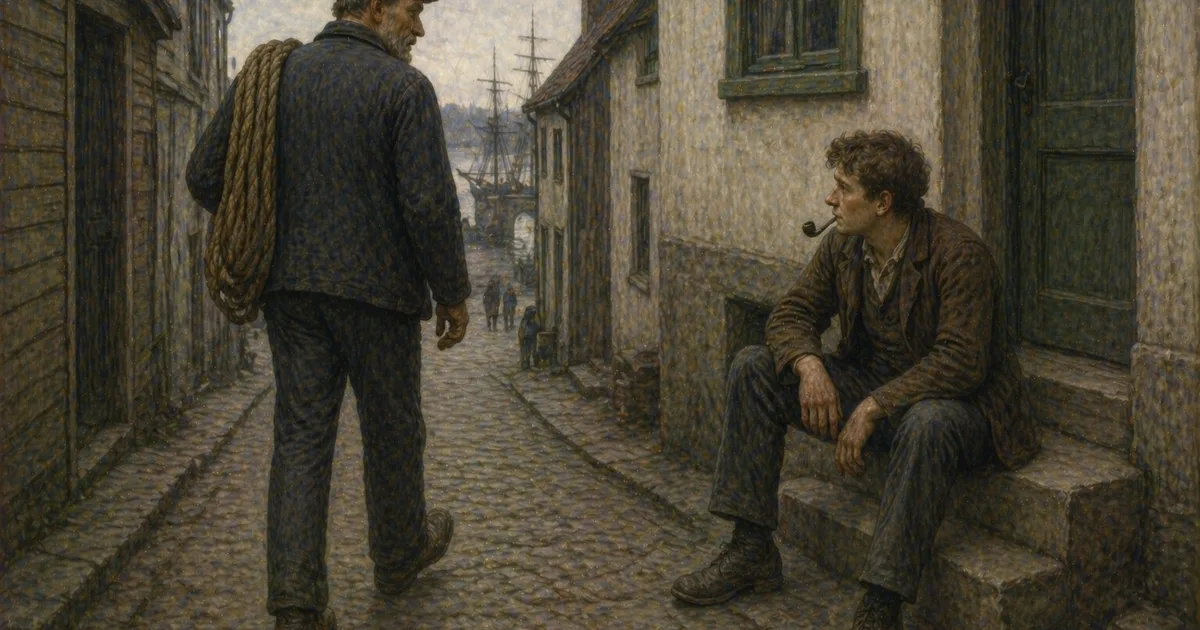
The morning after the captain’s night the sun came up over the hills above Lisbon at a quarter past six and laid a yellow stripe across the river that reached the Asta at her anchor at twenty past the hour. Haakon Berg of Hogganvik was at the foremast pin-rail at twenty past, with a coil of three-strand manila in his hands that the boy from the foretop had laid down wrong the day before, and he was laying it down right. He laid it down right because that was the work, and because the captain had not come up at four bells, and because the boy from the foretop had not come down from the rigging.
He had seen the boy come down at first light. He had seen the boy come down the mizzen ratlines with the marlinspike still in his hand and had seen the boy not look at the captain’s cabin door as he passed it on the way forward. The boy had gone below to the forecastle. Haakon had not stopped his work to watch. He had counted the seconds the boy was below—sixty-four, which was the time it took a man to look at another man in a bunk and to make a decision about what to do about him—and he had heard the boy come up again and go to the wash-bucket at the after deck. The boy had washed. The boy had come forward to the foremast at twenty past six. The boy was at the foremast pin-rail now, at the inboard end, ten feet from where Haakon was at the outboard end.
Haakon laid the coil down.
He did not look at the boy and he did not say to the boy that the night was over. The boy was a youngman of eighteen. The boy had sat eight hours in the mizzen rigging with a piece of iron across his knees. The boy did not need a man at the foremast to say to him at twenty past six in the morning that the night was over. The boy needed a man at the foremast to lay a coil down right and to leave him to come into the work in his own way. Haakon laid the coil down.
The deck-work of the morning was the work of a ship at anchor with a captain below and a first mate on the deck. Lønning was at the after deck with the carpenter; they were looking at the larboard cathead, where one of the bolts had begun to weep rust the day before in the Lisbon damp. The steward was at the galley scuttle with a basket of vegetables he had bought ashore in the early morning at a market on a side street the steward knew because the steward had been to Lisbon three times before. The vegetables had the color of a warmer place. Pål was at the wash-bucket. Sørli was below. Thompson was at the main fife-rail. The boy was at the foremast.
The captain had not come up.
It was the second morning the captain had not come up at four bells. Haakon had counted the morning before and was counting this one. He did not count for any reason he would have given a name to. He counted because he was the boatswain of a ship whose captain had not come up at four bells, and a boatswain of such a ship counted the mornings.
He went forward to the foretop at six bells with the boy. The order had come from Lønning at five bells; the foretop wanted overhauling at the gantline-blocks where the line had taken a chafe in the run down from Cape St. Vincent. Haakon went up first. The boy came up after. They did the work at the foretop as they had done it at the bowsprit cap in the North Sea after the burial: with Haakon showing the place and the boy doing it and Haakon watching the boy do it and saying “Good” once when it was done. The boy did not say anything. The boy had not said anything since the night before, except Sir to Lønning when Lønning had given him the marlinspike, and Haakon had heard that Sir through the after deck and had heard in the Sir the voice of a youngman who had decided in that moment what kind of sailor he was going to be on this ship.
When the foretop was secured Haakon went down. The boy came down after him. Haakon said, “Get a cup of coffee. The steward has it on. Eat the bread.” The boy went aft to the galley scuttle. Haakon stood at the foremast and did not watch him go. He did not need to watch him to know he had gone.
He went ashore at eight bells of the morning watch.
It was the errand of a boatswain who had decided, on his own, that the Asta needed a fathom of two-inch hemp for the cat-stopper that had taken a parting in the night and that the captain had not yet been told about because the captain had not yet come up. Lønning had given him a coin from the ship’s purse and had told him the chandler in the Rua dos Bacalhoeiros sold hemp at the price the captain would not be able to argue with later. Haakon took the coin. He went ashore in the boat with one of the ferrymen who had been at the wharf since first light, and he stepped onto the stones of the wharf at ten past eight, and he walked up into the lower city the way the boy had walked up the morning of the arrival, except that Haakon had been to Lisbon once before in his life, when he was sixteen and had crossed in a Bergen brig that had carried codfish for the salting-yards at Aveiro, and the streets had the half-strange shape of streets a man has walked once seven years before.
He found the chandler’s. The chandler was a Portuguese in a leather apron who spoke an English that was a sailor’s English and who did not need to ask Haakon what kind of hemp he wanted because Haakon told him. Haakon paid in the coin Lønning had given him. The chandler gave him the change. Haakon coiled the hemp over his shoulder and went out into the alley behind the chandler’s because the alley was the way back to the wharf that did not require walking through the busier street, and he had not walked through the busier street in any port he had been to when an alley would do.
He stopped in the alley.
He stopped because he had seen, at the back door of a building two doors down from the chandler’s, a young man of perhaps twenty-five years sitting on a step with a small clay pipe in his hand and a coat across his knees. The young man was not a Portuguese. The young man had hair that was not the hair of any country Haakon could name; it was light at the ends and dark at the roots and was cut short at the back of the neck the way a sailor cuts his after a few months ashore. The young man had a face that was not, at this distance, a face Haakon had seen before, but the face was the kind of face that Haakon had, in his life, looked at twice in a street without knowing why he had looked at it twice. The young man looked up. The young man looked at Haakon for the length of time it took Haakon to walk past the back door at the pace of a man who was not stopping. The young man did not say anything. Haakon did not say anything. Haakon walked on.
He came out at the corner of the wharf-end of the alley with the hemp on his shoulder and his face composed as it had been when he had walked into the alley. The boat that had brought him ashore was at the wharf. He went down to the boat. He gave the ferryman the rest of the coin Lønning had told him to give the ferryman. He came back across the river to the Asta.
He did not think, on the boat, about the young man on the step.
He thought about the hemp. He thought about the cat-stopper that needed splicing before the captain came up and saw it parted. He thought about whether the splice would be a long splice or a short splice and decided it would be a long splice because a long splice on a cat-stopper was the splice that did not surprise a captain when a captain looked at it later. He thought about the work. The work was the thing a man thought about when there was a young man on a step in an alley who had looked at him in a way that he had also looked back, and who he was not going to walk back to look at, because there was a ship at anchor with a captain below and a youngman of eighteen on her foredeck who had come down at first light from the mizzen rigging with a marlinspike in his hand. The work was the thing.
He came aboard at one bell of the afternoon watch. He spliced the cat-stopper at the larboard cathead with Pål holding the standing part. The splice was a long splice. The carpenter looked at it when it was done and said “Good” and went on with his own work at the rail. Haakon coiled the loose end and went forward to the foremast pin-rail.
The boy was not at the foremast pin-rail.
The boy was below.
Haakon went down through the forecastle scuttle. The forecastle was lit by the lamp at the after bulkhead, which the steward had trimmed up from where it had been trimmed at supper because the daylight was not enough now to do the work below. Nils was in the bunk that had been Eliasson’s. The steward had put the bandage on Nils’s head the night before, had changed it once that morning, and would change it again at supper. Nils was awake. Nils’s eyes were open and he was looking up at the deck-beams above his bunk the way a man looked up at the deck-beams when he had not yet decided whether he was going to sit up.
The boy was on the bench beside the bunk. He had a tin cup in his hand with water in it from the deck-barrel and he was holding the cup at the edge of the bunk where Nils could see it without turning his head. He was not saying anything. Nils was not saying anything. The water in the cup was sitting at the angle of a thing being held by a hand that knew how to hold a thing for a man in a bunk.
Haakon stopped at the foot of the ladder. He looked at the boy with the cup. The boy did not see him; the boy was looking at the cup and at Nils. Haakon stood at the foot of the ladder for the length of time it took a man to register a thing he had not been looking for. He went back up the ladder.
He came up onto the deck and he went aft to the after deck. He stood for a moment at the larboard rail with his hand on the rail and his eyes on the river and the city beyond the river. He did not think about the boy holding the cup at the angle of a thing being held by a hand that knew how to hold a thing for a man in a bunk. He thought about the river. He thought about the way the river ran out past the river-fort at the south side of the entrance and into the open sea. He thought about the open sea and about how many days the Asta would be at this anchor before the captain decided to begin loading the salt. He thought about the cat-stopper. He thought about the long splice. He thought about Lønning at the after deck with the carpenter. He thought about all the things a man at the rail of a ship in a foreign harbor thinks about when he is not thinking about a youngman of eighteen below who is holding a cup of water at the angle a man holds a cup for another man in a bunk.
The bell sounded at four o’clock for the change of the watch. Haakon went forward.
He did not, in the watch that followed and that took him through the dog-watches and into the first watch of the night, do anything about the youngman from the foredeck or the youngman in the alley or the bunk that had been Eliasson’s. He gave the orders for the work that needed doing on a ship at anchor in the evening with the daylight going. He stood at the after deck when the captain came up at six bells of the first dog-watch in his coat with the wrong button still on the wrong hole and walked the deck once and went below again without speaking to anyone. He stood at the wheel-box during the second dog-watch when Lønning had the deck and the watch was light and the city’s lights had begun to come on along the wharf as they had come on the night before. He went below at the change of the watch at eight to his bunk in the boatswain’s small cabin under the after deck, which was his because he was the boatswain, and which gave him a privacy no other man on the Asta had below the captain.
He lay in the bunk in the dark and he did not sleep.
He thought about the long splice he had put in the cat-stopper. He thought about whether the captain would notice the splice when the captain came up next, and whether the captain would notice that the splice was a long splice and not a short splice, and whether the captain would say anything if he noticed. He thought about Lønning. He thought about the carpenter. He thought about the steward. He thought about the men on the deck and below who were the Asta’s crew and were the men he was the boatswain of. He thought about the youngman from Hogganvik in the bunk that had been Eliasson’s, and about the youngman from the foredeck who had held a cup of water at the angle a man holds a cup for another man in a bunk. He thought about the young man on the step in the alley behind the chandler’s, and about the way the young man on the step had looked at him for the length of time it took him to walk past the back door at the pace of a man who was not stopping, and he thought about how he had not stopped.
He had not stopped. He had not stopped at the alley because he was the boatswain of a ship whose captain had not come up at four bells. He had not stopped at the alley because there was a youngman of eighteen on the deck of the Asta who had come down at first light from the mizzen rigging with a marlinspike in his hand. He had not stopped at the alley because seven years before, when he had himself been a boy of sixteen at the end of a season at the herring-stations on the coast north of Bergen, he had come home at the end of October and had walked down to the boat-shed on the third evening and had stood at the boat-shed door for a long minute before turning and going back up the path.
He had decided then that there were things a man learned to walk past at the pace of a man who was not stopping. He had been deciding it again every year since.
He lay in the bunk in the dark of the boatswain’s cabin and he listened to the timbers of the Asta and to the small sounds of the ship at anchor and to the music from a building on the wharf that was the same music he had heard from the same building on the wharf when he had been here at sixteen. He did not sleep.
He thought, at the end, about the boy at the foremast pin-rail at twenty past six in the morning with the marlinspike still warm against his coat and a face that was not yet a face for any of the things it had not yet learned to be a face for. He thought about the boy not for what the boy was. He thought about the boy for what the boy did not yet know. He had decided, by the time the bell sounded at midnight for the change of the watch, that what the boy did not yet know was a thing he, Haakon Berg of Hogganvik, was not going to be the man to teach him.
He turned in the bunk and put his face to the bulkhead and slept.