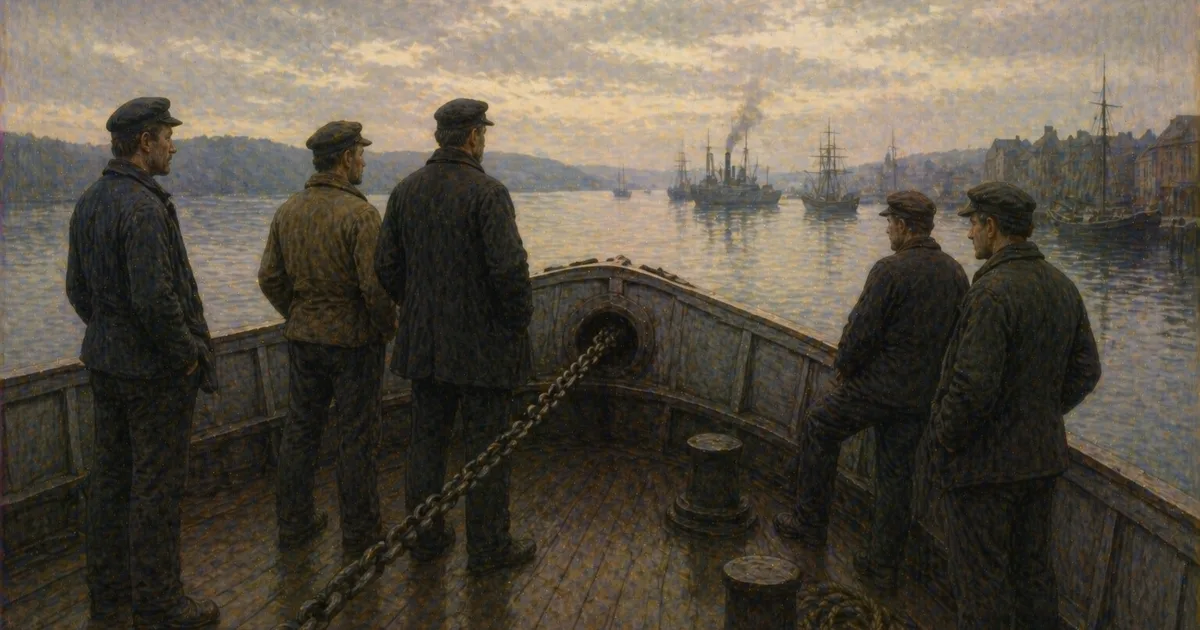
The English came up the Tagus on the Friday before Easter at one bell of the afternoon watch with a flagship that was the largest ship Olav had ever seen on water and four others behind her in the order of a squadron that had run down from Portsmouth to arrive at a place at the time it had said it would arrive. The flagship was a five-masted iron ship with yards on her four forward masts and a fore-and-aft sail at her after mast and a hull the color of wet slate, and she had the white ensign at her gaff and the Rear Admiral’s flag at her mizzen, and Pål, who was at the foremast head when the call came down from the lookout, said her name down to the deck and said the names of the four others after her without consulting any chart. Olav was on the main deck. He was at the wash-bucket at the after end with a coil of cordage that had taken a tar-stain at the foremast pin-rail and that he was rinsing in cold water before it set. He looked up when Pål called the names down. He saw the flagship come round the bend in the river under tow of two steam launches and slow at the place she had marked for her anchorage off the north shore, and he saw the four others come up after her at the half-cable interval of warships that knew their own line.
The flagship anchored at twenty past one. The four others anchored at intervals of two minutes after her. The Tagus, which had held three Norwegian-and-Swedish merchant ships and two French and one Spanish at her north-shore anchorage when the Asta had come up the river, now held the Asta and the same five merchant ships and five English warships of the Channel Squadron, and the river-fort at the south side of the entrance had run up the standard of the Crown Prince of Sweden-and-Norway on the stroke of the half-hour and had begun the salute.
The salute came in twenty-one rounds at three-second intervals from the flagship at three bells of the afternoon watch, with the four others firing their own salutes at intervals of fifteen seconds after her. The first round came at the moment Olav had not been ready for it because no one on the Asta’s deck had been ready for it; the carpenter had said now a quarter-second before the gun fired, but the now had not been enough warning for any man on the deck to put a hand to his ear. The first round was the loudest sound Olav had heard in his life. The second round was the loudest sound but for the first. By the eighth round his ears had filled with a fine high tone that he could hear inside his own skull and that he understood, from the look of the man at the wash-bucket beside him, the other man could hear as well. By the twenty-first round he could not hear the carpenter saying that’s the last and could only see the carpenter saying it, and after the carpenter said it the other four ships fired their twenty-ones in sequence, and the salutes went on, by Olav’s count, for the better part of a half-hour, though the carpenter said later it had been twelve minutes, and at the end of it the river was quiet in the way a river is quiet when it has been the floor of a great noise and the noise has stopped.
The captain came up at the end of the salute. He had not come up for any other reason in three days, and he came up now in his coat with the wrong button still on the wrong hole and stood at the wheel-box for the length of time it took a man to look at the flagship across the water and to understand that he had been below in his cabin during a thing he ought to have been on the deck for. He went below again. Lønning, who had stood at the after deck through the salute with his hands behind him and his face composed, did not look at the captain’s cabin door when the captain shut it. The first mate looked across the water at the flagship and then forward at the deck where the watch was at its work, and he gave the next order, and the watch went on.
Through the rest of the afternoon and into the dog-watches the Asta’s crew worked the deck with the English squadron at anchor across the river. The flagship was perhaps a quarter of a mile from the Asta and the four others were strung out beyond her at the cable’s length, and from the Asta’s deck a man could see, on the flagship, the order of a deck that ran to nine hundred men under a Rear Admiral’s flag, and Olav saw it as a man sees a thing he has not been near before and that he understood as the upper limit of what a ship became when the men who built her had been building her that way for a long time. The boats from the flagship went back and forth to the wharf with officers in dress uniform whose hats Olav could see across the water as small black shapes above small dark coats. The boats came back with packets and with men. The bells of the flagship rang the watches at the moment the watches were rung, which was the moment they were rung on the Asta and on the four other warships and on every ship in the river. The river was full of bells.
By dusk the watch had changed twice and the Asta’s decks were lit only by the riding-lamp at the bow and the lamp at the stern. The captain had not come up again. The watch below went forward to the forecastle for supper. Nils was at the table for the first time since the night the captain had beaten him, with his back against the curve of the hull and his hand at the bandage on his head as if to remind himself the bandage was there. Nils ate slowly. The steward had cooked a fish stew with a fish the steward had bought in the morning at the market on the side street, and the stew tasted of a place that grew herbs in March, and the men ate it without remarking on the taste. Olav sat across from Nils. He did not say to Nils that he had carried Nils’s water for him on the morning after the beating and would carry it again for as many mornings as Nils wanted it carried. He ate the stew. Nils ate the stew. Pål passed the bread without being asked and Nils took it without speaking. Sørli put a piece of fish on Nils’s plate from the pot when Nils’s plate had emptied and Nils did not put it back. Thompson said nothing and ate his own portion. The carpenter came forward at one bell and ate the stew with them and asked the steward whether the herb in the stew was the same herb the steward had bought at the market the week before, and the steward said it was, and that was the speech of the supper. Lønning ate aft with the steward at the after deck table because Lønning was the first mate.
After the plates were cleared Olav went on deck. He stood at the foremast pin-rail in the dark and looked across the river at the squadron’s lights. The flagship’s stern light was at the height of a ship’s stern that was not a height a man on the Asta was used to looking at across water. The bells from the city had stopped some hours before. The flagship rang the change of the watch at eight, and the four other warships rang at the same instant, and the merchant ships in the river rang at the same instant after them, and only the ships’ bells were left to speak on the river that night.
The Saturday went the way the Friday went except that the warships were silent and the Asta did the work of a ship at anchor in the third week of her stay at Lisbon, with the agent’s clerk coming aboard at noon and going below to the captain’s cabin and not coming back up until two o’clock, and the captain not coming up after the clerk left.
Palm Sunday came in on a wind off the west that had backed in the night and held.
The morning was bright. The bells of the city’s churches began ringing at six and went on ringing through the seventh hour and the eighth, ringing in the manner of a Catholic city on the Sunday of the palms, which was a Sunday Olav had not lived through the bells of before, and the sound of the bells reached the Asta at her anchor and stayed in the air over her deck through the morning watch. The captain came up at four bells.
He came up sober. He came up in his coat with the button now on the right hole, which was the first time since the Tagus mouth that the coat had been buttoned right, and he stood at the wheel-box and looked at the deck and at the men on the deck and at the Asta’s anchor-chain where it ran from the bow to the river. He spoke to Lønning. He said that the chain wanted shortening at the hawse because the wind was holding from the west and the Asta was riding to her chain at an angle that would put a chafe on the cable at the bow if the wind rose any further. Lønning said “Yes.” The captain said he would oversee the shortening himself. Lønning said “Yes” again.
The captain went forward to the bow.
The shortening of an anchor-chain at a ship’s bow was the work of the boatswain and the foredeck watch under the eye of the first mate, with the captain at the after deck giving the orders and the first mate seeing them carried out. The captain at the bow doing the work himself was a thing Olav had not seen on the Sigrid and had not seen on the Asta before this morning. Haakon was at the bow when the captain came forward. The captain told Haakon to go aft. Haakon went aft. The captain told Pål and Sørli, who were at the bow with Haakon, to stand by. Pål and Sørli stood by.
The captain put his hand on the chain.
What happened then happened in the way a thing happens when a man who has not done a piece of work for fifteen years tries to do the piece of work in front of men who do the piece of work every week. The captain unlashed the stopper from the chain at the windlass without first taking the chain at the hawse, and as soon as the stopper was off the chain the chain ran. It ran for the first half-fathom because a chain that is unlashed at the windlass without being taken at the hawse runs through the hawse under its own weight, and it ran for the second half-fathom because the captain put his hand on the running chain to stop it and the chain took the skin off the heel of his hand and went on running, and it ran for the rest of forty-five fathoms in the time it took Pål to step forward and try to take the chain at the bitt and to be thrown off the chain by the chain, and Sørli to step in behind Pål and try the same thing and to be thrown off in the same way, and the captain to grab at the chain a second time at the place where the chain went over the rail, and the rail to be the place where the chain caught the captain’s coat-sleeve and pulled the captain forward against the rail and threw him onto his side on the deck with the chain going over above him and the last fathom of chain running clear and the anchor going to the bottom of the Tagus with the noise an anchor makes when it goes to the bottom from forty-five fathoms of chain.
The chain stopped when there was no more chain.
The captain was on his side on the deck. His coat was torn at the sleeve where the chain had caught it. His hand was bleeding from the heel where the chain had taken the skin. His hat was at the larboard scupper where the chain had thrown it. He sat up. He looked at his hand. He looked at the rail. He looked at Pål, who was standing six feet from him with his face composed. He looked at Sørli. He did not look at Lønning, who had come forward from the after deck at a run and had stopped at the foremast pin-rail.
Lønning gave the order to make the Asta fast on her remaining cables. Pål and Sørli went to the work. The captain stood up. He went aft to his cabin. He shut the door.
The flagship across the water had seen the chain go.
Olav was at the foremast pin-rail when the boat from the flagship came across. The boat was a six-oared cutter with a lieutenant in the stern in a dress coat and a midshipman of perhaps fourteen years beside the lieutenant. The cutter came alongside the Asta’s starboard rail at the mid-section and the lieutenant came up the ladder. He spoke to Lønning in the English of an English officer addressing a Norwegian first mate—slowly enough that Lønning caught it, quickly enough that the lieutenant did not have to think about how slowly he was speaking. The lieutenant said the flagship had seen the Asta’s anchor-chain run and that the Rear Admiral had instructed him to offer the Asta the use of the flagship’s dredge-grabhook for the recovery of the anchor, with the flagship’s compliments and at no charge to the Asta or her owner. Lønning said “Thank you.” The lieutenant said the dredge-grabhook would be sent across at the change of the watch. He went down the ladder. The cutter went back across the river with the lieutenant in the stern.
Lønning stood at the rail with his hand on the rail and his eyes on the cutter going back. He did not say what he was thinking. He did not need to. The captain had been seen by an English Rear Admiral to drop his ship’s anchor through her hawse on Palm Sunday morning of 1876 with the captain himself at the work, and the Rear Admiral had sent his boat and his lieutenant across with a courtesy that no captain on the river was going to forget, and the courtesy had named the thing without speaking the thing’s name.
The dredge-grabhook came across at four o’clock. Pål and Haakon and the carpenter spent the afternoon and the evening at the recovery of the anchor, with the Asta’s longboat at the bow and the grabhook trailing on a line, and they brought the anchor up at half past nine in the dark of the river by the light of two lanterns at the bow. They rebent the chain. They made the anchor fast at the cathead. They returned the dredge-grabhook in the longboat to the flagship, with Olav and Sørli at the oars and the carpenter at the tiller, and the carpenter said “Thank you” in his own English to the watch officer at the flagship’s side, and the watch officer said “Good evening” back, and they came across the river to the Asta under stars that had come out over Lisbon at the end of a Sunday whose bells had stopped some hours before.
The captain did not come up at any point through the recovery. He did not come up at the change of the watch. He did not come up at supper. He did not come up at the lighting of the riding-lamp.
Olav was at the foremast pin-rail at midnight when his watch began. The river was quiet. The flagship across the water was lit at her stern and at her bow and at three places along her hull, and the four other warships were lit at the same places, and the wharf on the north shore was lit by the lamps of a city that did not know that on Palm Sunday morning a captain on a ship across the river had dropped his anchor in front of an English flagship with nine hundred men aboard. The bells of the city had stopped at the end of the day. The water at the Asta’s side made the small sound water makes at a ship’s side at anchor in a foreign harbor at midnight on the Sunday before Easter, and beyond the water there was the faint sound of the music from the building on the wharf that had played the night before and the night before that, and the music tonight was different from the previous nights, slower, and Olav stood at the pin-rail and listened to the music and to the water and to the small ringing in his ears that had not gone since the salute, and he watched the lights of the flagship across the water and thought about how a ship of nine hundred men kept her lights burning through a night with the same regularity she had kept them burning through every other night and would keep them burning through every night to come, and how the captain of the Asta had not come up.