The Dronningen came up to the wharf at Black River on the Jamaica south coast at the morning tide of the twenty-eighth day out of São Vicente.
The crossing had been the crossing of a Norwegian timber-bark on the southerly trade in May and June of 1877, which had run the bark west across the long water at fourteen north and then north-northwest to the latitude of Jamaica, and the trade had held for the whole of it. The bark dropped her anchor at the outer roads of Black River at half past nine on the twenty-eighth morning. The pilot took her to the inner wharf at the noon tide. She tied up at the inner wharf at half past one.
The unloading of the remaining balance-cargo from Cardiff began at three.
The wharf at Black River was the wharf of a Jamaica logwood-port at the south side of the island, which was a wharf of weathered dark timber set on stone pilings at the mouth of the river, and the men at the wharf were Black men in white shirts and work-trousers and broad straw hats the kind the Jamaica wharf-men kept against the heat of the south-coast sun. The heat at the wharf at three in the afternoon was the heat of the Jamaica south coast in June, which was a heat the Norwegian crew of the Dronningen had not known before. The men at the deck took it as men who had to do the work in spite of the heat took such a thing, which was without speaking about it.
Olav was at the foremast pin-rail at the change of the watch.
Bertel was at his side. The two of them had been at the foremast pin-rail beside each other for the eleven months since the Dronningen had sailed from Stavanger, and the rail was where they did the foremast work of the watch when the watch had foremast work, and where they stood when the watch did not. Bertel said the heat was a heat he had not known before. Olav said yes. Bertel said the men at the wharf were the men a Norwegian sailor was glad of, because the men at the wharf knew the wharf. Olav agreed. The two of them watched the wharf-men handle the lighter at the side of the bark.
The Dronningen was at Black River for the loading of a cargo of logwood for the run home.
The logwood was the dark dense dye-wood of the Caribbean trade that the British and the European cloth-mills had been buying out of Jamaica for the better part of a century, and the Dronningen’s charter was for a full hold of it for the run to Goole on the English east coast. The loading was slow. The logwood came down from the upper logwood-yards at the river by small lighter, two lighters in the morning and two in the afternoon, and the logs were the heavy dense logs the Jamaica trade had been loading at the same wharf since Tollefson’s grandfather had been at sea, and the loading of a full hold of logwood at Black River at the rate of four lighters a day took the better part of nine weeks.
The crew settled to the long stay.
Tollefson gave the watches the half-day shore-leave the captains of Norwegian timber-barks at Caribbean ports gave their men in the long port stays, which was a half-day every fourth day for the men of the larboard watch and a half-day every fourth day for the men of the starboard watch. Olav had the half-day on the seventh day at the wharf. He did not go far from the wharf. He walked along the river-bank for an hour and looked at the egrets at the upper bend, and he came back to the bark at four o’clock and sat at the foredeck with Bertel and they were quiet for some minutes because the heat at four o’clock at the foredeck was a heat that took the speaking out of two men at the foredeck.
Bertel said his wife at Tau would be at the herring-table at this hour at the long evenings of the Tau June. Olav said yes. Bertel did not say more about Tau. He had said, at the noon of the twentieth day out of São Vicente, that the box of teak with the brass hinges had not taken a knock in the whole of the run, and Olav had said yes to that too. The marriage-talk of Bertel was the marriage-talk of a carpenter four months married eleven months before the day of the saying, and Olav was the man at his side who had Olava’s letter at the breast-pocket inside his coat at the chest at the foot of his bunk where he had laid it after the dry-out at São Vicente, and the two men did not speak much about the marriage-talk because the marriage-talk did not need much speaking.
The scorpion was at the second week.
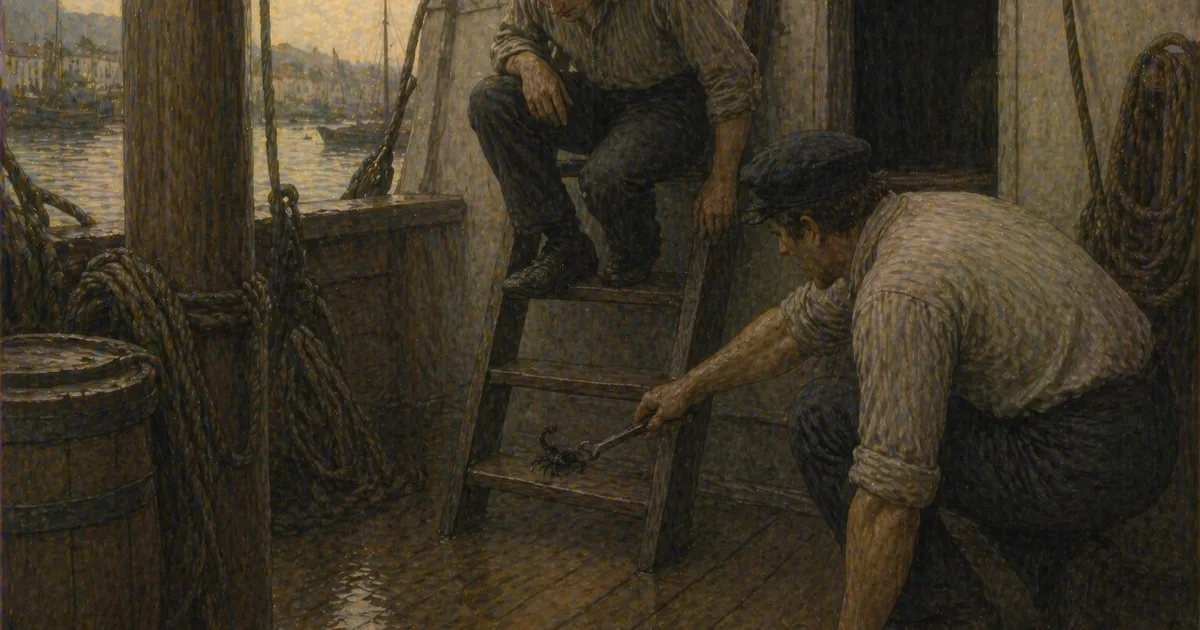
It was at the foot of the ladder that went down from the foredeck to the chain-locker. It was the ladder Theodor and Olav had been using for the four days of the locker-painting the boatswain had set them to. Theodor went down first on the morning of the second-week Wednesday. Olav went down after. Theodor was at the foot of the ladder and was reaching for the can of pitch-black at the side of the locker when he saw the scorpion at the second rung from the bottom at the inside of the rail.
The scorpion was dark and about three inches long, with the segmented tail curled over the back.
Theodor said: “Stand still.”
Olav stood at the third rung above the scorpion. He kept his hand on the rail. The scorpion held the second rung. Theodor reached up at his side at the bilge-pipe and took the iron pipe-wrench and brought it slowly to the second rung. He laid the head of the wrench at the rail above the scorpion. He brought the head down in a single short motion. After the wrench-head came down the scorpion was a dark thing at the rung that was not a scorpion any more.
Theodor said: “It is gone.”
Olav said yes. He came down the rest of the ladder. The two of them went on with the locker-painting. The scorpion at the second rung had been a scorpion of the kind a man at the wharf at Black River would have warned them about if the boatswain had asked him, and the boatswain had not asked him. The boatswain at the rail at the eight bells of the morning watch heard the scorpion-story from Theodor when the two of them came up at the noon. The boatswain said he would ask the men at the wharf about the scorpions of the Black River wharf. He said it without changing his face. He said it in the way a boatswain of forty-five at a Norwegian timber-bark at Black River said a thing he had not yet learned the right answer to. Olav stood at the foredeck and listened to the boatswain say it. He did not say anything.
The bark was at the Black River wharf for nine weeks.
The hands of Olav had been the hands of a sailor at sea for fifteen months by the second month at Black River, and the hands knew what the hands knew. The boatswain had given Olav the work the boatswain gave a sailor whose hands the boatswain trusted, which was the splice-work at the foretop and the figure-eight at the cat-falls and the small adjustments at the foreyard-iron the carpenter could not do because the carpenter was at the deck-cargo for the lashings. Olav did the work. He did it in the heat. He did it in the August rain when the rain came down at the wharf at the noon of the day. He did it at the foretop, which had been the Dronningen’s foretop since the cap had been replaced at Cardiff in October.
It was the figure-eight he had been laying at the cat-falls of the Dronningen for eleven months.
He laid it at the cat-falls at the dog-watch of the third day of the seventh week at Black River. The boatswain came up to the pin-rail at the laying. He looked at the figure-eight at the cat-falls. He said the figure-eight was a good figure-eight and asked Olav where he had learned it. Olav said he had learned it on the Asta in March 1876 from the boatswain on the Asta. The boatswain on the Dronningen said the boatswain on the Asta had taught the figure-eight at the cap of a Norwegian-flagged ship, and that the figure-eight had been a good figure-eight to learn at sixteen. Olav said yes. The boatswain went aft.
Olav stood at the pin-rail for some minutes after the boatswain had gone.
He laid another coil at the cat-falls in the figure-eight. He did not name to himself the man who had taught him the figure-eight. He had not named the man at the laying for some weeks now, because the not-naming had become part of the work at the cat-falls.
Olav wrote his second letter to Olava at the small writing-table at the boardinghouse at Black River on the Sunday of the eighth week.
He had got the half-day at the boardinghouse at the wharf-end which the keeper kept for the Norwegian sailors of the long-port-stay barks, and he had taken paper from the writing-stock at the table and ink from the small bottle at the writing-table at the wall, and he had written the letter slowly. He wrote about the scorpion at the second rung and about Theodor at the bilge-pipe with the iron wrench. He wrote about the heat at the wharf at four o’clock and about the small egrets at the upper bend of the river. He wrote about Bertel beside him at the foremast pin-rail and about the box of teak that had not taken a knock. He wrote about the figure-eight at the cat-falls and the boatswain who had recognized it.
He wrote about the long blue light at her small upper window at Lindøy that she had told him about in November, because he had been thinking about it at the watches at the foretop in the long Jamaica nights and the long blue light had come back to him in spite of the line at the third page of her letter that had bled with the water at the harbor at São Vicente and that had not given him the words. He wrote that the light had come back to him without the line. He wrote that he could carry the light at the window without the line at the page. He wrote that he was carrying it.
He signed the letter Olav Hestby of Vestbø.
He folded it and sealed it with the small wax-stick the keeper had at the table. He addressed the outside in three lines: To Olava Lindøy of Lindøy, in the parish of Hetland, by way of Bjørn Olsen Lindøy at Lindøy by way of John Stensøy at Stavanger. He took the letter to the Helland agent at Black River on the morning of the second day after the writing. The Helland agent at Black River was a Norwegian-Jamaican man of about fifty named Pedersen who handled the Stavanger shipping at the Jamaica south-coast ports, and Pedersen took the letter and said the letter would go on the Heimdal of Stavanger that was leaving for Liverpool at the morning tide of the Tuesday. Olav thanked him.
The Heimdal of Stavanger left Black River at the morning tide of the Tuesday.
The letter was at her bag.
The chest at the foot of Olav’s bunk was the chest he had taken to sea on the Sigrid in September 1875, and on the Asta in March 1876, and on the Dronningen in July 1876. It had at it now what it had had at it through the eleven months of this voyage, with the things added at the boardinghouses at Wilmington and Bristol and at the small upper room at Lindøy by way of the Helland forwarding.
The thing wrapped in a piece of brown paper the boy from Vestbø had wrapped on a Sunday foretop watch in March 1876 was at the chest at the side of the spare blanket.
He did not take it out. He had not taken it out at any of the ports at the eleven months. He had not decided whether the Dronningen’s voyage would be the voyage he took it out at, and the not-deciding had taken its place beside the not-naming.
The loading at Black River finished at the noon of the eighth Friday.
Tollefson gave the order at the noon to set the watches for the morning tide of the Saturday. The bark would sail north for the run to Goole on the English east coast on the southerly Gulf Stream that ran past the Florida coast and up through the Bahama Channel and out into the Atlantic at the latitude of the Carolinas, and from the Carolinas eastward across the long water to the British Isles. The Goole run would put a stop at Wilmington on the way for a small balance-cargo if the agents at Wilmington had a balance-cargo for the Dronningen’s holds, and the agents at Wilmington had said at the Dronningen’s February stop that they would have one, and the Dronningen would call at Wilmington in November.
The bark sailed at the morning tide of the Saturday.
The pilot took her down the river under topsails. The wharf at Black River fell behind at the larboard quarter. The Jamaica south coast fell behind at the larboard quarter of a Norwegian timber-bark going for the Bahama Channel and the Gulf Stream and the long run to the English east coast by way of the second Wilmington. Olav was at the foremast pin-rail. He had Olava’s letter at the breast-pocket inside his coat. He had the second letter at her bag at Liverpool. He had the boatswain’s voice at the cat-falls about the figure-eight at the cap.
The Gulf Stream took the bark at the second day out of Black River.
The bark went up the Bahama Channel at six knots with the Gulf Stream at her keel and the trade at her quarter, and Olav stood at the foremast pin-rail at the second night and watched the long warm water of the Gulf Stream go past at the larboard side. The water at the Gulf Stream was a different water from the water at the harbor at São Vicente or the water at the Atlantic at thirty-eight north. It was warm water that was carrying him north. He stood at the rail and watched it go.
He did not write to her again at the run to Wilmington.
He carried what he was carrying.
The Dronningen came up to the second Wilmington at the morning tide of the eighth day of November in 1877.