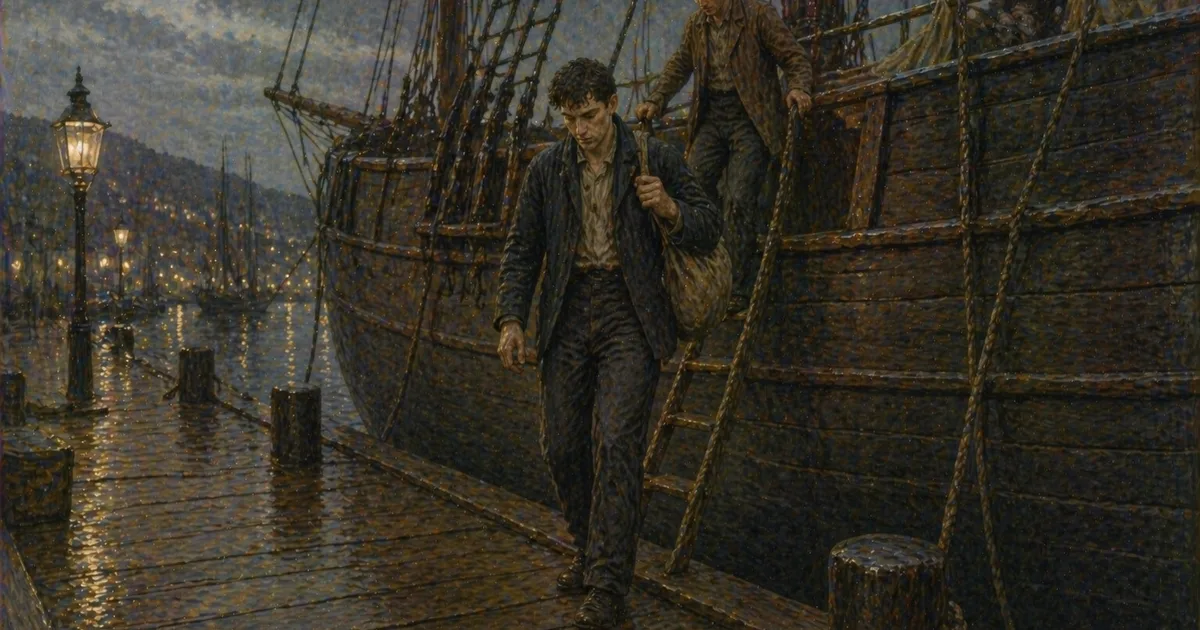
The Dronningen tied up at the inner Wilmington wharf at half past nine on the morning of the eighth day of November in 1877.
The wharf was the one Olav had been at in November of the year before this, which was a year and four days. The red-brick consul’s house was at the wharf-end. The Water Street boardinghouse was three streets up from the wharf. The smell of pine-tar and warm water at the morning was the smell he remembered. He stood at the foremast pin-rail at the tie-up and looked at the city across the wharf-end and registered, in the way a man at a port he had been at before registered the port at his second visit, that the city was the city it had been. He laid the coil at the cat-falls in the figure-eight and went forward to the work the boatswain had next.
The discharge of the balance-cargo from Black River began at noon.
The cargo was a partial logwood load the agents at Black River had not been able to fit at the Dronningen’s holds at the loading and which Tollefson had taken on at the agents’ second-call price for the Wilmington broker. The Wilmington broker was the same broker the Dronningen had had for the Bristol cord-wood the year before. Tollefson went up to the broker’s office at the half past one with the manifest at his coat and the carpenter at his side, and the discharge went on at the wharf without him.
The 1st mate had the deck.
The 1st mate of the Dronningen was a middle-aged man with a heavy brown full beard who had been mostly agreeable through the eleven months out under a fair captain. He was also a man who was capricious at certain hours when the captain was off the deck, and at the certain hours he had a way of finding the men of the larboard watch he had decided to find.
Thomas was at the loading-fall at the eight bells.
Thomas was the man from Stjernarøy who had been Olav’s bunk-neighbour at the larboard watch through the eleven months out, and he had been doing the work of the loading-fall as a man who did the work but did not put a quarter-knot’s-worth of extra into the doing for the deck-officer. The 1st mate had registered Thomas at the loading-fall over the eleven months and had decided, in the way the 1st mate decided things at the certain hours, that Thomas was the man at the watch he would find.
The line at the loading-fall came up wrong at the four bells of the afternoon.
It was a line at the lower fall the boatswain had reset that morning. Thomas had taken the line at the bend and laid it at the cleat the way the boatswain had set it, but the line had taken a half-turn at the cleat in the wrong direction at the strain, and the bale at the lighter had hung at the half-turn and had not come up clean at the lift. The 1st mate at the rail saw the half-turn. He came forward to the cleat. He stood at the cleat for a moment. He said to Thomas that the half-turn was the half-turn the men who could not lay a cleat in the right direction laid at a cleat. Thomas said the boatswain had set it that morning. The 1st mate said he had not asked who had set it. Thomas said the line had taken at the strain.
The 1st mate struck Thomas at the face with the back of his hand.
The strike was the strike of a 1st mate at a Norwegian timber-bark at the second wharf at Wilmington at the four bells of the afternoon watch in November 1877, made by a man who had been waiting for the captain to be at the broker’s office. The blood came at Thomas’s lip. Thomas did not step back. The men at the loading-fall stopped. The boatswain came up from the foredeck at the stopping. He saw the 1st mate at the cleat and Thomas at the rail with the blood at his lip, and he said to the 1st mate that the loading-fall was waiting at the line. The 1st mate said the loading-fall would wait as long as he set it to wait. He said it without looking at the boatswain. The boatswain stood at the rail for a moment. Then he went forward to the foredeck.
The 1st mate said Thomas would have the tar-mat for the next four days.
Olav was at the cat-falls at the foremast pin-rail and had seen the strike and the blood and had heard the saying. He stepped forward at the saying. The 1st mate looked at him. Olav did not say anything. He stood at the cat-falls and looked at the 1st mate. The 1st mate looked at him for the few seconds a 1st mate at a wharf at four bells looked at a man who had stepped forward without saying. Then the 1st mate said Olav would have the tar-mat with Thomas for the four days. Olav said yes. He went back to the cat-falls.
Tollefson came back from the broker’s office at half past five.
The discharge had stopped for the day at the eight bells. The 1st mate had the deck-report for Tollefson at the cabin door. Olav was at the foredeck stowing the loading-fall lines. He saw Tollefson go to the cabin and he saw the 1st mate go in after, and the cabin door closed behind the two of them. It stayed closed for the better part of half an hour. The 1st mate came out at the eight bells of the second dog-watch with the deck-report at his hand. Tollefson did not come out at the cabin door after the 1st mate had gone. Tollefson did not come to the deck the next morning either.
The tar-mat began at the four bells of the morning watch on the Friday.
It was the tar-mat at the foredeck where the seams at the foredeck-cargo lashings had taken the working of the run from Black River and were wanting the re-tarring before the bark sailed for Goole. The boatswain set the mat. The boatswain did not look at Olav or at Thomas at the setting. He laid the canvas square at the foredeck and the tar-pot at the side of the mat and the irons and the caulking-irons at the side of the tar-pot, and he set Olav and Thomas to the seams at the larboard side of the foredeck-cargo and went aft. The boatswain did not say what time the work would end. The 1st mate was at the rail for the morning watch. The work went on through the morning watch and the forenoon watch and the afternoon watch. The boatswain came forward at the four bells of the afternoon and looked at the seams that had been re-tarred and said the seams at the larboard side were done and that the next morning would be the starboard side. He went aft. The work ended at the eight bells of the afternoon.
Olav stood up at the eight bells.
His knees were the knees of a man who had been at a tar-mat for ten hours. His hands were the hands of a man who had been at the caulking-irons and the tar-pot for ten hours, and the tar at the hands was the tar a Wilmington November sun had dried at the hands in the long part of the day. Thomas stood up beside him. Thomas’s lip was the lip of a man who had been struck at the face the day before and had been at the tar-mat for the day after. The two of them did not speak at the foredeck. They went below to the forecastle to wash at the basin.
Tollefson did not come to the deck on the Friday.
Olav was at the bunk at the second dog-watch with the bottle of camphor the steward had given him for his hands when the steward had seen the tar at the supper. The forecastle was quiet. Bertel was at his bunk across the way with his back to Olav, awake but not turned. The boy Erling was at the bunk above Bertel’s. Theodor was at the bunk by the stove. Thomas was at his own bunk at the larboard side aft of Olav’s. Thomas turned at the bunk and looked at Olav across the space between the two bunks.
“I am going at the second middle watch,” Thomas said.
He said it in the voice a man at a forecastle bunk said a thing he had decided.
Olav said yes.
Thomas said, in the same voice, that the Kvik of Drammen was at the inner wharf at three berths down for a pine-board cargo for Hamburg, and that the Kvik was the kind of bark that took on a hand at the wharf-edge without asking too much about the hand. Olav said yes. Thomas said he would go at the second middle watch and that Olav could come or could stay, and that the going was Thomas’s going and not Olav’s. Olav said he would come.
Thomas said yes.
Olav lay at his bunk for the rest of the second dog-watch and through the first watch with his eyes at the boards above the bunk. He did not sleep. At the change of the first watch to the middle watch the boatswain made the rounds and looked at the bunks and went aft. Olav waited for the four bells of the middle watch.
He sat up at the four bells.
At the four bells of the middle watch the men of the watch off were at the bunks and the lamp at the side of the stove was turned low. Olav went to the chest at the foot of his bunk. He opened the chest. He took the thing wrapped in a piece of brown paper that was at the side of the spare blanket. He took the carte-de-visite of Olava from the studio at Pedersgate that was at the top of the second pair of trousers. He took Olava’s two letters that were at the inside of the leather wallet his father had given him at the leather roll. He took the leather wallet and the bone-handled knife at the bottom corner of the chest that Peder had given him for the Asta voyage in March of 1876. He left the spare blanket and the second pair of trousers and the spare shirt and the tin of tobacco from Isaksen at Judaberg and the writing-paper. He closed the chest. He laid the things he had taken at the inside of his coat at the breast-pocket and at the side-pockets.
Thomas was at his own chest at the larboard side aft.
Thomas had a smaller chest than Olav had. Thomas took the things from the chest the way a man at a forecastle at the four bells of the middle watch took things from a chest. He laid them at his coat. He closed the chest.
The two of them went up to the deck.
The deck of the Dronningen at the four bells of the middle watch in November at Wilmington was a deck a man could leave without making a sound the after-watch would hear. The wharf-line was at the larboard side. Olav went over the larboard rail at the wharf-line. He set his feet at the step the wharf had cut at the side. He went down the wharf-line to the wharf. Thomas came after.
The two of them stood at the wharf for a moment.
The bark stood above them. The mast stood in the dark. The wharf at half past two of the morning of the Saturday was empty around their feet. Olav looked up at the Dronningen’s rail once. He did not see Bertel at the rail. He did not see anyone at the rail. He turned away from the bark and walked along the wharf with Thomas at his side.
They walked off the wharf at the wharf-end and into Water Street.
The city was a city at half past two of a Saturday morning at Wilmington in November of 1877. The lamps at the corners were the lamps a Wilmington street kept at the corners. The two of them walked along Water Street to the corner of Front Street. They turned at Front Street and walked up Front Street toward the upper city.
The Dronningen was at her wharf behind them.
Olav had Olava’s two letters at his breast-pocket. He had the thing wrapped in a piece of brown paper at his side-pocket. He had the carte-de-visite at the wallet at his other side-pocket. He had the bone-handled knife at his coat. He did not have the chest. The chest was at the foot of his bunk at the Dronningen’s forecastle with the spare blanket and the spare shirt and the tin of tobacco from Isaksen and the writing-paper, and the chest would go to Goole on the Dronningen and from Goole back to Stavanger and from Stavanger to Vestbø by way of Stensøy whenever the Dronningen came home, and the chest would be at Vestbø waiting for him to come home to it.
He walked with Thomas up Front Street.
They turned at the second corner and went down a side street he did not know the name of and walked along the side street for some minutes and then turned again. They walked without yet knowing where they were going, in the direction that was away from the wharf. The wharf fell behind. The lamps at the side streets were not the lamps at Water Street. The dark at the upper end of Wilmington at three o’clock of the Saturday morning was a dark Olav had not known before.
He carried what he was carrying.