The fair weather held for nine days out of Wilmington.
The Dronningen made her run east-northeast as a coal-laden bark of fifteen years made such a run under the winter wind, eight knots through the days and seven through the nights. The wind held southwest by west for the first six days. It held west for the next two. It went west by north on the morning of the ninth day. Tollefson did not call for the topgallants to come in at the change, because he was watching it with the attention of a captain of fifteen years for a wind that had begun to do a thing he was not yet certain about.
The glass began to fall at three o’clock on the afternoon of the ninth day.
The boatswain noticed it first. He came up from the cabin where Tollefson kept the barometer at the chart-table and forward to the foremast pin-rail and laid his hand on the rail the way he laid it when he had seen a thing he was not yet ready to give to the watch. Olav saw him do it. Olav had been at the watches with him for four months and knew the boatswain’s hand at the rail. He left the question alone. The boatswain went aft and gave the wheel to Pallesen and went down to Tollefson’s cabin and was there for the better part of a quarter of an hour.
Tollefson came to the deck at four bells of the afternoon watch.
He gave the order to take in the topgallants and to set a single reef in the topsails. The watch went up. The boatswain went up with the larboard watch. Olav was at the foretop with Bertel and Erling and the boatswain’s-mate from Tau, and the four of them brought in the foretopgallant and set the reef in the foretopsail under a wind that had begun to lift but was not yet a strong wind. They came down at five bells. The wind backed into the southwest at six bells. By eight bells of the afternoon watch the wind was at a near-gale.
The cord-wood under the deck-lashings creaked at the lashings.
Tollefson sent the carpenter and Bertel down to the bilge at the change of the first watch to look at the pump-well. The bilge had two feet of water in it that had not been there at the noon-sounding. Tollefson called for the pump-bars at the after pump and put six men to the bars and the men pumped the bilge down to one foot at the four bells of the first watch and held it at one foot through the night.
The hurricane came on the morning of the tenth day.
It came as a hurricane came at thirty-eight north and thirty-five west in the second week of January 1877, a system that had moved up off the West Indies in the late autumn and had crossed the Atlantic against the prevailing winds and had met the Dronningen in the place the wind went south of west and held there. Tollefson had the deck. The 1st mate had the deck for him at the watch-changes. The boatswain led the work at the sail. The men of both watches stayed on without distinction through the whole of the second day after the glass had begun to fall, and through the third, and through the fourth.
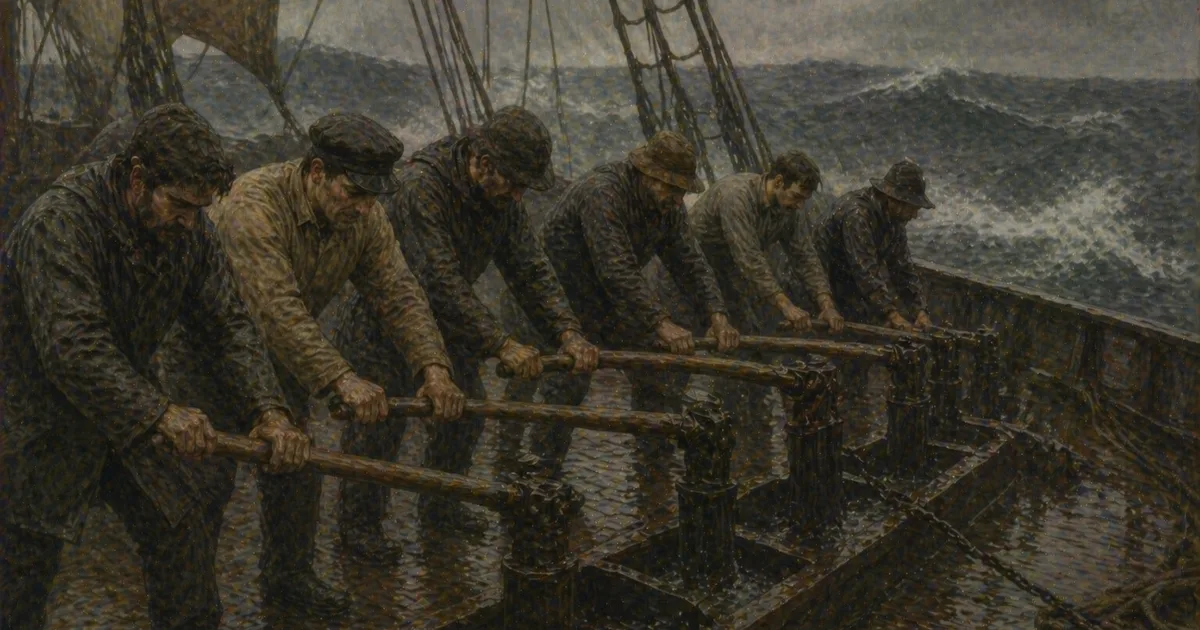
The pumping went on through the days and the nights.
It went on at six men to the bars and two at the lift, and the larboard watch took the bars for two hours and the starboard watch took them for two hours and the change came at the four bells of every watch and the bilge stayed at one foot if the pumping was steady and went to two feet if it was not. The pumping stayed steady because Tollefson made it so. He came to the after pump at every change of the watch and stood there for the few minutes it took the new men to get into the rhythm of the bars, and he stood without speaking until they got into it.
Olav was at the bars with Thomas at the second night.
Thomas was a man who had been at the bars of an after pump on a Norwegian timber-bark in a hurricane before, and he took the bar across from Olav at the change of the first watch and gave Olav the rhythm a man who had been there gave to a man who had not. The rhythm was a four-count. The bars went down at the one and at the three and came up at the two and at the four, and the six men at the bars worked it without speaking, because the bars in a hurricane were not a place for talking. Olav worked the rhythm. The water at the lift came up out of the gauge in a steady stream that went over the side at the larboard scupper. The pumping made the thrumming sound the after pump made when it was holding the bilge at one foot.
At the change of the four bells Thomas said, in the voice a man uses when he says something at the bars of a pump in a hurricane that is not about the bars, that the Dronningen was a ship that would come through the storm. Olav said yes. The new men came up to take the bars. Olav and Thomas went forward to the foredeck for the four bells of the rest. The wind at the foredeck was the wind of the second night, and a man at the rail stood under it with his hand at the pin.
Erling was at the rail. It was his first hurricane. He had not said much through the second day or the second night, and he stood with his hand at the pin and looked up at the wind in the rigging above the foretopsail-yard, and Olav saw what a boy of sixteen at his first hurricane looked like at the second night of one. The boy looked the way Olav had looked at the rail of the Sigrid in the small gale off the Skaw in October 1875, which was the way of a boy who had not yet decided whether he would come through the storm and was waiting for the storm to decide for him. Olav did not say anything to Erling. Bertel came up to the rail at the boy’s other side and said, “It is a good ship under a good captain. The ship will come through.” Erling said yes. The three of them stood at the rail for a few minutes. Then the four bells came and Olav and Thomas went back to the bars.
The worst night was the fifth night.
The wind on the fifth night was the kind a man at sea on the Atlantic in January at forty north did not face at the foremast unless the work took him there, because it took his breath, and he could not stand against it without the work to keep his hands at the rail. Tollefson took the wheel at the change of the first watch. He kept it at the four bells. He kept it at the eight bells. He held the wheel through the whole of the first watch and through the change to the middle watch and through the whole of the middle watch, eight hours at the wheel under the wind at the fifth night, because his ship needed him there.
Olav was at the foretop at the middle watch.
The boatswain had sent him up at the four bells of the middle watch with Bertel to look at the gasket-lashings at the foretopsail-yard, because the gasket-lashings were the place a tear would start if a tear was going to start, and they had been set in fair weather at Wilmington and had not been looked at since the storm had begun. Bertel went up first. Olav went up after. They came to the yard at the second cap and they checked the gasket-lashings hand over hand from the bunt to the yardarm at each side, and the lashings held. Bertel said the lashings were the lashings the carpenter at Cardiff had set in October and that they were good lashings.
Olav laid his hand on the cap where the coil was set. The wood was the new wood the Cardiff yard had laid in October. The coil was the figure-eight he had laid on his first night out of Stavanger and on every foretop watch since. It had come out at one of the turns in the wind at the fifth night, and was wanting the figure-eight set again. He set it.
He laid his hand on the cap for a moment after the coil was set.
The wind at the foretop yard on the fifth night was the kind a man could hold against if his hand was at the cap and his foot at the foot-rope, and Olav held against it for the few seconds it took him to register, in the way a man registers a thing at sea without naming it, that the chest at the foot of his bunk in the forecastle was below him at the deck, and that the chest held, beside the spare blanket, the thing wrapped in brown paper that he had wrapped on a Sunday foretop watch on the Asta in March, and at the top of the second pair of trousers the carte-de-visite envelope from Augustsen at Pedersgate, and at the bottom the spare blanket the aunt had folded in at the beginning of 1875. He did not name to himself, at the cap, what the chest held. He came down the ratlines after Bertel.
The storm broke on the morning of the sixth day.
The wind went down to a strong gale at the change of the morning watch and to a fresh gale at the four bells and to a moderate breeze at the eight bells. Tollefson gave the wheel to the boatswain at the four bells. He had been at the wheel for sixteen hours. He did not say anything in the giving. He went to the cabin and stayed there for the better part of an hour and came up at the eight bells with the boatswain’s-mate from Tau at his shoulder and gave the order to take the reefs out of the topsails. The reefs came out. The Dronningen set her topgallants again at the noon sounding. The bilge went to nine inches at the noon-pumping and to six inches at the eight bells.
There were two cords of pitch-pine in the deck-cargo lashed in the wrong place in the lashing-pattern, and the boatswain and the carpenter saw it at the noon-sounding when they came up to look at the deck. The boatswain said to Tollefson that the cords had moved in the storm and that the lashings had held them not at their starting-place but at a place six feet aft of where they had been set. Tollefson said the lashings would be reset at Bristol. The boatswain said the cords would hold to Bristol in the new place. Tollefson said yes.
Olav stood at the foremast pin-rail at the noon of the sixth day after the storm had broken. Bertel came up to the rail at his side. The wind was a moderate breeze and the sea was the long swell of an Atlantic that had come down from a hurricane four days before. Bertel said the box for Birgit had not been damaged in the storm because he had laid it in the locker at the foot of his bunk on the morning the glass had begun to fall and had not opened the locker since. Olav said yes. Bertel said the brass hinges had been the right brass hinges. Olav said they had. They stood at the rail for some minutes. Olav thought about the letter from Olava in the pouch in his coat-pocket, the pouch he had carried up from the boardinghouse on Water Street at Wilmington. He had not opened it at sea. He had carried it through the storm because the pouch was a thing that lived in his coat-pocket now. Bertel went aft.
The Dronningen made the run to the mouth of the Bristol Channel in eight more days under fair weather. The wind held south by west for the first three and west by south for the next four and went around to the southwest for the last day. The bark made eight knots through the days and seven through the nights, and the men did the work of a bark coming up to a port after a hurricane she had come through, at the rate of men who had been at the bars of the after pump for five days and four nights and were now at the work of fair weather and were grateful for it.
Tollefson came to the foremast pin-rail at the noon of the seventeenth day.
He stood at the rail with the boatswain. He did not stand at the rail often. He looked at the work of the men on the deck and at the new foregallant cap that had held through the storm and at the cord-wood under the deck-lashings, and he said to the boatswain, in the voice a captain uses at the rail of his own ship six days after sixteen hours at the wheel, that the Dronningen was a good ship and that he would not have wanted to be at the wheel of any other on the fifth night of the storm. The boatswain said yes. Tollefson did not say more. He went aft.
The Bristol Channel pilot came aboard at the entrance to the Channel on the morning of the eighteenth day after the storm had broken.
The pilot was an Englishman of about fifty in a blue coat and a pilot’s cap, and he took the Dronningen up the Bristol Channel in late January 1877 at six knots under topsails with the wind on her starboard quarter and the long blue line of the Welsh coast off her larboard. Olav was at the foremast pin-rail. Bristol came up at the head of the Channel at four o’clock in the afternoon. The Dronningen dropped her anchor at the Bristol Roads at half past five.
The cord-wood was on her decks. The new foregallant cap was at her foretop. The men of both watches were at the rail.
The bark was at Bristol.