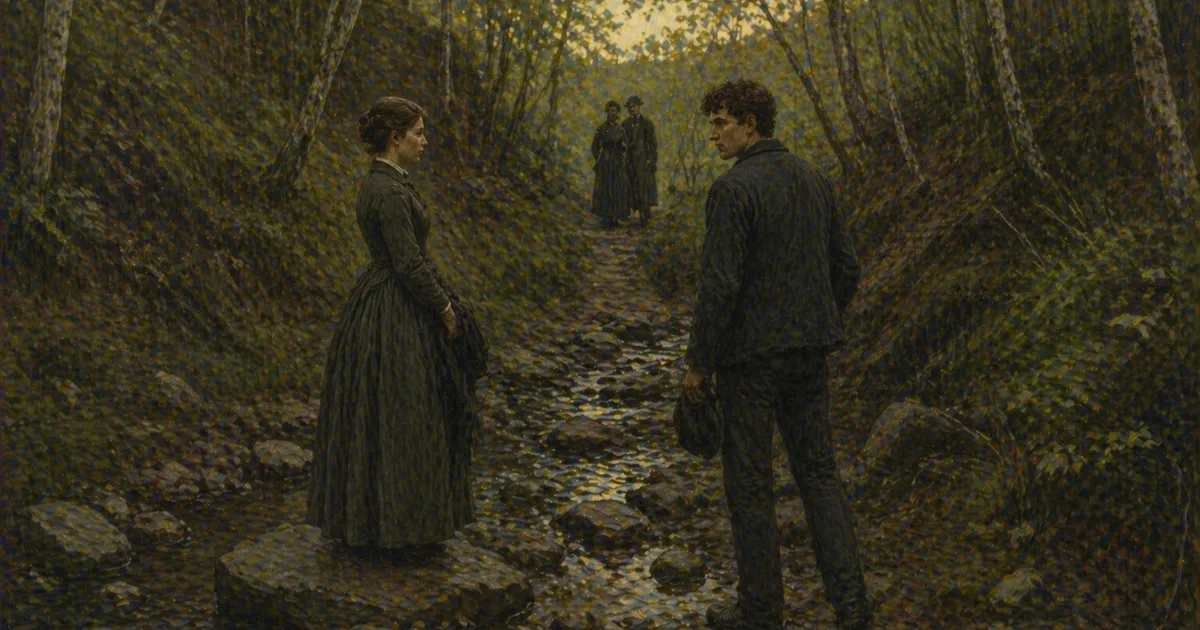
The Dronningen came up to the cotton-and-timber wharf at Wilmington on the morning of the third day after the pilot had taken her aboard at the river mouth. The Cape Fear River at Wilmington in November of 1876 was a river of brown water with a green flow at the center and a wide shallow flow at the banks, and the wharves at the inner town were the wharves of a port that handled the cotton from the upriver plantations and the pitch-pine from the inland forests and the turpentine from the distilleries that lay along the river above the town. The Dronningen tied up at the third wharf below the bridge.
The wharf was a wharf of long sheds with red-painted roofs and Black dock-men at the loading-falls and white agents at the offices at the inner ends of the sheds, and the air at the wharf smelled of pitch and turpentine and the sweet smoke of cotton-bale stamps and the river-mud of a southern American river in late autumn. Olav had not been at a southern American port. He had not been at a port that smelled of turpentine. He stood at the rail at the gangway as the lines went out and watched the wharf the way a man at his first southern American port did.
The dock-men at the loading-falls moved the cargo at the wharf at Wilmington in 1876, which was a kind of work the three voyages Olav had been on had not put him beside. The men were Black men. Some had been free since the war and some had been free since before the war, and the hierarchy among them was one Olav did not try to read at the gangway, because reading such a hierarchy at first sight was not work for a Norwegian sailor of nineteen at the rail. The agents at the offices at the inner ends of the sheds set the loading-rates and signed the bills-of-lading. The agents wore black coats. The dock-men wore the working-clothes of dock-men. The river-traffic at the wharf was four steamers and two flat-bottomed barges and a single brig of the kind that ran the inland rivers up to the cotton plantations above the town.
Tollefson came down from the quarterdeck.
He had the agent’s letter from Stavanger in his coat-pocket and a ledger under his arm. He gave Olav a nod at the gangway and went down to the wharf with the 1st mate at his shoulder and the consignment-papers in the agent’s hand from the wharf-end office. The consignment was a consignment of cord-wood for the return cargo to Bristol—three hundred cords of pitch-pine cut at the mills above the town that would be loaded as supplementary cargo on top of the timber the Dronningen had carried from Archangel and that was to come out of her holds for the Wilmington market. The agent at the wharf-end was a man in a black coat with a grey beard and a soft Carolina voice that had the slow vowels of the upriver country.
Tollefson did not like the agent’s count.
He stood at the wharf for a quarter of an hour with the agent and the 1st mate and went over the count of the cords as the cord-wood came up from the lighters that had brought it down from the mills. Three hundred cords had been contracted. Two hundred and seventy were on the lighters. The agent said the remainder would come down on the next lighters at the second day. Tollefson said the lighters had been said to bring the full three hundred and that two hundred and seventy was thirty short. The agent said it was the way of the trade at this port. Tollefson said it was not the way of the trade at any port he had known in fifteen years.
He took the count-paper and went up to the consul.
The Norwegian consul at Wilmington was a man named Brinch who held the consul’s office for the United Kingdoms of Norway and Sweden in a wooden building at the corner of Front and Princess Streets, three blocks from the wharf. Brinch had been at Wilmington since 1859 and had been the consul since 1864. He kept an office with a writing-table and two chairs and a flag of the United Kingdoms on the wall, and he handled the affairs of the Norwegian-flag ships that came up the Cape Fear three or four times a season. Tollefson came back to the wharf at three in the afternoon with a paper from Brinch in his coat-pocket. He did not say what was on the paper. The 1st mate said, when Tollefson had gone aft to the cabin, that Brinch had filed a complaint at the chamber of commerce on the Dronningen’s behalf and that the agent’s full three hundred cords would be on the wharf at the second morning if the complaint had any work in it.
The lighters brought the rest of the cord-wood at the second morning.
The loading took six days.
Olav had the half-day shore-leave Tollefson gave the larboard watch on the fourth day of the loading. He went up from the wharf to the consul’s office at Front and Princess to ask about letters that might have come for him at Brinch’s care, because Brinch had said at the gangway on the second morning, when he had come down to look at the loading, that the Dronningen’s mail-bag had come in on the Borgund of Stavanger eleven days before and was at his office for collection.
He passed the Wilmington Seamen’s Bethel at the corner of Water and Dock Streets on the way. The Bethel was a wooden building of two storeys with a sign at the door in English and another sign in Norwegian and Swedish and German, and it was the building the Seamen’s Friend Society at Wilmington had put up in the year after the war for the sailors of the foreign ships that came up the Cape Fear. The English sign at the door said All Sailors Welcome. The Norwegian sign said Velkommen til alle sjømenn. There were two sailors at the door who were not Norwegian. Olav did not know what nation they were of by the look of their coats. He did not go into the Bethel. He walked on to Front and Princess.
Brinch gave Olav the bag.
There were two letters at the bottom of the bag with Olav’s name on the inscriptions. One was in Jens’s hand. The other was in a hand Olav had not seen before. The second was the small careful hand of a young woman who had learned to write at the parish-school at Lindøy, the address-letters slightly larger than the inner-letters, with a small flourish on the y at the end of Hestby that Olav saw and recognized as a flourish on a y and not as a name his eye had read before. He took both letters from Brinch. He thanked Brinch. He left the consul’s office.
He read the letters in the small back room of the boardinghouse where the Dronningen’s crew was put up—a boardinghouse on Water Street kept by a Swedish woman who had married a Wilmington man in 1858 and had stayed at Wilmington since.
He read Jens’s letter first.
The letter from Vestbø was a longer letter than the four-line letters Olav had written from Hebburn and Stavanger and Archangel, and it was longer because Jens had written what the silence at Vestbø had given him to write across the autumn. Jens wrote about the second crop of hay at the upper field. He wrote about Peder finishing the path-fence in the second week of September and beginning the byre roof in the first week of October. He wrote about the aunt being at Vestbø on a Sunday in October and reading Olav’s Archangel letter aloud at the table after the coffee. He wrote about Lars crossing every Wednesday since the Dronningen had sailed and about the steady west wind that had been good for the inshore fishing through September.
Jens wrote about Olav’s mother.
He did not write directly about her. He wrote that Bertha at Lindøy had been a woman his wife had been close to in their girlhood, and that Bertha had said a small thing at the dinner at Karoline’s house in July about a walk she had taken with his wife to the chapel at Rossøy in the year before Bertha’s marriage, and that he had thought about it in the three months since. He wrote that he had not been able to say more at the dinner than he had said. He wrote that he might say more some time when Olav was home from the Dronningen, or that he might not.
He wrote that Olava was a young woman his wife would have known by way of Bertha’s mother and would have been pleased about.
He wrote that Olav was to write again from Cardiff.
The letter was signed Jens Hestby of Vestbø.
Olav read it twice. He did not read it again before he read Olava’s letter, because he had decided on the way down from the consul’s office that he would read each letter once and then read the second letter once and then read each letter again at his bunk in the forecastle that night.
He opened Olava’s letter.
The letter was three pages of the careful hand. Olava had written it at Lindøy in late September after Olav’s letter from Archangel had come down through Stensøy at Stavanger to her father at Lindøy. She wrote that the letter had come on a Tuesday morning when she had been at the kitchen with her mother and that her mother had read the inscription on the front and had given the letter to her without saying anything about the long August light at seventy north. She wrote that Inger had come to Lindøy on the Friday after the letter had come and that Bernhard and Inger were at the house on the divided piece at the south end of Lindøy now and were settling for the winter. She wrote that Gustav had been home for two weeks in October between voyages and had gone out again on a Stavanger ship for Cádiz on the third Tuesday of October. She wrote about her father’s boat and about the autumn fishing and about the things at Lindøy that the late autumn brought.
She wrote about the long blue light at the North Cape that Olav had told her about in his letter from Archangel.
She wrote that she had thought about the light through the autumn at Lindøy. She wrote that the light at Lindøy in late September was a different light from the light at the North Cape in August but was the same light in the way the long lights of a Norwegian autumn were the same light at every latitude north of fifty. She wrote that she had stood at the small upper window at her room at Lindøy on a clear evening in late September and had looked at the long light at the bay between Lindøy and Sandøy and had thought about the light at the bay being the same kind of light Olav had stood at the rail of the Dronningen at the North Cape to look at, or close to the same.
She wrote that she had not told her mother what she had thought about the light at the small upper window.
She signed the letter Olava Lindøy of Lindøy.
Olav read the letter once and folded it and laid it on the bed beside Jens’s letter and looked at the window of the back room of the boardinghouse on Water Street.
The window of the back room looked out at a yard at the back of the boardinghouse with a wooden fence at the far side and a scrub-magnolia at the corner of the fence and a chicken-coop the Swedish woman kept her hens in beside the back door of the kitchen. The light at the window at three in the afternoon at Wilmington in the third week of November was a slanting light that did not go from the air the way the light at Lindøy did not go from the air in September, and Olav saw the light at the yard the way a man sees a light he has not seen before but that is the same kind of light he has known. The chicken-coop had four hens. The magnolia had no flowers because the season was wrong. The Swedish woman was in the kitchen with the supper getting ready, and Olav heard her through the wall.
He had not been told that Olava would write back the way she had written back. He had not had a thing in his hands from Olava that was a longer thing than the four words she had said at the corner of the courtyard at Landa in June. The three pages were the longest thing she had given him. He would write to her that night from the boardinghouse on Water Street.
He laid the letters in the leather pouch he carried in his coat and went back to the Dronningen for the afternoon’s work.
He wrote the letters at the boardinghouse that night. He wrote first to Jens, four lines, that the Dronningen had come into Wilmington and was loading cord-wood for Bristol and would sail in three or four days. He wrote then to Olava, more slowly. He wrote that her letter had come up to him at the consul’s office at Wilmington with his father’s letter, and that he had read both letters at the boardinghouse on Water Street, and that he had thought about the long light at the bay between Lindøy and Sandøy that she had stood at the small upper window of her room at Lindøy to look at. He wrote that he had stood at the foremast pin-rail at Wilmington at sundown on the second day at the wharf and had looked at the river at the same kind of light that she had described, or close to the same, except that the river at Wilmington was not the bay between Lindøy and Sandøy and the light at Wilmington was an American light at the latitude of thirty-four north and was a different light from the long light at fifty-nine.
He wrote that he had not told the boatswain what he had thought about the light at the river at Wilmington.
He signed the letter Olav. He addressed it to Olava Lindøy of Lindøy by way of Bjørn Olsen Lindøy at Lindøy by way of John Stensøy at Stavanger, and he laid it beside the letter to Jens at the table at the back room.
Thomas came into the back room at half past eight that evening.
Thomas was a man Olav had not yet been beside on the Dronningen because he was at the starboard watch and Olav was at the larboard watch, and the two of them had passed each other at the changes of the watches and at the noon-meal on the half-deck and at the muster at the boarding without speaking. He was Olav’s age. He was from Stjernarøy by way of Finnøy, where he had done farm-work on a Hestby-neighbour’s farm in the years he had not been at sea. He had been at sea for three years before the Dronningen and had been on Norwegian ships in the American trade. He had a Finnøy girl at a farm above Judaberg who had been at the parish-school with Olav in the year Olav had been ten.
He came into the back room with the flush of a man who had been at the second whiskey-house up from the wharf and who was not drunk but had drunk enough to come into a back room a fellow Stavanger sailor was at and to sit at the table and to begin to speak.
“Olav Hestby of Vestbø,” Thomas said.
“Yes.”
“You are at the table.”
“I am writing letters.”
“Letters home.”
“Yes.”
Thomas sat down at the chair on the far side of the table. He looked at the two folded letters on the table. He did not pick them up. He said, in the voice of a Stjernarøy man who had been at sea for three years and was at a Wilmington boardinghouse on a Saturday evening at eight bells, that the girl at Judaberg whose name was Karen had written to him at Stavanger before the Dronningen had sailed, and that the letter was at his chest in the forecastle, and that he had not written back to her from Archangel because he had not had a thing to write that he had not already said in the year before the sailing. He said the girl at Judaberg was a girl who would wait or would not wait, and that he did not know which she would do, and that the not-knowing was a thing he had decided to live with for the eighteen months at sea.
He said Olav had a girl at Lindøy.
“Yes,” Olav said.
“Cousin John Stensøy’s connection.”
“My father’s neighbour’s daughter by way of Bertha at Lindøy who knew my mother.”
“That is a different kind of girl from a girl at Judaberg.”
“Yes.”
“You will write to her at every port.”
“Yes.”
“I will not write to mine. That is the difference between the kind of girl your girl is and the kind of girl mine is. There is no fault at either kind. There is only the difference.”
Thomas got up from the chair. He stood at the door of the back room for a moment and looked at the table and at the folded letters and at Olav. He said, in the voice of a man who had said what he had come to say, that he was going up to his bunk. He went up.
Olav sat at the table for a few minutes after Thomas had gone. Then he laid the letters in the leather pouch in his coat and he put out the lamp in the back room and went up to his own bunk.
Brinch sent both letters out on the Skien of Stavanger leaving for Bergen on the morning of the seventh day at Wilmington, which was the morning the Dronningen sailed for Bristol.
The Dronningen dropped down the Cape Fear River with a Wilmington pilot at the wheel and the wind out of the northwest at five knots. Brinch came down to the third wharf at six in the morning to give Tollefson the final papers and to take Tollefson’s hand at the gangway. The 1st mate cast off the bow line and the boatswain cast off the stern line and the steam-tug at the river-side took the bark by the head and pulled her out into the channel. The Wilmington dock-men at the wharf stood at the loading-fall with their caps off as the Dronningen went into the channel, which was the way the dock-men at Wilmington stood when a ship they had loaded for went out of the river in the working-week.
At the river mouth the pilot went back over the side and the Dronningen set her topgallants and turned east into the Atlantic with the cord-wood lashed on her decks and the new American coast diminishing astern. Olav was at the foremast pin-rail. The cord-wood under the deck-lashings was the cord-wood Tollefson had got the full three hundred of by way of Brinch’s complaint to the chamber of commerce on the second morning. The pitch-pine smell on the deck was a smell Olav had not known on any prior voyage.
He went to the work the boatswain had next.