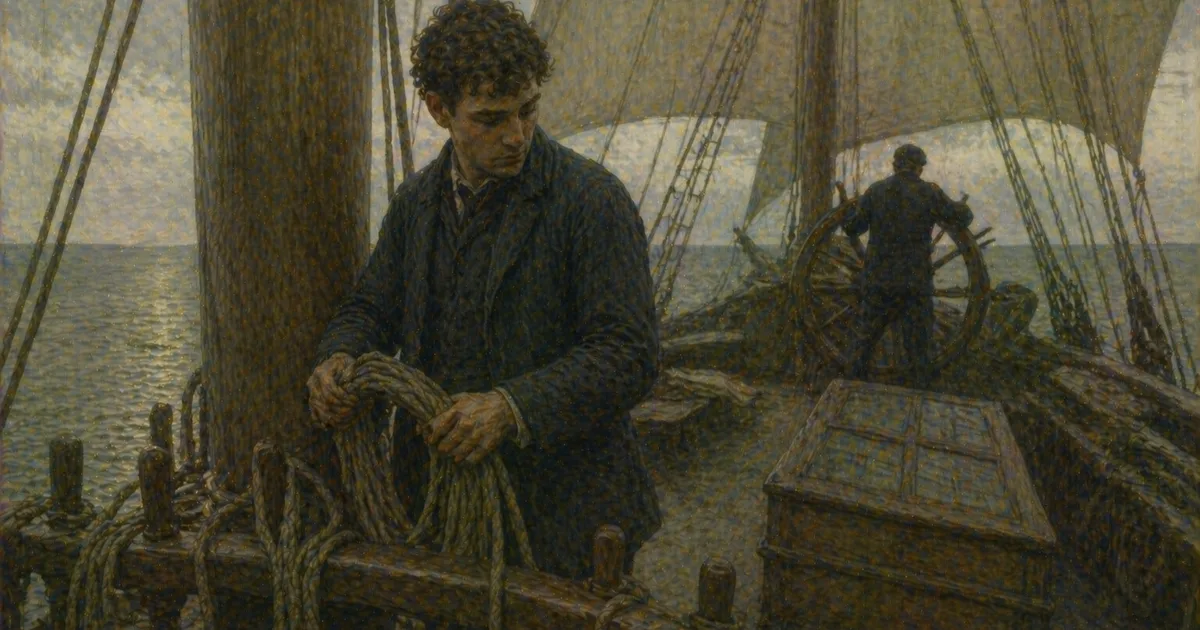
Olav came down from the main-topgallant yard at four bells of the afternoon watch. The boatswain at the foot of the foremast did not give him another piece of work; he gave him a nod, which was the boatswain’s way of telling a man he had done what was wanted of him on his first afternoon at sea. Olav went forward to the foremast pin-rail. The light at the bay astern of the Dronningen was the long July light of the third Tuesday’s late afternoon. Tungenes was a low shape at the larboard quarter and was diminishing as the bark ran. He set his hands at the rail and watched it for the few minutes the boatswain allowed a man at the foremast pin-rail to watch a thing on the first afternoon out of Stavanger. Then he went to the work the boatswain had next.
The wind held northwest by north for three days out of Stavanger and the Dronningen made her run up the coast under topsails. Tollefson kept the watches at four hours and the men at the watches were the men the boatswain had set in his book on the morning the ship had taken the wind. Olav was at the larboard watch with Bertel and a boatswain’s-mate from Tau and a young man from Jelsa whose name Olav had not yet learned. Pallesen had the starboard watch with Theodor Halversen and a deckhand from Lindesnes and the cabin boy. The 1st mate had the deck for Tollefson at the changes.
The larboard watch had fair-weather work. Sail-handling. Lookout. The repair-jobs the carpenter set at the boatswain and the boatswain set at the watch. Olav did the work at the pace of a man doing a third voyage. The boatswain did not need to tell Olav how to lay a coil at the cat-falls or how to hand a sail at the ratlines or how to hold the wheel through a small lift of the sea, because Olav did all of these in the way the boatswain himself would have done them, and the boatswain saw it.
The young man from Jelsa was on his first voyage. The boatswain told Olav so on the first morning at the change of the watch. The young man was sixteen, the boatswain said, and was the son of a man at Jelsa who had a small farm and three other sons and could not feed the four boys past the third winter. Olav had been on his own first voyage at the age of eighteen, and the young man at the rail was sixteen, and the difference between sixteen and eighteen at sea was a difference Olav now knew about. He did not say so to the boatswain. He looked at the young man at the foremast pin-rail at the first morning’s lookout and saw the way the young man held himself at the rail—the way of a boy who had not yet seen how a man held himself. Olav had held himself the same way at the rail of the Sigrid in June 1875. He gave the young man a quiet word about the lookout—what to look for at the eight points of the compass at the morning watch—and he gave it in the voice the boatswain on the Asta had used to give the same word to him in March 1876. The young man said yes. He said it in the voice a boy of sixteen used when he was being told a thing by a man of nineteen who had been told the same thing for the first time himself not so long before.
Bertel was at the larboard watch because the carpenter on a bark of this size worked at the watches when the carpenter’s bench was not wanted. The bench was not wanted on the days of fair weather, and the third day was a day of fair weather. Bertel stood at the foremast pin-rail with Olav for the morning watch. He was a man of about Olav’s height with the strong-forearmed look of a man who had been in his trade since he was sixteen, and he had the marriage-band on the third finger of his right hand that Tollefson had pointed out to Olav at the boarding. The band was four months old.
“Birgit at Tau,” Bertel said, when Olav had been at the rail with him for the better part of the watch and they had not spoken much. “She was at the wharf the morning of the boarding.”
“I did not see her.”
“She was at the back of the wharf. She did not come up to the gangway because she was at the place a wife stands when her husband is going out for twenty months, which is at the back of the wharf where she does not have to watch the gangway. She watched from the back. I saw her there as I came aboard.”
“Yes.”
“She is at Tau now. The letter she wrote is at my chest. She wrote three pages, and the writing was cleaner at the third page than at the first—she wrote the first two pages on the morning before I sailed, and the third on the evening after, when there was no longer anything to be done about it.”
“Yes.”
“You will write to your wife at Lindøy.”
“She is not yet my wife.”
“She will be.”
“Yes.”
“You will write to her from Archangel.”
“Yes.”
That night Bertel read from Birgit’s letter at his bunk in the forecastle.
He read at the lower bunk on the starboard side aft of the stove. Olav was at the upper bunk on the larboard side, which Tollefson had set him at on the morning of the boarding. Bertel had taken out the letter from the small chest at the foot of his bunk and unfolded it under the lamp at the head, and he read the third page in the small voice a man reads aloud in a forecastle when there are men sleeping at the after end of the room. The page was about the small things at the house at Tau—the cow that had calved on the morning of the sailing and the calf that had been born well; the seam at the roof above the kitchen that the rain had come through in the second week of June and that he was to look at when he came home; the fishing-net at the boathouse that Birgit had asked her brother to mend because Bertel was not at home to do it. Bertel read the page and folded it and put it back in the chest.
“Twenty months at Tau without me,” he said.
“Yes.”
“She will look at the roof in the second week of June next year.”
“Yes.”
“The seam will hold for a year. It is a seam I should have looked at in May. I will look at it when I come home.”
“Yes.”
Bertel put out the lamp at the head of his bunk. The forecastle went dark except for the light at the after stove. Olav lay at the upper larboard bunk and listened to Bertel’s breathing settle at the lower starboard bunk for the few minutes it took the breathing to settle, and then Bertel was asleep, and the men at the after bunks were asleep, and Olav was the only man at the forecastle who was not asleep. He thought about the chest at the foot of his bunk. The chest had a small thing at the side of the spare blanket that he had wrapped on a Sunday foretop watch on the Asta in March. The chest had Olava’s photograph at the top of the second pair of trousers in the carte-de-visite envelope from Augustsen at Pedersgate. The chest had not been opened since Stavanger.
He did not open it. He closed his eyes. He slept.
Tollefson played the organ in his cabin at sundown. The cabin was at the stern and the door of the cabin opened onto the after deck, and at sundown the door stood half-open and the organ on the cabin’s larboard bulkhead played a hymn the captain had not announced and that the men at the helm at the changeover heard for the length of the changeover. The hymn at the second sundown was Den signede dag. The hymn at the third sundown was a hymn Olav did not know. The hymn at the fourth sundown was Den signede dag again. Bertel said the captain often played Den signede dag in the early days of a voyage and then moved on to other hymns through the rest of it, and that the only thing about the captain’s playing that a man could ever know was that the playing was not a thing the captain spoke about.
“And the hymn at the third sundown.”
“I do not know what it was. He plays new ones sometimes. He learns them at the church when we are at home and brings them out at sea.”
“Yes.”
The wind held northwest by north for the first six days and turned north on the seventh and held north for two days, and at the end of the ninth day the Dronningen was past the North Cape with the long blue light of an August evening at the latitude of seventy north on her starboard quarter. The light at that latitude in August did not go. The sea was a pale grey-green that was the color of the sea at the entrance to the Barents in summer.
Olav stood at the foremast pin-rail at the second watch on the night of the North Cape passage. The boatswain was at the wheel and Bertel was below. The work at the pin-rail was the work he had done on the Asta in the spring at the same kind of pin-rail at the same kind of foremast, and the boatswain at the wheel gave the small adjustments at the wheel that the wind backing into the north required, and Olav at the pin-rail gave the small adjustments at the line that the boatswain’s adjustments at the wheel required. It was the work of two men whose hands moved at each other’s signals across the deck without speech. The pin-rail had a coil at the place where Olav had laid it in the figure-eight Haakon Berg had shown him on the Asta in March. He laid it again that night. He did not name to himself, at the laying, the man who had taught him the laying. He laid the coil.
The watch ended at four o’clock. Pallesen came up to relieve the boatswain. The deck went over to the starboard watch. Olav went below.
The Dronningen came down the White Sea on the eleventh day under a wind that was almost not a wind and a sea that was almost not a sea, and Tollefson called for the topgallants and the topsails to be set in the order the captain set sail when the weather was light at the approach to a foreign port. The men set the canvas in the order. The bark gathered way under the topgallants. The Russian coast came up at the larboard quarter at evening. The pilot came aboard at the mouth of the Dvina at half past nine in the long Russian-summer light.
The pilot was a Russian who spoke the ship-Norwegian a Russian pilot at Archangel spoke in 1876 for the Norwegian timber-bark trade, and he took the Dronningen up the river to the inner roads under almost-no-wind. The roads at Archangel at midnight in the long August light were a roads of three other Norwegian ships at anchor and four English barks and a Russian schooner. Tollefson dropped his anchor at the place the pilot pointed at. The pilot took the payment Tollefson gave him and the glass of port the steward gave him at the gangway, and he went back over the side at half past midnight.
The Dronningen was at Archangel.
Olav had not been at Archangel before. He stood at the rail at the time the men at the after-bunks were asleep and the watch had been set at the cat-falls for the night, and he looked at the city across the water. Archangel at midnight in August was a city of long timber-warehouses along the south bank of the Dvina, a Russian Orthodox cathedral with five domes at the inner end, and a row of wooden houses with steep tiled roofs along the river’s edge. The long Russian-summer light did not go. There were Russian dock-men at the warehouse-doors at half past midnight, as they always were at Archangel in summer—men whose work was the timber, at all hours of the light. The smell at the rail was the smell of the Dvina river—pine, and tar, and a small sweetness that came from somewhere upriver that Olav could not place. Bertel came up to the rail beside him. They did not speak. They stood for a few minutes. Then Bertel went below.
The loading began at six o’clock the next morning. The Russian timber-merchants at Archangel sent a steam-tug and four lighters out to the inner roads, and the lighters came alongside in turn, and the timber came up the side. The loading was done by the steam-tug and the four lighters and twenty Russian dock-men and two Norwegian carpenters at the loading-fall and the Dronningen’s entire crew at the stowing of the timber as it came aboard. The timber was Russian pine cut at the mills above Archangel and floated down the Dvina to the city for the export trade. It came aboard in lengths of twelve feet and twenty feet and thirty feet and was stowed in the after hold for the twelves, the after-and-main holds for the twenties, and the deck-cargo for the thirties. The deck-cargo was the part of the loading that took longest because it had to be stowed in the lashing-pattern that would hold the lengths through the Atlantic crossing.
The loading took five days.
On the second day at Archangel Olav wrote to his father at Vestbø and to Olava at Lindøy. He wrote at the table at the boardinghouse the agent had put the Dronningen’s crew up at—a boardinghouse run by a Swedish woman who had been at Archangel since 1853 and who let the timber-crews have a back room with a writing-table for the letters that would go home in the next outbound mail.
The letter to Jens was four lines. Olav wrote that the Dronningen had made the run to Archangel under fair weather without incident; that Tollefson was a captain Cousin John Stensøy had been right to recommend; that the loading had begun on the second morning and would take five days; and that the next port was Cardiff and that he would write again from Cardiff. He signed it Olav Hestby and he folded it and addressed it to Jens Hestby of Vestbø by way of John Stensøy at Stavanger, and he laid it on the table to the side.
The letter to Olava was a longer letter and he wrote it more slowly. He told her about the run up the coast and about Tollefson at the wheel through the second night when the wind had backed and held into the north. He told her about Bertel beside him at the watches and about Bertel’s wife Birgit at Tau. He told her about the Russian pilot’s ship-Norwegian and about the long August light at Archangel that did not go at midnight. He told her that the Dronningen would be at Cardiff in October if the wind was fair through the autumn, and that she should send any letter she wrote to Cardiff care of the Helland office at Stavanger and that they would send it on. He told her he had thought of her at the rail at the North Cape passage on the night the long blue light at seventy north did not go through the second watch.
He did not tell her what he had thought.
He signed the letter Olav. He folded it and addressed it to Olava Lindøy of Lindøy by way of Bjørn Olsen Lindøy at Lindøy by way of John Stensøy at Stavanger, and he laid it beside the first letter.
The Swedish woman took the two letters from the table that afternoon and put them in the canvas bag that went out on the next outbound Norwegian ship, which was the Brilliant of Bergen leaving for Stavanger on the morning of the third day.
On the fifth day the loading was done. The Dronningen lay at her anchor at the inner roads with her decks heaped with thirty-foot pine and her holds full and the lashing-pattern set for the Atlantic. Tollefson came to the deck at six in the evening of the fifth day and looked at the loading and gave Bertel and the deckhand from Lindesnes the approval that Tollefson gave a piece of work he was satisfied with, which was a single nod and a half-sentence about good work.
Olav stood at the foremast pin-rail with the long Russian-summer light at his face. The work of the loading was done. The next thing was the run south to Cardiff. The wind would back into the southwest within the next two days as the Russian-summer high broke; the Dronningen would have a beam-reach for the run out of the White Sea; the run down the Norwegian coast would be on a lee shore in late summer.
He thought about the letter to Olava that was at sea now on the Brilliant.
He went below for the supper of the fifth evening and the run-south morning.