The Dronningen had lain at the inner roads at Archangel for six weeks after the loading was done while Tollefson waited for the papers from the Russian customs and for the wind that would carry the bark down the coast. Both came in the third week of September. The bark cleared the mouth of the Dvina at the morning tide on the third Tuesday of September with the wind backed into the southwest as the Russian-summer high broke, and the Dronningen had a beam-reach for the run out of the White Sea. The pilot took her down to the open water and went back over the side at noon. The Dronningen set her topgallants. She made eight knots through the afternoon and the night.
The run from the White Sea to the North Sea was eleven days under the wind that held through September. The wind held southwest by west for six days and held west for three and went north by west for the last two. The bark made her run down the Norwegian coast at a distance of forty miles offshore because Tollefson did not want a lee shore in late September, and the larboard quarter showed the long blue line of the Norwegian hills going past in fair autumn weather.
On the fifth night Olav was at the foretop at the second watch and saw the small lights of a Norwegian fishing village pass on the larboard quarter at three in the morning. The village was forty miles off and the lights were small. There were three of them at the village and one at the breakwater, and the four lights together made the small constellation a fishing village made on the Norwegian coast at three in the morning in late September. Olav did not know the name of the village. The boatswain at the wheel did not call it up. The lights went past at the pace at which a bark on a beam-reach passes a fishing village forty miles off, and were astern at half past three, and were gone at the change of the watch.
Olav was at the larboard watch. The young man from Jelsa had begun to take the watches as a boy of sixteen took the watches when the boy had been at sea for a month, which was as a boy who had begun to do the work without asking what the work was. Bertel had given the young man his name on the third day at Archangel during the loading. The name was Erling. Erling was the son of a man at Jelsa whose own father had been at sea on a Stavanger schooner under a captain Bertel had heard of through his own father at Tau. Bertel had told this to Olav at the foremast pin-rail on the second day out of Archangel. Olav had said yes.
On the seventh day out of Archangel Bertel went up to the foretop with the carpenter’s gear in a small canvas bag at his shoulder, because the bench-work was wanting some attention at the foretop crosstrees and the weather had given Bertel the morning to do it. He came down at the change of the watch with his face in the look a carpenter has on his face when the carpenter has found a thing the carpenter had not been looking for, and he went aft to the quarterdeck without speaking to any man on the deck.
He spoke to Tollefson at the wheel-box.
Olav at the foremast pin-rail did not hear what Bertel said. He saw Bertel’s face. He saw Tollefson’s face change in the way Tollefson’s face changed when the captain heard a thing he had not been expecting. Tollefson nodded once and called the 1st mate over, and the three of them stood at the wheel-box for the better part of a quarter of an hour.
The boatswain came forward to the foremast pin-rail.
“The foregallant mast-top is rotten,” he said. “Bertel found it. The captain wants the mast looked at by every man on the deck who has been at the foretop in the last week and who can speak to the state of the mast at the cap. You were at the foretop on the second night.”
“I was.”
“What did the cap look like?”
Olav had laid the coil at the cap on the second night in the figure-eight he had laid for the Dronningen since his first night out of Stavanger, and the wood at the cap had been the wood at the cap. He had not looked at the wood. He had laid the coil. He told the boatswain so.
“The wood was the wood you had laid the coil at.”
“It was.”
“You did not look at the wood.”
“I did not.”
“That is well. The wood at the cap is not a wood you look at if you have not been told to look at it. The captain wants you to go up now and look at it with the carpenter. The captain will decide what to do with the mast at Cardiff. He has eight days to decide.”
“Yes.”
Olav went up the ratlines with Bertel. They came to the foretop at the second cap, and Bertel showed Olav the place at the wood where the rot had set in. The place was at the inside of the cap on the larboard side at the joint between the cap and the topgallant mast, and the rot was at the depth of about an inch into the wood. The wood at the rot had the look of pine that had been wet for too long and had then been dry for too long and had then been wet again. Bertel said the rot had been at the wood for at least two years and possibly three. Bertel said the rot had not been at the wood when he had gone up to the foretop at the loading at Stavanger in July, because he had looked at the cap then and the cap had been a sound cap.
Olav pressed at the place Bertel had pressed at, and the wood gave at the press in the way wood gives when wood is rotting from the inside out.
“It will hold to Cardiff,” Bertel said. “It will not hold the Atlantic crossing under the wind we are likely to get in November.”
“Yes.”
“Tollefson will set a new topgallant cap at Cardiff. There is a yard at Cardiff that does the work for the Norwegian timber-barks coming through with the Russian timber. Tollefson knows the yard. The yard will do the work in two days while the coal is going aboard.”
“Yes.”
They came down the ratlines.
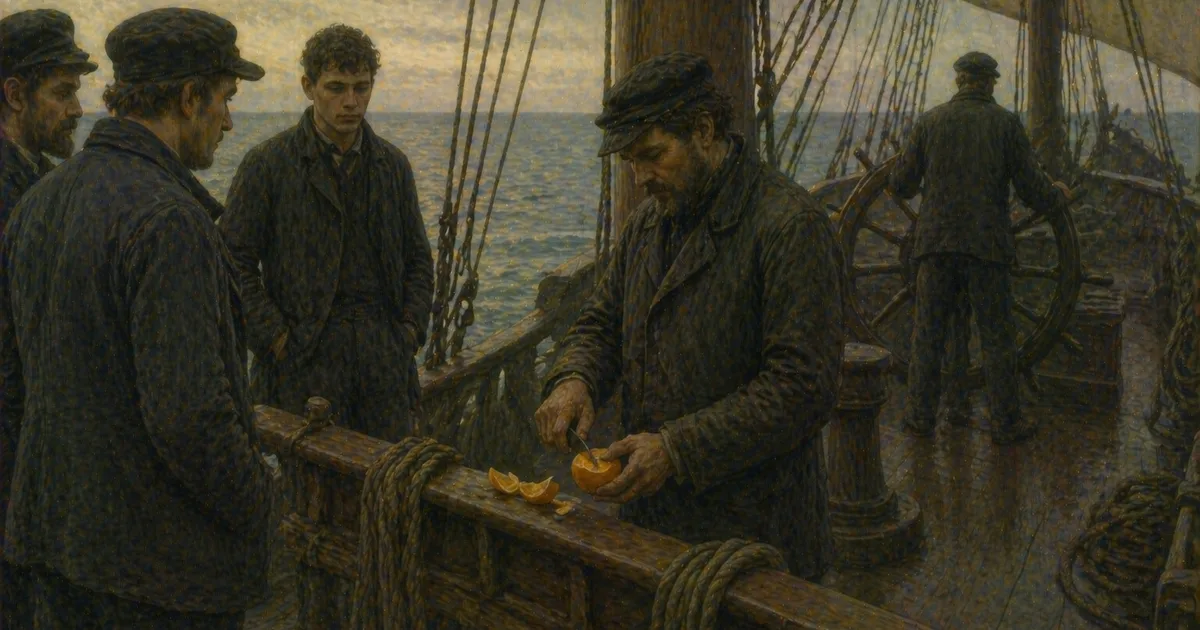
The orange came aboard on the ninth day out of Archangel.
It came aboard with the small consignment of fresh stores Tollefson had taken at Archangel for the run south, and that the steward kept in the small locker at the cabin’s after bulkhead. Tollefson’s orange came up to the deck on the ninth day in the steward’s hand because the steward had been told by Tollefson to bring the captain’s orange up to the quarterdeck after the noon meal.
The boatswain saw the orange come up.
He had not had an orange in some time. He had been at sea on Norwegian timber-barks for fifteen years and had got an orange at the captain’s table at four ports in those years, and the Russian orange the steward was carrying up to the quarterdeck on the ninth day out of Archangel was an orange he had not had at any port he had been at. He stopped the steward at the foredeck.
“That is a Russian orange,” the boatswain said.
“It is.”
“Where is the captain’s orange?”
“This is the captain’s orange. It is the orange the captain bought at Archangel in the loading.”
“That is the captain’s orange and not a forecastle orange.”
“It is the captain’s orange.”
The boatswain did not take the orange from the steward. He looked at the orange in the steward’s hand for the few seconds a man looks at an orange he has not had and is not going to have, and the boatswain stepped back from the steward and let the steward go aft to the quarterdeck. The orange went up to Tollefson at the quarterdeck. The boatswain came forward to the foremast pin-rail.
“The captain has an orange,” he said to Olav. “He has not given it to the forecastle. He has not said he will. He will eat it at his cabin alone. That is the way of an orange on a Norwegian timber-bark in eighteen seventy-six.”
Olav did not say anything.
“It is a small thing. It is the kind of small thing a man at sea on a long voyage thinks about more than he should. I have been at sea fifteen years. I have not had an orange at a port in those fifteen years. I will not have the orange today.”
The boatswain looked at the rail and then at Olav.
“You were at the Asta under Captain Gjermund.”
“I was.”
“Gjermund would have eaten the orange at his cabin alone too.”
“He would.”
“Tollefson is not Gjermund. Tollefson is a different captain. But the orange goes the same way at every Norwegian timber-bark in eighteen seventy-six. The captain has the orange. The forecastle does not have the orange. That is the way of it.”
The boatswain stood at the rail beside Olav for a few seconds longer. Then he went aft.
After the noon meal Tollefson came to the deck with the orange in his hand. He had not opened the orange. He came down to the main deck and forward to the foremast pin-rail where the boatswain was now standing alone, and he handed the boatswain the orange.
“You will share it with the watch,” Tollefson said.
“Yes, sir.”
“The watch will share it with the off-watch at the change.”
“Yes, sir.”
Tollefson went back to the quarterdeck.
The boatswain held the orange in his hand for a moment. He looked at Olav. He did not say anything about the captain. He did not say anything about the orange. He took out his pocket-knife and cut the orange into eight pieces at the foremast pin-rail and gave one piece to himself and one piece to Olav and one piece to Erling who was at the lookout and one piece to Bertel who was at the after rail, and saved four pieces in his cap for the off-watch at the change. Olav ate the piece. The orange was sweeter than the orange Olav had had on the Sigrid at Hebburn in 1875.
“The captain heard,” Olav said.
“The captain heard. The captain hears most of the things on this deck. The captain does not say he hears them. That is the captain’s way.”
The boatswain put the cap with the four pieces at the side of the foremast pin-rail and went back to the wheel.
The Dronningen came into the Bristol Channel on the twelfth day out of Archangel and into the mouth of the Severn at noon on the thirteenth and dropped her anchor at Cardiff Roads at four o’clock.
Cardiff was a coal port. The Dronningen lay at the inner roads for the night and came up to the loading-bench at the south Cardiff colliery dock at the morning tide. The colliery was the colliery the Norwegian timber-barks came to for the run to the American coast. The coal came down the loading-chute in the noisy way coal came down a chute at Cardiff and went into the holds at the pace of a colliery dock that handled forty Norwegian timber-barks a year.
The yard at Cardiff that did the foregallant cap took the work as Bertel had said it would. The yard sent two men aboard at the second day of the loading, and the two men went up to the foretop with Bertel and the carpenter’s gear and the new piece of pine that the yard had cut at the spar-shop at the inner end of the colliery dock, and the three of them set the new cap in two days. Tollefson came up to the foretop on the morning of the third day to look at the new cap, and Tollefson nodded once and gave the yard-men the small approval Tollefson gave a piece of work he was satisfied with, which was a single nod and a half-sentence about good work being done.
The coal-loading took five days.
Olav went ashore at Cardiff for the half-day Tollefson gave the larboard watch on the third day of the loading. He walked from the colliery dock up to the inner town and along the Bute Road to the dock-gate and along the dock-gate road to the Welsh chapel Bertel had told him about—a chapel a Stavanger sailor on the run home from the American trade in 1864 had built a small thing on by way of a payment for the Welsh-language Bible the chapel had given him at his first run out from Cardiff in the wartime year of 1862. The chapel was a small chapel of red brick with a slate roof. The Welsh writing above the door was in letters Olav could read but in a language he could not. He stood there with the writing above his head and did not try to make out the letters.
He thought about the letter to Olava that was on the Brilliant of Bergen now—wherever the Brilliant of Bergen was on its run home from Archangel—and he thought about Olava at Lindøy reading the letter when the Brilliant came in. He thought about the chapel at Rossøy his father had walked to with his mother in the year before Bertha’s marriage, which Bertha had set down at the dinner at Rossøygate in July, and which he had heard about for the first time at the table at Rossøygate from a woman who had been his mother’s friend.
He did not go into the Welsh chapel. He walked back to the dock.
The Dronningen cleared Cardiff on the morning of the eighteenth day out of Archangel. The wind backed into the southwest at the mouth of the Severn and held southwest by south for the run past the Lizard, and on the night of the nineteenth day the bark turned west into the Atlantic with the new foregallant cap holding and the new coal in her holds and the long autumn light of the Bristol Channel astern.
The Atlantic crossing took twenty-three days. The wind held southwest by south for the first eight and west by south for the next nine and went around to the north by west for the last six. The Dronningen made her run as a coal-laden bark made her run across the Atlantic in late October and early November of 1876, which was as a bark that had been in the trade for fifteen years and was carrying a cargo she had carried six times before. There was no incident at the crossing. The new foregallant cap held. The boatswain led the small adjustments at the wind-changes. Tollefson took the wheel at the last watch of every day that the wind was at any point of the compass the captain wanted to feel at his hands. On the fifteenth day of the crossing the wind went from southwest by south to west by south at the change of the morning watch, and Tollefson was at the wheel and held the wheel through the change without giving it back to the boatswain, and the bark answered to the new wind under Tollefson’s hands at the pace at which a captain who had been at the wheel of his own ship for fifteen years took a wind-change without speaking about it.
Bertel sat at his bench at the after rail and made the bits of woodwork Bertel made when the carpenter’s bench was not wanted for repair. On the eleventh day of the crossing he made a small wooden box with a hinged lid that he said was for Birgit at Tau to keep her sewing-thread in. The box was of teak. He had got the teak at the spar-shop at Cardiff. The hinges were of brass. He worked at the box with the care of a man making a thing for his wife when his wife is at home and he has eighteen months at sea ahead of him before the wife will see the thing.
On the twelfth night of the Atlantic crossing Olav was at the foremast pin-rail with Erling at the second watch. The wind was at west by south and was steady, and the work at the pin-rail was the work of a man and a boy at the night watch with no adjustment to make. Olav had given Erling the lookout for the first hour, and Erling had given the lookout to Olav at the second. They had not spoken much through the watch. At the change of the third hour Erling said, in the voice of a boy who had been at sea for two months and had not been at sea before, that he had not thought the Atlantic would be this large. Olav said it was as large as it was. Erling said yes. They did not speak again before the change of the watch at four o’clock.
On the morning of the eighteenth day of the Atlantic crossing the lookout called the American coast.
Erling was at the foremast head and he called it down. The land was a long low blue line on the larboard quarter that became, in the next half-hour, the long low blue line of the North Carolina coast that ran south to the Cape Fear River. Olav was at the deck when the call came. He looked up at the land and he looked at it the way he had looked at the English coast from the deck of the Asta in March 1876, which was the way of a man looking at a thing he had been told he would see and was now seeing.
The Wilmington pilot would come aboard at the river mouth in the afternoon.
Olav went forward to the foremast pin-rail. The American light was new to him. He had not been to America before.