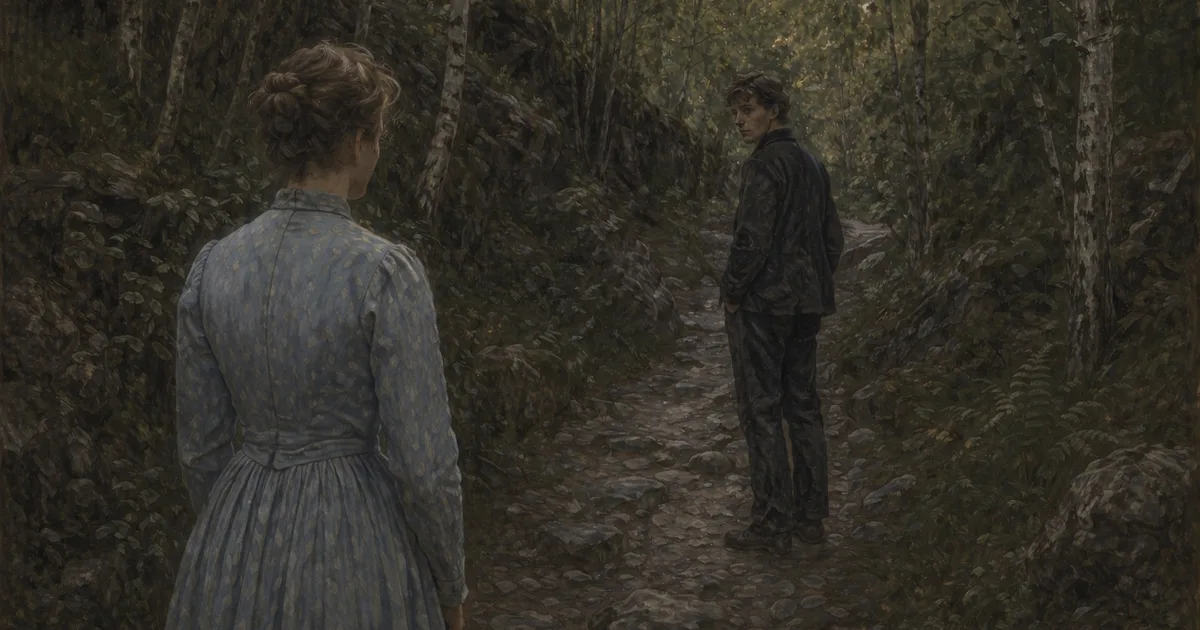
The road from Landa to Roda was a road Olava had walked twice before this evening. She was eighteen, and she was walking it for the third time in her life with the youngman from Vestbø beside her.
She had run across the field at Landa because she had decided, at the line of small stones where she had been caught by the elder son of Landa and had looked round the field once and her eye had stopped at him at the gorse, that she would not let the day end without putting her hand at his arm.
She had put her hand at his arm.
The hand had stayed there for the time it had taken her to say the four words she had decided to say, and then she had taken it off because the next thing was to walk, and walking they were now doing.
Peder was beside Olav at the front of the column on the road. Olav was on Peder’s left. She was on Peder’s right. Inger was a few steps behind them because the road was narrow at the gate and four people did not walk easily abreast.
The road went up from the gaard at the south end of the island and crossed the valley above Østhusvik. The light at half past six was the light of a June evening with the sun south of west and the heat going out of the day. She did not say anything to Olav at the road. She had not decided what to say yet. She was looking at the road and at the back of Peder’s head and at the place where Olav’s coat was on his arm, and she was taking the measure of the evening the way her mother had taught her to take it. The evening was clear. It would hold its light until eleven and then go to the long blue of June at this latitude, which was not dark. The air at the road had the cooling of a June day going into a June evening. The grass at the side of the road was not yet the grass that would be cut for the haying.
Peder spoke first.
He spoke to Olav about the elder son of Landa. He had asked the elder son of Landa about the Landa boat and the new caulking, and the elder son had told him about the new caulking, and Peder was telling Olav now what the elder son had told him. Olav listened. Olav said yes when yes was the place a man said yes. Peder went on for a few hundred yards about caulking and about a boat someone at Landa had built in the spring, and Olava, who was on Peder’s right and was listening, saw that Peder was talking because the four of them on the road had to walk for an hour and a quarter to Roda, and that Peder had decided he would do the talking until someone else decided to do the talking.
She was glad of it.
She did not want to talk yet.
She wanted to walk in this June evening with Olav at the other side of Peder and with Inger behind them, and she wanted to learn what kind of man Olav was by walking on the road beside him for an hour and a quarter without speaking to him. She had been at his side at the corner of the courtyard at Landa with her hand on his arm for the length of time it had taken her to speak four words and for him to say one word back, and she had read what she could read about him in that time. Now she wanted the rest of the walk.
She had heard about him from Inger before today. Inger had heard about him from the elder son of Roda, who had been at the parish-school with her brother Bernhard before her brother had married Inger this past Easter. The youngman from Vestbø was the son of Jens Hestby of Vestbø, whose wife had been the friend of her own mother in their youth. She had thought about him through the morning. She had not thought about him in the way she had thought about the elder son of Roda when she had been fifteen, which was the way she had thought about the elder son of Roda for one summer and then not thought about him again, but in the way she had begun in the last year to think about a thing—slowly and from several sides, the way her mother thought about a thing.
The road bent inland half a mile north of Landa and went into the small ravine that ran from the upper gorse-fields down toward the bay. The ravine was a deep cut in the island where a stream had once gone before the stream had gone underground, and the path through it followed the old streambed for a quarter of a mile before it came up the other side. The light in the ravine was not the light of the open road. The slopes of the ravine were thick with birch and rowan, and the path was narrow enough that two people could not walk abreast. Peder went first. Olav went second. Olava went third. Inger came after.
The ravine was the place she had decided, when the road had bent inland and the ravine had come up before her, that she would speak to Olav.
She did not know yet what she would say.
She walked behind him in the ravine. The path had stones in it that were the stones of the old streambed and that were rounded and dark and held the heat of the day in them, and the birch on the slopes had the leaves of mid-June that were not yet at their full size, and the air in the ravine was cooler than the air on the open road. Olav walked at the pace Peder set, which was not a hurried pace. He did not look back at her. He did not turn his head. He walked with his coat over his arm in the way a man who had been a sailor for two months carried it—as a thing he had got used to keeping out of the way of his work.
She knew what he had come back from in May. Inger had heard the inventory at her father’s table at Stavanger the second day after the customhouse—the captain’s beating of Nils on the half-deck, Eliasson at the upper topsail, the rotten pork at the mizzen-cap, the tar on the deck, the orange crates on the customhouse stoop, the captain’s coat with the wrong button. She had heard the inventory through Inger and she had heard who had stood at the bottom of the stoop in front of John Stensøy and the king’s officer and named it.
She had been thinking about her brother who had died.
She had been thinking about him since they had left Landa. She had been thinking about him in a way she had not been thinking about him for some months. She had been remembering the long quiet evenings of his last year, when she had sat at his bedside in the small back room at her father’s house at Lindøy with the lamp turned low, and had heard his breathing, and had read to him from the gospel of John when he had asked. He had been twenty-one years old and she had been seventeen, and he had died in March of the year before this. He had been her oldest brother. He had been the brother she had loved best.
He had been called Tore. He had been the brother who had taught her, when she was eight and he was eleven, how to row a boat in the waters between Lindøy and Sandøy on a summer morning, and the brother who had shown her, when she was twelve and he was fifteen, the way one held a fishing-line so that the line did not cut the hand. He had been a quiet boy and had become a quiet young man, and what he had said to her in the last week was that the room was warm enough and that he was glad she was there. He had said it three times. The third time he had said it she had known that he had no other thing to say to her and that what he had wanted to say to her in his last days was the one thing.
She had been seventeen. She had not been a person who had been sat beside in such a way before. She had come to know, in the months after, what it had been to be the person beside the bed, and she had come to know what it had been for him to be the person in the bed. The two knowings were not the same. The one she could speak of to her mother. The other she could not speak of at all.
She had thought that the asking was something one did at home. The asking after a man who had come back from a place where he had been alone. Her mother had asked her, after the brother had died, whether the long evenings of nursing had been heavier than the day of the death itself, and she had told her mother yes, and her mother had said she had thought so. The asking had been the asking. It was a thing one woman could do for another, who had been alone in a room with a thing.
She did not know whether one young woman of eighteen could ask one young man of eighteen who had been alone in another kind of room.
She thought, at the place in the ravine where the path crossed a small flat stone that the streambed had laid bare, that she would try.
She said his name.
He turned at his name. He stopped and turned and looked at her. He did not say anything. He waited.
“On the Asta,” she said. She was speaking to him in the Stavanger dialect. “Was there anyone on the Asta who was something other than the captain.”
She did not say it as a question. She said it as a thing she was leaving for him to do with whatever he was going to do with it.
He did not answer at once.
He looked at her the way he had looked at her earlier in the evening at the courtyard when she had put her hand on his arm. It was the look of a man for whom what the woman had asked was something he had not been asked before. She held it as long as she had held the look at the boat-landing in the afternoon.
“Yes,” he said.
It was the smallest of the answers he could have given. It was the same word he had given her at the courtyard and the same word he had given her companion’s announcement at the gate. It was the answer of a young man of eighteen who had not had this asking from anyone on the island and who did not know what he could say after the “Yes.”
She did not push.
She walked on past him on the flat stone of the streambed, and he turned and walked behind her up the path, and Peder, who had got further ahead in the ravine because he had been talking to himself about a piece of caulking, slowed at the top of the ravine to wait for them, and Inger came up behind Olav at his shoulder and put her hand at his arm in the way one woman puts her hand at the arm of a young man when she has seen that a thing has just passed between the young man and the young woman in her care and the older woman wishes to stand where she might be useful.
They came up out of the ravine.
The road came up onto the open ground above the bay where the gorse was thinning into the heath that ran up to Roda. The light at seven o’clock was the long light of June. She walked at Peder’s right and Olav at Peder’s left, and Inger walked behind them with her hand off Olav’s arm now because the road had widened. Peder, who had observed the slowing in the ravine and had not said anything about it, started a different conversation about Lindøy. He asked Olava who at Lindøy fished for the herring. Olava told him. He asked her how many boats Lindøy had at the herring. She told him. He asked her about her father’s boat and she told him about her father’s boat. The conversation was easy and the walking was easy, and the road came down toward the bay and ran along the inside of the bay for a mile and then went up to Roda.
Olav did not say anything in the conversation about Lindøy.
He walked at Peder’s left.
She knew, at her right, that he was still in the place his “Yes” had put him.
She did not push him out of it.
She had heard the “Yes” and what had been in the “Yes.” The “Yes” had been a person. The “Yes” had been a person at the Asta who had been something other than the captain, and she did not need to know who or how. She had asked the question and he had answered the question and the answering had been the small thing it had needed to be, because in the answering he had given her something he had not given to anyone else.
She walked at Peder’s right with the long light of the June evening on the heath that ran up to Roda, and she knew that the asking and the answering had passed between her and the youngman from Vestbø down in the ravine, and that none of it had come up out of the ravine onto the road with them—that what had passed had stayed where it had passed, and what was on the road with them now was the ordinary thing that came before the next time.
She had a week, until Stavanger, to think about what she had been told.
She thought she would sit at the table at Roda this evening and write to her mother. She thought her mother would understand the writing without Olava’s having to explain too much of what was in it, because her mother understood writing of that kind.
The gaard at Roda came up over the rise above the bay at half past eight. The sun was low. The bay was silver at the side and dark at the middle, and the long light of the June evening was on the upper grass at Roda where the cows were at the far field. Peder slowed at the gate of the gaard.
“You will come in for a glass,” Inger said.
“Thank you, no,” Peder said. “We are home another hour. My father will worry.”
“Yes,” Inger said.
Inger went in through the gate of Roda. She did not look back. She was a woman who had seen that the next minutes were not for her to be in, and she went in to the gaard to leave Olava and Olav and Peder at the gate.
Olava stood at the gate of Roda with the youngman from Vestbø and his brother.
Peder, who had walked the road with them from Landa and who had seen enough of the evening to know what the next minutes were, said, “I will walk down to the bay.”
Peder went down the path toward the bay.
Olava and Olav stood at the gate.
“When will you be at Stavanger?” she asked.
“Next week.”
“What day.”
“Thursday or Friday.”
“My father has business at Stavanger on Thursday.” She did not say what the business was. She said it in the way her mother had taught her to say a thing she wanted a man to hear. “He will be at the boardinghouse on Bredalmendingen.”
“Yes.”
“Will you come and see him.”
“Yes.”
“Good.”
She looked at him for a moment in the way she had not looked at him yet that evening, which was the way her mother had looked at her father in the photograph her mother had kept on the dresser since the autumn after her wedding. It was the way one looked at a man one had decided about. She did not know whether he saw it. She did not need him to.
“Goodnight, Olav,” she said.
“Goodnight, Olava.”
He turned and went down the path after Peder. She stood at the gate and watched him until he was at the curve of the path that took him out of sight.
She went into the gaard.
In the kitchen at Roda her father’s cousin’s wife had supper on the stove. Inger was at the table cutting bread. Olava stood at the door for a moment and saw the kitchen as the kitchen of a gaard she had been at since she was a girl. She put off her coat. She put off the yellow straw hat. She sat at the table at the place she had sat at since she was eleven, on the wooden bench at the side.
Inger looked at her. She did not say anything. She put a slice of bread on the plate at the place. Inger went on cutting the bread.
The cousin’s wife brought the stew to the table. There was barley in the stew and a piece of cured pork from a leg the cousin had killed in November, and the cousin’s wife sat at the foot of the table and asked Olava and Inger about the day at Landa, and Inger told her, and Inger told her well, leaving out what was not for the cousin’s wife to know yet, and the cousin’s wife was satisfied with the telling and asked nothing more.
After supper Olava and Inger walked together to the small upper room of the gaard where they slept when they were at Roda. Inger had said nothing on the walk up the stairs and said nothing now, and Olava was glad of it. She put the light blue dress on the chair at the foot of the bed and she put the yellow straw hat on the table at the side, and she sat at the edge of the bed for a moment and looked at the small window above the table.
She would write to her mother in the morning.
The light at the small upper window held the long blue of a June evening at the latitude of Finnøy.