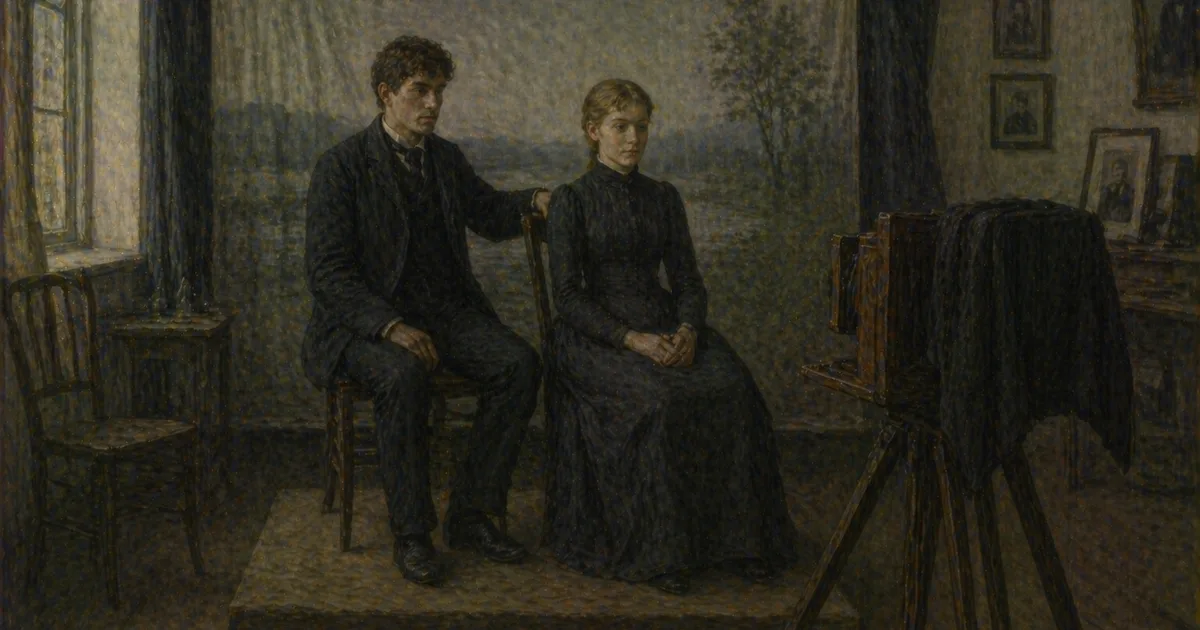
The boardinghouse on Bredalmendingen was a tall building with three windows on each floor and a door that had been painted blue in the autumn and was still blue, and Olav came up to the door from the corner of Bredalmendingen and Pedersgate at half past two on the Thursday afternoon of the first week of July. He had come up from the wharf at half past one on the Stavanger coast-steamer that had left Judaberg at noon, and he had walked up from the wharf with his leather bag in his right hand and his good coat over his left arm, and he had not stopped at any of the chandlers’ or any of the agents’ offices on the way up because the boat had been a quarter of an hour late at the wharf and he had wanted to get to the door of the boardinghouse before three.
He went in.
The hallway of the boardinghouse had a writing-table at the foot of the stairs and a coat-stand by the door and a long mirror on the wall and an oil-painting of a brig at sea above the writing-table. The keeper was a woman of about fifty in a black dress with a white apron, and she came out of the door beside the writing-table when she heard him come in. She said good day. He said good day. He said he was looking for Bjørn Olsen Lindøy. The keeper said yes. The keeper said Mr Lindøy had gone to the offices of Helland at one and was expected back at three. The keeper said the daughter of Mr Lindøy had been at the boardinghouse with her cousin from Rossøygate at noon, and had said to expect the youngman from Vestbø this afternoon, and to send him up to the small sitting-room at the first floor when he came.
“Yes,” Olav said.
“Up the stairs and at the right at the top.”
“Yes.”
The keeper went back into her room. Olav went up the stairs.
The small sitting-room at the first floor had a window that looked down onto Bredalmendingen and a sofa and two chairs and a table at the side of the sofa with a vase of yellow tansy on it. Olav put his bag on the floor at the side of the sofa and his coat on the back of one of the chairs, and he stood at the window and looked down at Bredalmendingen for the few minutes it took a young woman in a green dress and a yellow straw hat to come up the street from the lower end with a basket on her arm.
He saw her come up the street.
She did not see him at the window because the window was at the first floor and she was looking at the doorway as she came, and she came up to the door of the boardinghouse and stood at the door for a moment to set down her basket and to take off the straw hat and fan her face with it because the afternoon was warm, and then she put the hat back on and picked up the basket and came in.
The keeper came out into the hallway. Olava said something to the keeper that Olav could not hear because the door of the sitting-room was closed. Then he heard her coming up the stairs.
She came in.
She had on the green dress now, not the light blue. The yellow straw hat was the same hat. Her face was a little flushed from the climb and from the afternoon sun on Bredalmendingen, and she set the basket on the table beside the vase of tansy, and she took off the hat and laid it on the chair beside her hand, and she looked at him.
“You came on the Thursday,” she said.
“Yes.”
“I had said Thursday or Friday. I had not been certain which it would be.”
“I came on the Thursday.”
She did not sit down at first. She stood at the table beside the basket and she looked at him for a moment in the way she had looked at him at the gate of Roda twelve days before, and then she went to the sofa and sat down at the corner of the sofa nearest the window, and Olav sat down at the chair on which his coat was not.
“My father will be back at three,” she said.
“Yes. The keeper told me.”
“You will meet him.”
“Yes.”
“He has been at the Helland office about a question of an account from the spring herring. The account had a discrepancy that was a discrepancy of his and not of Helland’s, and he has been at the office to explain it. He will be in a good humor because Helland has agreed to settle the discrepancy in his favor.”
“Yes.”
“My mother is at her cousin’s at Rossøygate. She came across yesterday on the Wednesday boat.”
“Yes.”
“My brother Gustav is at his ship. His ship is at Stavanger this week unloading, and he will come to the dinner at Rossøygate on Saturday with us. My father has written to your father at Vestbø to come to the dinner on Saturday at Rossøygate. Your father has written back. He will come on the Saturday morning boat.”
“Yes.”
“Saturday is the dinner.”
“Yes.”
She did not say more about the Saturday. She sat at the corner of the sofa with her hands at her lap. She said, “There is a photographer at Pedersgate who is making a likeness of a captain and his wife this afternoon and on Friday morning. I have spoken to him. He will sit for us at three on the Friday afternoon.”
“Yes.”
“You have not had a likeness made.”
“No.”
“He will sit for you alone first and then for me alone and then for the two of us together. He will make three likenesses. We will pay him together.”
“Yes.”
“Two on the carte-de-visite and one on the cabinet card. You and I will keep one each of the carte-de-visite. The cabinet card will be for the families.”
“Yes.”
The keeper’s door opened at three o’clock. Bjørn Olsen Lindøy came up the stairs at the pace of a man of fifty-six who had been at sea for thirty-five years before he had come ashore to be a fisherman of Lindøy and who walked the stairs of a boardinghouse the way he walked the deck of his own boat, which was as a thing he expected to give him no surprises and which gave him none. He came into the sitting-room. Olav stood up. Olava stood up. Bjørn looked at his daughter, and he looked at the youngman from Vestbø whom his daughter had brought to a sitting-room at a Bredalmendingen boardinghouse on a Thursday afternoon, and he held out his hand.
Olav took the hand.
“Bjørn Olsen Lindøy.”
“Olav Hestby.”
“Your father knew my wife in their youth at Rossøy.”
“Yes.”
“You are Jens Hestby’s older boy.”
“Yes.”
“Sit down.”
They sat down. Bjørn sat at the chair where Olav’s coat had been until Olav had moved it. Olava sat at the corner of the sofa. Olav sat at the chair where he had been sitting. Bjørn took out a pipe from his coat and packed it and lit it and drew at it. He looked at Olav at the chair and he looked at Olava at the sofa, and he said to Olav, after some time, that he had heard a good account of him from John Stensøy.
“Yes.”
“From the customhouse in May.”
“Yes.”
“Stensøy said at the dinner at his house in June that the youngman from Vestbø had stood at the bottom of the stoop and named what was to be named without leaving anything out and without inventing anything. Stensøy said it twice.”
“Yes.”
“That is a good account.”
“Yes.”
Bjørn drew at the pipe. He did not say more for some minutes. He looked at the oil-painting of the brig that was the same painting as the one in the hallway only smaller and on a different wall. The light at the window of the sitting-room was the afternoon light of a Stavanger street in July, and the light fell at the table with the vase of yellow tansy, and the tansy in the light had the color of the gorse at the side of an island path in late June. Bjørn looked at the tansy at the table for a moment, and then he looked at the brig, and then he looked at Olav. He did not say what he had been thinking in the looking. He drew at the pipe. He said, after a while, “Your father is in good health.”
“Yes.”
“The knee.”
“He walks slower than he did but he walks.”
“Will you come down to Lindøy at the end of the summer.”
“Yes.”
“Good.”
Friday came on. Olav slept at the boardinghouse on the Thursday night in a small upper room at the third floor, and he ate breakfast at the keeper’s table at half past seven on the Friday morning with two other lodgers and Bjørn, and he walked out into Stavanger at nine to find his way at the streets he had walked twice before in his life. Olava came to the boardinghouse at ten. She wore the green dress again. They walked together down to the harbor and along the harbor-front to the mole at the end where the herring-boats came in, and they watched the boats come in for some time. Olava named the men at the boats whom she knew because she had been to Stavanger every summer of her life since she was six, and Olav named the boats he knew because two of them had been at Stavanger in May when the Asta had come in. The wind was off the south at the harbor, and the boats came in under it without rowing, and the men at the boats did not have to put their backs into the work. Olava said her father had said the spring herring had been a thin run, and that the agents had not paid as much for it as he had expected. Olav said he had not heard. Olava said her father did not say it about anyone in particular.
The photographer’s studio was at the second floor of a building at the corner of Pedersgate and Asylgata. The photographer’s name was Augustsen. The studio had a long room with a tall window at the north end and a chair on a platform at the center and a curtain at the south end with a painted scene of an Italian garden on it that the photographer had bought at an auction in Hamburg in 1873. He had a camera on a wooden tripod and a box-camera at the side and a stack of plates and a stack of cards. He was a man of forty in a dark coat that had once been a good dark coat and was now a working coat. He looked at Olav and at Olava when they came in and he said good day and he said the carte-de-visite would be three crowns each and the cabinet card would be six crowns and that the three together would be twelve crowns paid in advance.
Olava handed him twelve crowns from a purse her mother had given her for the morning.
The photographer took Olav first. He sat Olav at the chair on the platform with his back to the painted Italian garden and he turned Olav’s head a little to the right and he asked Olav not to smile because a smile in a likeness was a thing that did not last well. He went to the camera and he opened the lens and he counted, and he closed the lens, and Olav had been a likeness.
Then he took Olava.
He sat her at the chair on the platform with her back to the painted Italian garden and he did not turn her head. He let her sit at the chair the way she sat. He let the green dress fall the way it had fallen when she sat down. He let the hat be on the table beside the chair where she had set it. He went to the camera and he opened the lens and he counted, and he closed the lens, and the likeness was made.
Then he took the two of them.
He sat Olav at the chair and he sat Olava on a smaller chair beside Olav and he asked Olav to put his right hand at the back of Olava’s chair and Olava to put her left hand at her lap and to look at the camera. He stood at the camera and he opened the lens and he counted, and he closed the lens.
The photographer said the cards would be ready at noon on the Saturday.
Olav and Olava walked back from Pedersgate to the boardinghouse on Bredalmendingen. Olava did not come in. She said she would be at her cousin’s at Rossøygate for the evening with her mother. She said Olav was to come to Rossøygate at one o’clock the next afternoon for the dinner. Olav said yes. Olava walked up Bredalmendingen toward Rossøygate. Olav stood at the door of the boardinghouse and watched her until she was at the corner of Pedersgate.
He went in.
He had supper at the keeper’s table with Bjørn and the two other lodgers at half past seven. Bjørn was at his own quiet through the supper, in the way a man of fifty-six is at his own quiet at the end of a Friday at Stavanger, and the two other lodgers were a clerk from the Helland office and a fisherman from Sandnes whose talk was the talk of two men who had been at the keeper’s table together for a week and whose business with each other was their own. Olav ate and listened. After supper he went up to the small upper room at the third floor. He laid out the good coat on the chair for the morning. He sat at the edge of the bed for a few minutes and looked at the window above the table.
The light at the small upper window was the long light of a July evening at Stavanger.
He thought about the dinner at Rossøygate that was to be the next afternoon. He did not yet know what kind of dinner it would be. He lay down on the bed and he slept.