The rain came at the upper end of Front Street at half past four in the morning.
It was a thin cold November rain without much wind and at a steady fall. Olav and Thomas had been at Front Street for the better part of an hour and had turned at the side streets twice and had come back to Front Street at the upper end where the brick warehouses ended and the smaller frame houses began. The lamps at the corners were further apart there. The rain came down at the cobbles and the cobbles went dark.
They walked another quarter of a mile up Front Street.
Olav did not have a hat. His coat was the working coat he had been at the foredeck in for the eleven months out, and it was a coat that was not made for a November rain. The rain went down at the back of his neck where the coat-collar ended. Thomas had a knit cap from Stjernarøy that he had on his head, and the cap was not making much against the rain either.
They stopped at the corner of a side street that went off Front Street to the east.
The side street was a street of frame houses with front yards behind low wooden fences, and the houses were the houses of working people at Wilmington at the eastern side of the upper city. There was a steeple at the upper end of the side street that the lamp at the corner showed against the dark, and the steeple was a white wooden steeple with a small wooden cross at the top. Thomas looked at the steeple. He said the steeple was a Catholic church.
Olav said yes.
He said it more because Thomas had said about the steeple than because he had a thing to say about it. He was beginning to know that his head had a heat at it that the rain at his neck was not cooling, and the heat was not the heat of the work at the tar-mat the day before that he had thought it was at the second dog-watch.
Thomas said they would go to the steeple.
The two of them walked up the side street to the steeple. The rain came down. The church at the steeple was a frame church with the door at the front and a painted sign at the door that said Saint Mary’s Mission in English and Latin. The door was closed. Thomas tried the door. The door was locked. The two of them stood at the porch of the church for some minutes out of the rain.
A man came down the path at the side of the church.
The man was a man of about forty in a black coat and a black hat the kind a Catholic priest of a Wilmington mission kept, and he had a lamp at his hand that he was carrying down to the lock at the rectory door at the side path. He saw the two of them at the porch. He stopped. He came up to the porch with the lamp.
“You are sailors,” the priest said in English.
“We are,” Thomas said.
“The bark you are off of.”
Thomas said the name of a bark that was not the Dronningen. Olav heard him say the name and did not say anything himself. The priest looked at Thomas at the lamp for a moment. He looked at Olav at the lamp. He saw the heat at Olav’s face.
“This man has the fever,” the priest said.
“He has been in the rain,” Thomas said.
“He has the fever before the rain.” The priest set the lamp at the porch. “Stand here. Do not go anywhere.”
The priest went down the path to the rectory and was at the rectory for a few minutes and came back up the path with a piece of paper at his hand and a lantern that was lit. He gave the paper to Thomas. He said the paper was the address of a household at the second street to the south where the O’Briens lived, who were a family of his parish who had taken sailors in before, and that Thomas was to take Olav to the O’Briens and to give the paper to the woman who answered the door, and the priest would come at the morning to see them. He said it in the slow English of a man who was making sure each piece of the saying was at the right place.
Thomas said yes.
The priest gave Thomas the lantern. He said it was Father Donovan’s, and that Father Donovan would come for it in the morning. Thomas said yes.
They went down the path and along the side street to the second street to the south.
The second street to the south was a street the same as the side street they had come up. Olav walked at Thomas’s side and his head was the head of a man who had a fever beginning at it that was not a small fever, and his legs were the legs of a man who had been at a tar-mat for ten hours the day before and who had not slept since the four bells of the middle watch. The lantern at Thomas’s hand made a small circle at the cobbles in the rain.
They came to the house.
The house was the third house on the right of the second street to the south. It was a frame house painted white with a front yard and a wooden gate at the front and a porch at the door. There was a single window at the front lit at the lamp behind a curtain. Thomas opened the gate. He went up to the porch. He knocked at the door.
The door opened at the second knocking.
The woman at the door was a woman of about forty-five in a dark dress and a white apron, and she had grey-brown hair pulled back at her neck and a lamp at her hand. She looked at the two of them at the porch in the rain.
“Father Donovan sent us,” Thomas said.
He held out the paper. The woman took the paper. She read it at the lamp. She looked at the two of them. She looked at Olav at the porch with the heat at his face and the rain at his hair.
“Come in,” she said. “Come in out of the rain.”
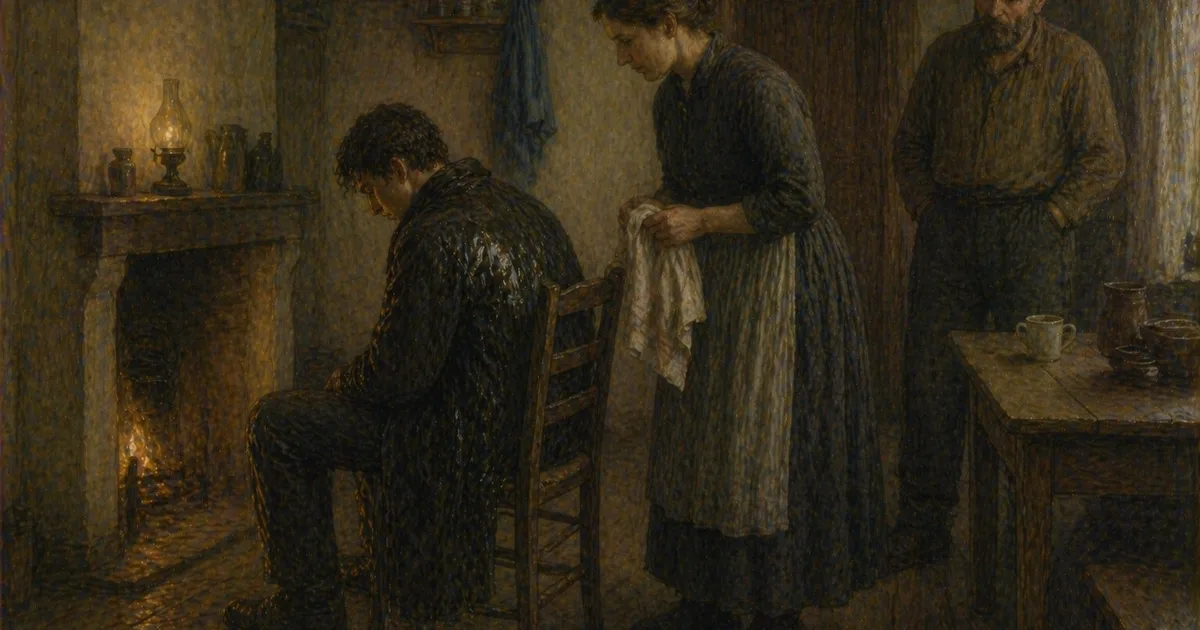
She brought them into the front room of the house. The front room had a fire at the grate and a lamp at the table and a small wooden cross at the wall above the lamp. She sat Olav on the wooden chair at the side of the fire. She sat Thomas on the wooden bench across from Olav. She went out of the front room into the back of the house.
Olav sat at the chair.
The fire was at the grate. The heat at his head was not the heat at the fire. He felt the difference. He had been at a tar-mat for ten hours the day before and had not slept since the four bells of the middle watch, and he was now at a chair at a fire in a house he did not know.
The woman came back into the front room with a man behind her.
The man was a man of about fifty in his shirtsleeves and his work-trousers, and he had grey at his beard and a lamp at his hand. The woman said to the man, low so the front room would not carry it, that Father Donovan had sent the two sailors and that one of them had the fever. The man looked at Olav. The man came up to the chair and laid the back of his hand at Olav’s forehead in the way a man of fifty with grey at his beard laid the back of his hand at the forehead of a sailor at the chair at his fire at the morning of the Saturday.
“He has it,” the man said.
“He does,” the woman said.
The man said his name was Patrick O’Brien and that the woman was his wife Mary, and that the two of them had taken in Norwegian sailors at the parish of Saint Mary’s two times before this morning and that the taking-in this morning was the third time. He said it in the slow English of an Irishman who had been at Wilmington since 1862 and whose English was the English of a man who had crossed at the famine and had been at Wilmington for fifteen years. Olav said yes. He said his name. Thomas said his.
Patrick O’Brien said the bunk at the back room would be the bunk for Olav and that Thomas would have the folding-cot at the side. He said the back room was the room of his eldest son who had gone to Charleston six months before this morning for the work at the railway and who would not be at Wilmington for some weeks. He said it without making a thing of it. Mary O’Brien said she would bring the warm water and the cloth.
The two of them brought Olav back to the bedroom at the back of the house at the second street to the south.
The bedroom was a small back room with a single bed at the wall and a folding-cot at the side and a chest of drawers at the foot of the bed and a window at the wall. The window had a small wooden cross above it. There was a folded shirt at the chest of drawers and a pair of work-shoes at the floor at the foot of the bed that had belonged to the eldest son who had gone to Charleston. Mary brought the warm water. She brought a clean cloth. She wiped the rain at Olav’s hair and the rain at his face. She unbuttoned his coat. She helped him out of the coat. She laid the coat at the chair at the side of the bed.
Olav had the things from the chest at the inside of the coat at the breast-pocket and at the side-pockets, and Mary did not look at the pockets. She folded the coat over the back of the chair and smoothed a sleeve. The things stayed at the pockets at the chair at the side of the bed.
She put him into the bed.
The bed was the bed of the eldest son who had gone to Charleston six months before this morning. The sheets were the sheets the woman of the house had washed for the eldest son before he had gone and had washed once more for guests since. The pillow and the blanket smelled of soap and stored linen. Olav lay at the bed with the heat at his head and the chill at his back from the rain. The bed held both.
Mary said she would come back at the morning.
She said it without raising her voice. She turned the lamp at the chest of drawers down to a low flame. She went out of the small back room. The door closed behind her.
Thomas sat at the folding-cot at the side of the bed.
Thomas did not say anything. He took off his coat and his boots and laid the coat at the cot beside him. He took off his knit cap. He laid the cap at the chest of drawers. He sat at the cot with his back to the wall and looked at the small wooden cross at the window.
Olav lay at the bed.
The bed was a bed in a house at a city he did not know on the morning of a Saturday in November of 1877. The fever remained at his head. Olava’s two letters were at the breast-pocket of the coat at the chair at the side of the bed. The thing wrapped in a piece of brown paper was at the side-pocket of the coat at the chair at the side of the bed. The carte-de-visite of Olava from the studio at Pedersgate was at the wallet at the other side-pocket. The bone-handled knife was at the coat-pocket. The chest at the foot of his bunk at the Dronningen was at the Dronningen at the inner wharf at the lower end of Wilmington. He had carried what he had carried out of the wharf to the upper city. He had carried it to the back room at the second street to the south. He had carried it to the bed.
He closed his eyes.
The lamp at the chest of drawers made a low light at the room. Mary O’Brien came back at the morning.