The studio at the corner of Pedersgate and Asylgata was open at half past eleven on the Saturday morning when Olav came up the stairs to the second floor. The photographer Augustsen was at the small table at the south end of the room with a small stack of envelopes in front of him and a thin paper of accounts beside the envelopes. He looked up when Olav came in. He said good day. He said the cards had come out clean from the plates and that he was satisfied with the work. He gave Olav an envelope.
Olav opened the envelope at the table and looked at the three cards inside.
The card of him alone was the card of a young man of eighteen at a chair in a Stavanger photographer’s studio with his back to a painted Italian garden and his head turned a little to the right. The man at the chair on the card looked older than Olav had thought of himself as being. He had not seen his own face at this size before, because the small mirror at the kitchen at Vestbø was not a mirror in which a man saw his own face at the size of a carte-de-visite. The card of Olava alone was the card of a young woman of eighteen at a chair with her back to the painted Italian garden and the green dress fallen the way it had fallen when she had sat down and the yellow straw hat on a small table beside her. The cabinet card of the two of them was a larger card, and on it Olav was at the chair and Olava was at the smaller chair beside him, and his right hand was at the back of her chair, and her left hand was at her lap, and the two of them were looking at the camera with the small distance between their bodies that the photographer had set when he had seated them.
Olav looked at the cabinet card for some time. Then he put the cards back in the envelope. He thanked the photographer. He went down the stairs.
He walked from Pedersgate to the corner of Bredalmendingen and up Bredalmendingen toward Rossøygate with the envelope inside the breast-pocket of his good coat. The morning was warm. The street was busier than it had been on the Friday evening because Stavanger on a Saturday at noon was a city of men coming up from the wharves and women coming back from the markets at Torvet, and Olav passed among them at the rate of a man who had a thing in his coat-pocket that he had not had on the morning before. He came up to Rossøygate at half past twelve and went past the cousin’s house once before he turned at the lower end of the street and came back. The cousin’s house was the third door from the corner. He stood at the door for a moment with his hand at the breast-pocket where the envelope was, and then he raised the knocker.
The cousin’s husband opened the door. He was a man of about fifty in a black coat with a small grey beard, and he said good day and showed Olav up the stairs to the long upstairs room with the window that looked down at the small bay between Stavanger and the islands.
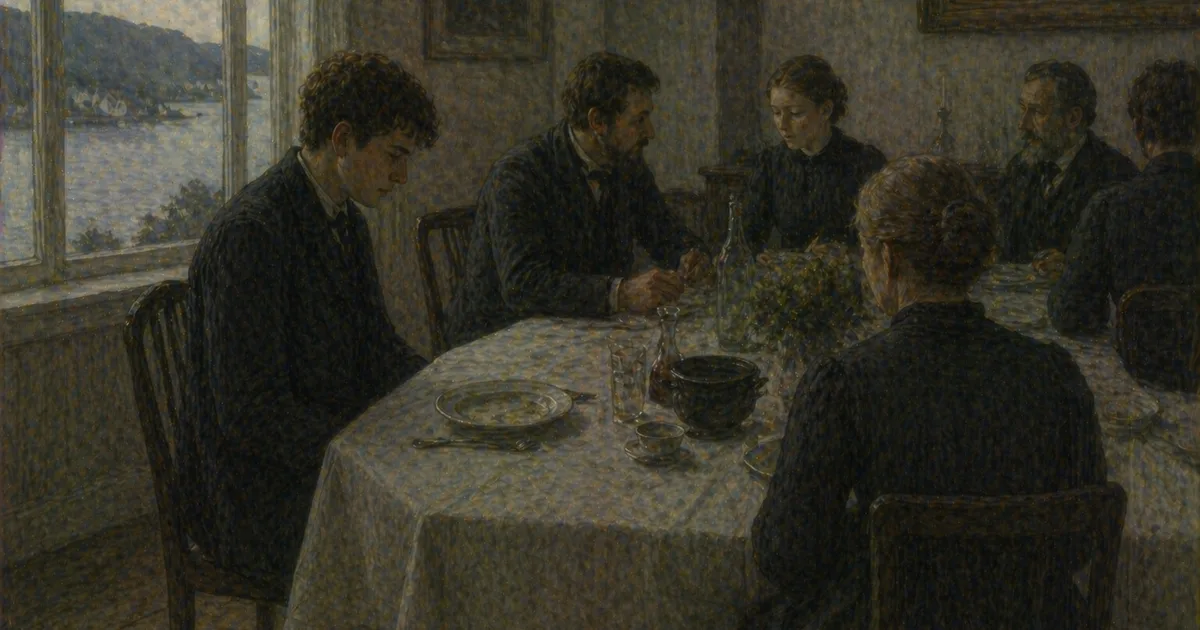
The dinner at the cousin’s house at Rossøygate on the Saturday afternoon was at a long table in the long upstairs room. Bertha Nilsdatter Rossøy was at the head of the table. Bjørn Olsen Lindøy was at the foot. The cousin was at the side. The cousin’s husband was at the other side. Bertha’s brother had come in from a neighbouring street and was at the side of the cousin. Gustav Lindøy was at the side of his father with the look of a sailor in his father’s good clothes who had not been at his father’s table for some weeks. Olava sat between Gustav and her mother. Jens Hestby came up the stairs at one with John Stensøy, who had brought him across from Vestbø on his own boat that morning, and Jens sat at the side of the cousin’s husband. Stensøy did not sit. He had a glass of port at the door and he greeted Bertha and Bjørn and the cousin and Jens at one and then he was away to his own house. Olav sat at the side of Jens.
There was rabbit, which was not common at Stavanger in July but which the cousin had got from a farmer at her husband’s connection at Sandnes the day before, and there was the herring of the spring run, and there was potatoes, and there were small green peas which Bertha had brought from her cousin at Rossøy in a small basket, and there was a pudding at the end with raspberries from the cousin’s garden in Stavanger.
Bertha said grace.
Then they ate. Gustav spoke first because Gustav had not been at his father’s table for some weeks. He said to his sister that the youngman from Vestbø had a face like a man who had not eaten well at sea, and he said to the cousin’s husband that the Asta had been a ship he had been glad not to sign onto in March because the captain of the Asta had been the captain of the Asta, and he said to his father that the small green peas were as good as the small green peas at Rossøy in 1872 which had been the best small green peas Gustav had ever eaten. He said all of this at the rate of a man who had not been at his father’s table for some weeks, and the table laughed at it. Olava did not look at Olav during Gustav. Olav did not look at Olava. Both kept their faces at their plates. Bertha at the head of the table looked at her son for a moment when he had said the thing about the youngman’s face, and Gustav set the thing down without elaborating it. The cousin’s husband asked Jens about Vestbø, and the conversation moved on.
Bertha asked Jens, after the rabbit, whether he remembered the year they had walked to the chapel at Rossøy together with Olav’s mother.
Jens said yes.
Bertha said it had been the year before her marriage. Jens said yes. Bertha said Olav’s mother had worn a yellow ribbon at her hair that day, and that Bertha had thought, walking behind her at the path, that the ribbon had been the color of the gorse at the side of the path. Jens said yes. Bertha said she had not had a yellow ribbon herself that day. Jens said no. He said his wife had worn the yellow ribbon to the chapel because the chapel had been a thing his wife had liked in a yellow ribbon. Bertha said yes.
Bertha said his wife had sung the four hymns at the chapel that day because the minister had not had a singer that summer.
Jens said yes.
Bertha said she had thought, hearing the voice from the back of the chapel where she had sat with her mother, that the voice was a Rossøy voice and not a Finnøy voice. Jens said the voice had been a Rossøy voice. Bertha said she had not thought about the singing for some years, and that hearing of the photographer at Pedersgate this afternoon had brought it back to her. Jens said he had not thought about the singing for some years either. Bertha said she had also remembered the way his wife had stood at the side of the chapel door before the service, with her hand at the door-post and her face turned to the bay, and that the standing had been a thing his wife had done at every chapel she had been at since she had been a girl. Jens said yes. He said his wife had stood at the door of Hesby church the same way for the twelve years of their marriage.
Olav at the side of his father set his fork down at the rim of his plate.
His left hand was at his lap. He did not look at Bertha at the head of the table. He did not look at his father at his side. He looked at the cloth at the table. The cloth had been laid that morning. The cousin had ironed it on the Friday. The white was the white of a fine white cloth ironed for a Saturday dinner.
He had heard her voice once.
He had been eight years old. She had been at the kitchen table at Vestbø singing a hymn while she set the bread for the morning’s baking, and he had been at the doorway, and that had been a small thing he had not thought about for nine years. He had not had any other thing of her singing. He had not known about the chapel at Rossøy or about the four hymns or about the standing at the door with the face turned to the bay. He had been born two years after the walk Bertha had walked behind his mother at, and what Bertha was setting at the table at Rossøygate this afternoon was a thing his mother had done before she had been the woman his mother had been when his mother had been his mother.
He looked at the cloth.
He did not lift his fork.
The two of them did not say more for some time. Bertha at the head of the table did not look at Jens. Jens at the side of the cousin’s husband did not look at Bertha. They both looked at their plates.
Then Bertha said, in the voice she had used to ask the first question, that the gorse at Rossøy was always the brightest gorse in the islands by a week. Jens said yes. Bertha said she had thought so as a girl and had thought so still. The cousin asked Bertha whether the gorse at her cousin’s at Rossøy was in flower yet this June. Bertha said it had been by the second week.
Olav lifted his fork.
The cousin’s husband asked Jens about Vestbø again, and the conversation moved on, and the cousin brought coffee at the end. The talk turned to the boats at the harbor and to the season’s herring and to the price of grain at the agents’ office and to the small bay below the window. Olav sat at his father’s side and did not say much because his place at the table was not yet a place for speaking. Olava sat between Gustav and Bertha and did not say much for the same reason. The two of them did not look at each other across the table because looking at each other across the table was not a thing one did at a dinner of this kind in 1876 at Rossøygate.
After the dinner Olav and Olava walked down from Rossøygate to Bredalmendingen together. Bertha had stayed at her cousin’s. Bjørn had walked back to Bredalmendingen at the front of the two of them and had gone in at the boardinghouse without waiting at the door. Jens had stayed at the cousin’s house with Bertha and the cousin and the cousin’s husband to talk for another hour before he went to John Stensøy’s for the night.
Olava did not ask Olav about the yellow ribbon as they came down Rossøygate to the corner of Bredalmendingen. She had registered, at her place between Gustav and her mother, that her mother had set down something at the table that her mother had not set down for some years, and that Olav at the side of his father had felt it at his place. She had also registered that the asking after a thing of this kind was a thing one did at home and not on the way home, and she did not ask now. She walked at Olav’s left and looked at the houses on the lower end of Rossøygate as they came down toward the corner.
Olav and Olava came down Bredalmendingen at the evening pace of a young man of eighteen and a young woman of eighteen who had had the dinner of the families in the afternoon and who had not yet said much to each other since the dinner. The light at Bredalmendingen at half past eight on a Saturday in July was the long light of the Stavanger summer. The street was not busy. The two of them came down the street to the door of the boardinghouse, and they stopped at the door.
Olav took the small envelope from his coat-pocket. The envelope had three cards in it: the card of him alone, the card of her alone, and the cabinet card of the two of them. He gave Olava the card of him alone. He kept the card of her alone. He kept the cabinet card of the two of them.
“You will keep this,” he said.
“Yes.”
“I will keep the one of you.”
“Yes.”
“The cabinet card I will give to my father when I am next at Vestbø.”
“Yes.”
She put the card in the small purse she had brought with her in the basket. She did not look at it before she put it in. She put it in and closed the purse and held the purse at her lap.
She said, “On the Wednesday evening I will be at Bethania at the seven-o’clock meeting.”
“Yes.”
“My father has agreed that I may go with my cousin from Rossøygate.”
“Yes.”
“You will be there.”
“Yes.”
“Goodnight, Olav.”
“Goodnight, Olava.”
She turned and walked back up Bredalmendingen toward Rossøygate. He stood at the door of the boardinghouse and watched her until she was at the corner of Pedersgate and Bredalmendingen, and then she was at the corner and gone, and he went in.
The small envelope with the two cards in it was at his coat-pocket.
The light in Bredalmendingen was the long light of a July evening.