The lamp at the kitchen table had gone out in the night and the bread was on the board at the side of the stove and the stove had been laid by the aunt the evening before. The aunt had crossed back over the hill at first light. Olav came down the stairs in the gray of half past four on the morning of the second day at Vestbø and stood at the foot of the stairs with his hand on the post and registered the kitchen as the kitchen he had stood in on every spring morning of his sixteenth year and his seventeenth year and on the morning he had got up to leave for the Asta in March. The chair at the foot was the chair the aunt had sat at the previous afternoon, and the chair at the side was the chair Peder had sat at, and the chair at the head was the chair his father had sat at, and the chair at the place at the table that had been Olav’s place since he was five years old was empty.
He sat down at it.
The asking after the coffee on the evening before had been short. Jens had asked. Olav had told him. He had told him about the Asta in the order in which the Asta had happened—the captain at his place at the breakfast table with the steward’s locker on his breath, Eliasson at the upper topsail, Lisbon, the tar on the deck. He had told him the customhouse last because the customhouse was the last. Jens had not interrupted. Jens had asked three questions, and Olav had answered the three questions, and at the end of the asking there was a quiet at the table that was not the quiet of a question that had not been answered but the quiet of a thing the table at Vestbø had received and was now carrying. Jens had said, Tomorrow. The aunt had cleared the cups. Peder had been at the chair at the side the whole time and had not said anything. Peder had looked at his brother for the length of time it took a sixteen-year-old to register that the brother he had said goodbye to in March was not the brother who had come back in May. Then Peder had gone to bed without saying anything.
The next day Olav went out with Peder to the byre. The byre had been cleaned in March before he had left for Stavanger and had not been cleaned since, and Olav and Peder cleaned it on the second morning of his being at Vestbø, and on the third morning they went down to the landing and got the shore boat out of the boathouse and into the water, because the sea-trout were running in the bay in the second week of May, and Jens, who was at the door of the boathouse with his hand on the post in the way a man stands at the door of a boathouse when his knee is not the knee for the boat that morning, said his son and his other son were to take the boat and to bring the trout.
They took the boat.
They were on the bay until noon and they came back with eleven sea-trout and a ling, and Peder cleaned the trout at the stone at the side of the boathouse, and Olav cleaned the ling, and the two of them did not say much because they were brothers and brothers cleaning fish at the boathouse-stone do not need to say much. The hands knew the cleaning. The shoulders knew the rowing. The eyes knew the bay. The return to the work of the place came faster than Olav had thought it would.
In the third week of May the haying-meadow above the upper field was inspected by Jens and by Olav together. Jens walked the meadow with his stick. He stopped at the place where the grass was thinnest and he stood at the place for some time, and he said to Olav that the grass was thinner than he had liked it to be and that the haying would be the last week of June or the first week of July depending on the weather, and Olav said the haying would be the last week of June or the first week of July depending on the weather. They walked back to the house in the order in which a father walks back to a house with the son who has come home from a voyage on which the son has been a thing the father had warned him he would be—though Jens did not say this and Olav did not say this and neither of them needed to.
Later that week the aunt came across the hill at noon with a basket of new-baked bread for the household, and she stayed at Vestbø for the afternoon and the evening because Jens had asked her to stay. The four of them ate at the table—Jens at the head, Olav at the place that had been his since he was five years old, Peder at the side, the aunt at the foot. The aunt did not ask Olav about the Asta. She had asked Jens about it on the morning after the homecoming, and Jens had told her, and what she now needed to know about the Asta she now knew. She asked Peder about the spring lessons at the parish-school. She asked Olav whether he would want a cap for the summer. Olav said he had a cap. The aunt said she would make him one anyway.
In the fourth week of May Jens and Olav and Peder cut peat at the bog above the upper field. The bog was the bog Jens’s grandfather had cut, and his father had cut after him, and Jens had cut for fifty years. It was work for two men and a boy at the cutting-spades and the barrow, on three days of cool weather in the last week of May. Jens cut at the rate his knee allowed him to cut. Olav cut as a young man cuts who has been pulling on rope and standing watches for two months and whose shoulders are good for the spade. Peder barrowed. The peats came up. They were stacked in the herringbone stacks the people of Finnøy had stacked peats in for as long as people on Finnøy had cut peat, and at the end of the third day of cutting the bog had given them a winter’s worth of fuel, and the three of them walked down to the house in the order they had walked up, and Jens at the table that night ate the supper of a man who had cut three days of peat against his knee.
That night, after the lamp had gone out, Peder said, from the bed at the other side of the loft, that the boy who had been on Olav’s last voyage and whom the captain had beaten on the half-deck had been called Nils. Olav said yes. Peder said the boy was at home now in Hogganvik. Olav said that was so. Peder said the boy had a mother and a father and the father had a boat. Olav answered him. There was a quiet for the length of time it took a sixteen-year-old in a bed in the loft at Vestbø to register the thing he had been thinking for several nights and to put it down. Then Peder said goodnight. Olav said goodnight. The wind moved at the window. They slept.
In the last week of May Olav went to Judaberg with Peder for the post and to settle with Lars’s wife for the boat-crossing she had taken him across in on the day he had come home. He paid Lars’s wife half a crown for the crossing. She said it was too much. He said it was the crossing fee. She said the crossing fee was a third of a crown. He said the crossing fee on the Asta in March had been half a crown and that Lars had taken him across the way Lars’s father had taken Jens across in the year of his confirmation, and that Lars’s wife was to take it. She took it. Peder, who had watched the whole exchange, said, on the path back to the boat, that Olav had paid more than the going rate. Olav said he had paid the right rate. Peder did not say more.
The chest was at the foot of his bed at Vestbø where Jens had put it on the afternoon of the homecoming, and Olav had not opened the chest in the first week and a half. He opened it on a Tuesday morning in the last week of May. The lid came up the way the lid had come up in October when he had come home from the Sigrid and in March when he had packed for the Asta. The smell at the inside of the lid was the smell of the wool the aunt had packed at the bottom in 1875 and the smell of pitch and tar and salt-stiffened canvas that the chest had taken on at sea and that no airing at Vestbø had got out of the wood. He took out the oilskin Tønnesen had worn until January and that Olav had worn from March to May. He laid it on the floor at the side of the chest. He took out the wool shirts and the cap and the second pair of trousers and the leather roll his father had given him on the morning of the Sigrid. He laid them on the floor in the order in which they had been at the top of the chest. Under them at the bottom of the chest was the spare blanket the aunt had folded into the chest at the beginning of the year before, and at the side of the spare blanket was a thing wrapped in a piece of brown paper.
He had wrapped it himself in the watch on the homeward run. He had wrapped it on a Sunday night in the foretop watch when no one was at the foretop with him. Haakon had been at the after watch that night. He did not unwrap it. He put it back at the side of the spare blanket. He put the trousers and the wool shirts and the cap and the leather roll on top of the spare blanket and the wrapped thing. He put the oilskin on top of the trousers and the wool shirts and the cap and the leather roll. He closed the lid.
The lid closed.
On the first Sunday of June he walked the road to Hesby with his father and his brother. The road was the road he had walked in October and in January and in March. The fields at the side of the road were not the fields they had been in January. The hawthorn at the gate at the lower end of the road was in flower. The grass in the verge was the grass of late May going into June. He walked between his father and Peder. He did not walk in front of his father and he did not walk behind. He walked at the pace his father walked, which was slower than the pace of a man with two good knees but which was the pace Jens had walked the road since 1856.
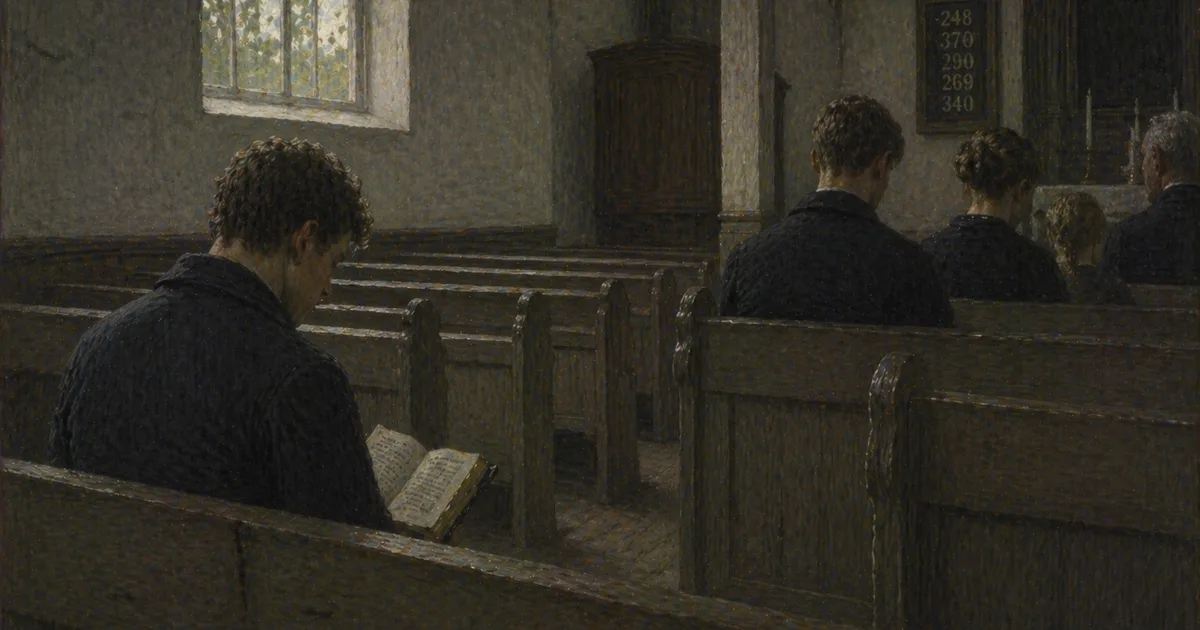
The minister Lindbergen was at the pulpit in the same black coat. His spectacles had slipped the same small distance down his nose. His text was not a January text and was not a Sunday-before-Easter text. His text was consider the lilies of the field from the sixth chapter of Matthew, and he preached on it in his slow careful voice, and the small window above the pulpit gave a light that was not the winter light and was not the slanted spring light, but the light that came into a Norwegian church on the first Sunday of June, which was a light like the inside of a clean shell.
Olav sat between his father and Peder. He sang the hymns he had known since his confirmation.
In the pew across the aisle Karsten Tjørn was sitting with his mother.
Karsten was wearing a coat that was not the dark coat Olav had seen in March on the Sunday before Easter and was not the heavier coat Olav had seen in January. It was a coat of the kind a young man wore in June at Finnøy. His hair had grown to the place at the back of the neck where it had been in January, and a little past it. The light from the small window came down at the angle the June light came down, and it fell on the back of his neck where the hair came over the collar and on the shoulder of the coat and on the hand at the hymnal and on the page at the place where his thumb held the book open.
Olav looked at his own page.
He found his place.
He kept his place. Through the next hymn and the next and through the singing of the long psalm he kept his place at his own page, and he knew without looking that Karsten was at the pew across the aisle and that Karsten was at the place where Karsten had been at the pew in January and in March and now in June, and the not-looking was a thing he was doing on purpose at the rate of a man who had come back from seven weeks at sea on a ship under a captain who had taught him several things. One of the things the captain had taught him by accident was that some kinds of attention a man could decide to put down.
Another of the things was that some kinds of attention a man could not.
He kept the place.
After the service the three of them went out with the rest. His father stopped in the yard to speak to Knut Tjørn about a fence Knut had said something about in January that Jens had not gone to look at until April and that was now wanting a discussion before the summer brought the cattle back to the upper ground. Olav stood apart with Peder. Karsten passed them on the path with his mother on his arm. He did not nod. He did not look at Olav. He went on. His mother, who had been Knut Tjørn’s wife for thirty years and had been the mother of two sons and had sat in the same pew across the aisle from the Hestby family at Hesby church for thirty Sundays a year for three decades, looked at Olav as she passed. The look was a short look. It was a look of the kind a woman could give a young man in passing in the gate of a churchyard on the first Sunday of June, and the look was not unkind. She and her son went on through the gate. Peder, who had been watching the road and not the gate, did not see the look or the not-nodding.
Jens and Knut Tjørn finished their conversation about the fence.
The three of them walked home.
In the second week of June Bjørn the postman brought a letter to Vestbø from Landa, which was a letter from the family that held the gaard at Landa on the south end of Finnøy and that was a family Jens knew in the way Jens knew the families of the south end of the island, which was the way of a man who had been at the church at Hesby for fifty years and who had married a woman from one of the south-end farms. The letter was an invitation. The family at Landa would hold a Sunday gathering on the third Sunday of June after the church service, with the young people of three islands invited, because the daughter of the family had a cousin from Lindøy at Landa for the weeks before the haying.
Jens read the letter at the kitchen table at the noon meal. He gave it to Olav. Olav read it. He gave it back to his father. His father gave it to Peder. Peder read it.
“You will go,” Jens said.
“Yes.”
“Both of you.”
“Yes.”
Jens folded the letter. He put it on the shelf above the table where the aunt kept the letters that were not yet answered and that were not yet thrown out. The shelf had three letters on it now—one from a man at Stavanger who owed Jens four crowns from a hay sale in 1874, one from Jens’s sister who lived across the hill and who had put a letter on the shelf at Christmas to make her brother smile when he picked it up, and now the one from Landa.
Peder, at his chair at the side of the table, asked his brother who would be at the Landa Sunday.
Olav said he did not know.
“Anyone we know?”
“I don’t know.”
Peder, who had been watching his brother the whole month and who had been learning the new brother in the way a younger brother learns a brother who has come back from seven weeks at sea, did not ask another question. He went to the door and put on his cap and went out. Olav sat at the table and looked at the cloth at the place that had been his place since he was five years old.
In the field above the upper meadow the grass was the grass of the second week of June.
The Sunday after next was the third Sunday of June.