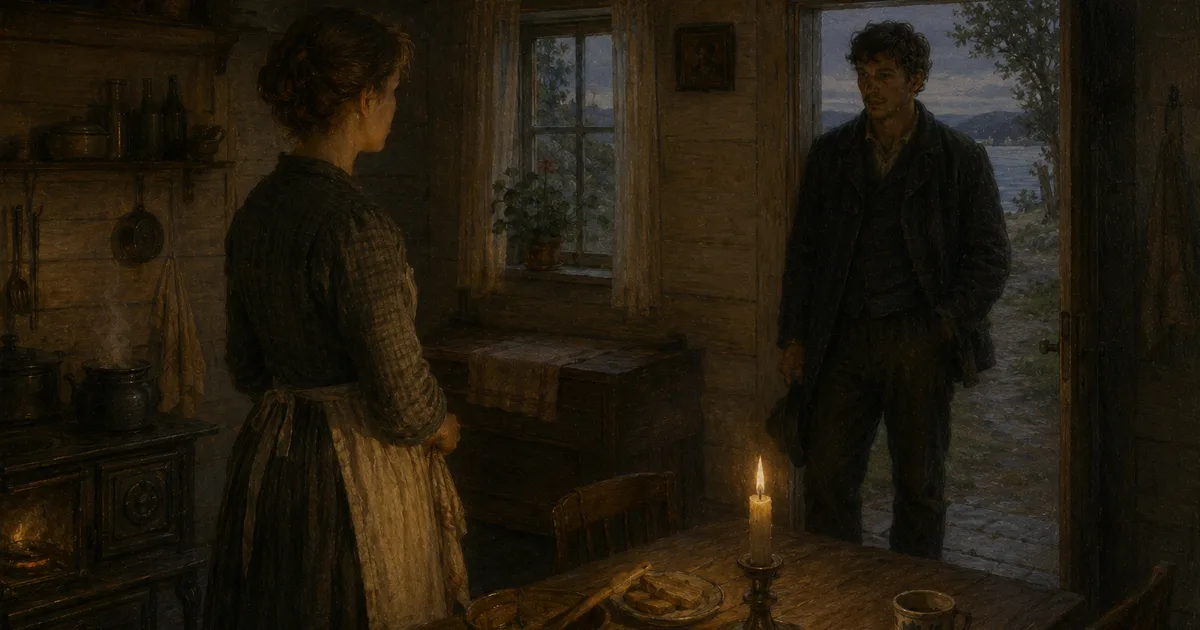
The morning of the fourth of September came at the kitchen at Lindøy at the half past six.
Olava had been at the kitchen since the quarter past six. She had brought down the wood from the upper end of the woodshed and set it at the firebox, and she had set the kettle at the stove, the way she set the kitchen at the mornings; and the window at the side of the stove showed the morning of an early September—the slopes at the green that the late summer kept at them, the strait at the blue of a strait in the first part of September, the light at the window come later than it had come at the August and earlier than it would come at the October.
She set the loaf at the table at the quarter to seven.
She set the butter at the small dish and the milk at the pitcher. She set the four cups at the four places for her father and her mother and Gustav and herself. The four places were the morning places at the kitchen at Lindøy at the September, the way they had been the morning places at the August and would be the morning places at the October.
Bjørn was at the head of the table at the breakfast.
The winter cough had been at him at the January, and had eased at the February, and had gone off at the spring the way the winter cough went off at the spring; and Bjørn had been at the summer-work of a man of his years through the summer, and at the September he was at the breakfast at the head of the table and was well. He said the upper field would be ready for the autumn-haying at the end of the second week of the September. Olava said yes.
Gustav came in from the byre with the milk-pail. He set the pail at the cool corner and sat at his place and ate the bread and drank the coffee and did not say much, and went back to the byre, the way Gustav was at the morning kitchen.
The household at Lindøy was at the September.
The lambing was long past. The summer-fishing was past. The autumn-haying at the upper field was not yet. The household was at the rhythm of the early September, between the things of the summer that were finished and the things of the autumn that had not begun, and Olava set the kitchen and did the morning’s work at that rhythm.
The household at Lindøy had had a word about Olav at the August.
It had come from Stavanger, from Karoline at Rossøygate, the way a word came—from a hand to a hand to the steamer to Lindøy. The word had been that the Brio, the ship Olav had hired onto in the June, had been at Vardøy at the top of the country; and that Olav had been discharged sick at Vardøy; and that he had gone south from Vardøy on a Bergen steamer. The word had been that much, and not more. It had not said how sick. It had not said where south the steamer had been bound, or whether it had got him south, or how the body of him was at the place south it had got him to. The word had come to Lindøy at the middle of the August, and it had been at the household since—at the kitchen, at the table, at the little that was said of it—and Olava had carried it through the rest of the August and into the September.
She had read the word the way she read a word.
Discharged sick at Vardøy. A man was not put off a ship at the top of the country for a small sickness. A man worked a ship through a small sickness, the way the men of the islands worked through the things the body had; and a man who had been discharged sick off a ship was a man whose sickness had been the kind a ship would not carry. Olava had had the shape of the thing at her knowing since the March. She had carried the watching of it through the spring and the summer, at the not-saying-of-it to Bertha and the not-asking-of-it of Olav; and the word of the August had come to the watching as the kind of word the watching had been at the slow approach of. She had read it, and had not said what she read at it, and had carried it.
The fourth of September was a day of the household-work.
Olava was at the household-work of the day the way she was at the household-work of a day. She set the kitchen, and she was at the wash, and she was at the September things of the household; and the waiting was at the work the way the waiting had been at the work through the August. She did not stand at the window of the kitchen and look at the strait for a boat. A woman who had been at the watching for the years of the voyages had learned that the standing-at-the-window did not bring a boat to the strait, and that the work brought the day on toward the evening as well as the standing-at-the-window brought it, and better; and Olava was at the work, and the day went on at the work, and the strait at the window had the boats of the strait at it and not the boat.
Olav came to the kitchen door at Lindøy at the dusk.
Olava was at the kitchen at the dusk. The supper-things were at the stove. The candle was lit at the table, the evening candle, because the dusk had come into the kitchen and the light of the window had gone to the dusk-light; and Olava was at the kitchen at the candle when the kitchen door opened, and it was Olav at the door.
Olava looked at Olav at the door.
She had been at the watching of the body of him for the years of the voyages and the school and the strait, and the watching was a thing her eyes did at the moment of the seeing of him, before she had told them to do it. She looked at him at the door at the candlelight.
The color was at his face.
She read the color first, because the color of his face was the thing the watching had been most at since the March—the color that had gone from his face at the borrowed-boat winter, the color a cough took from a face. The color was at his face at the door at the candlelight. It was the color of a face the sea-air and the work and the getting-well had put the color back at.
She listened for the cough.
She listened for it the way she had listened for it at every evening he had crossed the strait since the borrowed-boat winter, and she did not hear it. He stood at the door; he had come up the path from the boathouse; and a man who had come up a path with the cough at his chest came up it at the breathing the cough gave him. There was no cough at the breathing of the man at the door. She listened, and the cough was not there.
He was healed.
That was the first of the reading. The word of the August had been discharged sick at Vardøy, and the man at the kitchen door at the dusk of the fourth of September was a man the sickness had gone from—healed, the color at his face, no cough at his breathing, the body of him at the door the body of a well man. Olava read it, and it was the thing she had carried the watching toward without letting the watching call itself a watching, and the reading of it at the door went through the whole of her.
He was home.
That was the second of the reading. He had been at the Brio and at Vardøy and at the steamer and at the place south the steamer had carried him, and he was at the kitchen door at Lindøy now, home, the voyage of him done; and Olava read that he was home.
And then she read the third thing.
She read it the way she had read the color and the cough, with the eyes that did the watching before she told them to. The man at the door was healed, and the man at the door was home; and the man at the door was at a waiting still. Olava read the waiting at him. It was not the waiting of a man waiting to be well, because the man was well. It was not the waiting of a man waiting for a voyage to be over, because the voyage was over and the man was at her kitchen door. It was a waiting she had no account at her hand for, at the door, at the candlelight, at the first looking; and she read that it was at him, and she did not have the account of it, and she held the reading where it was and crossed the kitchen to him.
Bertha came into the kitchen at the sound of the door.
Bertha saw Olav at the door, and Bertha saw, the way Bertha saw a thing, that the man at the door was a well man; and she set her hand at his arm at the candlelight for the length of a breath, the way she had set her hand at his shoulder at the kitchen at the May, and she said the supper would stretch to another plate, and she went to the stove for the stretching of it. That was the whole of what Bertha said at the door, and it was said.
The supper at the kitchen at Lindøy was Olav at the table.
Bjørn came to the table from the parlor. Gustav came in from the byre. The household at Lindøy was at the supper at the kitchen at the evening of the fourth of September, with Olav at the table at a place set for him at the side of Olava; and the supper was the household’s, and Olav was at it.
Olav told the household where he had been.
He told it at the supper the way a man told a voyage at a table—the Brio, and the salt-cargo, and the run north up the coast, and Vardøy at the top of the country at the gray of it; and the Bergen steamer, the Thalia, and Captain Sars who had taken him on to work a passage south; and the inside coast, and Bergen, and the work at the Bergen wharf. He said he had been unwell at the Brio and at Vardøy, and was well now. He said it in that size—I was unwell; I am well now—and he did not say the doctor at Vardøy, or the word the doctor at Vardøy had said, or the gray, or the thing the cough had been at his chest at the months of it.
Olava heard him say it in that size.
She had the watching’s knowing of the thing at her hand—the shape of it she had carried since the March, the cough she had listened for at every crossing—and she heard Olav give the kitchen the thing in the four words of it, I was unwell; I am well now, and she heard that the four-word size of the telling was a size, and that the size was a thing he had chosen, and that a man who gave a table the four-word size of a thing was a man who had the rest of the thing and was keeping it. She did not press him at the table for the rest of it. The not-pressing was the form her care had taken at a kitchen before, and it was the form it took at the supper of the fourth of September.
Olav said he had earned well at the Bergen wharf.
The work at the Bergen wharf had been the work of the four-and-twenty-hour shifts at the unloading and the loading, and the work had paid well; and Olav said he had two hundred kroner of it. He had the two hundred kroner at the leather purse at the inside pocket of the coat, and the coat was at the chair at the wall of the kitchen, the way a man’s coat was at a chair at a kitchen at a supper. Bjørn said two hundred kroner was a good sum for a summer’s wage. Olav said it was. He said the Thalia was to go on from Bergen to the Mediterranean, and that he had wanted to go on with her, and that the place had been filled before he asked for it; and so he had taken the coast-steamer to Stavanger, and had crossed to Lindøy at the afternoon.
Olava heard that too.
She heard that the man who was healed and home had wanted, at Bergen, to go on with the steamer to the Mediterranean, and had been kept from the going-on only by the place being filled. She set it at the day’s account with the other things of the day. She did not say anything at it.
Olav did not ask Olava for the date.
He had the navigator’s certificate at the chest at the back room at Vestbø. He had two hundred kroner at the purse at the coat at the chair. He was healed of the thing that had been at his chest. The three of those were the things the marriage had waited at—the certificate, and the means, and the body that could promise a household the years a household wanted of it—and the man at the supper-table at Lindøy at the side of Olava had the certificate, and had the two hundred kroner of a summer’s good wage, and had the healed body; and he did not ask Olava for the date.
Olava did not ask him why he did not ask.
She knew the account a household would give of the not-asking, which was that a man did not promise a household on the wage of a single summer, and that two hundred kroner were the beginning of the means of a household and not the whole of them, and that there would be the autumn’s voyage and the voyages after it before the means were the means. The account was a true account. Olava did not ask Olav why he did not ask for the date, the way she had not asked him the other things; and she set the not-asking at the day’s account with the rest of the day, to look at later, at the candle, at the end of the evening.
The household at Lindøy was at the evening after the supper.
Bjørn read the evening’s chapter at the kitchen at the candle, the way the household at Lindøy was at the evening’s reading, and the household was at the reading—Bjørn and Bertha and Gustav and Olava, and Olav at the chair at the side of Olava. The candle was at the table, and the dusk had gone to the dark at the window, and the strait at the window was the dark strait of a September night. Olav was at the reading. He was at the chair at the side of Olava at the kitchen at Lindøy, home, healed, at the household’s evening worship at the candle; and he was at the waiting still, and Olava, at the chair at the side of him, read that he was.
Olava went up to the upper room at the end of the evening.
The room was the room she had had since the eighth year of her life. The chest of drawers was at the inner wall, and the carte-de-visite of Olav was at the upper end of it, propped at the lamp, the way it had been since the photograph had come. The candle of the upper window was at the sill. Olava lit the candle at the sill. She was at the end of the day at the upper room at the candle, at the worship a person was at alone at the end of a day, and the strait was at the window at the dark.
She set the day at its account.
She set it the way she set a day at its account at the end of a day. Olav had come to the kitchen door at the dusk. She had read him at the door. He was healed—the thing the word of the August had not said, the thing she had carried the watching toward, was read and was true. He was home—the voyage of him done, the man at the kitchen and not at the sea. He had been at the side of her at the supper, and the certificate was got, and the two hundred kroner were at the coat at the chair, and the autumn would bring the voyage and the voyages after would bring the means, and at the end of the means there would be the marriage. All of that was at the account, and the account was a good one, and Olava set it at the candle and looked at it.
And the third thing was at the account too, the thing she had read at him at the door, and the third thing did not come right with the rest.
She thought it at the candle, at the upper room, at the end of the evening of the fourth of September.
He is healed and home and waiting and I don’t know why it isn’t enough for him yet.
She had read the thing at him before. She had read it at the June of 1876, at a ravine on Finnøy, when she had asked him the question and he had said the yes—and the yes had been true, she had not doubted the yes at the three years since, she did not doubt it at the candle now; and at the yes there had been a thing at the man the yes had come from that the yes had not reached. Olava had read the thing at the ravine and had not had the word for it, and had carried it. She had carried it for the three years. She had read it again at the man at the kitchen door at the dusk, healed and home, and the healed and the home had not reached it either.
She did not have the word for the thing.
She set the day’s account at the candle, and the account had in it the thing she did not have the word for, the way the account had had it since the ravine in 1876; and Olava did not turn the thing into words that were not hers to have. She let it be at the account unworded, the way she had carried the watching all the years without calling it a watching. The candle was at the sill. The strait was at the window at the dark of the September night. Olav was at the household below, home and healed, and would cross to Vestbø at the morning tide, and would be at the autumn’s voyage after that, and would come back from the autumn’s voyage the way he had come back from the voyages before it; and Olava would be at the kitchen at Lindøy, and at the watching, and at the not-asking, and at the carrying of the thing she did not have the word for.
She blew out the candle.