The Thalia sailed from Vardøy at the morning.
She went out of the gray harbor at the morning tide and turned south, down the inside coast, for Bergen. The gray harbor of Vardøy fell astern of her as she ran, and the gray racks and the gray fort fell astern, and the Thalia stood south. The inside coast was the route a steamer took down the country in the sheltered water inside the islands and the skerries, and not outside in the open sea; and the Thalia would be seven days at the run from Vardøy to Bergen. Olav was the Thalia’s hand for the seven days, working the passage at the deck-work the Thalia gave him.
The cough was at his chest at the deck of the Thalia at the first morning.
It came up at his chest at the first morning of the inside coast the way it had come up at the white inside of the Thalia the night before, and Olav was at the deck-work with the cough at his chest. The Thalia ran south. She came that day to Hammerfest, which the men of the Thalia said was the northernmost town of the world, and she did not lie long at Hammerfest, and she ran on south down the inside water.
Hammerfest was a town of the far north. It was a town of the north the way Vardøy had been a town of the north—the timber houses set at the rock, the fish-racks, the boats of the northern fishing at the harbor—but it was not out past the North Cape the way Vardøy was, and it was a town the inside coast began to run south from. The Thalia lay at it the short while a steamer lay at a port she had no great business at, and ran on. The far north was astern of her now, and the inside coast was ahead of her.
The Thalia came to Tromsøy at the second day.
She came in to Tromsøy and lay a part of the day, and ran on. The cough was at Olav’s chest at the second day at the deck-work—lighter, perhaps, than it had been at the gray of Vardøy, the way a cough was lighter when a man was out of the cold and the wet that had worked at it; and Olav did not make much of the lighter, because the cough had been lighter before. It had been lighter at the May, and it had come back at Vignesholmene. A man who had had a cough lighten and come back did not make much of the cough being lighter at a deck on a second day, and Olav did the deck-work of the Thalia and let the cough be.
The Thalia came to the Rystrømmen strait.
The Rystrømmen was a strait where the current ran hard, and the current of it ran at the speed of seven miles in the hour; and the Thalia at her steam made the speed of seven miles in the hour. At the place in the strait where the current ran hardest against her the Thalia held her seven miles against the seven miles of the current and did not move. She stood in the strait. The water ran past her hull at seven miles in the hour, and the Thalia held against it at seven miles in the hour, and the two speeds came to the one speed; and the Thalia was a steamer holding still in a running strait. Olav stood at the deck and watched the water run past the held ship. Then the current eased at the turn of it, and the Thalia came on through the strait, and ran south.
The Rystrømmen was a thing of the inside coast the men of the Thalia knew and a man new to the run did not. The crew had run the strait before, at the run north or the run south, and they knew the hour the tide gave a ship the strait and the hour it did not; and Captain Sars had brought the Thalia to the Rystrømmen at the hour the tide would turn, so that the holding-still in the running water, the seven miles against the seven miles, was the short while of the turn and no more, and then the strait let the ship through. Olav had not run the Rystrømmen before. He stood at the deck and watched the strait, and the Thalia came through it at the hour her captain had brought her to it for.
The slopes of the inside coast were green.
Olav had been at the gray of Vardøy—the gray sky and the gray rocks and the gray water and the gray faces of the wharf and the gray stockfish on the racks—for the weeks of the Brio and the discharge. The inside coast south of the Rystrømmen ran between the slopes of the islands and the slopes of the mainland, and the slopes were green; they were green with the green of a Norwegian summer at the latitudes south of the gray. Olav stood at the deck of the Thalia at the mornings—off Senja, and in the water off Harstad, and at the crossing of the Vestfjord where the wall of the Lofoten islands stood off to the west in the long line of it—and the slopes came up green at the two sides of the inside passage, and the body of him at the deck looked at the green of them.
The green of the inside coast was the green of the Norwegian summer—the green of the grass at the slopes, and the green of the leaf at the birch, and the green of the farmed ground at the farms. Olav had been at the green of the islands of his own coast all the summers of his life until the summers of the ships, and he had been at the green of Vignesholmene at the June past; and the green of the inside coast at the run south was that green. It was not a green a man at a deck remarked on to the man at the deck beside him. It was the green the country had at the summer, the green the slopes were, and the Thalia ran south between the slopes of it, and Olav at the deck-work looked at the green at the two sides the way the eye looked at the country a ship ran through.
The Thalia ran south down the inside coast, and the country went by at the two sides of her.
She came to Bodøy and ran on. She passed Torghatten, which was an island with a hole bored clean through the rock of it—a hole a man at the deck of a passing ship could see the daylight of the far side at—and the men of the Thalia looked at the hole through Torghatten as the Thalia went by, and Olav looked at it, and the Thalia ran on south. The work the Thalia gave Olav was the work of her decks at the days of the run, and the body of Olav did the work, and the days of the run went by at the green country.
The inside coast was a sheltered way. The Brio had carried Olav north up the coast at the outside water, at the open sea, where a ship took the weather the open sea had; and the Thalia carried him south at the inside water, in the lee of the islands and the skerries, where the sea did not reach the way it reached outside. The steamer threaded the sounds. She ran the narrow water between an island and the mainland, the green slopes standing up close at the two sides of her, near enough that a man at the deck saw the farms at the slopes and the people at the farms and the cattle at the green; and then the water widened, and the slopes stood off, and the steamer ran the wider water until the next narrows. It was a way of running a coast that the sailing-barks did not run—a bark wanted the sea-room the outside passage gave her—and Olav, who had been at the outside passages of the barks, was at the inside passage of the steamer and watched the country of it go by close at the two sides.
The Thalia lay at Folda for a weather-delay.
The weather came up at Folda. Folda was an open stretch of the route, a place the inside passage gave onto a piece of less-sheltered water, and the weather that came up at it was a weather a steamer waited out rather than ran into; and the Thalia lay at the shelter of the land at Folda and waited. She lay at the shelter for the part of a day. The crew of the Thalia at the weather-delay were at the things a crew was at when a ship lay weather-bound—the work that could be done at a ship lying-to, and the off-watch, and the bench—and Olav was at the deck-work the delay gave and at the bench at the off-watch of it. The weather went off by the evening, the way a summer weather of the coast went off, and the Thalia ran on south from Folda. The weather-delay at Folda was the one delay of the seven days.
The evenings of the inside coast were the evenings at the bench.
At the off-watch evenings of the run south the crew of the Thalia were at the bench, and the older man was at the bench with the Bible, and he read it in the low voice at the evenings the way he had read it at the first evening at Vardøy. Olav was at the bench at the evenings and heard the reading. At one of the evenings a crewman of the Thalia told the thing the Thalia had been at in the years of her—that she had been at the Black Sea once, a long time before, and had run foul of the private yacht of the Russian Emperor and sent the yacht to the bottom, and had been held at Odessa under the chains and the locks until a maritime court cleared her crew of the blame of it. The crewman told it at the bench, and the men at the bench heard it. Captain Sars had been the master of the Thalia at the years she was at the Black Sea and the chains at Odessa, and he did not say anything at the telling of it; he let the crewman tell it. Olav heard the telling and looked at Captain Sars, who had been the master of a ship under the chains at a foreign port and had brought his ship and his crew out from under them, and was the master of the Thalia now at the run down the inside coast; and the work Captain Sars gave Olav across the days was the work a man’s body could do, and Olav did it.
The crew of the Thalia at the bench were the crew at the off-watch of a steamer running an easy coast in a summer—the inside passage was an easy run, the weather of it the one weather at Folda and no more—and the evenings at the bench were easy evenings, the older man at the Bible and the crew about him at the off-watch quiet. Olav was at the bench at the evenings. He heard the older man read, and he heard the talk of the crew that was the easy talk of an easy run, and the evenings of the inside coast went by at the bench the way the days went by at the deck.
The Thalia ran on south. She ran through the narrow sound past Kristiansund—a sound so narrow that the town stood close at the two sides of the steamer’s way through it, the houses of it at the water and the people of it at the wharves—and Olav at the deck saw Kristiansund go by close the way the narrows of the inside coast went by close. She came to Molde and lay at it and ran on. She came to Aalesund, the town at the islands at the mouth of the fjord-country, and ran on south. The country at the two sides of her was the green country of the summer—the slopes green, the farms at the slopes, the mountains standing up behind the green—and the days of the run went by at the country, the sixth day of the run and toward the seventh.
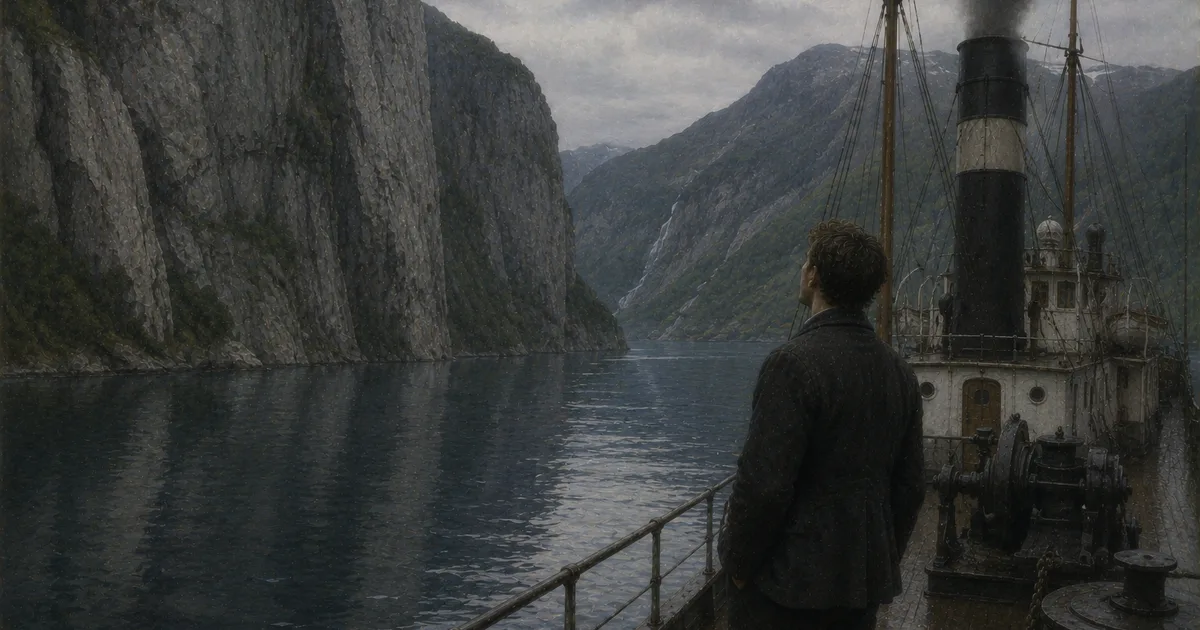
It was at Nordfjord that the Thalia sounded the steam-siren.
The Nordfjord was a fjord of the steep mountain walls, where the rock stood up sheer at the two sides of the water, and the Thalia ran in at the narrow part of it; and at the narrow water Captain Sars had the steam-siren sounded. The siren sounded. The sound of the one blast went out at the narrow water and struck the mountain wall at the one side and came back, and struck the wall at the other side and came back; and the one blast of the siren went up and down the Nordfjord between the walls and came back and came back. Olav stood at the deck of the Thalia at the Nordfjord and heard the siren-blast go out and the echoes of it come back off the rock—the one sound made into the many sounds by the walls of the fjord. The Thalia ran on through the Nordfjord, and the echoes died at the rock behind her.
The Nordfjord was the deepest the mountains of the run came down to the water. The walls of the rock stood up sheer from the fjord, higher than a ship’s masts, higher than a man at the deck could well see the tops of without the head going back; and the Thalia ran in at the narrow water at the foot of the walls, a steamer small at the foot of the rock the way a ship was small at a thing of the country bigger than ships. The mountain walls of the Nordfjord were a thing of the country the way Torghatten had been and the green slopes were; and the steam-siren’s blast going up and down between the walls had been the Thalia’s sound set against the country’s rock. Then the fjord opened, and the Thalia ran out of the Nordfjord, and the mountains stood off again.
The Thalia came to Bergen at the evening of the seventh day.
She came in at the late evening of the seventh day of the run from Vardøy, and Bergen was a city at the green slopes and the water and the long blue light of an August evening; and the Thalia came to her berth at the Bergen wharf, and the run down the inside coast was done.
He had been at the ports of the world—the foreign ports and the Norwegian ports the ships and the steamers had carried him to—and he had not been at Bergen, which was a city of his own country and the biggest city of the western coast. The inside coast that had begun at the gray harbor of Vardøy ended here, at the wharf of a city set under green slopes, and Olav came in to Bergen at the deck of the Thalia.
Olav was at the deck at the coming-in. He was at the work of the coming-alongside—the lines and the fenders and the made-fast—and he was at the deck after, at the preparations for the unloading that would begin at the morning; and he had not coughed at the deck-work of the coming-in to Bergen, and he had not coughed at the unloading-preparations. The body of Olav stood at the deck of the Thalia at the Bergen wharf at the long blue light of the August evening, and the green slopes of Bergen stood up behind the city, and the Thalia was at her berth.