The wind backed to the south at the change of the four bells of the first watch.
The bank of cloud that had stood at the west at the second dog-watch of the Day Four had come on through the first watch and was overhead at the change. The wind that had been at the south-southwest at fourteen knots at the second dog-watch was at the south at sixteen knots at the four bells of the first watch and at twenty-four knots at the change of the middle watch. The captain came forward at the eight bells of the first watch and said to the boatswain that the watch below should not lie down and that the second pump should be brought to its place at the bilge-pump-hatch. The boatswain said yes. He went forward to the foremast pin-rail and called the watch below up.
The pumps were both at their places at the four bells of the middle watch.
The captain had ordered the spanker down at the four bells of the first watch and the topsails close-reefed at the eight bells. The boatswain went aloft with Olav and the Stavanger carpenter at the topsail yards in the dark and made the close-reef at the wind that had come to twenty-four knots and was coming to thirty. They came down at the change of the middle watch. The foresail had come down at the second dog-watch at the captain’s order, when the cloud at the west had begun to take the slate.
The Drammen-born young hand was at the wheel at the change of the four bells. The Stavanger carpenter, who had a home at Hamburg with a wife and two daughters, came down from the topsail yards and went to the cat-falls to make ready the spare clew-lines for what the second dog-watch had not finished. The Hamar man stood at the foremast pin-rail without speaking. Olav was at the bars of the first pump. Thomas was at the other bar. The boatswain went aft to the wheel-box and the captain came to the bilge-pump-hatch and stood at the side of the first pump for a minute. He looked at the bars. He looked at the rod. He went aft.
The first gale came down at the eight bells of the middle watch.
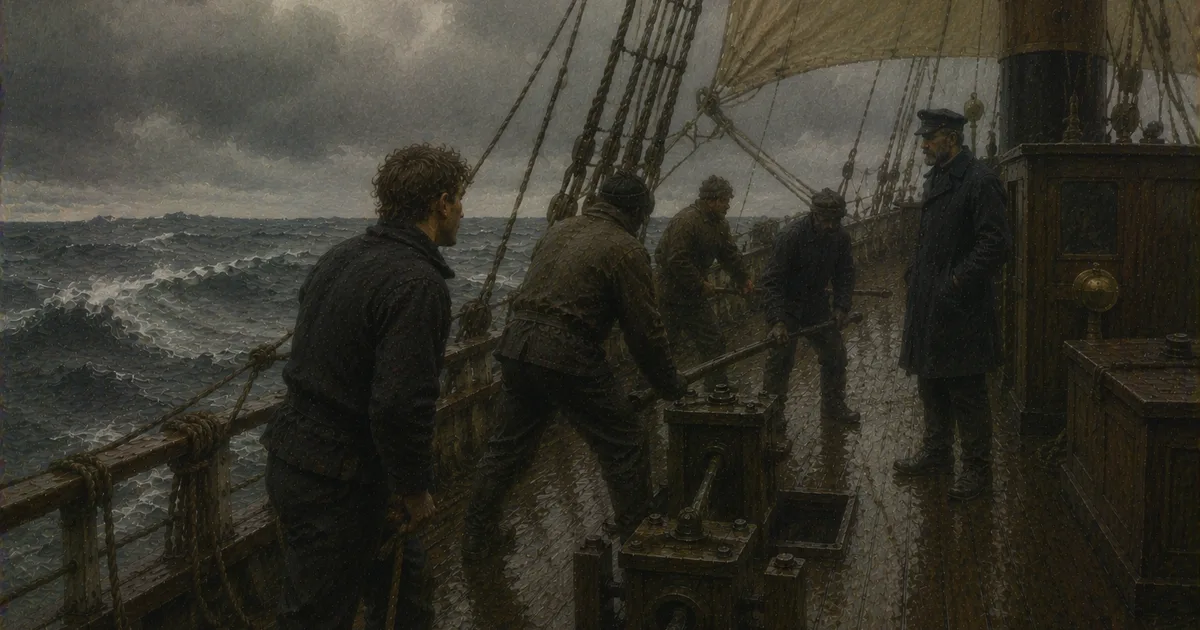
It came down at the rate of a gale on the open Atlantic in the December trade. The wind came to thirty knots. The sea came up to the rail at the larboard quarter. The bark went to the south-southeast at six knots with the topsails close-reefed and the foresail down. The captain was at the wheel-box and the man at the wheel was the boatswain. The watch on deck was Olav and Thomas and the Hamar man and the Stavanger carpenter. The first pump was at the bars and the second pump was made ready at the side of the first.
The bilge-rod was at four inches above the noon-marking of the Day Two at the eight bells of the middle watch.
The bilge-rod was at six inches above the noon-marking at the four bells of the morning watch.
The boatswain came to the bilge-pump-hatch at the four bells and said the springs at the bow had gone to a leak-with-the-sea. He said the watch should go to the second pump and that the watch below should be called and that the captain had set the six-and-two for as long as the gale held. Olav said yes. Thomas said yes. The Hamar man said yes. The Stavanger carpenter said yes.
The six-and-two began at the four bells of the morning watch.
Six hours at the bars. Two hours at the bunk. Six hours at the bars. Two hours at the bunk. The bars were two for each pump and a man at each bar, four men at the two pumps at any given hour, the watch on the bars rotating at the change of the bells.
Olav was at the bars at the six bells of the morning watch.
He pumped at the Kvik’s rate. The water at the bilge was at the level the rod had said. The bars went up and the bars went down. The man at the other bar of the first pump was Thomas. Thomas pumped at the rate he had pumped on the Dronningen in the November of 1876 on the Atlantic crossing, when he and Olav had been at the same bilge-pump-hatch in a watch that had not been a six-and-two and the bow of the ship below them had not had a leak-with-the-sea. He pumped at the Kvik’s rate now. The men at the bars of the second pump were the Hamar man and the Stavanger carpenter. The bilge-pump-hatch was wet. The deck forward and aft of it was wet. The wind came over the larboard quarter and the sea came over the larboard quarter and the deck was wet from rail to rail.
The eight bells of the morning watch came at the change.
The bars went on through the forenoon watch.
The bars went on through the afternoon watch.
The captain came forward to the bilge-pump-hatch at the eight bells of the forenoon watch and at the four bells of the afternoon watch and at the eight bells of the afternoon watch and at every change of the watch through the day, and he stood for a minute at the side of the pumps each time and looked at the bars and went aft to the wheel-box.
The Hamar man came off the bars at the eight bells of the afternoon watch with his arms shaking the way they had shaken at the eight bells of the second dog-watch on the Day Two but worse.
He was back at the bars at the four bells of the first watch and could not hold himself upright at the bars.
He had been at the bars for six hours through the afternoon and dog-watches and was back at the bars at the four bells of the first watch after the two-hour bunk. He stood at his bar for the first quarter hour. He went to his knees at the second quarter hour. He went to his knees not because he had decided to but because his arms had given. The bar went up without him. The Stavanger carpenter at the other bar of the second pump kept it going alone for the next stroke.
Olav came across from the first pump at the change of the bar.
He laid his hands at the Hamar man’s arms under the elbows and lifted. The Hamar man came up. Olav stood him at the bar and laid his hands at the bar and stood at the side of him for the strokes the Hamar man’s arms could not give. He gave the strokes the Hamar man’s arms could not give. The Hamar man kept his hands at the bar. The Hamar man came to the rhythm again at the third quarter hour and held it for the rest of the change. The boatswain at the bilge-pump-hatch saw it and said nothing.
The man who had taught Olav how to lift another man under the elbows was a man whose name he did not name to himself.
The first watch went to the middle watch.
The middle watch went to the morning watch.
The bilge-rod was at eight inches above the noon-marking at the eight bells of the middle watch and was at seven and a half inches above the noon-marking at the four bells of the morning watch.
The gale held at thirty knots through the morning watch.
The Day Six of the voyage was the thirtieth of December.
It was the day after the week of Christmas at Lindøy and at Vestbø. He did not name to himself the chair at the side of the kitchen at Lindøy at the noon meal of the week after Christmas. He did not name to himself the chair at the head of the table at Vestbø at the same noon meal at six hours’ difference of longitude. He stood at the bars at the Kvik’s rate at the eight bells of the morning watch with the gale at thirty knots over the larboard quarter and the bilge-rod at seven and a half inches above the noon-marking. The bars went up and the bars went down.
The gale eased at the second dog-watch.
The wind that had held at thirty knots through the day came to twenty-six and then to twenty-two at the four bells of the second dog-watch. The sea at the larboard quarter eased and the deck was wet but no longer washing. The captain came forward to the bilge-pump-hatch at the eight bells of the second dog-watch. He said the six-and-two would hold. The bilge had held at the rod’s reading in the day’s work of pumping that had been four men’s work at the bars at any given hour.
The night of the Day Six came down with the wind at twenty knots and the bars going up and the bars going down.
The morning of the Day Seven came at the change of the four bells of the morning watch.
The wind was at sixteen knots. The bank of cloud at the west of the Day Four was gone. The sky was a winter sky of the open Atlantic at the end of the year. The captain stood at the wheel-box at first light. He had been at the wheel-box or at the bilge-pump-hatch or at the cat-falls for the whole of the gale, two and a half days of it, with three hours’ sleep in the cabin at the change of one watch. He stood at first light without the glass at his hand.
The captain spoke to the boatswain at the wheel-box.
He said the watch on deck should come aft. The boatswain called them aft. Olav came aft with Thomas and the Hamar man and the Stavanger carpenter and the Drammen-born young hand who had been at the wheel at the change. They stood at the quarter-deck before the wheel-box.
The captain spoke briefly.
He said the bark had come through the first gale of the run. He said the bilge had held at the six-and-two and would be at the six-and-two until the springs were tight again, which would be after Hamburg if the Kvik came to Hamburg. He said he would say a prayer for the men and for the bark. He spoke the prayer in Norwegian. It was a short prayer of a Drammen captain of fifty at the morning after the first gale of a run. He spoke it and did not look up at the saying. He said amen. The men said amen. He said the watch should go to the change.
The watch went to the change.
Olav came off the bars at the eight bells of the morning watch and went below to the upper bunk on the larboard side aft of the stove for the two hours. He laid his coat at the foot of the bunk with the four objects in the pockets and the rosary in the inside-pocket. He did not take the coat into his sleep. He did not sleep through the two hours. He lay at the bunk with his arms not at the bars for the first time in the count of hours that had been the bars for the count of hours, and he did not lift his arms to lay them at any other thing.
The bilge-rod was at six inches above the noon-marking at the eight bells of the forenoon watch.
The six-and-two went on.