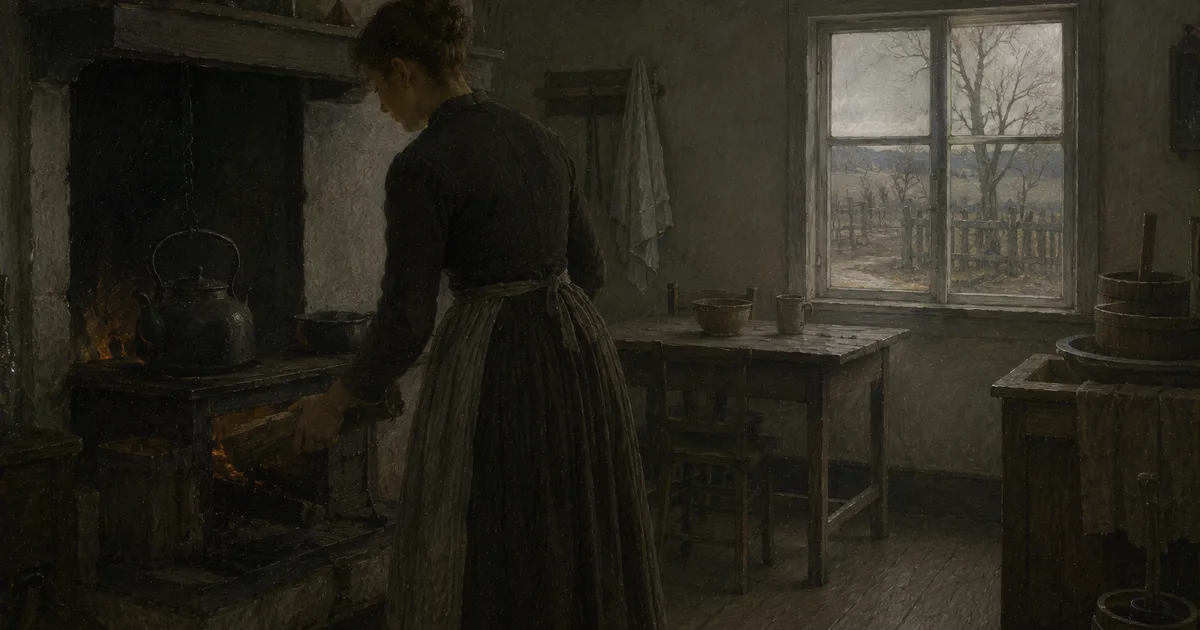
The morning of the seventeenth of January came at the kitchen at Lindøy at the half past six.
Olava had been at the kitchen since the quarter past six. She had brought down the wood from the upper end of the woodshed the way she had brought down the wood from the upper end of the woodshed on every morning of January, and on every morning of the December before the January. She had set the wood at the firebox at the half past six. She had set the kettle at the stove at the half past six. The kettle had been the household’s kettle for the eight years Olava had kept the morning kitchen.
She set the loaf at the table at a quarter to seven.
She set the butter at the small dish at the side. She set the milk at the pitcher at the other side. She set the four cups at the four places at the table for her father and her mother and Gustav and herself. The four places were the morning places at the kitchen at Lindøy in the winter, when the brothers and Inger were at the other houses on the island and the cousin Karoline was at Stavanger.
The kitchen window at the side of the stove showed the morning of a steady snow that had been falling since the night.
Bertha came into the kitchen at the half past six.
She had been at the upper room with Bjørn for a few minutes before coming down. Bjørn had been at a cough in the night and was at the bed when Bertha came down. Bertha said the cough was no worse than the cough of the previous January. Olava said yes. Bertha said the breakfast would be three at the table for the morning of the seventeenth and that the kitchen would be the warmer side of the cough until Bjørn was at the table again.
Olava set down the fourth cup and took up the fourth place.
She made the coffee at the seven of the morning. She set the bread at the cutting-board at the table. She and Bertha sat for the breakfast, and Gustav came in at the side door and joined them at the table.
Gustav had been at the byre at the dawn for the milking of the four cows the household kept through the winter. He set the milk-pail at the cool corner at the door for Bertha. He sat at his place at the table and ate the bread and the butter and drank the coffee and did not say much.
Gustav was the oldest of Olava’s brothers and was thirty-one and had been married for seven years to Margrete who lived at the other side of the island at the upper house at Lindøy with their three children. Gustav came across to the kitchen at Bertha’s house in the morning for the milking and the breakfast through the winter because the upper house had a cow only at the summer and was not a household for the winter milking. Margrete and the children kept the upper house. Gustav slept at the upper house and came down at the dawn.
After the breakfast Olava went up to the upper room with a cup of coffee for Bjørn.
Bjørn was at the bed with the wool blanket at his chest and the spare quilt at his feet. He took the cup with both hands and held it for a minute before he drank. He said the cough had not been bad in the night, only steady, and that he would be at the kitchen by the noon for the noon meal. Olava said yes. She set the cup at the small table at the side of the bed. She went down to her own room at the half past seven.
Her room was at the upper end of the kitchen at the small back room at the upper floor that looked at the east toward Roalsdyret across the strait.
It was a room of a daughter of a Lindøy household at the winter of 1878. It had a bed and a chest of drawers and a writing-table at the window. It had a candle at the sill. It had a small wool rug at the foot of the bed. It had the carte-de-visite of Olav at the chest of drawers, propped at the lamp at the upper end.
She sat at the writing-table for a few minutes.
She did not write at the writing-table on the morning of the seventeenth because she had written the last letter to Olav at the eleventh of December and had given it to John Stensøy at Stavanger at the twelfth, and the next letter she would write would be the letter she wrote when she had a letter from Olav to answer. The letter she had given John Stensøy on the twelfth had been the eighth letter Olava had written to Olav since the Dronningen had sailed from Stavanger on the eighteenth of July of 1876.
The letters from Olav at her chest of drawers were four in number.
The first was the letter from Archangel that had come at the autumn of 1876. The second was the letter of the engagement-yes from Bristol that had come at the spring of 1877. The third was the letter from Cape Verde that had come at the spring of 1877. The fourth was the letter from Jamaica that had come at the summer of 1877.
The fifth letter, the letter that would be the letter from the port the Dronningen had come to after Jamaica, had not come.
The fifth letter would have come at the November of 1877 or the December of 1877 if the Dronningen had been at a port at which Olav had been able to write and the post from that port had been a post the Stavanger consul could receive. The fifth letter had not come. Olava did not know whether the fifth letter had been written and lost at the post or had not been written or had been written and was still at the consul’s office at the city the Dronningen had been at and had not yet been brought by the next packet to Stavanger.
She looked at the carte-de-visite at the chest of drawers.
The carte-de-visite was the photograph the photographer at Pedersgate had taken of Olav at the summer of 1876 when the Dronningen had been at Stavanger for the loading at the upper wharves before the long voyage. Olav had been at the chair at the photographer’s at the half past three on a Thursday of the second week of July. The photographer had set him at the chair with his cap at his hand and his face at the camera. The carte-de-visite had come to Olava from Olav’s hand at the door of the boardinghouse at Bredalmendingen on the Saturday evening of the second week of July of 1876.
She had been at the carte-de-visite at the chest of drawers at the upper window for the eighteen months between July of 1876 and January of 1878.
She had been at it on the third or fourth morning of each week. She had not been at the carte-de-visite on the morning of the seventeenth before the writing-table. She was at the carte-de-visite now. It was the picture of a young man of nineteen years at the third voyage of his life looking at a camera at a photographer’s at Pedersgate in the summer of 1876. The photographer’s lamp had been at the side. The light at the carte-de-visite was the light of the lamp.
She went down to the kitchen at the eight.
Bertha was at the stove with the iron. Olava took the iron at the chair at the side of the stove and ironed the shirts of Bjørn for the week of the eighteenth. The shirts were three. She ironed the collars and the cuffs and the fronts. She set the shirts at the linen-press in the parlor at the half past nine and came back to the kitchen.
She made the coffee at the ten for the half-time of the morning.
Bertha sat at the table with the coffee. Olava sat at the table with the coffee. Gustav was at the byre with the spare hay and would not be in until the noon. Bjørn was at the upper room.
It was at the coffee at the ten that Olava said to Bertha that the fifth letter had not come.
Bertha said yes.
Olava said the fifth letter would have come if the post at the port had been the post a Stavanger consul could receive. Bertha said yes. Olava said she did not know whether the fifth letter had been written. Bertha said yes.
Bertha said it was the way of the post at the winter of the Atlantic. She said the letter would come at the spring with the next packet or with the Dronningen itself when the Dronningen came home from Goole at the spring. She said the Dronningen would come home at the spring at the latest. She said Olav would be at the Dronningen when the Dronningen came home.
Olava said yes.
Bertha said also that Tore at the March of 1875 had been at the bed for the third week before he had stopped speaking, and that Bertha had been at his side at the third week and at the speaking, and that Olava had been at his side at the fourth week at the not-speaking, when Olava had been seventeen and Tore had been twenty-one. Bertha said the third week and the fourth week were not the same week.
Olava said yes.
Bertha said the silence of a third week and the silence of a fourth week were not the same silence. She said the silence of Tore at the fourth week had been a silence Olava had learned at the side of his bed. Bertha did not say what the silence of Olav at the winter of 1878 was. She did not say what week it was the silence of. She said the silence and Olava knew what week.
Olava said yes.
The morning of the seventeenth went to the noon.
The noon came at the kitchen at the noon meal. Bjørn came down at the quarter to noon and sat at the head of the table with the wool blanket at his shoulders. Bertha set the soup at the table and the bread and the cheese. Gustav came in at the side door at the noon. The four of them sat at the table for the noon meal at the kitchen at Lindøy on the seventeenth of January of 1878.
Karoline came to Lindøy at the half past four of the afternoon of the eighteenth.
She had come from Stavanger by the steamer at the noon and had walked from Judaberg to Lindøy across the island at the snow that had eased at the morning of the eighteenth. She came to the kitchen at the half past four with her wool cape at her shoulders and her boots wet to the knees. Bertha took the cape. Olava took the boots.
Karoline sat at the kitchen at the chair at the side of the stove for a half-hour before she said the news. She drank a cup of coffee. She said the steamer had been at the noon at the wharf at Stavanger and the wharves of Stavanger had been at the loading of the Bergen packet and at the unloading of the Hamburg packet. She said the Hamburg packet had not had a letter for Lindøy in the bag.
Olava said yes.
Karoline said the Dronningen had been at Goole at the second week of December at the unloading of the resin and was at Goole still at the second week of January at the loading of the iron-ore for Stavanger. She said the Dronningen was the ship that would come home in the spring with the iron-ore. She said the captain Tollefson had written to the consul’s office at Stavanger at the first week of January at the report of the Dronningen’s passage from the Carolinas and had said the crew was at Goole and the Dronningen had wintered well.
Olava said yes.
Karoline said the consul’s office had not had the names of the crew at the Dronningen’s report.
Olava said yes.
Karoline said it was the way of a captain’s report at the winter to not give the names of the crew because the names were a thing the crew gave at the home port at the discharge. She said the Dronningen’s names would come at Stavanger at the spring at the discharge. She said it would be two months at most.
Olava said yes.
Karoline said the Hamburg packet had also brought word that a bark of Drammen called the Kvik was overdue at Hamburg from a port at the Carolinas the bark had sailed from at the close of December. She said it was the kind of small news the Stavanger consul’s office set out at the bulletin in the office at the wharf-end at the upper street for the families of sailors. She said she had read the bulletin at the noon at the wharf-end before the steamer.
Olava said yes.
She did not say why Karoline had mentioned the Kvik of Drammen overdue from a Carolinas port. Karoline did not say either. They sat at the table at the kitchen and finished the coffee.
The Sunday of the twentieth of January was at the chapel at Rossøy.
Olava and Bertha walked to Rossøy at the morning. Bjørn was at the bed still. Gustav drove the sled with Margrete at the wife’s seat at the side and the three children at the back. The chapel at Rossøy was at the upper end of the village at the harbor. It was a wood chapel of the year 1837 with a small bell at the side and a stove at the back wall and pews of pine wood that had been pews for forty-one years.
The pastor at Rossøy was a man of forty-eight who had been at the Rossøy pulpit for nine years.
He spoke at the first reading and at the sermon. He read at the prayer-list the names of the sailors of the parish who were at sea at the winter and asked the parish to pray for them. The names were eleven. Olav Hestby was the fifth name.
She heard Olav’s name spoken when the pastor read the fifth name.
She did not look up at the pulpit. She looked at the pew rail at her hand at the cuff of her glove at the second knuckle. She was at the pew of the Lindøy family at the third pew from the front at the chapel of Rossøy at the morning of the twentieth of January of 1878. She had been at the pew of the Lindøy family at the third pew from the front at the chapel of Rossøy at every Sunday of her life that the weather had allowed the family to come from Lindøy.
The hymn after the sermon was the hymn the chapel sang at the first Sunday of the year when the chapel asked for the protection of sailors at sea. It was the hymn she had sat at the pew through at every January Sunday of her seventeenth and her eighteenth years. The hymn was four verses. She sang the first verse and the second verse and the third verse and the fourth verse. Bertha sang at her side.
After the hymn the pastor at Rossøy gave the benediction. The parish stood and bowed for the benediction. The parish filed out at the door. Olava and Bertha stopped at the porch for a few minutes with the pastor’s wife at the porch step. The pastor’s wife said to Olava that the parish would pray for Olav at every Sunday through the winter. Olava thanked her. They walked to the sled.
It was the evening of the twentieth of January of 1878 at the upper room at the chest of drawers that Olava opened the lower drawer.
The lower drawer of the chest of drawers was the drawer where Olava kept the four letters from Olav. The letters were a bundle tied with a piece of brown twine at the lower end of the drawer at the right corner. Olava had tied the bundle at the receipt of the fourth letter at the September of 1877 and had not untied it since.
She did not open the bundle.
She lifted it from the drawer and laid it at her lap at the chair at the chest of drawers. She held the bundle at her lap with both hands. It was four sheets of letter-paper each, in four envelopes, with four wax seals at the back, written in Olav’s hand at the slight flourish at the y of Hestby.
She laid the bundle back at the lower drawer.
She closed the drawer.
She went to the window at the upper room at the long blue light of the January evening.
The window looked at the east toward Roalsdyret across the strait. The strait was at the long blue light of the January evening. The sun had set at the horizon to the west of the upper window, and the east of the strait was at the blue of a Norwegian January evening at the upper window of a house at Lindøy, when the snow at the slopes of Roalsdyret was at the blue of the light.
She stood at the window for a few minutes.
She did not have a letter at her hand. She did not have the carte-de-visite at her hand. She had her two hands at the window-sill at the wood of the sill that had been worn at the middle where her two hands had been at the sill at the evenings of the half year of waiting.
She did not speak.
She turned from the window at the quarter to five and lit the candle at the sill.
The candle was the candle of the upper window at every January evening at Lindøy.