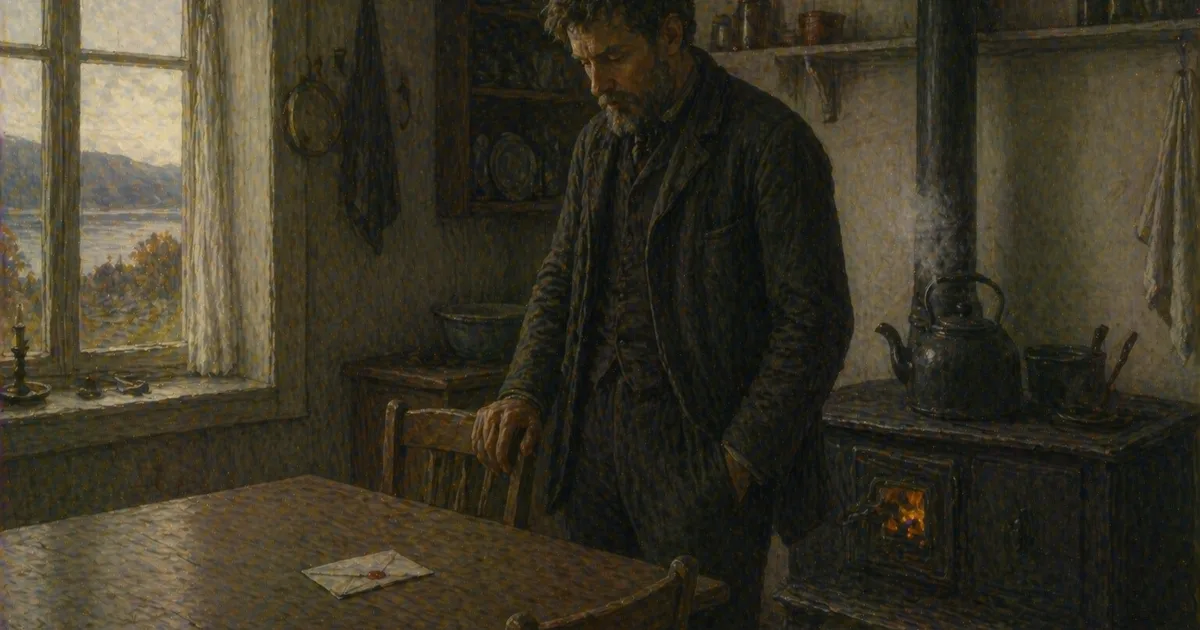
The letter from Archangel came down to Vestbø with Lars on a Wednesday in the second week of October.
Lars had brought it across from Judaberg in the small boat in the morning along with two letters for Knut Tjørn at the upper farm and a parcel from the chandler at Stavanger. The Archangel letter had a Russian stamp at the upper right of the paper and Olav’s hand at the inscription, and Jens took it from Lars at the door of the kitchen at half past eleven.
“That is the boy’s hand,” Lars said.
“It is.”
“He is at Archangel.”
“He is.”
“It will have been a fair run if it has come down through Stensøy at the rate it has come.”
“It will have been.”
Lars did not stay for coffee. He had three more crossings to make at the Wednesday tide-state, and the wind would back into the southwest in the afternoon, and Lars set down the parcel from the chandler and took back the cup of water Jens had offered him at the door and went down the path to his boat. Jens stood at the door of the kitchen with the letter in his hand for the few minutes after Lars had gone and looked at the inscription.
Olav had written the address in three lines.
Jens Hestby of the farm Vestbø Finnøy
He had written the farm Vestbø with a small underline, the way he had written it on the articles document at the office of registry in March 1876 when Stensøy had read the articles aloud and had asked Olav to give his identifying information for the third time in two years. Jens looked at it.
He went into the kitchen.
Peder was not in the kitchen at half past eleven on a Wednesday in the second week of October because Peder was at the byre cleaning the calf-stall, which was the work Peder did at this hour on a Wednesday. The aunt was at her own house across the hill. Jens was alone in the kitchen with the letter from Archangel in his hand and the lamp not lit and the autumn light at the window above the sink.
He set the letter at the head of the table where he sat at meals.
He did not open it.
He went to the stove and put a piece of birch on the fire because the fire had got low while he had been at the door with Lars, and he took down the kettle from the high shelf and set the kettle on the stove because the morning was the morning for coffee. The kettle was the kettle his wife had brought to the house at her marriage in 1855, and he had used it through the twelve years of his marriage and the nine years since, and the kettle was a thing his hand had held at the stove for almost twenty-one years. He set it. He set the can of water from the bucket beside the stove. He waited for the water to come to the boil.
The letter lay on the table.
He did not read it before the coffee was made.
The kettle came to the boil.
He made the coffee. He set the cup at his place at the table beside the letter. He sat down.
He opened the letter.
The letter was four lines. He had expected four lines, because the boy wrote four lines from a foreign port—four from Hebburn in August 1875, four from Stavanger in March 1876 before the Asta had sailed, and four now from Archangel.
The letter said the Dronningen had made the run to Archangel under fair weather without incident. It said that Tollefson was a captain Cousin John Stensøy had been right to recommend. It said that the loading had begun on the second morning and would take five days. It said that the next port was Cardiff and that he would write again from Cardiff.
The letter was signed Olav Hestby in the hand the boy had written his name in at the office of registry in March 1876, with the small flourish at the y that the boy had not had at the y in his name in June 1875.
Jens read the four lines twice.
The boy was at Archangel.
He had been at sea for three months. He would be at Cardiff in October if the wind held, and at Wilmington in November if the wind held after Cardiff, and the Dronningen’s voyage would take eighteen months by Stensøy’s account at the dinner at his house on the Sunday after the Dronningen had sailed. Olav would not be at Vestbø before April 1878. The boy would have a letter from Olava at Cardiff if Olava had sent it through the Helland office at Stavanger in time, and Olava would have a letter from the boy in November if the boy had written from Cardiff in October as he had said he would.
Jens thought about the letter from Olava that was at the Helland office at Stavanger now waiting for the Dronningen to come into Cardiff.
He had not seen the letter. He did not know what Olava had written. Olava and her family at Lindøy were not a household Jens had sat at the table of more than once, which was the dinner at Bertha’s cousin’s at Rossøygate on the Saturday in July, and what Olava had written to the boy from Lindøy was not a thing Jens had any access to. The boy would write to him from Cardiff. The boy would write to Olava from Cardiff. The two letters would go out from the same port on the same week, and one would come to Vestbø and the other would go to Lindøy, and the two letters would be the two halves of the boy’s life that the boy now had—the half at Vestbø with his father, the half at Lindøy with his future wife.
Jens thought that this was the way of it from now until the boy was married. The boy at sea would write two letters at every port, and Jens would read his letter at Vestbø and Olava would read hers at Lindøy, and the two of them would read the same kind of letter from the same boy and would not see each other’s letter, and this would go on until the boy came home.
He thought that this was the right way of it. The boy’s life was not the same as the father’s life, and a son who had a wife-to-be at another island had a half of his life that was not his father’s to read. Jens did not envy Olava that part of the boy’s life. He thought that Olava had been the right young woman for the boy. The half of a son’s life that was a wife’s half was not the half a father knew about.
He looked at the cloth on the kitchen table.
The cloth was the autumn cloth his wife had woven in 1860, and the autumn cloth had a small pattern at the corners his wife had set into the weaving that the spring cloth did not have, which was a pattern she had taken from a cloth her mother had woven at Rossøy in the time before his wife had been born.
He had not thought about the pattern at the corners until he had been at the dinner at Karoline’s house on the Saturday in July.
Bertha had said at the dinner that his wife had stood at the door of the chapel at Rossøy with her face turned to the bay before she went in. Bertha had said this in front of his son and in front of his son’s intended wife, and he had said yes to Bertha, and he had said the small piece he had said about the twelve years of his own marriage. He had not said more at the time. He had not been able to say more at the time, because the dinner had been the dinner of two families meeting at a third household, and the things he could have said about his wife at his own table at Vestbø were not the things he could have said at Karoline’s table at Rossøygate.
He had thought about Bertha’s words on the boat back to Vestbø with John Stensøy.
He had thought about them in the days after.
He had thought about the way his wife had stood at the door of Hesby church the same way Bertha had described her standing at the door of the chapel at Rossøy. He had stood beside her at the door of Hesby church for twelve years and had not seen that she stood the same way every Sunday. He had seen that she had a way of standing; he had not seen that the standing was the same standing she had done at every chapel she had been to since she had been a girl. Bertha had noticed it because Bertha had walked behind her on the path in the year before Bertha’s marriage, and Bertha had seen what a friend saw of another woman from the outside-going-in. He had stood beside her, and the inside-looking-out of a husband at the door of his own parish church had not given him what the friend had seen.
He thought that this was the way one came to know the woman one had been married to—through the friends who had seen what the husband had not.
The aunt came across the hill on the Sunday after the letter had come down from Archangel.
She came at the noon hour with a basket of bread and a jar of preserved plums from her own kitchen, and she set the basket on the table at the foot and sat down at the chair there in the way she had been sitting since she had been a girl. Peder came in at the noon hour because Peder had been at the path-fence above the house mending the rail that had come loose in September. The three of them ate the bread and the dried fish at the table and drank the coffee, and Jens did not bring out the letter from Archangel before the meal, because the letter was a thing that wanted to be brought out at the right moment in a meal and not at the beginning of one.
He brought it out at the coffee.
He read the four lines aloud. The aunt did not say anything during the reading. Peder did not say anything during the reading. When Jens had finished the four lines and had folded the letter and set it on the table in front of the aunt for her to look at, the aunt picked up the letter and looked at the inscription and at the four lines and at Olav’s signature with the small flourish at the y, and she said, “He has come home from Archangel in his hand.”
“He has,” Jens said.
“He will be home from Cardiff in his hand in November.”
“He will.”
“And from Wilmington.”
“And from Wilmington.”
“It is good that the captain is a good man.”
“It is.”
The aunt did not say more about the letter. She set the letter on the table at the place where Jens had set it before the coffee. She finished her coffee. Peder went out to the byre. The aunt did not go back across the hill at once. She stood at the table and looked at the things in the kitchen the way a sister looked at a brother’s kitchen on a Sunday afternoon when she had crossed the hill and had not yet decided to go back.
She did not stay long after the coffee. She had her own stove to tend. She crossed the hill at half past two.
Peder went back out to the byre after the aunt had gone. Jens stood at the door of the kitchen for a moment and watched his younger son go down the path. Peder had turned sixteen on the last day of January, and the Peder who had gone back to the byre on the Sunday after the letter from Archangel was not the Peder who had stayed at the door of the kitchen with his cap in his hand on the morning Olav had gone out for the third time. Peder had taken on the byre roof in the autumn without being asked. He had ordered the wood from the chandler at Stavanger by way of Lars in the second week of September. He had set the day for the start of the work in the first week of October because the first week of October was the week the autumn weather settled at the latitude of Finnøy. Jens had not asked Peder to do any of these things. Peder had done them as a younger son did when the older son was at sea for eighteen months and the father was at fifty-two with the knee. Jens watched Peder go down the path to the byre. He did not call after him.
Jens went up to the upper field after the aunt had gone.
The upper field was the field he had walked at the beginning of every season of his life, and he walked it now in the autumn light at three o’clock with the bay below the field and the hill above it. The field had been mown in the second week of August, and the second crop had come up the way grass comes up at this latitude in autumn—knowing it would not be cut a second time but would be left for the cattle to find under the snow in the winter. The grass at three o’clock on the second Sunday of October was knee-high in the places where the light reached it and was lower in the places where the wall threw a shadow.
He walked to the place his father had walked when his father had wanted to think a thing through to its end.
His father had walked there for the last fifteen years of his life and had stood at the place at the upper end of the field above the wall and had looked at the bay, and his father had thought through whatever a man thought through at a place a man walked to. Jens had not asked, when his father had been alive, what his father had thought through. Jens had been a younger man then. Jens now stood at the place his father had stood at, and he understood what his father had thought through, because Jens was now thinking through the same kind of things at the same place.
He thought about his son at sea.
He thought about his wife who had been dead nine years.
He thought about the yellow ribbon at the chapel at Rossøy in 1855 and about the standing-at-the-door that Bertha had set down at her cousin’s table in July.
He thought, after some time, that he would write back to the boy that evening.
He went down to the house.
He wrote the letter at the kitchen table in the lamplight.
He did not write four lines. A father at fifty-two years did not write four lines back to a son at sea who had written four lines from a foreign port; a father wrote what the silence at Vestbø had given him to write in the months since the son had sailed. He wrote that the second crop of hay at the upper field was a thinner crop than the first as the years past had taught him to expect. He wrote that Peder had finished the path-fence at the upper rail in the second week of September and had begun the byre roof in the first week of October. He wrote that the aunt had been at Vestbø on the Sunday and had read the boy’s letter aloud at the table after the coffee. He wrote that Lars had crossed to Judaberg every Wednesday since the Dronningen had sailed, and that Lars had said the wind in the bay in September had been a steady west wind that had been good for the inshore fishing.
He wrote about his wife.
He did not write directly about his wife. He wrote that Bertha at Lindøy had been a woman his wife had been close to in their girlhood, and that Bertha had said a small thing at the dinner at Karoline’s house in July about a walk she had taken with his wife to the chapel at Rossøy in the year before Bertha’s marriage, and that he had thought about it in the three months since. He wrote that he had not been able to say more at the dinner than he had said, because a dinner of two families at a third household was not a place for that kind of saying. He wrote that he might say more some time when his son was home from the Dronningen, or that he might not.
He wrote that Olava was a young woman his wife would have known by way of Bertha’s mother and would have been pleased about.
He wrote that his son was to write again from Cardiff.
He signed the letter Jens Hestby of Vestbø.
He folded it and laid it on the table and put out the lamp.
The kitchen was dark. The fire at the stove had gone to embers. Peder had gone to the loft an hour before. The cloth at the table was the autumn cloth his wife had woven in 1860, and the small pattern at the corners his wife had taken from a cloth her own mother had woven at Rossøy was at the edge of the cloth Jens could see by the light of the embers.
He sat at the table for a few minutes with the letter folded in front of him.
He went to bed.