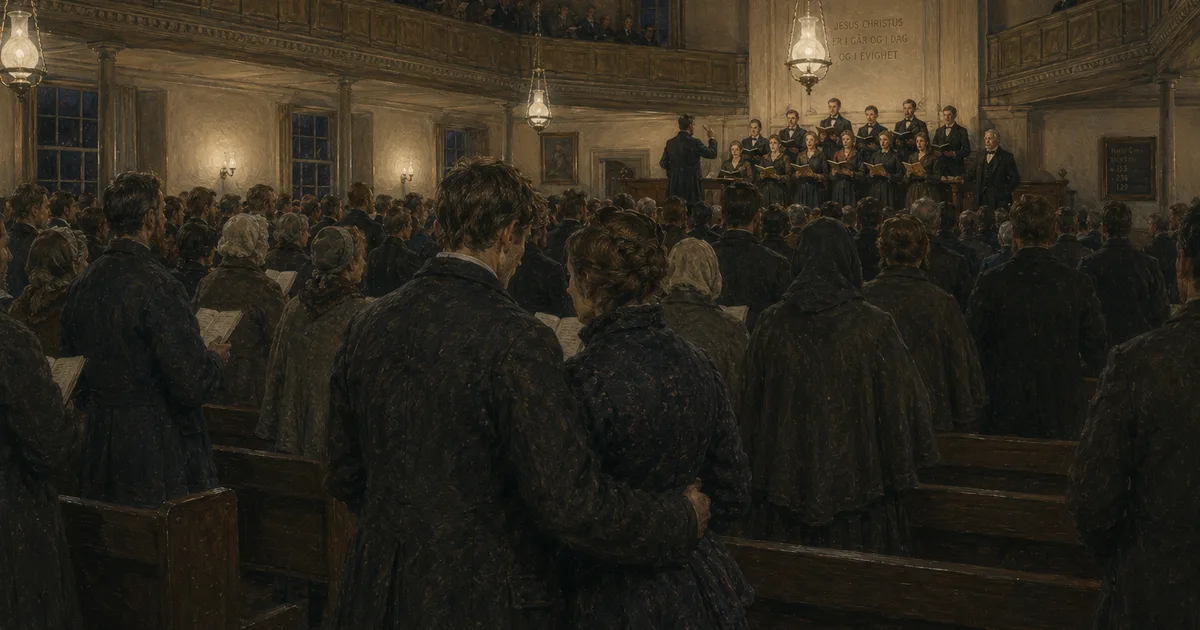
The Bethania chapel was at the upper town of Stavanger, and the service of it was at the seven of the Sunday evening.
It was a chapel of the prayer-house kind, a hall of the city built for the holding of a large parish at a Sunday evening, and the people of Stavanger came to it at the Sunday evenings of the winter—the wharf-men and the shop-keepers and the women of the households and the students of the schools and the sailors at the city between the ships. Olav came to the Bethania at the Sunday evening of the second week of December.
The Bethania was a thing the city of Stavanger talked of, and a man at the city for a winter heard it talked of. The men at the school spoke of Oftedal and the Sunday evenings at the Bethania; the people at the streets spoke of him; the table at Kindingstad’s spoke of him. Oftedal was a man the city had at it the way a city had a man it was not of one mind about—some of the city for him and some of the city against him, and the most of the city at the Sunday evenings filling the hall he preached at. Olav had heard the Bethania talked of through the autumn and the early winter and had not gone to it. At the second week of December he went. He went the way a man at a city went at last to a thing of the city he had heard talked of through a season—not for a reason he had set out to himself, but because the thing was there at the city and he was at the city, and a Sunday came when the borrowed boat did not have him at Lindøy.
He came to it alone at the first time. Olava was at Lindøy at the second week of December and the steamer had not run on the Sunday, and Olav went to the Bethania at the seven of the evening alone, the way a man at the city went to a thing of the city alone, to see what the thing was.
The hall of the Bethania at the seven of a Sunday evening filled with the people of the city. They came in at the chapel-door out of the December dark and the December cold—the wharf-men and the shop-keepers, the women of the households at the wool capes and the hoods, the men in the coats of the working week put off for the Sunday, the students of the schools, the sailors at the city between the ships. They filled the pews of the hall from the front and the sides and up into the gallery. Olav sat at the pew at the middle among them. He did not know the people of the city; he had been at Stavanger for the autumn and the winter at the school and the room at Kindingstad’s and the wharf where the Lindøy boats came in, and the people at the pews of the Bethania were the people of a city a man came to know the streets of before the faces of. He sat among them the way a man sat among the people of a city he was at and was not of. The hall filled, and the talk of it went down to the quiet a hall went to before a thing began, and at the seven the service began.
Rev. Lars Oftedal was at the pulpit.
Oftedal was a man the city of Stavanger knew. He was a man at the front of the hall in the black coat, and he preached at the seven of the Sunday evening in a voice the hall was built to hold—a voice that went to the back wall of the hall and the upper gallery without the man at the pulpit seeming to send it there. He preached briefly at the first Sunday Olav was at the Bethania, a sermon of the Advent season, of the waiting of the year for the thing the year waited for, and Olav sat at the pew and heard it. He did not hear it the way the men and the women of the city at the pews around him heard it. He heard it the way a man heard a thing at a hall he had come to alone to see what the hall was. The sermon was the sermon. Olav had been at the windlass of the Kvik at the Atlantic at the winter past, at the iron of the windlass under his forearms at the nights, and he had been at a thing at the windlass that he had not said the shape of to anyone and did not say the shape of at the pew at the Bethania; and the sermon at the Bethania was a sermon at a hall, and the thing at the windlass had been a thing at a windlass, and the two were not the one thing.
Mr. Davidson directed the choir.
The choir of the Bethania sang without the organ—a cappella, the voices alone, the men’s voices and the women’s voices at the parts—and Mr. Davidson directed them from the front, and the singing of the choir at the hall at the Sunday evening was the thing of the Bethania that Olav was at the most of. The hymn rose at the hall and went to the upper gallery and the back wall the way Oftedal’s voice had gone, and the people of the city sang it with the choir, and Olav sang it. He had the hymns by his confirmation. He sang the hymn at the pew at the middle of the hall, and the singing was a thing the body did at a hall where the people sang, and Olav did it.
Olav had not heard singing of that kind before. The singing of the church at Hesby was the singing of a parish to the small organ, and the singing of the chapel at Rossøy was the same; and the singing Olav had been at the most of in the years of the ships was the singing a forecastle did at a watch-below, or a crew did at a halyard—the chanties at the hauling, the songs of the forecastles at the off-watch. The choir of the Bethania was not those. It was the trained voices set at the parts, the men’s voices and the women’s, ranged against each other and with each other by Mr. Davidson’s hand at the front, and no organ under them to hold them up; the voices held themselves. The hymn went up at the hall on the voices alone, and the hall took it and held it the way the hall had been built to hold a voice, and Olav sat at the pew and was at the hearing of it. It was a thing of the Bethania a man came back to the Bethania for. Olav had come the first time to see what the hall was, and he came to know, across the Sunday evenings of the December, that the singing of the choir was the thing of the hall he had come to see.
He came back to the Bethania at the Sunday evenings of the December.
The Bethania at the Sunday evenings became a thing of Olav’s winter, the way the school was a thing of it and the skating was a thing of it and the borrowed-boat-nights were a thing of it. A man at a city at a winter took the things the city’s winter had; the hall and the voice and the hymn at the Sunday evening were a thing the city had, the way the ice of the lakes was a thing the city had, and Olav took the Bethania the way a man took the things of a place he was at for a winter. He sat at the pew at the middle of the hall. He heard Oftedal at the pulpit and the choir at the hymn, and he sang the hymns of his confirmation, and came out at the close into the December street and went up to Kindingstad’s.
At one of the Sunday evenings of the December Oftedal preached on the dark of the year. He stood at the pulpit in the black coat and said the year had come to its dark—that the days of the December were the shortest days of it, and the light of them the least light, and that the people of the hall had come to the Bethania out of the dark of a December evening and would go back out into it at the close of the service. He said the dark of the year was the year’s way of teaching a man the worth of the light, because a man did not learn the worth of a thing while the thing was at his hand in plenty, and the light was not at a man’s hand in plenty at the December. He preached it in the voice the hall was built to hold, and the voice went to the back wall and up to the gallery, and the people of the city heard it. Olav heard it at the pew among them. It was a sermon of a December, preached at a hall at a Sunday evening at the dark of the year; Olav had his own December and the things his own December had at it, and he did not set the sermon against them. He heard the sermon. The choir came up at the hymn after it, and the hall sang.
He came at the Sundays the borrowed-boat-night did not have him at Lindøy and the Sundays Olava was at Stavanger. At the fourth Sunday of the December Olava was at the city, at Karoline’s at Rossøygate for the two nights of a household-thing, and she came to the Bethania with Olav at the seven of the evening.
They sat at a pew at the middle of the hall.
The hall filled at the people of the city at the Sunday before Christmas. Oftedal preached. Mr. Davidson brought the choir up at the hymn after the sermon, and the hymn was a hymn of the season, and the hall stood for it, and the choir’s voices went up and the parish’s voices went up with them.
Olav stood at the pew with Olava at his side and sang the hymn.
The body of Olav at the pew at the Bethania at the Sunday before Christmas of 1878, standing at the hymn with Olava at his side and the parish of the city at the pews around him, was the body that had been at the things the body had been at. It had been at the bench at the captain’s office at Hamburg beside a Danish man with a patch over the left eye. It had been at the foretop of the Asta beside a man of Hogganvik in the spring of 1876. It had been at the windlass of the Kvik at the nights at the Atlantic. It was at the pew at the Bethania now, at the hymn, with Olava at the side of it, and the parish of the city did not know what the body at the pew had been at, and Olava at the side of it did not know, and the hall did not ask. A hall of a parish at a Sunday evening did not ask a man at a pew what he carried. It asked him to stand at the hymn, and Olav stood at the hymn, and the body sang.
He did not name to himself, at the pew, what it was to stand at a hymn at a public hall with the whole of what he carried at the one body and no word for the half of it.
He had the language now for the half of it that he had not had a language for at the pew at Hesby at the January of 1876. The language had come to him at the years between. But the language was a language he had at the inside of him, and the hall at the Bethania was a public hall, and the having-of-a-language at the inside was not the same as the having-of-a-word at the public hall, and Olav stood at the pew at the Bethania and sang the hymn and knew the difference of the two. The hymn did not ask him to set anything down. It did not lift anything off him. It was a hymn at a hall, and he stood at it, and the carrying went on at the body the way the carrying went on, and the singing went on at the body at the same time, and the two were at the one body at the one pew, and that was the whole of what the Bethania was at Olav.
Olava sang at his side.
She had the hymn the way Olav had it, by her confirmation at Rossøy. She sang it at the pew at his side. She did not know what the body at her side had been at; she knew the man at her side as the man she had been at the engagement of since the Bristol letter, the man she had skated the ice with at the December afternoons, the man who crossed the strait to her at the borrowed-boat-nights. She had a thing she registered about him—Olav knew that she registered it, the way he had known at the cafe at the Stavanger wharf-end at the July that she had registered a thing—a thing she had not a word for and did not ask after. She stood at the pew at the hymn and registered it and did not ask. It was the not-asking Olav had come to know as the kind of care Olava did a thing with. She did it at the pew at the Bethania the way she had done it at the cafe and at the garden and at the kitchen.
The hymn ended. The hall sat. Oftedal gave the closing.
After the service Olav and Olava came out of the Bethania at the chapel-door with the parish of the city, and they went down the steps into the Sunday-evening street of the upper town. The lamps were lit. The cold of the December was at the street.
The people of the city who had been at the Bethania went down the street with Olav and Olava and turned off it at the streets that took them to their houses. The city at the Sunday evening before Christmas was a city at the end of a December week with the Christmas at the days ahead—the windows of the houses lit, the snow of the December at the edges of the street, the cold hard at it. Olav and Olava walked down among the parish of the city going home. They did not walk close. They walked the way a man and a woman walked at a public street of a city at a Sunday evening, a hand’s breadth of cold air between them, and the walking-down was a thing of the public street the way the carrying across the ice had been a thing of the public ice.
The bell of the Bethania at the upper tower rang the half past eight as the two of them walked down toward Bredalmendingen, where Olava would go on to Karoline’s at Rossøygate and Olav would go up to Kindingstad’s.
“Oftedal preaches the way the city says he preaches,” Olava said.
“He does. The hall is built for the voice.”
“The choir is a good choir. The singing without the organ is a thing I had not heard before. At Rossøy there is the small organ.”
“At Hesby there is the small organ. The singing without the organ is the Bethania’s way.”
They walked down the street at the cold. Olava had the wool cape at her shoulders and the hood of it up. At the corner where her way went to Rossøygate and Olav’s went to Bredalmendingen they stopped, and Olava said good-night, and Olav said good-night, and Olava went down toward Rossøygate. Olav watched her to the turn of the street and then went up to Kindingstad’s.
He came to the third-floor room at the half past nine.
He stood at the small table at the window. The window looked at the wharf at the lower end of the upper harbor where the Lindøy boats came in, and the wharf was at the dark and the lamps. Olav stood at the window at the Sunday evening before Christmas of 1878. He had been at the Bethania at the hymn with Olava at his side. He would cross to Vestbø at the days before Christmas and be at the Vestbø household for the Christmas with his father and Peder and the aunt, and would cross back to Stavanger after, and the school would take up again at the new year, and the winter would go on.
The body of him at the window had been at the pew at the public hall, and had carried what it carried at the pew, and had sung the hymn. It was, at the half past nine of the December evening, a body that was well.