The winter came to Stavanger at the November.
It came at the days going short and the light at the morning coming late and the light at the afternoon going early, and the lamps of the lower streets at the four of the afternoon, and the cold settling at the city the way cold settled at a city at a latitude that was the latitude of Finnøy. The school went on at the days. The chart-work at Professor Nilson’s room went on at the chart and the celestial tables and the instruments. The borrowed-boat-night went on at the evenings the strait and the weather and the school let it go on, and at the evenings the weather did not let it go on Olav was at the third-floor room at Kindingstad’s with the chart-work at the table, and the not-crossing was a thing of the winter the way the crossing was a thing of the winter.
Olava came to Stavanger at the days.
She came at the Lindøy steamer that made the crossing to the city, at the days the steamer ran and the days she had a reason at the city—a thing of the household, a thing of Karoline’s at Rossøygate, a thing she did not always name. She came to the city and Olav was at the school until the four, and at the four Olav came from the school and met her at the street or at the door of Kindingstad’s or at the wharf, and the meeting at the city at the winter was a thing the winter settled into the way the summer had settled into the rowing between the two islands.
The meetings at the city were the meetings of a man and a woman at a city at the winter.
Olav came from the school at the four with the chart-work of the day in his hand, and Olava was at the street or at the door of Kindingstad’s or at the wharf where the Lindøy boats came in. At the wharf-meetings Olav saw the cold of the crossing on her—the Lindøy steamer at the winter was a cold crossing at the small cabin and the small stove of it, and a woman came off it at the cold of an hour at the winter water—and the first thing of a wharf-meeting was Olava coming up off the cold of the steamer to the city. The two of them had the hours of the late afternoon then, before the steamer took her back. They walked the streets of the upper town at the cold. At the afternoons it was too cold to be long at the streets they went to a coffee-house of one of the streets—one with the steam at the windows and the city at the tables—and sat at a table at the window with the coffee. Olava told him the things of Lindøy at the table: her father’s winter cough that came on at the January every year and was not yet on him, the lambing the spring would bring, the small news of the island that a woman carried to a man at a city. Olav told her the things of the school. They were not at a kitchen with a household at the table, and they were not at a strait at the dark; they were two people at a table at a coffee-house at a city, and the city did not know them and asked nothing of them, and the talk at the table was the easy talk the two of them had, and Olav was at it the way he was at few things.
It was at the last week of November that they first went to the skating.
The lake of Mosvannet was at the upper side of the city, a lake of the kind a city kept at its edge, and the lake had taken the ice at the third week of November and held it, and the people of Stavanger went to the ice of Mosvannet at the afternoons. Olav had his skates—the skates a man fastened to the boot with the straps, the skates Olav had skated the frozen water of Finnøy with as a boy—and Olava had her skates, which she had brought from Lindøy at the steamer, because a girl of the islands had skated the frozen water as a boy had.
They went to Mosvannet at the afternoon of a Saturday at the last week of November.
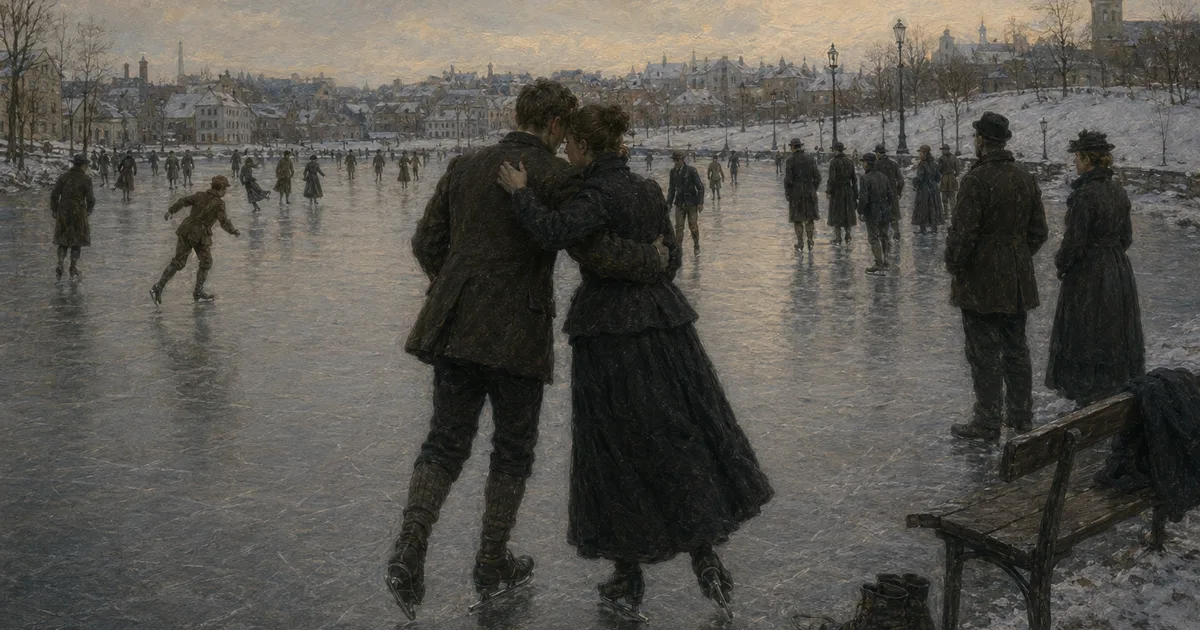
The ice of Mosvannet at the Saturday afternoon was an ice of the city at the winter, with the skaters at it—the men and the women and the children of Stavanger at the ice at the short afternoon, and the lamps of the streets at the upper side of the lake coming on at the four. Olav fastened his skates at the lake-edge and fastened Olava’s at her boots, and the two of them went onto the ice.
The ice of Mosvannet held the city at the afternoon. There were the men of the city at the ice in their coats, and the women at the ice, and the children of the city at the ice the way children were at ice—the small ones held up by the hands, the larger ones at the long glides and the falls and the getting-up again. There were the old men at the lake-edge who had come to stand at the edge and watch the ice and not to skate it. The lamps of the street at the upper side of the lake stood unlit at the afternoon and would be lit at the four. It was the ice of a city at a winter afternoon, a public ice, the ice of a place a city kept at its edge for the going-to of it; and Olav and Olava went onto it among the city, and skated it among the city.
Olava skated well. She skated the way a girl of the islands skated, which was the way of a body that had skated the frozen water before it had thought about the skating of it, and Olav skated at her side. They went round the lake at the first round. Olava had her hand at Olav’s arm at the first round, at the crook of his arm at the inside of his elbow, the way a woman had her hand at a man’s arm at the ice, and Olav skated with her hand at his arm and was at the body-knowing of her hand at his arm.
“You skate the way a Lindøy girl skates,” Olav said.
“I skate the way the children of the islands skated the frozen water.” She said it at the lightness of the ice, and they went round the lake a second time.
“Are you tired?” Olav said at the second round.
“I am not tired. The cold is good. The cold at the ice is a better cold than the cold at the steamer.”
“The steamer is a cold crossing at the winter.”
“It is a cold crossing. The cabin at the Lindøy steamer is a small cabin and the stove at it is a small stove.”
“You will have the cold crossing back at the evening.”
“I will have it. The cold crossing back is the price of the ice.” She said it at the lightness a woman said a thing at the ice, and Olav skated at her side at the second round, and the talk at the ice was a talk Olav was at more of than he had been at any talk of the winter or the summer, because the ice at the afternoon was a place a man and a woman talked at, and the talking was easy at the ice the way it was not easy at the kitchen at the supper with the household at the table.
It was at the ice that the two of them talked of the islands they had skated as children.
“You skated the frozen water at Lindøy,” Olav said.
“There is a small water at the upper side of Lindøy that freezes at the December. The children of the island skated it. I skated it from the time I was small.” She skated at the crook of his arm at the saying of it. “And you skated the water at Finnøy.”
“There is a tarn above the upper field at Vestbø. It freezes early and it holds the ice. Peder and I skated it as boys, and the boys of the farms above the road skated it.”
“The tarn above the upper field.” Olava said it the way a person said back the name of a place she had not been to and was glad to have the name of. “You will skate it again at a winter.”
“I will skate it again at a winter,” Olav said.
They went round the ice. The talk at the ice was the talk of two people who had skated the frozen waters of the two islands as children and were skating the ice of a city lake now at the one winter, and it was the easy talk the ice gave them.
They went to the ice at the afternoons of the days Olava was at the city and the lakes had the ice. They went to Mosvannet at the most of the afternoons, and at one Sunday afternoon they went to Breivannet. The skating at the afternoons of the late November and the December was a thing of the winter Olav had not known would be at the winter when he had been at the writing of the winter at Stavanger at a letter at a watch-bunk of the Atlantic. He had not known the winter would have a frozen lake at it and Olava at the ice of the frozen lake at his side. The body of him at the ice at the afternoons was at a thing the body was glad of, and Olav skated at the afternoons with Olava at the crook of his arm and was glad.
The Sunday they went to Breivannet was a Sunday of the December.
Breivannet was the other lake, at the upper side of the city beyond Mosvannet, and it was quieter than Mosvannet—a lake the city went to less, a lake without the lamps of a near street at the edge of it. They went to it at the afternoon of a Sunday, at the parish-quiet that was at a city at a Sunday afternoon. The ice of Breivannet at the Sunday afternoon had the few skaters at it and not the many, and the slopes at the sides of the lake had the snow at them, and the light of the December Sunday was the short light that would be gone by the four. Olav and Olava skated the ice of Breivannet at the quiet. There was not the talk there had been at Mosvannet, because Breivannet at the Sunday was a quiet place, and the quiet of it was a thing the two of them skated at rather than talked across; and the skating at the quiet—Olava at the crook of his arm, the few other skaters far off at the ice, the snow at the slopes and the short light going—was a thing of the winter Olav set beside the other things of the winter and did not say anything of, the way a man did not say anything of the things he was most glad of. They skated until the light went off the ice. Then they walked down from Breivannet to the city, and Olava went to the wharf for the steamer, and the Sunday was behind them.
It was at an afternoon at the second week of December that Olav carried her across the ice.
They had come to Mosvannet at the afternoon. Olava had her skates at her hand at the lake-edge, and at the fastening of them the strap of the one skate was a strap that had worn at the leather across the winter and had a tear at the leather, and the strap would not hold the skate at the boot. Olava looked at the torn strap. She said the skate would not hold and she would have the strap mended and would not skate at the afternoon, and she would sit at the lake-edge at the bench and watch the ice.
Olav looked at the torn strap.
“You will not sit at the bench,” he said.
He had his own skates fastened. He took Olava’s two skates and her boots-with-the-torn-strap and set them at the bench at the lake-edge. Then he came to Olava and he put his arm at her back and his other arm under her, and he took her up off the lake-edge against his side, and Olava put her arm at his shoulder, and Olav skated out onto the ice of Mosvannet with Olava carried at his side.
The body of Olava carried at Olav’s side at the ice of Mosvannet at the afternoon of the second week of December of 1878 was a weight at Olav’s arm and a closeness at Olav’s side. Olav skated the ice with the weight of her at his arm. He skated it carefully, because the carrying of a woman at the ice was a thing a man did carefully, and the ice had the other skaters at it, and the carrying was a thing the other skaters at the ice saw and a thing a man did at the seeing of the other skaters—which was to say it was a thing of the public ice, a thing a man and his promised wife did at the ice of a city lake with the city at the ice around them, and not a thing of anywhere else. Olav skated Olava across the lake. Her arm was at his shoulder. Her face was at the side of his face at the closeness the carrying made. He felt the cold of the afternoon at his face and the weight of her at his arm and the moving of the ice under the skates, and he skated her the length of the lake and back.
“You skate steadily with a weight at your arm,” Olava said.
“I have carried weights at worse footing than ice.”
“I do not doubt it.” Her arm was at his shoulder, and Olav skated her back toward the lake-edge.
He set her down at the lake-edge at the bench where her skates were.
Olava sat at the bench. She had the color of the cold at her face. She looked at Olav at the few seconds, and Olav looked at her, and neither of them said anything at the few seconds, and then Olava said the strap could be mended at a leather-man she knew of at a street of the lower town, and Olav said he would take the skate to the leather-man, and the few seconds were behind them and the afternoon went on.
Olav took the skate to the leather-man at the street of the lower town at the week after. The leather-man set a new piece of leather at the place the old strap had torn, and Olav paid him the small coin a mended strap cost and carried the skate back up to the room at Kindingstad’s. Olava had the skate again at the afternoon she next came to the city, and the strap held, and she skated the ice of Mosvannet on the two skates the way she had skated it before the strap had torn. The carrying across the ice had been the once, at the afternoon of the torn strap; the strap was mended now, and the carrying did not come again. But the once had been, and it was at the winter with the other things of the winter.
The skating was the warmest the winter had at it.
Olav came to know, at the afternoons of the December at the ice, that he and Olava were at a thing that was not the marriage and was not the not-yet-of-the-marriage either, but was a thing the winter had given the two of them at the time between. They were at the engagement, which had been the engagement since the Bristol letter of the February of 1877, and the engagement was a thing that waited at the school and the certificate and the real navigator a man was to be before the marriage; and the waiting was a long waiting, and the skating at the ice of the city lakes at the December afternoons was a thing the waiting could have at it. Olav had Olava at the crook of his arm at the ice. He had her at the talk at the ice that was easier than the talk anywhere else. He had her carried at his side the once at the afternoon of the torn strap. It was the body-and-the-presence that the winter gave the two of them in the place of the marriage the school still stood in front of, and Olav was at the December at the ice and did not ask the winter for more than the December gave.
At the evenings Olav crossed to Lindøy for the Lindøy-nights, or did not cross because the weather did not let the crossing, and at the evenings he crossed he was at the borrowed boat at the strait at the dark.
It was at one such crossing, at the pre-dawn cross back to Stavanger from a Lindøy-night at the third week of December, that Olav was at the borrowed boat at the strait at the dark with the cold of a December night at the water and the oar-blades. The body of him at the oars at the strait at the dark was the body that had carried Olava across the ice of Mosvannet at the afternoon of the torn strap, and the two—the carrying at the ice at the afternoon and the rowing at the strait at the dark—were the one body’s at the one winter, and Olav rowed the borrowed boat across the dark of the strait toward the lights of Stavanger at the lower end of the upper harbor.