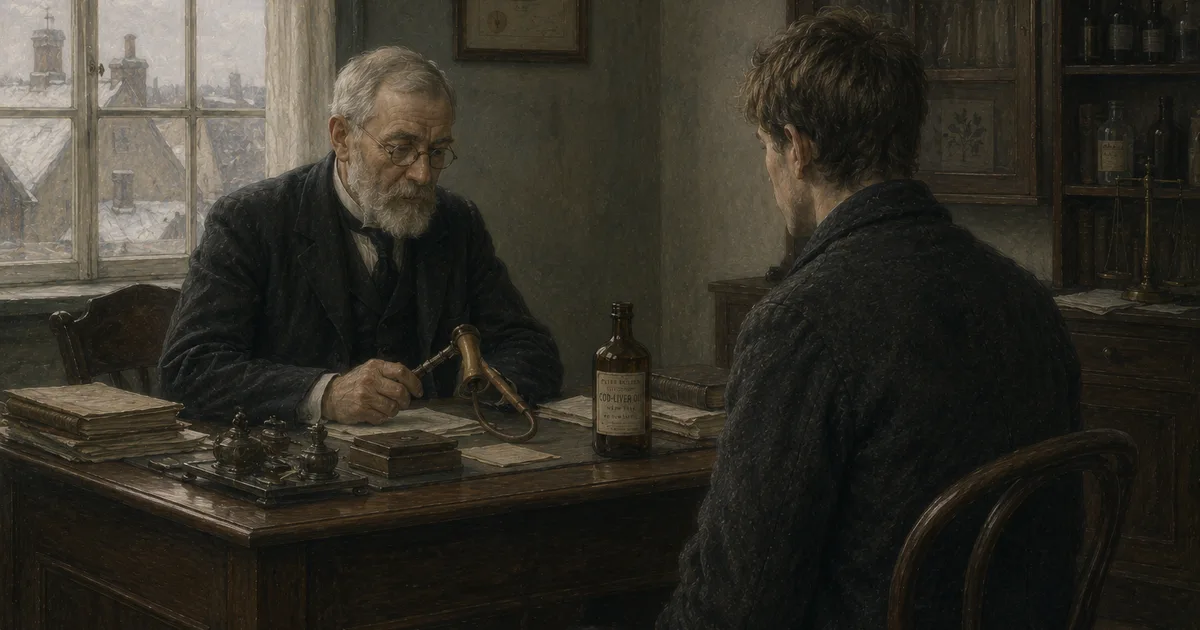
The school took up again at the new year.
Olav had been at Vestbø for the Christmas, at the household with his father and Peder and the aunt, and had crossed back to Stavanger at the first days of the January, and the school had taken up at the chart-work and the celestial tables and the instruments. The January went at the school by the days and at the borrowed-boat-night by the evenings the strait and the weather let it go. The January was a cold January. The strait did not let the crossing at the most of the evenings of it, and Olav was at the third-floor room at Kindingstad’s at the most of those evenings with the chart-work at the table.
It was at the first week of the February that the cough came.
It came at the school. Olav was at the desk at Professor Nilson’s room at the chart-work of the forenoon, the parallel-rule at his hand, and a cough came up at his chest, and he coughed it. It was a cough. A man coughed at a winter; a man at a city at a February coughed the cough of a winter; and Olav coughed the cough at the desk and set his hand at the parallel-rule and went on at the chart. He did not think about the cough at the forenoon.
The cough came again at the afternoon.
It came again at the evening at the room at Kindingstad’s, and at the morning at the school, and at the forenoon at the desk. It came at the days of the first week of the February, and it did not go off the way the cough of a winter cold went off at the four or five days of a winter cold. It held. Olav registered, at the close of the first week, that the cough had held. He knew it the way the body knew a thing—before he had set a word to it, the body had registered that the cough at the chest at the close of the first week of February was not the cough of a winter cold.
He did not set the word to it at the first week.
He went on at the school. He did the chart-work. He coughed the cough at the desk and at the room and at the street, and at the second week of the February the cough was at the chest at the mornings worse than at the evenings, and there was, at the mornings, a thing at the cough that had not been at it at the first week, which was a small wet thing at the lower of the cough that Olav heard at his own chest and did not look at.
The brother had died of the cough.
Olav’s older brother had died of the cough at Vestbø in the years before Olav had gone to sea. He had been a young man. He had been near the age Olav was now—near the twenty-two Olav would be at the spring—when the cough had taken him, and he had died of it at the back room at Vestbø at a winter, and Olav had been a boy at the house at the winter the brother had died. The brother was at the churchyard at Hesby at the row of the stones. Olav did not think about the brother at length at the second week of the February. He thought about him the once, at the room at Kindingstad’s at an evening of the second week, at the hearing of the small wet thing at the lower of his own cough, and then he did not think about him again, because the thinking-about-him was a thing Olav did not let his head go on at.
At the third week of the February Olav went to the doctor.
The doctor was Dr. Due, who had an office at a street of the upper town of Stavanger, and who was a man Olav’s father had known since the years before Olav had been born—a doctor of the kind a man’s father knew, an older man, a man who had been a doctor at Stavanger for the most of a life. Olav went to the office at the afternoon of a day the school let him. He gave his name and his father’s name at the door, and Dr. Due, who heard the name Hestby and the name of Jens of Vestbø, took him into the office.
Dr. Due had Olav take off the coat and the shirt at the office. He listened at Olav’s chest with the stethoscope, the wooden tube of it at Olav’s chest and Dr. Due’s ear at the other end, and he had Olav breathe at the deep breaths and the slow breaths, and he listened at the front of the chest and then at the back, with his hand flat at Olav’s back between the listenings. He had Olav cough. He listened at the cough. He was a while at the listening.
Then he had Olav put the shirt and the coat back on, and he sat at the chair at the desk, and he told Olav what he had heard.
He said the chest was not a chest with the tuberculosis at it. He said it in those words, and Olav heard the words. And then he said the other thing, which was the thing Olav had come to the office to hear and had not let himself know he had come to hear, and Dr. Due said it in the plain voice of an old doctor who did not soften a thing for a young man because the softening did the young man no good.
“Not yet,” Dr. Due said. “But it can become tuberculosis.”
Olav sat at the chair at the office.
“You have a chest that is weak at this winter,” Dr. Due said. “It is not a chest with the disease at it. But it is a chest that the disease could come to, if the winter and the work and the want-of-rest are let to go on at it the way they have gone on. You have been at sea. You have been at the wet and the cold and the bad food of the ships, by the look of you and by what I knew of your voyages from your father’s account of them. The chest has taken that. The chest is telling you now what it has taken. You will take the cod-liver oil. You will take it at the mornings and the evenings. You will rest the chest where the chest can be rested. And you will know that the not yet is a not yet and not a no, and that the keeping of it at not yet is a thing partly at your own hands.”
He gave Olav the cod-liver oil—a bottle of it, the brown bottle of the cod-liver oil a Stavanger apothecary sold—and he named the taking of it, and he said Olav was to come back to the office at the April if the cough had not gone off, and he stood up from the desk, which was the doctor’s way of saying the visit was done.
Olav thanked him. He paid the doctor’s fee at the door. He went out at the street.
The street of the upper town at the afternoon of the third week of the February was a street of the city at a February thaw, the snow at the edges of it gone to the gray of a thaw, the eaves of the houses dripping. Olav walked down from Dr. Due’s office to Kindingstad’s at the streets. He had the brown bottle of the cod-liver oil at the pocket of the coat. He walked down at the streets and the body of him walked, and the body of him at the street had heard the doctor say the thing the doctor had said, and the body of him at the street carried the thing the doctor had said the way the body carried a thing.
He came to the third-floor room. He set the brown bottle at the small table at the side of the bed.
The February went on at the days after.
Olav was at the school at the days. He did the chart-work at Professor Nilson’s room. He coughed the cough at the desk, and Theodor Halversen at the desk at his right heard the cough and did not say anything about it, and the men of the room heard it and did not say anything about it, because a man coughed at a February and the men of a room did not remark on a man’s winter cough. Olav did the chart-work. His hand knew it; he did it.
It was at the evenings at the room at Kindingstad’s that the February was the February.
Olav did not sleep at the nights the way the body slept. He lay at the bed at the room at the nights and the body did not go down into the sleep the way the body went down into the sleep, and Olav lay at the bed at the dark with the cod-liver oil at the small table at the side of the bed and the cough at the chest, and the body did not sleep. He did not eat at the meals at Kindingstad’s kitchen the way the body ate. He ate what a man at a table ate so that the table did not remark on it, and the body did not want the food, and Olav ate it because the eating was a thing a man did and not because the body wanted it. He took the cod-liver oil at the mornings and the evenings, the spoon of it from the brown bottle, and the cod-liver oil was a foul thing at the mouth and Olav took it.
He did not name to himself, at the room at Kindingstad’s at the nights of the February, the thing the body was at.
He had a word for it. The word was a word a man had. But the naming of the thing to himself was a thing Olav did not do, because the naming of it would have been the setting-of-it-loose at the room, and Olav held it at the not-naming the way a man held a thing he could not afford to set loose at a small room at the nights. He lay at the bed. He did not sleep. He took the cod-liver oil. He went to the school at the mornings. He did the chart-work. The thing the body was at was at the body at all of it—at the lying-at-the-bed and the not-sleeping and the not-eating and the cod-liver-oil and the going-to-the-school—and Olav did not name it, and it was at the body unnamed, and that was the February.
He did not cross to Lindøy at the Sundays of the February after the doctor.
The strait did not let the crossing at some of the Sundays, and the strait was the reason a man could give for the not-crossing of those Sundays. But there were Sundays the strait would have let the crossing, and Olav did not cross at those Sundays either. He was at the room at Kindingstad’s at those Sundays, at the chart-work at the table, with the cod-liver oil at the small table and the cough at the chest. He did not cross to Lindøy because the crossing was the crossing to Olava, and Olava at the Lindøy kitchen would see the body of him the way a body was seen at a kitchen at a Sunday evening, and Olav was not, at the February, at a thing he could carry across a strait to a kitchen at Lindøy and have Olava see. He stayed at the room. He did not write to Lindøy the reason of the not-crossing. He let the not-crossing be a thing the strait could be the reason of, and Olava at Lindøy had the strait for the reason, and Olav at the room had the other reason, and the two reasons were not the one reason.
The school went on. The chart-work went on. The examination of the navigators was at the first of the April, and the first of the April was at the five weeks ahead of the February, and Olav did the chart-work for the five weeks ahead the way a man did a thing that was ahead of him whatever else was at the body.
Olav lay at the bed at the room at Kindingstad’s at a night of the close of the February.
He did not know what the cough at his chest would be at the spring. He did not know whether the not yet would hold at the not yet or would go to the thing the not yet stood in front of. He did not know what the navigator’s certificate would be at the wages of a ship, if a ship’s articles at a Stavanger office would take a man with a cough at his chest, or whether the cough would be a thing a ship’s captain heard at the hiring and turned a man away from. He did not know what Olava at the upper window at Lindøy at the Sundays of the February—the Sundays he had not crossed—was at the not-knowing of. He did not know what the body of him that had been at the bars and the wheels and the cat-falls of the ships since the summer of 1875 was, at a third-floor room at a city at a February, with a brown bottle at the small table and a cough at the chest and a brother at the churchyard at Hesby who had died of the cough at near the age Olav was now.
He lay at the bed at the dark and did not sleep, and the February went to its close at the window.