The second day at Stavanger came at the third-floor room at Kindingstad’s at the light of an October morning.
Olav was at the small table at the window. He had the chart-paper and the pencils and the small ruled tables Jens had ordered from a Stavanger man through Lars at the September, the things a student of a navigation school was to have at the first week, and they were at the table at the window, and Olav had set them out at the morning the way a man set out a thing he had not used and was to use. He had not been at a desk since the parish-school at Hesby. He had been at the bars and the wheel and the cat-falls and the chart-table of the Dronningen under Tollefson at the dead-reckoning watches, and the chart-table of the Dronningen had been a thing the body did at the watch; the desk of a navigation school was a thing the body had not done since a boy of fifteen had done it under a parish-schoolmaster at Hesby. Olav sat at the small table at the window and the body of him did not yet know the desk.
The window looked at the wharf at the lower end of the upper harbor where the boats of the islands came in.
It was at the wharf that Olav arranged for the boat.
He went down to the wharf at the forenoon. The wharf at the lower side of the upper harbor was the wharf where the small boats of the Ryfylke came to the city, and there were boats at the wharf at the forenoon and there were the men of the boats, and Olav asked at the men of the boats after a boat he could have the borrowing of for the crossings to Lindøy. A man of the wharf, a boat-man of Hundvåg who knew the Lindøy households and knew Bjørn Olsen Lindøy by name, had a small boat he did not have the use of through the winter, and the boat-man said Olav could have the borrowing of it for the crossings, and they settled the few kroner of the winter’s borrowing. The boat was a small boat of the kind a man rowed at the strait. It had two pairs of oars and a small lug-sail Olav would not have the use of at the most of the crossings of a winter. Olav looked the boat over at the wharf the way a man looked a boat over he would have his life in at the dark of a winter strait, and the boat was a sound boat, and Olav said it would do.
He crossed to Lindøy that evening.
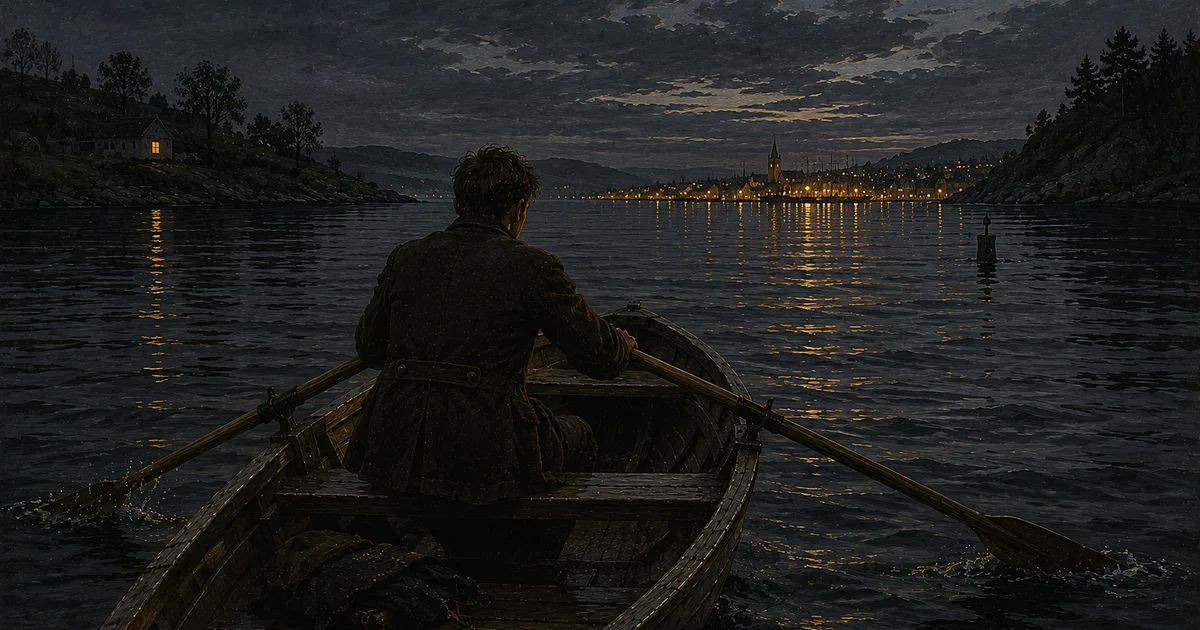
The light at the Stavanger wharf at the late afternoon of the October was the light of an October afternoon at the latitude of Stavanger, which was a light that went early. Olav took the borrowed boat off the wharf at the half past four. He rowed it out of the upper harbor and into the strait that ran out toward the islands of the Ryfylke. The strait was the four miles or so of water between the Stavanger wharf and the Lindøy boathouse, and Olav rowed it at the oars at the rate the body of him rowed a small boat, the rate of a man who had been at the bars and the cat-falls of the Kvik and the American bark and the Sandefjord ship and at the oars of his father’s boat at the summer. The crossing was the better part of two hours. The light went from the light of the October afternoon to the long blue of the October evening at the half of the strait, and Olav rowed the second half of the strait at the long blue, with the slopes of the islands at the two sides going to gray and the water at the oar-blades going to black.
He came to the Lindøy boathouse at the half past six.
The boathouse at the lower end of the slopes was the boathouse Olav had come to at the steamer at the homecoming of the July and had crossed to in his father’s boat at the summer. He came to it now at the borrowed boat at the half past six of the October evening, and the coming-to-it at a borrowed boat at the dark of an October evening was not the coming-to-it of the summer. He made the boat fast at the wharf at the lower end of the boathouse. He went up the path at the slopes to the house at the lower side of the ridge.
The kitchen window of the house showed the light of the lamp.
Olav came to the south door. He did not know, at the door, whether Bertha would be at the surprise of a man at the door at the half past six of an October evening, because the borrowing of the boat had been a thing Olav had settled at the Stavanger wharf at the forenoon and had not sent word of across the strait. He opened the door.
Bertha was at the stove.
She turned at the door. She saw Olav at the threshold. She was not at the surprise of him. She had the soup at the iron pot at the stove and the bread at the cutting-board at the table, and she had, Olav understood at the seeing of the soup and the bread, set the soup and the bread at the knowing that a man at a navigation school at Stavanger with a borrowed boat at the wharf and a household at Lindøy across the strait would be at the door of the kitchen at the evenings of the winter. She had been at the household at Lindøy for the whole of a life, and a woman who had been at a household for the whole of a life knew the shape of a winter before the winter came.
“You will sit at the table,” Bertha said. “The soup is at the stove.”
Olav sat at the table at the place at the east side.
Bjørn was at the parlor. He came to the door at the east wall at the few minutes, the pipe at his hand, and he said Olav had a hard crossing ahead of him at the winter and a hard crossing behind him at the evening, and Olav said the boat was a sound boat, and Bjørn said a sound boat at a winter strait was the half of it and the man at the oars was the other half, and he did not say more than that. He went back to the parlor.
Olava was at the kitchen at her chair at the side of the stove.
She had been at her sewing at the chair when the door had opened. She had the sewing at her lap—a thing of the household, a thing of the linen—and she set it at the small table at the side of the chair when Olav came to the table, and she came to the table and sat at the place at the south side at the side of Olav. She did not say what she had at the half-minute. She had a way of being at a thing without saying it that Olav had been at the summer of and would be at the winter of and would be at the marriage of.
The evening at the kitchen was a short evening.
Olav had the school in the morning and the cross back to Stavanger before the morning, and the evening at the Lindøy kitchen was an hour and the part of an hour after it. Olav ate the soup. He told Bertha and Bjørn and Olava about the room at Kindingstad’s at Bredalmendingen and the window that looked at the wharf where the Lindøy boats came in. He told them about the navigation school building he had walked to at the first day. He did not tell them a long telling of it, because the room and the window and the school building were not yet things that had happened to him; they were things that were to happen to him; and a man did not give a long telling of a thing that had not happened yet. Olava sat at his side at the table and heard the telling. Bertha sat at the north side. Bjørn did not come back from the parlor.
At the kitchen at the half past eight Olava said the strait would be at the dark for the cross back and Olav should not be late at the wharf.
“Yes,” Olav said.
He stood at the chair. He thanked Bertha for the soup and the bread. Bertha said the soup and the bread would be at the stove and the cutting-board at the evenings of the winter, and that Olav was not to thank her at every evening of a winter for a thing that was at the stove, and that he should go now and not be late at the wharf. Olav said yes.
Olava walked with him down the path to the boathouse.
The path at the slopes at the half past eight of the October evening was at the dark. Olava walked at his side. She did not speak at the walk down. At the wharf at the lower end of the boathouse she stood at the stones while Olav put the boat off, and she said, at the boat going off the wharf, that the lamp would be at the kitchen window at the evenings he made the crossing. Olav said yes. He took the boat out at the oars into the dark of the strait.
The cross back to Stavanger was at the dark.
Olav rowed the borrowed boat at the strait at the dark of the October night with the lamp of the Lindøy kitchen window astern of him and going small, and the lights of Stavanger at the lower end of the upper harbor ahead of him and going large. The strait at the dark was the strait at the dark; the body of him rowed it; the body of him knew the water at the small scale of a strait the way it knew the water at the large scale of an ocean, and the knowing at the small scale was a knowing the summer at the two islands had set in the body, and the body rowed the boat across the dark of the strait at the better part of two hours.
He came to the Stavanger wharf at the small hours of the morning.
He made the boat fast at the wharf where the boat-man of Hundvåg had said to make it fast. He walked up from the wharf into the city. The streets of the upper town were at the dark and the quiet of a city at the small hours, and Olav walked up by the streets to Bredalmendingen and came to Kindingstad’s and went up the stairs to the third floor. Kindingstad’s door-rule of the ten of the evening was a rule for the lodgers who were at the city at the evenings; Olav had settled with Kindingstad at the second day that a lodger who crossed a strait at the nights would come in at the hours a strait gave him, and Kindingstad, who took the rent and kept the rules and had kept a lodging-house at a harbor city for the years of it, had said that a lodger who paid the rent and did the coming-in quietly could come in at the hours the lodger’s life gave him.
Olav came into the third-floor room at the small hours.
He did not light the candle. He lay at the bed at the room at Kindingstad’s at the few hours that were left of the night, and the body of him at the bed was the body of a man who had been at the school-paper at the table at the morning and at the wharf at the boat-arranging at the forenoon and at the oars of a borrowed boat at the strait at the evening and at the Lindøy kitchen at the supper and at the oars of the borrowed boat at the strait again at the dark. The body of him had crossed the strait twice in the one day. The body of him would cross the strait at the evenings of the winter that the strait and the weather and the school let him cross it, and would be at the school at the days, and would be at the room at Kindingstad’s at the hours between, and the rhythm of it was a rhythm the day had set at its first turning.
Olav lay at the bed until the light came at the window.
The light at the window at the dawn was the light of an October dawn at Stavanger. Olav got up from the bed and stood at the small table at the window. The wharf at the lower end of the upper harbor was at the gray of the dawn. The borrowed boat was at the wharf where he had made it fast at the small hours. The school’s first day was at the three hours ahead.
Olav stood at the window at the dawn-light.
He had crossed to Lindøy and back at the one day, and the school he had come back from the sea to be at was at the morning ahead, and the body of him at the window at the dawn was at the start of the thing the room and the boat and the school and the strait would be at the winter. He did not know the winter yet. He knew the first turning of it, which he had done, and he stood at the window at the dawn-light of the room at Kindingstad’s at Bredalmendingen with the school’s first day at the three hours ahead.