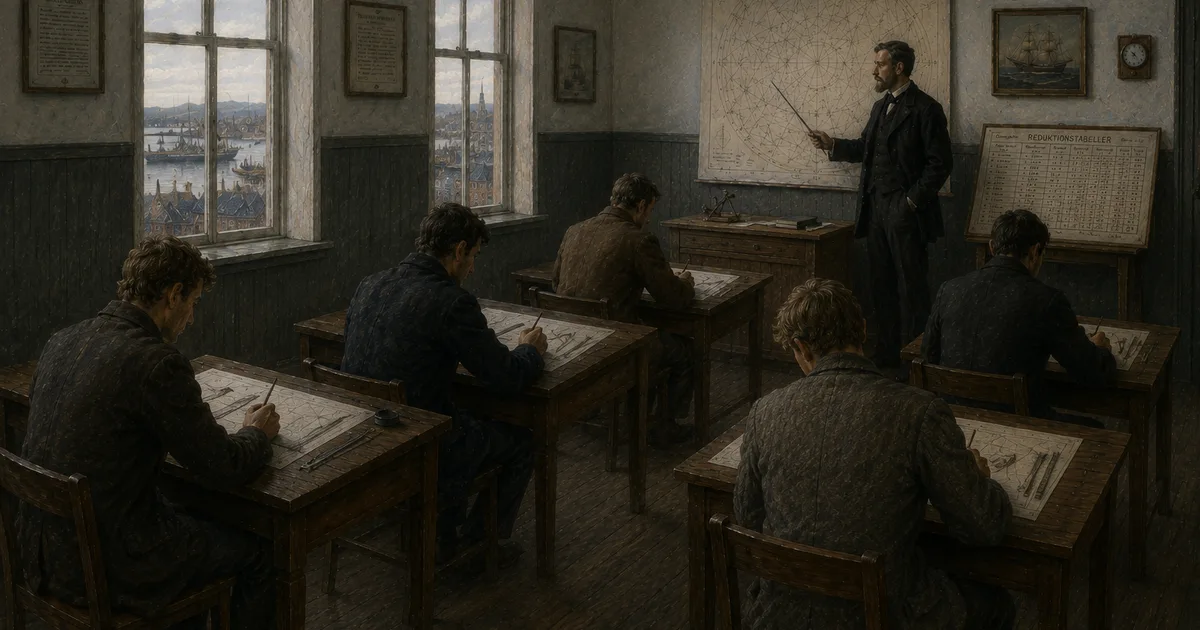
The navigation school took the students at the eight of the morning of the first day at the front hall of the building at the upper town of Stavanger.
Olav came to the building at the streets he had walked at the first day from Kindingstad’s, and the body of him had the route now, the way the body had a route at the second walking of it. He came to the front hall at the eight less a few minutes. The front hall was a hall of a stone building of the city, and the students of the navigation school were at the hall before the eight—the hundred and twenty of them, by the count a man heard at the hall, the men who had come to Stavanger for the winter at the school the way Olav had come.
The students at the front hall were men of the kind Olav had been at sea with. They were men of twenty and twenty-five and thirty, men who had been at the bars and the wheels and the cat-falls of the ships and had come to the school for the navigator’s certificate the way a man came to a thing he had done the work for and wanted the paper of. Olav stood at the hall among them. He did not know any of them at the hall, and he did not look to know any of them, because a man at a hall of a hundred and twenty did not look to know a face; he waited at the hall for the thing the hall was for.
The front hall at the eight less a few minutes was a hall of a hundred and twenty men and the sound a hundred and twenty men made at a hall before a thing began. They stood at the hall in the coats they had come to the city in. Some of them knew each other—men who had been at a ship together, or at a town together, or at the school’s first reckoning a year before, had not passed the examination, and had come again—and the most of them did not, and the hall was the hall of a hundred and twenty men the most of whom did not know each other and would come to know the thirty or so of their own rooms across the winter and not the rest. Olav stood among them. He had stood at the musters of the ships, where a crew was named over at a deck; and the front hall of the navigation school at the eight of the first morning was a kind of muster too, and Olav stood at it and waited the way a man waited at a muster.
Dean Gabrielson came to the front of the hall at the eight.
He was a man of sixty in a dark coat. He stood at the front of the hall and named the school and the term of it—October to April, the certificate at the close for the men who passed the examination of the first of April—and he read the rooms and the teachers. There were four teachers and four rooms. He read the names of the students at each room. Olav heard his own name read at the third reading, which was the room of Professor Halvdan Nilson, and he heard, at the same reading, the names of the men who would be at the room with him through the winter, though he did not yet set the names to the faces.
The students went to the rooms.
Professor Nilson’s room was a room at the upper floor of the building. It had the desks at the rows, and a chart at the wall at the front, and a celestial-navigation table at the front beside the chart, and a window at the side wall that looked at a street of the upper town. There were the thirty students of the room, near enough to thirty, and they took the desks at the rows the way men took desks at a room—the front desks last, the back desks first, the middle desks at the order a man found a place.
Professor Nilson came to the front of the room.
He was a man of about forty. He had a coat of a teacher and a beard kept short and a way of standing at the front of a room that was the way of a man who had stood at the front of a room for the years of it. He named himself to the room. He said he was Halvdan Nilson and he would have the room for the winter, and that the men of the room had come to the school having done the sea-work, and that the school was not the place a man learned the sea; the school was the place a man learned the reckoning that the certificate of a navigator asked a man to have set down on paper. He said the work of the room would be the chart-work and the celestial tables and the instruments. He said it in the voice of a man who had said the same thing at the first morning of the winter for the years of it, and the voice was not the voice of a hard man.
Olav had taken a desk at the middle of a row.
The man at the desk at his right turned and looked at him.
Olav knew the face. It was a face Olav had been at the watches of a bark with, at the starboard watch of the Dronningen under Pallesen, at the run from Stavanger to Archangel and Bristol and Cardiff and the Atlantic and Jamaica and Wilmington and the long way home—a face Olav had been at the jib-boom with at a parting splice off Cape Verde and at the chain-locker with at Jamaica. It was Theodor Halversen.
“You are at the school,” Theodor said.
“I am at the school.”
“I did not know you would be at the school.”
“I did not know you would be at it either.”
Theodor Halversen nodded once. He was a man of few words at the Dronningen and he was a man of few words at the desk at Professor Nilson’s room, and the few words he had said were the words a man said when he had been at the watches of a bark with another man for a year and more and had not seen him since the Dronningen, and the two of them set the words down and that was the recognition done. Theodor had been at the Dronningen a deckhand of Olav’s own kind. He had killed a scorpion at the chain-locker ladder at Jamaica with a pipe-wrench and had said it is gone and had not said more. He was at the desk at Olav’s right at Professor Nilson’s room now, and the friendship that had been a watch-friendship at a bark was a thing that took up at a desk-row at a school without either of them making an occasion of the taking-up.
The other men of the room Olav came to know across the first day the way a man came to know the men of a room—not at an introduction but at the desks and the corridor and the noon.
Erik Rasin was a man of Olav’s own age at the desk at the row in front, broad at the shoulders, who had been on the Bergen ships. Laland was an older man, near thirty-five, at the back of the room, who had a way of sitting at a desk that said the desk did not come easy to him. Tonning was a quiet man at the window-side. Hamre was a man of about twenty-five at the desk two places from Olav’s, dark-haired, who had a quickness at the talk of the corridor and a slowness at the chart-paper that Olav did not register at the first day as a thing that would matter and would register later. Sivert Murer was at the front row. They were the men of the room, and they were the men Olav would be at the desks and the bench and the chart-work with for the winter, and Olav took the measure of them the way a man took the measure of a forecastle at the first day of a voyage—not to know them yet, but to know the room they made.
The room of thirty men was the company Olav would be at the winter with, and it was a company of a kind the body had not been at before. A forecastle was a company too—the men of a watch were a company, bound at the work and the watch and the one bad weather—but a forecastle was a company at the sea, and the room at Professor Nilson’s was a company at the desks: thirty men of the sea set down at the desks of a school for a winter to get the paper the sea-work had earned them. They were not a watch. There was no weather to bind them and no work aloft to bind them; there was the chart-paper and the celestial tables, and the examination of the first of April standing at the end of the winter for all of them. Olav had come to know the men of the forecastles by the watches and the weather. He would come to know the men of this room by the desks and the chart-work and the corridor at the noon, and it would be a slower knowing and a different knowing, and it would be the knowing the winter gave.
It was at the corridor at the noon that Olav came to the Finnøy face.
The man was at the corridor at the noon among the students of the four rooms. He was a man of about Olav’s age. Olav knew the face for a Finnøy face before he knew the name—the way a man knew an island face at a city, which was a knowing that came before the name and was a different knowing than the knowing of a name. The man saw Olav at the same moment, and the man’s face did the same thing Olav’s was doing, and the two of them came to each other at the corridor.
“You are from Finnøy,” the man said.
“From Vestbø at Finnøy. Olav Hestby.”
“Christian Naaden. From the Naaden farm at the upper side of the island.”
Olav knew the Naaden farm. He did not know Christian Naaden; the Naaden farm was at the upper side of Finnøy and Vestbø was at the lower, and the two of them had not been at the parish-school together or at the Hesby church in a way that had put them at an acquaintance. But the Naaden farm was a name Olav had known the whole of his life, the way a man knew the names of the farms of his own island, and Christian Naaden knew the name Hestby the same way, and the two of them stood at the corridor of the navigation school at Stavanger at the noon of the first day and were, at the city, two men of the one island. It was a small thing. It was the thing of a Finnøy face at a corridor of thirty desks and a hundred and twenty students, and it was not a small thing either.
Olav took the noon meal with Theodor Halversen.
The school broke at the noon for the hour the students took the noon meal, and the men of the rooms went down to the front hall and out to the street, and Olav and Theodor went out with the noon meal each of them had brought. They ate it at a low wall at the side of the school the way two men ate a noon meal at a wall. Theodor said little, the way Theodor said little. But the little he said at the wall was the talk of two men who had been at the watches of the Dronningen together—the starboard watch under Pallesen, the run to Archangel and Bristol and the Atlantic, the men of the bark and where the men of the bark had gone since. Theodor asked where Olav had been since the Dronningen. Olav said he had been on a bark in the American trade and had come home in the summer past, and he did not say the whole of it; and Theodor did not ask the whole of it, because Theodor had been at a forecastle with Olav and knew that a man told the whole of a thing or did not, and that a noon-wall at a school was not a place a man was asked. Theodor said he had been at sea since the Dronningen and had come to the school for the certificate the way Olav had come for it. The two of them ate at the wall, and the watch-friendship of the Dronningen was at the wall with them, and neither of them made an occasion of it.
In the afternoon the chart-work began.
Professor Nilson stood at the chart at the wall at the front of the room and laid down the first position for the room to see it laid. He had the courses and the distances of a reckoning—a ship’s courses and distances such as a watch set down on a slate at sea—and he laid the position on the chart with the parallel-rule and the dividers, naming the steps of it as his hand did them, the way a teacher named the steps of a thing the room was to do after him. Then he set the room to do it. The thirty men of the room bent to the charts at the desks, and the room went to the quiet of a room of thirty men at a thing of the hand and the head, and the only sounds of it were the small sounds of the parallel-rules walked across the paper and the dividers set and lifted. Professor Nilson came down the rows as the men worked and looked at the charts. He came to Olav’s desk and looked at the position Olav had laid down on it and said nothing, which was the thing a teacher’s silence said at a position laid down right.
Olav had a chart at his desk and the pencils and the parallel-rule and the dividers. He had done the reckoning at the chart-table of the Dronningen under Tollefson at the dead-reckoning watches, with the log-line and the glass and the compass and the leeway, and the reckoning at the chart-table of the Dronningen had been a thing the watch did and the body learned. The chart-work at the desk at Professor Nilson’s room was the same reckoning set down on the school’s paper with the school’s care. Olav’s body knew the reckoning. His hand at the parallel-rule and the dividers was the hand of a man who had laid down a position at a bark’s chart-table, and the school was not the place the hand learned the work; the school was the place the work was set down and signed and made a certificate of.
He saw, at the first afternoon, that the chart-work would not be the hard part of the winter for him.
He saw also, at the desk two places from his, that Hamre’s hand at the parallel-rule was not the hand of a man whose body knew the reckoning, and that the chart-work would be a harder winter for Hamre than for the men whose hands had been at a bark’s chart-table. He did not say anything about it. He registered it the way a man registered a thing at a room he would be at for a winter, and he set it beside the other things of the first day, and he went on with his own chart.
The first day ended at the four of the afternoon.
Olav walked back to Kindingstad’s at the streets, the body learning the route a fourth time, and he came to the third-floor room and set the chart-work of the day at the small table at the window. The window looked at the wharf at the lower end of the upper harbor where the Lindøy boats came in. The light at the window had gone to the long blue of an October evening. Olav stood at the window for the few minutes at the evening of the first day of the school, with the chart-work at the table beside him and the wharf at the lower streets going to the dark.
The chart-work of the first day was at the table—the chart with the first position laid down on it, the work Professor Nilson had set and the room had done. A school was a thing a man carried home to a third-floor room at the close of the day; the work did not stay at the desk the way the work of a ship stayed at the ship. Olav had not had work that came home with him before. The work of the farm had stayed at the farm and the work of the ships had stayed at the ships, and the chart-work of the navigation school came up Bredalmendingen to the third-floor room at Kindingstad’s in a man’s hand at the close of the day, and would go back down to the school in the morning, and that was a thing the winter would be.
He had been at sea since the summer of 1875. He had come back from the sea to a desk and a chart and a room of thirty men, and the desk and the chart and the room were the work he had come back for, and the first day of the work was behind him.