Olav crossed to Stavanger at the coast-steamer from Judaberg at the morning of the first day of October of 1878.
He had left Vestbø at the early morning. Peder had rowed him across to Judaberg in the father’s boat at the first light, the way the household sent a man to the Judaberg steamer, and Jens had come down to the Vestbø landing at the leaving and stood at the landing while the boat went off across the strait. The leaving of Vestbø at the first day of October was not the leaving of a man going to sea. A man going to sea left at the chest and the articles and the not-knowing of the when of his coming back; and Olav left Vestbø at the first day of October at the leather bag and the four hundred crowns and a school at Stavanger, and would be back across the strait at the Lindøy-nights of the winter and back at the Vestbø kitchen at the Christmas, and the leaving was a leaving of that kind. Jens had said at the landing the few words a father said at a landing. Peder had rowed the boat. The father’s boat had crossed to Judaberg at the October morning, and Olav had taken the coast-steamer from the Judaberg wharf.
He stood at the passenger-deck of the steamer at the run down the fjord. He had stood at the passenger-deck of a steamer once before, at the Hamburg mail-steamer at the run to Stavanger at the July, and the standing at a passenger-deck was a thing the body of him had not had at the years before the July—it had been at the forecastles and the bars and the cat-falls of the ships, and at the oars of his father’s boat at the summer, and now it was at the passenger-deck of a coast-steamer at the run to Stavanger at an October morning, and a man at the passenger-deck did not have the watch and did not have the work. He stood at the rail. He had the leather bag at his hand. He did not have the chest; the chest was at the foot of the bed at the back room at Vestbø, and Olav had left it there because a man did not take a sea-chest to a room at a navigation school. He had the leather purse with the four hundred crowns at the inside pocket of the coat, and he had the rest of what the coat carried.
The steamer came to the Stavanger wharf at the noon.
The wharf at the lower end of the upper harbor was the wharf Olav had been at three times now—at the eighteenth of July of 1876 at the Dronningen loading, at the twenty-seventh of July of 1878 at the homecoming, and at the first day of October of 1878. The stones of the wharf were the stones. Olav had come to know the wharf as a place a man knew, the way a man came to know a wharf he had been at three times across two years and three months, and the knowing was a small thing and was a thing nonetheless.
He walked up from the wharf into the city.
The walk from the wharf to Bredalmendingen went up by the streets of the upper town. Olav walked it at the leather bag at his hand. He passed the office of Helland at the lower end of one of the streets—the office where Helland had put him to the Dronningen in the July of 1876, the office of the Stavanger agent who put Finnøy and Ryfylke men to the ships that wanted crew. The office was at its door and its window the way it had been at the July of 1876. Olav did not go in. He had no ship to be put to. He passed the office and went on up.
He came to the corner of Pedersgate.
The photographer’s studio of Augustsen was at the upper side of the corner of Pedersgate, at the rooms above the street, where it had been at the July of 1876 when Olav had sat at the chair with the cap at his hand and the photographer had set the lamp at the side and made the carte-de-visite. The studio was at its windows the way it had been. Olav passed it. He had the carte-de-visite at the wallet at the side pocket of the coat—the carte-de-visite of Olava, of the sitting Olava had made at the same studio at the same July of 1876, the carte-de-visite she had given him at the week he had given her the carte-de-visite of himself that was now at the chest of drawers at the upper room at Lindøy. Olav set his hand at the wallet at the side pocket at the passing of the studio. He did not take the wallet out. He set the hand back at the side and went on up Pedersgate.
The boardinghouse at the corner of Bredalmendingen and Pedersgate was the boardinghouse Olav had been at in the July of 1876, at the small upper room at the third floor where he had slept the nights of that July week. That had been the week Olav had come to Stavanger and seen Olava—the photographer’s chair at Pedersgate, the dinner at Rossøygate, the meeting at the Bethania—the summer before the Dronningen carried him to Archangel and the years that came after Archangel; and the boardinghouse had been the room a youngman had the week at. Olav passed it now at the leather bag and the four hundred crowns and the two years of the ships behind him. He did not go in. He had no week to be at it; he had a room taken farther up the street. Kindingstad’s was farther up Bredalmendingen, at a house at the upper end of the street, and Olav had the address of it at a paper Jens had got from a Stavanger man at Judaberg, and he came to the house at Kindingstad’s at the half past noon.
Kindingstad was a man of about sixty at a gray coat. He took the rent of the first month at the door. He showed Olav up the stairs to the third floor and named the rules of the house at the stairs—the door at the ten of the evening, the meals at the kitchen at the hours Kindingstad’s wife set, the no-candles-left-burning. Olav said yes at the rules. Kindingstad showed him the room and went back down the stairs.
Kindingstad’s was a house that took lodgers, and at the winter it took the men of the navigation school. There were two other school-men at the rooms of the second floor—Olav had heard them named at the stairs as Kindingstad took him up, and would come to know them at the kitchen table at the suppers—men who had come to Stavanger for the winter the way Olav had come. The meals of the house were at the kitchen at the ground floor at the hours Kindingstad’s wife set. Kindingstad’s wife was a woman of about the age of Kindingstad, and Olav had seen her at the kitchen door at the coming-in—a woman in an apron at a kitchen that had the smell of a kitchen at the noon—and she had looked at the new lodger the way the wife of a lodging-house looked at a lodger her house had taken for a winter, and had said the supper was at the six, and had gone back to the kitchen.
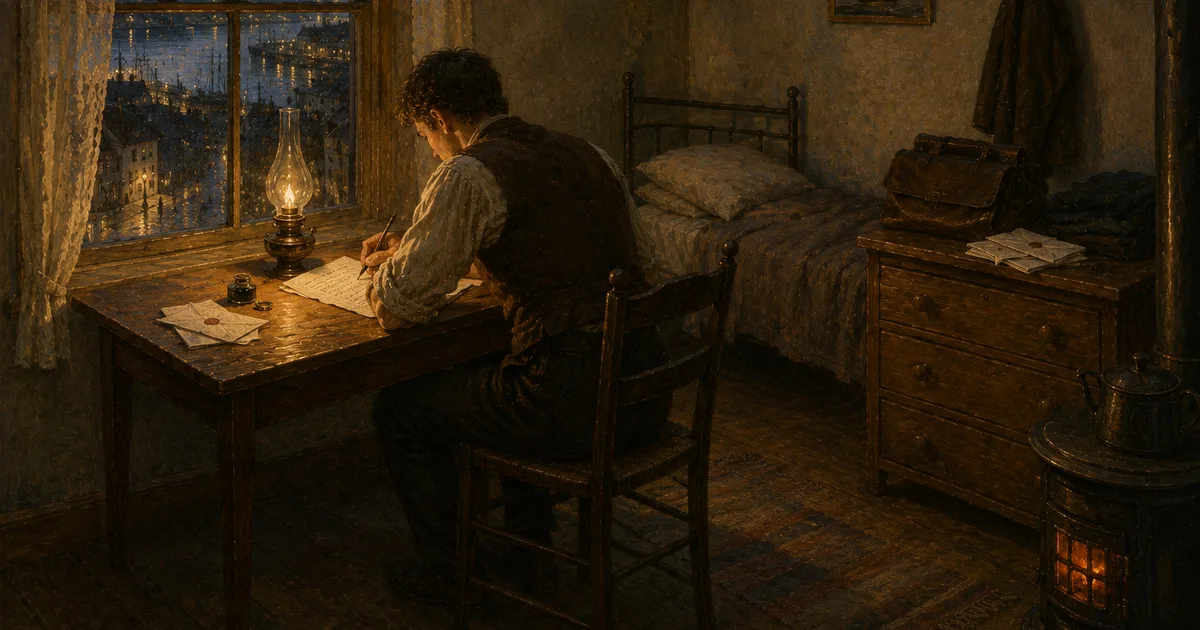
The room was a room at the third floor at the upper end of Bredalmendingen. It had a bed and a chest of drawers and a small table at the window and a chair. It had a stove of the small kind a Stavanger lodging-house put at a third-floor room.
The window of the room looked at the harbor.
Olav stood at the window. The window looked down across the roofs of the lower streets to the wharf at the lower end of the upper harbor—not the wharf the coast-steamers came to, but the wharf at the lower side of it where the small boats came in, the wharf where the Lindøy boats and the Finnøy boats and the boats of the islands of the Ryfylke came to the city. Olav stood at the window of the third-floor room at Kindingstad’s and looked down at the wharf where the Lindøy boats came in, and he understood, standing at the window, that he had taken a room at a window that looked at the wharf where the boats from Lindøy landed, and that Olava at her crossings to Stavanger across the winter would come to the city at the wharf at the window’s view.
He set the leather bag at the chair.
Then he took the things of the leather bag out and set them at the room. There were not many things—the clothes of the bag, which went at the chest of drawers, and the few things besides; and there were the things the coat carried, which Olav did not take out of the coat. He set the clothes at the drawers and stood the emptied leather bag at the top of the chest of drawers. The room had the bed and the chest of drawers and the table at the window and the chair and the small stove, and it was a room of the kind a lodging-house kept, a room that had held a lodger before Olav and would hold one after him. It was not a forecastle, and it was not the back room at Vestbø. It was the room the months of October to April would be lived at, and Olav set it as far as the few things of the bag let it be set.
In the afternoon he walked to the navigation school.
The navigation school was at a building of the upper town that Olav walked to from Kindingstad’s at the streets a man walked to come to it. He did not go in. The school took the students at the days of the first week of October and the day was not yet the day. He stood at the street at the outside of the building and looked at it. It was a building of the city, of stone and of two stories, and it was the building Olav had come back from the sea to be at for the months of October to April, and he looked at it from the street the way a man looked at a thing he would be at and was not yet at. Then he walked back to Kindingstad’s at the streets he had come by, and the walking-back was the body of him learning the route a second time, because the route from Kindingstad’s to the school was a route the body would walk at every school-day of the winter and the body learned a route by the walking of it.
Olav had not been at a school since the parish-school at Hesby. He had been at the parish-school as a boy, at the reading and the writing and the figuring and the catechism, and had been confirmed out of it under Rev. Lindbergen in the spring of 1872; and from the parish-school the body had gone to the work of the farm and then to the work of the ships. It had been at the work of the body for the years since—the farm-work and the boat-work and the forecastles and the cat-falls—and the work of the body was the work the body knew. The navigation school at Stavanger was not the work of the body. It was the desk and the chart-paper and the celestial tables, the work of a man’s head set down on a school’s paper to be examined; and Olav, walking back from the school-building at the first afternoon, was a man of twenty-one going back to a desk, and the going-back-to-a-desk at twenty-one was a thing the winter ahead would be made partly of.
He came back to the third-floor room at the evening.
At the six Olav went down to the kitchen of Kindingstad’s for the supper.
The kitchen at the ground floor had the one long table, and the supper of the house was at the table at the six—Kindingstad at the head, and Kindingstad’s wife at the serving of it, and the two other school-men at the sides, and Olav at the side. The two school-men were a man from up the Boknafjord and a younger man from Jæren, and the two of them had come to Stavanger for the navigation school the way Olav had come and were at Kindingstad’s for the winter the way Olav would be. The talk at the table was the talk of three men and a fourth at the first supper of a winter—where a man was from, and what ships a man had been at, and what room of the school a man had been read into. The Boknafjord man had been on the Bergen ships. The Jæren man had been at the Mediterranean trade. Olav said he had been on a bark in the American trade, and named the Dronningen, and did not name the way the Dronningen voyage had ended for him or the ships that had come after it. The supper was the supper of a Stavanger lodging-house, plain and enough of it, and the talk was the easy first talk of men who would be at the one table through a winter; and at the close of it the school-men went up to the rooms, and Olav went up to the third floor.
He sat at the small table at the window. The light at the window had gone to the evening. The wharf at the lower end of the upper harbor was at the lamps coming on at the lower streets.
Olav wrote a letter to his father at the table at the window before the evening was old. It was the letter a son wrote at the first evening of a thing his father had crossed to Stavanger and stood at the Vestbø kitchen table about—the letter that said the crossing was made and the room was taken and the school took its students at the first week. He wrote that the room was a third-floor room at a lodging-house at the upper end of Bredalmendingen, and that the keep of it was at the rent his father knew the figure of, and that the man of the house and the man’s wife kept it the way such a house was kept. He wrote that he had seen the school from the street and would be at it at the first week of October. He did not write the other things, because the other things were not yet things a letter had to carry—the chart-work was not begun, the winter was not begun, and a letter of the first evening was a letter of the arriving and not of the thing arrived at. He signed it Olav Hestby of Vestbø and folded it for the post.
Olav took the two letters of Olava from the breast pocket of the coat—the letter of the engagement-yes from the Bristol of the February of 1877 and the letter from the Cape Verde of the spring of 1877—and he held the two letters at his hand at the table at the window. He had carried the two letters at the breast pocket of the coat through the Kvik and the American bark and the Sandefjord ship and the homecoming and the summer. He did not read them at the table. He held them for the few minutes and set them back at the breast pocket.
The room at the third floor at Kindingstad’s at the evening of the first day was a room of a man at the start of a thing.
Olav sat at the table at the window at the evening.
He did not know what the school year would be at the chart-work and the celestial-navigation tables, because he had not been at a desk since the parish-school and the desk of a navigation school was not the desk of a parish-school. He did not know what Olava would be at her crossings to Stavanger across the winter, or at the times the winter would and would not let a boat make the crossing. He did not know what the body of him that had been at the bars and the cat-falls of the ships for the years would be at a third-floor room and a desk and a city across the months of an October-to-April. He did not know what the four hundred crowns at the leather purse at the inside pocket of the coat would be at the rents and the meals and the keep of the winter, or whether the careful-with-a-thing his father had named at the kitchen table at Vestbø would carry the purse the length of the year.
He sat at the table at the window until the lamps at the lower streets were all of them lit.
Then he banked the small stove and lay at the bed at the third-floor room at Kindingstad’s at Bredalmendingen at the first day of October of 1878, and the school’s first week was at the days ahead.