The bark came to her anchor at the Brooklyn anchorage at the noon of the thirty-second day of the run from Hamburg.
The pilot came aboard at the bar at the morning watch and brought her up through the Narrows under the wind at the south-west at six knots and let her go at the anchorage at the head of the Buttermilk channel where the captain had said the anchor would go. The bark dropped the larboard anchor and laid out the chain. The pilot left at the half hour after the noon. The captain went into the cabin at the half hour after the pilot.
The crew was on deck for the harbor-furl.
Olav was at the foretop. The Dane was at the foreyard-arm at the lee side. The boatswain was at the deck at the foot of the foremast. The French seaman was at the upper end of the mainyard. The little Swede was at the cat-falls of the larboard anchor at the foredeck. The two German wharf-hands were at the main-deck running gear. The man called the Red Shirts was at the larboard rail at the upper end of the deck-house. The Austrian steward was at the galley.
The watch furled the topsails and the topgallants and the courses at the running rigging of the harbor-furl. The work took two hours. The watches went below at the change of the bells of the afternoon watch at the eight bells of the afternoon. The bark was at anchor at the Brooklyn anchorage at the head of the Buttermilk channel at the lower end of the East River.
The morning of the thirty-third day came over the anchorage at the change of the morning watch.
The Swedish first mate was at the deck at the morning. He saw the rail and the lee and the steward’s galley and the second mate’s bunk and did not say anything at the seeing. He went aft to the cabin door and the captain came up at the cabin door and the two men talked at the cabin door for some minutes and the captain went back down to the cabin and the Swedish first mate went forward to the foredeck.
The Swedish first mate told the crew at the foredeck that the bark would not unload at the wharf until the third day at anchor at the earliest and that no man would have the wages of the run from Hamburg before the unloading was begun and that the captain would have a new second mate and a new steward signed onto the articles before the unloading was begun. He said the watches would be the anchor-watches of an American bark at anchor at Brooklyn at the fourth week of March.
Olav said yes.
The Dane said yes.
The French seaman went over the rail at the night of the thirty-third day at the half past nine of the evening with a boardinghouse-runner from a skiff at the lee. The boatswain went at the noon of the thirty-fourth day with a boardinghouse-runner who had been at the deck for the first hour of the morning watch with the Swedish first mate and had come up to the foredeck at the change of the bells. The two German wharf-hands went at the evening of the thirty-fourth day.
Olav and the Dane were on the foredeck at the change of the bells of the morning watch of the thirty-fifth day.
The two of them had been at the anchor-watches through the third night and the fourth night of the anchorage. They had taken the watches in halves and slept in halves at the bunk-row of the forecastle. The Swedish first mate had not said the two of them should take the watches in halves. The Swedish first mate had been at the cabin and at his own bunk at the four watches. The captain had been at the cabin.
The boardinghouse-runners came aboard at the change of the bells of the forenoon watch of the thirty-fifth day.
There were two of them. They came up the larboard side at the gangway at the lee. The Swedish first mate was at the foredeck and saw them come up and went to the cabin door and the captain came up at the cabin door and the captain and the Swedish first mate stood at the upper end of the deck-house while the two boardinghouse-runners came forward at the main deck to the foredeck where Olav and the Dane were at the foremast pin-rail.
The first runner was a small man in a green coat with a soft hat at the head and a revolver at the coat-pocket at the outside of the coat where the shape of the revolver was at the cloth of the coat. The second runner was a larger man in a black coat with a hat of a different cut and a revolver at the inside-pocket. Both men had the English of New York wharf-runners at the consonants and at the vowels.
The first runner spoke at the foredeck.
He said in the English of a New York wharf-runner that the two men at the foredeck had been at the run from Hamburg for thirty-five days and were at the anchor-watches at the Brooklyn anchorage for the fourth day of the four days and that the captain was not paying the wages of the run at the anchorage and would not pay the wages of the run at the anchorage and was a captain who did not pay the wages of a run that had begun at the Elbe at the noon tide of a Day Fifty-nine of February of 1878. He said the two men at the foredeck should know that the boardinghouse at the upper end of Pearl Street had a bed for each of them at the night of the thirty-fifth day and a meal for each of them at the night of the thirty-fifth day and a berth at a Liverpool bark at the morning of the thirty-sixth day for each of them at the wages of fifteen dollars at the month.
The second runner did not speak.
He stood at the lee of the larboard pin-rail with the right hand at the side of the coat where the inside-pocket was at the coat.
Olav looked at the first runner.
The Dane looked at the first runner.
Olav said in the English he had learned at the back room at the upper end of Front Street at Wilmington and at the bench at the table at the forecastle of the bark for thirty-five days that he was not going to the boardinghouse at Pearl Street and was not signing onto the Liverpool bark at the morning. He said he was at the bark and he was going to be at the bark until the captain paid the wages of the run from Hamburg.
The Dane said in the English of a Danish able seaman who had been at the foredeck of the bark for thirty-five days that he was not going to the boardinghouse at Pearl Street and was not signing onto the Liverpool bark and that he was at the bark until the captain paid the wages.
The first runner looked at Olav.
He said in the English of a New York wharf-runner that the captain was not going to pay the wages and that the two men at the foredeck were not understanding the way New York worked at the anchorage of a Hamburg-bark with a captain who was at the cabin. He said the second runner at the lee of the larboard pin-rail had a revolver at the inside-pocket of the coat and that the first runner himself had a revolver at the coat-pocket at the outside.
Olav had his right hand at the inside-pocket of his coat where the rosary was at the cord of beads beside the wages of the Kvik run. He did not take the rosary out. He laid his hand at it through the wool of the coat at the inside-pocket and held the hand there. The wood of the small cross at the lower end of the cord was at his hand through the wool.
He said no.
The Dane said no.
The first runner stood at the foredeck for some seconds.
The second runner stood at the lee of the larboard pin-rail with the right hand at the side of the coat.
The Swedish first mate at the upper end of the deck-house at the captain’s shoulder did not come forward.
The first runner turned at the deck. He said in an English that was not the English of a New York wharf-runner that the two men at the foredeck were fools. The second runner took the hand off the side of the coat. The two of them went aft along the main deck to the gangway at the larboard side and down the gangway to the skiff at the lee of the bark and the skiff went off to the wharf at the lower end of the Brooklyn waterfront.
The captain went back to the cabin.
The Swedish first mate went aft of the deck-house.
Olav took his hand out of the inside-pocket of the coat.
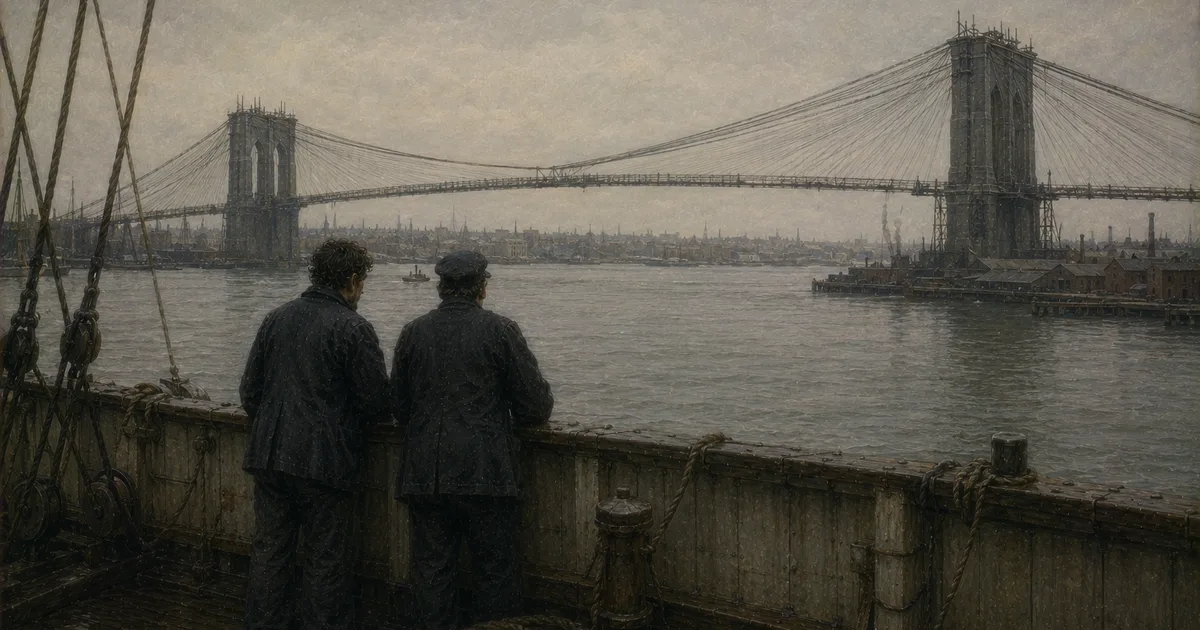
The towers of the bridge at the upper end of the East River were at the north of the bark at the Brooklyn anchorage.
They were two towers of granite at the river. The southern tower was at the Brooklyn side and the northern tower was at the New York side. The towers had been built up to the upper limit of their stone in the years before, and the cables of the bridge were at the second year of the stringing at the fourth week of March of 1878. The cables ran from the Brooklyn anchorage of the bridge over the southern tower and out over the river to the northern tower and from the northern tower to the New York anchorage of the bridge. The cables were at the upper hundred and forty-five feet over the East River at the middle of the river at the fourth week of March of 1878.
Olav stood at the foremast pin-rail of the bark and looked at the cables and the towers.
He had not looked at the cables and the towers at the harbor-furl of the noon of the thirty-second day. He had been at the foretop at the harbor-furl. He had not looked at the cables and the towers at the morning watches of the thirty-third and the thirty-fourth and the morning of the thirty-fifth, although the cables and the towers had been at the north of the bark at every watch. He looked at the cables and the towers at the change of the bells of the forenoon of the thirty-fifth day, after the boardinghouse-runners had gone off in the skiff.
The Dane was at the foremast pin-rail beside him.
The Dane looked at the cables and the towers too. The two of them stood at the foremast pin-rail at the foredeck of the bark and looked at the cables of the great bridge of New York that was at the second year of its stringing at the upper hundred and forty-five feet over the East River.
The Dane did not say anything at the looking.
Olav did not say anything at the looking.
It was the few minutes a man at a Brooklyn anchorage held the standing at another man he had been at the bench beside in a forecastle for thirty-five days, in the way a man at a Bristol Bethel reading-room had once held the few seconds. Olav had his right hand at the side-pocket of the coat at the outside where the piece of brown paper was at the parcel at the side-pocket. He laid the hand at it through the wool of the coat. He did not take the parcel out. He did not look at the parcel. He looked at the cables of the bridge.
The body of Olav at the foremast pin-rail of the bark at the Brooklyn anchorage at the forenoon of the thirty-fifth day of the run from Hamburg had at the standing-beside what it had had at the looking at the bench at the office at the third quay at Hamburg at the morning of the Day Fifty-eight, and what it had had at the bench at the table at the forecastle at the change of the watch of the off-watch of the fourth day of the run, and what it had had at the change of the second dog-watch of the nineteenth day at the bench of the forecastle when the steward had come up the galley ladder with the butcher knife.
He did not name to himself, at the foremast pin-rail of the bark at the Brooklyn anchorage of the thirty-fifth day of the run from Hamburg, what the body of him knew at the standing-beside.
The Dane did not name it either.
The two of them stood at the foremast pin-rail for some minutes in the way two men at the foredeck of an American bark at the Brooklyn anchorage who had refused the boardinghouse-runners at the change of the bells of the forenoon watch of the thirty-fifth day of the run from Hamburg stood at the foremast pin-rail and looked at the cables of the great bridge of New York.
Then the Dane turned at the rail and went aft for the work the captain or the Swedish first mate would have at the afternoon watch.
Olav stood at the foremast pin-rail for the half minute after.
He took his hand out of the side-pocket of the coat.
He went aft.
The captain came up from the cabin at the eight bells of the afternoon watch.
He came up at the cabin door with a piece of paper at his hand. He stood at the cabin door and held the paper out at the deck for the Swedish first mate. The Swedish first mate took the paper. The captain went back down to the cabin. The Swedish first mate looked at the paper for some seconds and then went forward to the foredeck.
The Swedish first mate said at the foredeck to Olav that a letter had come to the captain’s office at the wharf at the morning of the thirty-third day at the post from Wilmington and that the captain had sent ashore for the post-bag at the morning of the thirty-fifth day with the second mate’s-and-steward’s-replacement papers and had brought the post-bag back at the noon. He gave Olav the letter.
The letter was a single sheet folded twice with the wax of a Wilmington parish at the seal.
Olav took the letter to the bunk at the lower end at the starboard side of the forecastle. He sat at the bunk. He broke the wax. He read the letter at the bunk.
The letter was from Patrick O’Brien at the parish of Saint Mary’s at the upper end of Front Street at Wilmington in the State of North Carolina. Patrick said the Wilmington-letter Olav had sent from Hamburg at the Day Fifty-six had come to Saint Mary’s at the second week of March, three days before the parish second-Sunday-of-March prayer-for-sailors. Patrick said Margit had been well at the second week of March and had asked after Olav at the receipt of the letter. Patrick said Father Donovan had read the post at the kitchen at the back of the parish house and had said Olav had been at the bars of the Kvik at a six-and-two for forty-seven days at the run from Wilmington and had said and from a six-and-two for forty-seven days a man comes home, Patrick, you remember what it was at the Atlantic in the year I came over and you tell Margit her young Olav has been at it and is at Hamburg now. Patrick said Daniel had been at the door of the kitchen at the reading of the letter and had not said much and had gone back to the upper room at the half hour after.
Patrick said the parish was praying for the run from Hamburg to wherever the run took Olav next.
Olav folded the letter at the bunk. He put the letter at the inside-pocket of the coat beside the rosary and the wages of the Kvik run.
He went up to the deck for the afternoon watch.
The captain paid the wages of the run from Hamburg at the cabin door at the eight bells of the second dog-watch of the thirty-fifth day. The wages were thirty dollars at the month for the thirty-five days at the run from the Elbe to the Brooklyn anchorage. Olav signed off the articles at the captain’s ledger. The Dane signed off the articles at the line below. The captain said: that will do.
He went back into the cabin and shut the cabin door.
Olav took the dollars at his hand. He put them at the inside-pocket of the coat beside the rosary and the letter and the wages of the Kvik run. The dollars were the dollars of an American bark out of Hamburg to the Brooklyn anchorage at the fourth week of March of 1878.
The Dane took the dollars at his hand. He put them at his own coat-pocket.
The two of them went down the gangway at the larboard side to the boat at the lee that the Swedish first mate had called for from the wharf at the lower end of the Brooklyn waterfront.
The boat took them across the lower end of the Buttermilk channel to the wharf at the foot of Atlantic Street at the Brooklyn waterfront.
It was the evening of the thirty-fifth day.
The light at the western sky at the New York side of the river was at the going-down of the sun at the fourth week of March. The cables of the bridge at the upper hundred and forty-five feet over the East River were lit at the underside by the going-down. The Dane did not look at the cables at the going-down. Olav did not look at the cables at the going-down.
The two of them walked up Atlantic Street.
They had no boardinghouse at the upper end of Pearl Street. They had no berth at a Liverpool bark at the morning. They had the wages of the run from Hamburg at the coat-pocket each. They walked up Atlantic Street at the evening of the thirty-fifth day of the run from Hamburg at the fourth week of March of 1878 at the city of Brooklyn in the lower end of the State of New York in the United States of America.
They went looking for a cheap house for the night.