The morning of the twenty-fourth of April came at the kitchen at Lindøy at the half past five.
Olava had been at the kitchen since the five. She had brought down the wood from the upper end of the woodshed the way she had brought down the wood through the March and the April. She had set the wood at the firebox. She had set the kettle at the stove. The window at the side of the stove showed the morning of a long spring light that had been on the strait since the four.
She set the loaf at the table at the quarter to six.
She set the butter at the small dish at the side. She set the milk at the pitcher at the other side. She set the five cups at the five places for her father and her mother and Gustav and herself and the cousin Karoline who had come from Stavanger at the evening of the twenty-third. The five places were the morning places at the kitchen at Lindøy at the late April when the brothers and Inger were at the other houses on the island and the cousin was at Lindøy for the first time in spring.
Bertha came into the kitchen at the half past five.
Bjørn was up at the upper room and would come down at the seven. He had been at the kitchen at the noon meals through the March and at the breakfast since the second week of April. The winter cough was gone. He was at the seven for the morning of the twenty-fourth.
Gustav came in from the byre with the milk-pail.
He set the pail at the cool corner at the door. He sat at his place. He said the lambs at the upper meadow were at fifteen and the last ewe at the lower byre would lamb at the night or the morning. Bertha said she would go to the lower byre at the noon. Gustav said yes.
Karoline came down at the six.
She had been at the upper guest-room since the evening of the twenty-third. She sat at her place at the table and ate the bread and drank the coffee and did not say much at the breakfast.
Olava set the kitchen at the half past seven.
She set the dishes at the dish-rack and the cups at the cup-rack and wiped the table with the cloth. She set the firebox to the lower setting because the fire would not be needed at the high until the noon. The kitchen at the half past seven was the kitchen at the late April morning at Lindøy with the light at the window at the height of a morning that had not been the height in February.
Olava went up to the upper room at the eight.
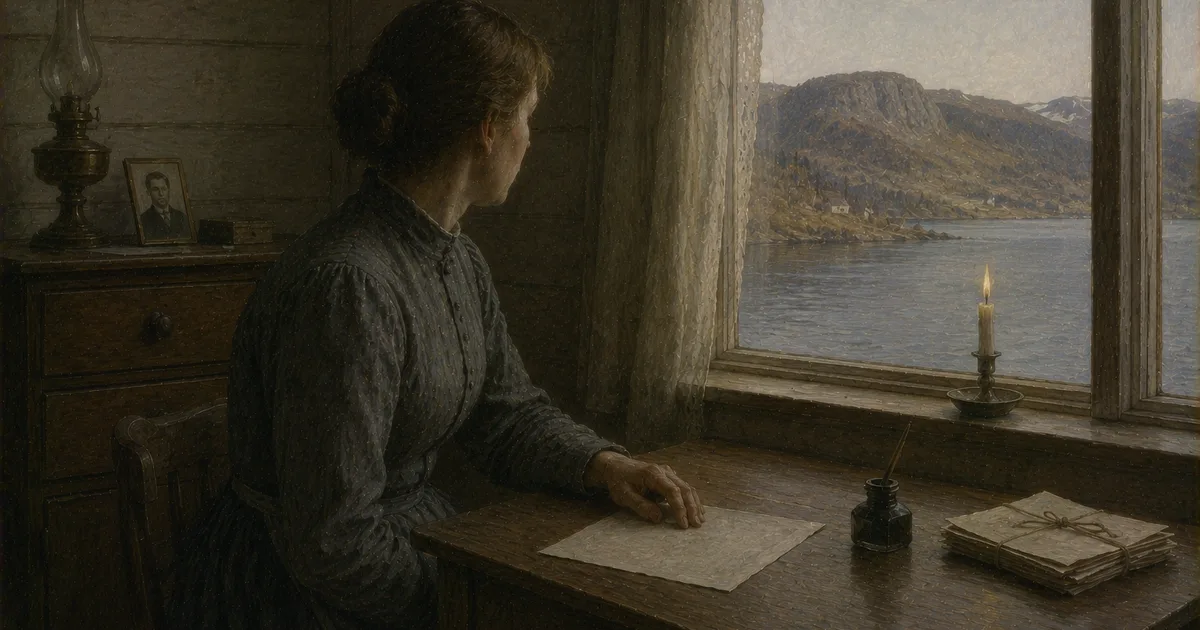
The room was the room she had had since the eighth year of her life. The bed was at the wall. The chest of drawers was at the inner wall with the carte-de-visite of Olav at the upper end propped at the lamp. The writing-table was at the window that looked east toward Roalsdyret across the strait. The candle of the upper window was at the sill. The small wool rug was at the foot of the bed.
She set a sheet of letter-paper at the writing-table.
The sheet was the sheet she had set at the writing-table on the morning of the eleventh of April and on the morning of the eighteenth and on the morning of the twenty-second. It was the spring sheet of letter-paper for a letter she had not begun to write.
She sat at the chair.
She laid her hand at the sheet. She did not lift the pen. The pen was at the inkstand at the right of the sheet. She had not lifted it on the eleventh and had not lifted it on the eighteenth and had not lifted it on the twenty-second. She did not lift it on the twenty-fourth.
She sat at the chair for a few minutes.
She looked at the strait. The strait was at the morning light at the slopes of Roalsdyret. The slopes were at the brown of an April morning that had not yet gone to green. The sea between Roalsdyret and Lindøy was calm. There was a small boat at the lower end of the strait that was likely the boat of one of the Roalsøy fishermen at the early lines.
She put the sheet at the small drawer at the side of the writing-table.
She had put the sheet at the small drawer on the eleventh and on the eighteenth and on the twenty-second. She put it at the small drawer on the twenty-fourth.
She did not open the lower drawer.
The lower drawer was the drawer where the four letters from Olav were at the bundle tied with the brown twine. The bundle had been at the lower drawer at the right corner since she had laid it back on the evening of the twentieth of January. Olava had not opened the bundle. She had not lifted it from the drawer through the February or the March or the April. She had laid her hand at the top of the chest of drawers some mornings and had not opened the lower drawer.
She went down to the kitchen at the half past eight.
Bertha was at the parlor at the linen-press. Karoline was at the side door at the boots for the walk to the lower byre with Bertha at the noon. Gustav had gone back to the upper meadow.
The morning of the twenty-fourth went to the noon.
Bjørn was at the kitchen at the noon meal at the twelve. The household was five at the noon meal at the twenty-fourth of April. The soup was the spring soup of carrots and onions and a piece of pork that Bertha had laid in at the morning. The bread was the bread of the morning. The cheese was the cheese of the Lindøy household.
After the noon meal Karoline went with Bertha to the lower byre at the lambing.
Olava stayed at the kitchen.
She washed the dishes at the basin at the side of the stove. She set the dishes at the dish-rack. She wiped the table.
The afternoon went to the four.
Karoline came back to the kitchen at the four and Bertha came back at the half past four. The last ewe had had her lamb at the half past three. The lamb was a small healthy lamb at the lower byre. Bertha was pleased. Karoline was pleased. They drank coffee at the kitchen.
It was at the coffee at the half past four that Karoline said the news.
She said the steamer from Stavanger had come to Judaberg at the noon of the twenty-third. She said the steamer had brought the post of the second week of April from the south of Norway and from Hamburg. She said the wharf-end office of the Stavanger consul had set out the bulletin at the noon of the twenty-second.
Olava said yes.
Karoline said the bulletin had said that the Kvik of Drammen had come to Hamburg at the fourteenth of February of 1878, the second week of February, from Wilmington in the State of North Carolina in the United States of America, by way of the Atlantic at a six-and-two of the pumps at the bars of the bilge for forty-seven days. She said the Kvik had been at the wharf at Hamburg at the unloading and the captain had paid the men at the wharf-end office at the evening of the fourteenth of February. She said the consul had been to the captain at the wharf-end office at the second week of February.
Olava said yes.
Karoline said the consul had asked the captain for the names of the men he had paid at the wharf-end office. She said the captain had said the names were at the articles of the Kvik at the office of the company at Drammen. She said the captain had said the company at Drammen sent the articles to the consul at Stavanger at the end of every voyage at the company’s own time. She said the consul had not yet had the articles of the Kvik of Drammen for the run from Wilmington of the Christmas Day of 1877.
Olava said yes.
Karoline said the consul had said also that the bark had sunk one foot at the anchor at the night after the pumps had stopped, and that the boatswain had pumped her back to the wharf at the morning, and that the Kvik would not be sailing again from Hamburg.
Olava said yes.
She did not say why Karoline had told her the news of the Kvik of Drammen. Karoline did not say. They sat at the kitchen and drank the coffee and ate the bread.
The Friday of the twenty-sixth came and went. The Saturday of the twenty-seventh came and went.
The Sunday of the twenty-eighth of April was at the chapel at Rossøy.
Bjørn and Bertha and Olava and Karoline went down to the landing at the morning and Gustav rowed them across the strait. The water was at the calm of an April Sunday. Gustav rowed at a steady pull and the boat came to the landing at Rossøy at the quarter to ten. They walked up the path from the landing to the chapel at the upper end of the village. The gorse at the side of the path was at the flower of the last week of April. The buds were yellow.
The chapel was at the eleven.
The pew of the Lindøy family was at the third pew from the front. Bjørn sat at the upper end of the pew. Bertha sat at his side. Olava sat at Bertha’s side. Karoline sat at Olava’s side. Gustav was at the back with the men of the parish at the small bench at the wall.
Bernhard and Inger came in at the pew across the aisle.
Inger sat at Bernhard’s side. She had been Bernhard’s wife at two years at the Easter of the year of 1878. She was in the long Sunday dress of a woman of the parish at a Sunday in spring, with the waist of the dress set out a little at the side. She was carrying the child at the eighth month, the way a woman of the parish at the eighth month of her first child was at the pew at her husband’s side at the Sunday after Easter at the chapel at Rossøy.
Olava did not look at the pew across the aisle for more than the time it took the pew to file in.
The pastor read the first reading. He read the gospel. He read the prayer-list of the sailors of the parish at sea at the spring.
The names at the spring were thirteen. The pastor read the names in two parts. The first part was the seven names of the sailors of the parish whose ships were at known ports at known dates as the consul’s office had set out at the bulletin at the wharf-end at the noon of the twenty-second of April. The second part was the six names of the sailors whose ships had not given an account at the consul’s office at the spring of 1878 and whose families had not had a letter at the post of the second week of April.
Olav Hestby was at the second part. His name was the third of the six.
The pastor read each name and asked the parish to pray for the man whose name had been read.
Olava heard her own waiting when she heard Olav’s name. She had been at the pew at the morning of the twentieth of January when the pastor had read the prayer-list of the eleven sailors at sea at the winter and Olav Hestby had been the fifth name of the eleven. The body of the daughter of a Lindøy household at the third pew from the front at the chapel of Rossøy on the morning of the twenty-eighth of April knew that the third of the six was not the fifth of the eleven. It knew the shape of the moving.
She did not look up at the pulpit.
She looked at the pew rail at her hand at the cuff of her glove at the second knuckle.
The hymn after the sermon was the hymn the chapel sang at the second Sunday of Easter when the chapel asked for the protection of sailors at sea and the return of the lost to the harbor. She sang the first verse. She sang the second verse. She sang the third verse. She sang the fourth verse.
Bertha sang at her side.
After the benediction Olava and Bertha and Karoline stopped at the porch with the pastor’s wife. The pastor’s wife said the parish would pray for Olav and for the other five at the second part of the list. Olava thanked her. Bertha said the lamb at the lower byre had come at the half past three of the twenty-fourth. The pastor’s wife said yes.
Inger came past the porch at Bernhard’s arm.
She said good morning to Olava. Olava said good morning. Inger said the child would come at the second or third week of May. Olava said it was a good time of the year for a child to come. Inger said yes. Bernhard said the upper meadow at his house had eleven lambs at the upper end and four at the lower end. Olava said yes.
The two of them went on toward the landing.
Olava and Bertha and Karoline walked back to the landing at the half past noon.
The afternoon of the twenty-eighth went to the evening.
The evening of the twenty-eighth was at the upper room.
Olava lit the candle at the sill at the quarter to nine because the light at the strait had gone to the long blue of the April evening at the eight, and the candle was the candle of the upper window at every evening at Lindøy since November.
She sat at the chair at the writing-table.
She took the sheet of letter-paper out of the small drawer at the side of the writing-table. She laid the sheet at the table. She laid her hand at the sheet. She lifted the pen at the inkstand and held the pen for a few seconds at her hand.
She set the pen back at the inkstand.
She did not write at the writing-table at the evening of the twenty-eighth of April.
She put the sheet back at the small drawer.
She closed the drawer.