The bark was in the latitude of forty-eight north at the third week of the run from Hamburg.
She had had the wind from the north-west and from the west at the first ten days and had come round to a south-westerly run at the change of the wind to the south at the eight bells of the second dog-watch of the eleventh day, and she had been on the south-westerly run for seven days at the eighteenth day of the run when the wet weather came at her from the south. The wet weather was a wet from the south that did not bring much wind and did not lift much sea but laid the rain at the deck through the eighteenth day and the nineteenth day so the deck was wet at every watch and the boards of the deck held the water at the seams.
The Austrian steward had been quiet at the galley for eighteen days.
He was a small man with a small head and small shoulders and a small voice. He had a quick eye and a quick hand at the galley and was quick at everything he did at the galley, and he was quick at being angry at everything said to him at the galley and at everything not said to him at the galley. He had been at the cabin twice in the fourteen days, and at the second time he had come out of the cabin without his cap and had gone back to the galley with the cap at his hand. He had been at the table at the cabin with the captain at the dinner, and the captain had said what the captain had said at the dinner, and the steward had come out without the cap.
The man called the Red Shirts had been at the cabin for the same dinner.
The Red Shirts was the second mate of the bark. He berthed aft of the deck-house in his own bunk and stood the starboard watch on deck and came aft to the cabin at the dinner-call when the captain set the dinner-call. He was a head and shoulders past the captain at the cabin and a head and shoulders past every man at the bark. The red shirt was at the open of his coat at the throat at every watch and at the dinner and at the bunk.
He had not been quiet at the bark.
He had been at the deck through every watch and at the cabin through every watch and at the upper end of the deck-house through every watch, in the English of a Lillesand-Norwegian who had been at New York for twelve years, loud at the consonants and loud at the vowels and loud at the orders he gave at the deck.
The wet weather went on at the nineteenth day.
The steward came up from the galley at the change of the second dog-watch of the nineteenth day with a kettle at his hand. The kettle had water at it that had been at the stove at the galley for the boiling of the salt meat that was the food of the bark for the change of the dog-watches. He carried the kettle by the handle at his right hand and held the cover at the kettle with a piece of cloth at his left hand. He came up the ladder out of the galley to the main deck and turned aft along the deck on the larboard side under the lee of the deck-house to bring the kettle to the cabin where the captain had said the steward should bring the kettle at the change of the second dog-watch.
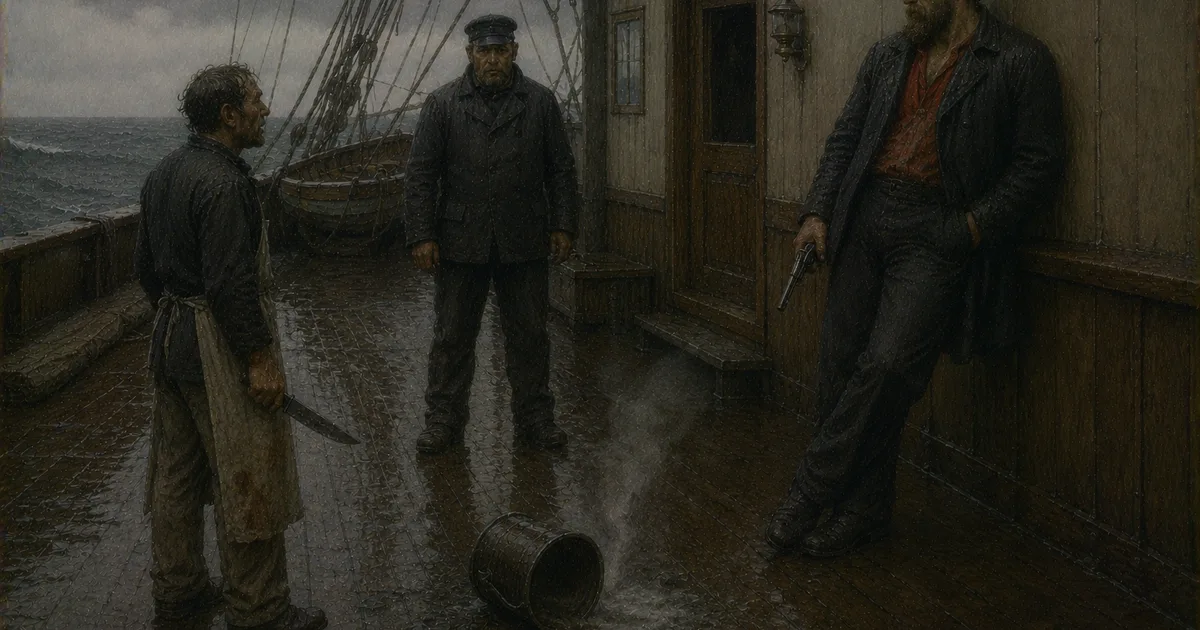
The Red Shirts was at the upper end of the deck-house at the larboard rail.
He had been at the watch on deck for the afternoon watch and at the change of the bells of the second dog-watch had not gone below. He was at the larboard rail at the upper end of the deck-house with his back at the rail and one boot at the rail and the red shirt at the open of his coat at the throat. He did not move when the steward came up the ladder. He stayed at the rail with the boot at the rail.
The steward came up the deck.
He came up the deck at the lee of the deck-house with the kettle at his right hand. The deck was wet at the boards. The steward put his foot at the deck at the change of his stride at the upper end of the ladder and at the second step he came past the upper end of the deck-house at the larboard rail where the Red Shirts had the boot at the rail.
The Red Shirts took the boot off the rail.
He took the boot off the rail and brought it down at the steward’s leg below the knee. He did not kick the steward at the body or at the head. He kicked the steward at the leg below the knee and the steward came down at the wet deck at the side of the deck-house with the kettle at the deck at his hand and the boiling water at the deck under him.
The steward came down at the boiling water.
He came down at the wet deck and the wet deck went under him and the boiling water from the kettle went under him at the trousers of the steward’s leg and at the side of the steward’s coat at the lower side. He cried out at the deck. He cried out the cry of a small man at a small voice at a wet deck at the side of a deck-house with the boiling water at his leg.
The Red Shirts did not move from the rail.
He stayed at the rail with the back at the rail and the boot now at the deck and the red shirt at the open of his coat at the throat. He looked at the steward at the deck. He did not say anything at the steward.
The steward stood up.
He stood up at the side of the deck-house with the kettle at his hand and the boiling water no longer at his leg but at the boards of the deck. He held the leg at the trousers with the left hand and stood at the deck for some seconds. Then he turned and went back to the ladder of the galley and went down the ladder.
The Red Shirts stayed at the rail.
The forecastle was at the lower end of the foredeck forward of the deck-house at the lee of the larboard side.
Olav was at the bench at the forecastle table at the off-watch. The Dane was at the bench beside him at the off-watch. The Frenchman was at the bench at the lower end. The boatswain had come down to the forecastle from his bunk at the deck-house some minutes before for a piece of tobacco he had left at his sea-chest at the lower end of the forecastle and was at the door of the forecastle when the cry of the steward came down the deck. The little Swede was at his bunk at the upper bunk-row at the upper end. The little Swede had been at his bunk at the off-watch from the dinner-call.
The five men at the forecastle heard the cry.
The boatswain at the door looked out through the door at the deck. He did not move from the door. Olav at the bench looked at the door. The Dane at the bench beside him looked at the door. The Frenchman at the bench at the lower end did not look at the door. The little Swede at the upper bunk did not move at the bunk.
The steward came back up the galley ladder.
He came up the ladder at the half minute after the cry. He came up the ladder with the butcher knife of the galley at his right hand. The butcher knife of the galley was a knife of about fourteen inches at the blade. He came up the ladder and came up the main deck at the lee of the deck-house and came at the upper end of the deck-house at the rail where the Red Shirts was at the rail.
The Red Shirts drew the revolver.
He drew the revolver from the coat-pocket at the inside of the coat. The revolver was a revolver of about six inches at the barrel of the kind a second mate at an American bark out of New York carried. He held it at his right hand at the deck at his side. He did not lift it at the steward. He held it at the deck.
The steward stopped at the upper end of the deck-house.
He stopped at two paces from the Red Shirts. He held the butcher knife at the hand at the side. He looked at the Red Shirts. He looked at the revolver at the Red Shirts’ hand at the deck at the side. He did not move at the deck.
The boatswain at the door of the forecastle went up the ladder of the forecastle to the foredeck.
He went up the ladder at the change of his weight at the lower step and came up to the foredeck and went aft along the foredeck and down the four steps to the main deck at the larboard side and came up the main deck at the lee of the deck-house to the upper end where the steward was at the deck-house and the Red Shirts was at the rail.
The boatswain stopped at three paces from the steward.
He did not look at the revolver and he did not look at the butcher knife. He looked at the steward. He said in the German of a Hamburg boatswain at the deck of a bark at the change of the second dog-watch of the nineteenth day of a run with wet weather at the southerly run that the steward should go to the cabin and that the steward should go to the cabin with the butcher knife at the hand if the steward was going to go to the cabin with the butcher knife at the hand, and that the captain would say what the captain would say to the steward and to the second mate.
The steward did not move at the deck.
The Red Shirts did not move at the rail.
The boatswain said in the German of a Hamburg boatswain at the deck of a bark that the captain was the captain of the bark and that the captain would say what the captain would say.
The captain came up at the cabin door.
He came up at the cabin door at the half minute after the boatswain had spoken. He came up at the cabin door and looked at the deck. He looked at the steward and at the butcher knife at the steward’s hand and at the Red Shirts and at the revolver at the Red Shirts’ hand at the deck at the side and at the boatswain at the three paces from the steward. He did not come out onto the deck from the cabin door.
He said in the English of a Massachusetts master that the second mate should put the revolver at the bunk and that the steward should put the butcher knife at the galley and that both men should come to the cabin at the change of the first watch of the night.
The Red Shirts put the revolver at the coat-pocket.
He did not put it at the bunk. He put it at the coat-pocket at the inside of the coat. He went aft along the rail to the deck-house door and went down to his bunk.
The steward stayed at the deck-house for some seconds with the butcher knife at the hand. He looked at the Red Shirts going aft. Then he turned and went to the galley ladder and went down to the galley.
The boatswain stayed at the deck for a moment.
He looked at the cabin door. The captain was at the cabin door. The captain did not say anything more. The boatswain turned at the deck-house and came back along the lee to the foredeck and down the ladder of the forecastle.
He came back into the forecastle. He went to the sea-chest at the lower end and took out the piece of tobacco he had come down for. He put the tobacco at his coat-pocket. He looked at the four men at the forecastle. He went out of the forecastle and up the ladder of the forecastle to the foredeck and aft to the deck-house and his bunk.
Olav was at the bench at the forecastle table.
The Dane was at the bench beside him. The Dane took a breath at Olav’s shoulder. The breath was a breath of a Danish able seaman at a bench at a forecastle of an American bark. The Frenchman at the bench at the lower end did not say anything. The little Swede at the upper bunk did not say anything.
Olav did not say anything.
The Dane did not say anything either.
The watch went on at the first watch of the night.
Olav went on deck at the change of the bells. The Dane went on deck at the change of the bells. The bark was at the southerly run at the wet weather at the wind at the south-east at three knots at the latitude of forty-eight north. The deck was wet. The night was wet. The wind was at the beam. The bark went on.
The change of the first watch of the night came at the eight bells.
The steward did not come to the cabin at the change of the first watch of the night. The Red Shirts did not come to the cabin at the change of the first watch of the night. The captain did not come up out of the cabin at the change of the bells.
The bark went on at the southerly run for the four days after the nineteenth day and came to the westerly run at the four bells of the morning watch of the twenty-third day and went on the westerly run for the rest of the run to the bar of New York.
The bar of New York came up at the change of the morning watch of the thirty-second day.
The bark dropped the anchor at the Brooklyn anchorage at the noon of the thirty-second day. The Austrian steward went over the rail at the night of the thirty-second day with a boardinghouse-runner from a New York skiff at the lee of the bark at the watch. The man called the Red Shirts went over the rail at the night of the thirty-second day at the half hour after the steward with a different boardinghouse-runner from a different New York skiff.
Neither came back.
The captain was at the cabin at the morning of the thirty-third day at the Brooklyn anchorage of the bark out of Hamburg with a salt cargo and German manufactured goods of the run that had begun at the noon tide of the Day Fifty-nine at the Elbe at Hamburg.
The night went to the morning.