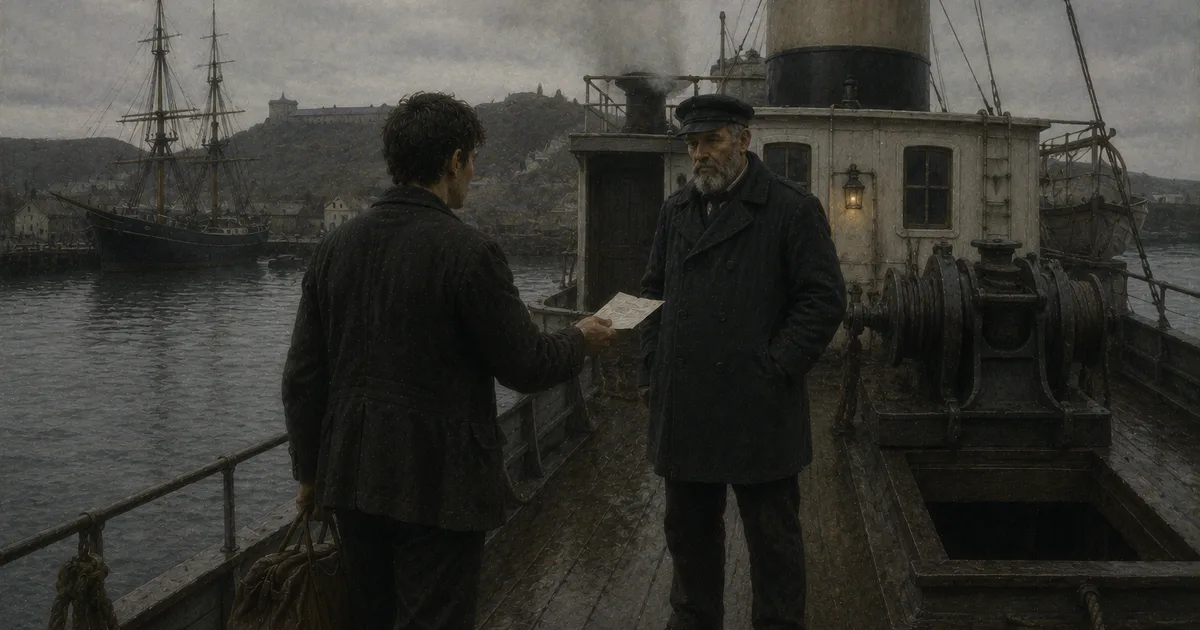
Olav rowed the small boat out to the steamer.
The small boat was a boat at the Vardøy wharf, and the steamer was at anchor out in the gray water of the harbor, and Olav set the leather bag at the stern of the small boat and took the oars and rowed out. The body of him at the oars was the body the doctor of Vardøy had said was a sick man’s body and should be at the home of him; and the body rowed the small boat out across the gray water at the gray light of the discharge-day evening, slower than the body had been before, and the steamer came up at the bow of the small boat. She had a name at the bow. The name was Thalia.
The Vardøy harbor at the discharge-day evening had the other vessels at it—the Russian fishing boats at their moorings, a coast-craft or two; and the Brio lay at the wharf astern of the small boat’s track, with the two no-wage men aboard her now in the boatswain’s place that had been Olav’s. Olav did not look back at the Brio. The Thalia was a steam-freighter of a few hundred tons, not new, her hull dark against the gray water and the smoke standing a little from the funnel of her at the banked fire of a ship at anchor; and the small boat came up under the side of her.
A man was at the rail of the Thalia when the small boat came alongside.
He was a crewman of the Thalia, and he looked down at the small boat and the man at the oars of it, and Olav said up to him that he had been discharged sick off the Brio and was asking to speak to the captain. The crewman said the captain was Captain Sars, and that Olav was to come up. Olav made the small boat fast and took the leather bag and came up the side of the Thalia to the deck.
The deck of the Thalia was the deck of a steam-freighter. It was not the deck of a sailing-bark—there were not the masts and the yards and the standing rigging of a bark, or the braces and the pin-rails a bark’s deck had; there was the funnel, and the deck-house, and the steam-winch at the hatch, and the round windows of the deck-house, and the gear of a steamer. Olav had been at the decks of the barks for the years of the voyages and had not worked a steamer. He stood at the deck of the Thalia with the leather bag and looked at the steamer-deck of her the way a sailing-ship man looked at a steamer-deck, while a crewman of the Thalia went to bring the captain. The crew of the Thalia that Olav saw at the deck were fewer than a bark’s crew, because a steamer was worked by fewer hands than a bark; and they looked at the man who had come up the side in the small boat the way a crew looked at a man come aboard at a far harbor, and went on at the work the deck had.
Captain Sars was the master of the Thalia.
He was a man of near sixty, weathered at the face the way a man was weathered who had been the master of ships at the coast for the years of a life, and he came to the deck where Olav stood with the leather bag at his hand. Olav said the thing he had come to say. He said he had been the boatswain and the sailmaker of the Brio, and had been discharged sick at Vardøy, and had the discharge-papers from the mustering officer; and that he was asking to work a passage south on the Thalia in exchange for the berth and the food of it.
Captain Sars looked at Olav.
He looked at the discharge-papers Olav held out, and he looked at Olav—at the face of him, and at the cough that came up at the chest of him while the two of them stood at the deck—and he looked at the leather bag at Olav’s hand. Then he said the thing.
“You will work the passage,” Captain Sars said.
He said it the way a man said a thing that was decided. He did not ask Olav how sick he was, or whether a sick man could work a passage, or what the Brio had been. He said you will work the passage, and the saying of it was the whole of the arranging of it. Olav had been at the ports of the world asking captains and mates and shipping-masters for berths, and a berth had been a thing got at a desk or a deck at the terms of the getting of it. Captain Sars at the deck of the Thalia said you will work the passage in four words, and Olav stood at the deck with the four words said to him.
Olav had been under the captains of the ships. He had been under Captain Gjermund of the Asta, who had counted a thing of cost the way the Brio’s captain counted it; and he had been under the consumptive American captain of the bark; and he had been under Captain Tollefson of the Dronningen, who had been a master a man was glad to have been under. A man who had been at sea for the years Olav had been at sea had a measure in him for the captains of ships, a measure the body took at the first hour of a new ship; and the body of Olav, that had taken the measure of the Brio’s captain at the Stavanger wharf and had found the slave-shop register at it, took the measure of Captain Sars at the deck of the Thalia and found the other thing. Captain Sars did not say more to Olav at the deck than the arranging of the passage wanted said—the steward would show Olav the bunk, the steward would show Olav the work. But the you will work the passage had been said in the four words and no terms set against it, and a man who had asked for berths across the ports of the world heard the four words and the no-terms and knew the kind of master he had come aboard of.
The inside of the Thalia was painted white.
Olav had come off the forecastle of the Brio, which had been a low dark space under the main deck, with the wet floor and the no-air and the smell of it; and he came down into the Thalia, and the inside of the Thalia was painted white. The bulkheads of her were white. The deckhead was white. There were round windows at the sides of her, ports that were round and that opened, and the gray light of the Vardøy harbor came in at the round windows and lay in the white space as a light and not as a grayness; and the white space had air in it that moved, and the air did not carry the smell of a forecastle. Olav stood at the white inside of the Thalia, and the body of him took in the white and the light and the moving air the way it had taken in the dark and the no-air of the Brio.
There was a bed made up for Olav.
The steward of the Thalia showed Olav the bunk that was his for the passage, and the bunk had a bed made up at it—the blanket spread, the place ready—and the bed had been made up and was waiting for the man who would have it. Olav stood at the bunk with the made bed at it. He had come over the side of the Thalia an hour before, a man discharged sick at the top of the country with a light purse and no ship, and the steward of the Thalia showed him a bunk with a bed made up and waiting, and the body of Olav at the bunk was a body a thing had been done for.
The bunk that was Olav’s for the passage was at a bunk-space below the deck-house—a space of the steamer, white-painted the way the rest of the inside was white-painted, with the round windows that opened and the air that moved. It was not a forecastle. The Brio’s forecastle had been a slave-shop space under the bow, dark and wet and stinking and without the air; and the bunk-space of the Thalia was a space a man could be at and not have the body counting the hours until the watch took it out of the space. Olav set the leather bag at the bunk. He did not lie down at the made bed at the hour of the coming-aboard, because the first watch the Thalia would give him was the watch ahead of him; but the made bed was there, and the body of Olav knew it was there.
Olav laid the figure-eight at the cat-falls of the Thalia at the first watch.
He was the Thalia’s hand now, working the passage, and the work the Thalia gave him was the work a man’s body could do at the cough-state; and at the first watch he was at the cat-falls at the bow, and the body of him laid the figure-eight at the cat-falls of the Thalia the way it had laid the figure-eight at the cat-falls of every ship since the Asta. The body laid it without being told to. The man who had taught a younger Olav to lay the figure-eight, on a ship years before, was not a man Olav named at the laying of it; the body laid the figure-eight and the man stayed unnamed. Captain Sars was at the deck at the first watch. He saw the figure-eight at the cat-falls, and he said it was a well-laid figure-eight, and Olav said it was the only way he had been taught to lay it.
There was an older man at the crew of the Thalia who read the Bible.
He was a man older than the rest of the crew, a Christian man, and he read the Bible at the off-watch hours. Olav came to know, at the first day on the Thalia, that the older man read the Bible at the bench at the off-watch the way another man would mend a thing or sleep. The older man did not preach. He sat at the bench with the Bible and read it, and at some of the readings he read it aloud, in the low voice a man read aloud in to himself and to whoever at the bench would hear it. Olav sat at the bench at an off-watch hour of the first day and heard the older man read.
He read from the Bible at the low voice, and the men of the Thalia who were at the bench at the off-watch were at the hearing of it or were not, as a man was or was not; and the older man did not mind which, because he did not read the Bible at the bench to be heard. He read it the way a man read a thing he read every day of his life. The passage he read at the off-watch hour of the first day was a passage of the Psalms—Olav did not after hold the words of it, but held that it had been of the Psalms—and the older man read it through and was quiet, and then read on. Olav had been at the forecastles where the off-watch was the talk and the cards and the foul talk of a forecastle. The off-watch bench of the Thalia was not that. It was the older man and the Bible at the low voice, and the crew about him keeping the talk clean—not because the older man asked it, for he did not ask it, but because a bench with a man reading the Bible at it was a bench a crew kept the talk clean at. Olav sat at the bench and heard the reading, and the reading was a thing of the Thalia the way the white paint was a thing of her and the made bed was a thing of her.
The supper at the Thalia was the best food Olav had had at sea.
Olav had been at sea on the Sigrid and the Asta and the Dronningen and the Kvik and the American bark and the Sandefjord ship and the Brio, and the food at sea had been the food of those ships, which was the salt-meat and the hard bread and the things a ship’s cook made of the salt-meat and the hard bread. The supper at the Thalia at the first evening was a better supper than the supper of any of those ships.
The supper was at the table at the white inside of her, and the crew of the Thalia ate it at the table—the watch that was below, and the steward at the serving of it, and Olav at the table among them at the first evening. The food was the food a steamer’s cook set who set a good table: the salt-meat and the bread of a ship, but more of it and better of it than the Brio had set, and a hot thing with it. Olav had been at the gray of Vardøy and the cold of the salt-cargo and the cough, and the body of him at the Thalia’s table ate the supper the way a body that had been at those things ate a good supper set in front of it. The men at the table did not make much of the new hand; they had had new hands at the table before, men worked aboard at a far harbor. Olav ate at the table among them, and the Thalia fed the new hand the way she fed her own.
The Thalia lay at anchor in the Vardøy harbor at the first night.
She would sail south at the morning, down the inside coast toward Bergen, with the stockfish in her holds for the run south and the run on from Bergen to the Mediterranean after; and she lay at anchor in the gray water of the harbor, and Olav was at the bunk with the made bed, at the white inside of her, at the round window that gave on the gray light that did not go.
The cough was at his chest at the first night.
It came up at his chest in the white space the way it had come up at his chest in the dark space of the Brio’s forecastle; the white paint and the moving air and the made bed did not reach the cough. Olav lay at the bed and coughed it. But the bed was a bed made up and waiting, and the space about him was a white space with the air moving in it, and the supper at the body of him was a good supper, and the captain of the ship had said you will work the passage in four words at the deck. The body had been taken in once before this, at a port, at a winter, by a household that had nursed a sick stranger; and the body of Olav at the made bed of the Thalia knew the kind of thing that had been done for it. He lay at the made bed at the white inside of the Thalia at the first night, and the Thalia lay at anchor in the gray harbor, and the body of him was a sick body that had been received.