The Brio came to Vardøy in the July.
She had stood north up the coast for the weeks of the run—past Lofoten, past the North Cape, past the Nordkyn that was the head of the country—and she came in to the harbor at Vardøy at the July of 1879, and Vardøy was gray.
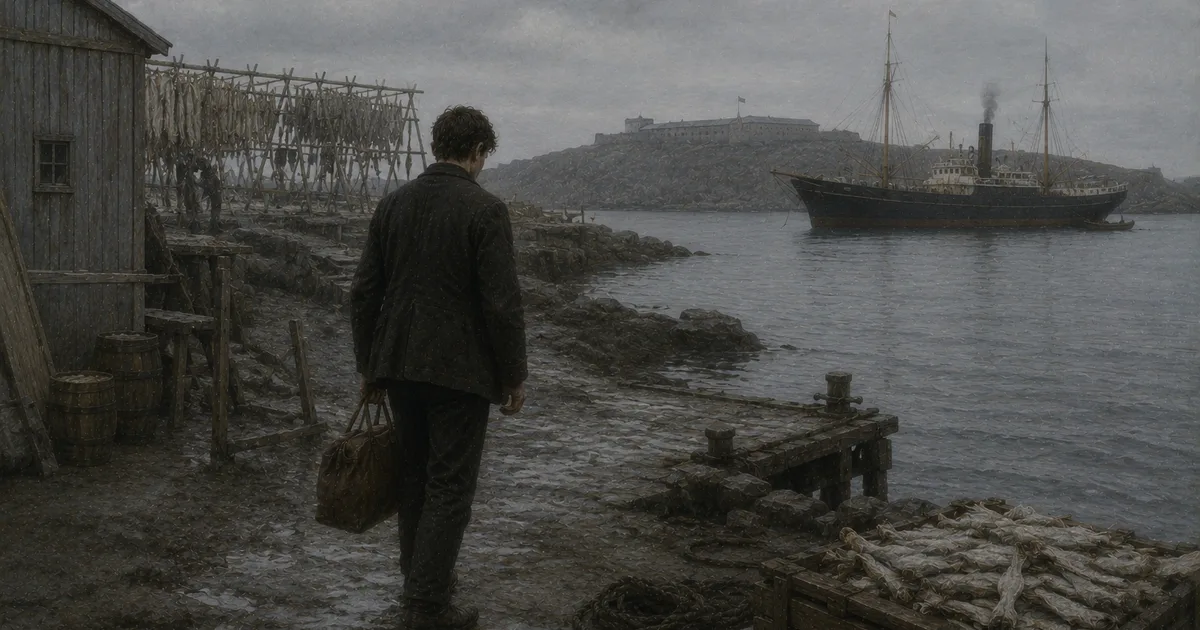
Everything at Vardøy was gray. The sky over Vardøy was the gray of a sky that did not go dark, because the summer at the latitude of Vardøy was a summer of the light that did not go, and the light that did not go was a gray light. The rocks of the island were gray. The water of the harbor was gray. The faces of the Lapps and the Finns at the wharf were gray with the weather of the place. The Russian fishing boats at the harbor were gray with the salt and the years. The stockfish on the drying-racks was gray, and the racks themselves were gray, and the houses behind the racks were gray. Olav stood at the deck of the Brio at the coming-in to the harbor and looked at Vardøy, and Vardøy was gray, gray, gray.
Vardøy was a town at the top of the country.
It was the last town of Norway at the northeast, out past the North Cape, at the open water that ran toward the Russian coast, and it had the Vardøyhus fort at it, which the men at the wharf said was the northernmost fort in the world. The tide at Vardøy ran a great range between the low water and the high—the men at the wharf put it at twenty-three feet. The drying-racks of the stockfish ran along the shore for the half of a mile. The Lapps and the Finns at the wharf wore caps that were flat at the top, mortar-board caps, with a line of red at the trim of them. The Russian fishing boats had the one mast forward and a small mast aft, and the planks of them were planks an axe had cut and not a saw. The business of Vardøy at the summer went on at the four-and-twenty hours of the day, because the light went on at the four-and-twenty hours, and a place where the light did not stop was a place where the work did not stop. Olav had been at the ports of the world—at Archangel, at the Atlantic ports, at Jamaica, at the American ports, at Hamburg, at Bordeaux—and he had not been at a port the like of Vardøy, a frontier-port at the top of the country at the gray light that did not go.
The body of Olav at Vardøy did not know the hour.
The light at the windows of the harbor was the same light at the noon and at the midnight, and a man’s body, that had told the hour by the light all the years of its life, did not have the light to tell the hour by at Vardøy; and Olav slept the watch-below at the gray light and woke at the gray light and did not know, at the waking, whether the hour was an hour of the morning or an hour of the night until he had asked it of a man or looked at the work the harbor was at.
The unloading of the salt was the work of the Brio at Vardøy.
The Brio had carried the salt up the coast for the Russian fishermen, and the salt came up out of the holds at Vardøy and went to the Russian boats and the Russian stores, and the unloading of it was the work of the crew at the harbor at the four-and-twenty-hour light. Olav was the boatswain of her. He was at the unloading-work at the deck and the hold—the salt at the barrels and the salt at the loose bulk, the slings and the tackle, the wet of the salt against a man’s hands and a man’s clothes—and the work was the work of the salt-cargo at the cold of the Vardøy air.
The cold of the Vardøy air worsened the cough at Olav’s chest.
The cough had been at his chest since the February, and it had come back at the second night at Vignesholmene, and it had been at the forecastle of the Brio through the nights of the run north. At Vardøy it worsened. The cold of the Vardøy air came off the gray water and into a man’s chest, and the wet of the salt-cargo work was at a man’s clothes through the watches of the four-and-twenty-hour day, and at the third day at Vardøy Olav caught a bad cold on top of the cough. The bad cold and the cough together were at his chest. The body of him was a body that the salt-cargo work took the strength out of faster than the rest of the watch took it out of the other men, and Olav, at the deck of the Brio at the gray harbor, was the slowest hand at the unloading, and he had not been a slow hand at a deck before.
Olav went to the doctor at Vardøy.
There was a doctor at the town of Vardøy, and Olav went to him at the cough-and-the-cold-state, and the doctor’s room was a room at the town behind the drying-racks. The doctor examined Olav. He listened at Olav’s chest, and he asked Olav the questions a doctor asked, and the examination was the examination a doctor made; and at the close of it the doctor said the thing.
He did not say not yet.
Dr. Due at Stavanger had said not yet, but it can become tuberculosis, at the February, at the school, and the not yet of Dr. Due had been a thing Olav had carried with the cough through the spring and the Vignesholmene fishing trip and the run north on the Brio. The doctor at Vardøy did not say not yet. The doctor at Vardøy said that he could not tell Olav that the cough was not tuberculosis. He said that the cough at Olav’s chest, at the cold of Vardøy, at a man who had been at sea and at a school and at sea again, was a cough that had gone past the place where a doctor said not yet. He said that Olav was a sick man, and that a sick man did not get well at the deck of a salt-ship at the cold of the gray water, and that Olav should be at the home of him and not at the Brio.
Olav paid the doctor at the close of the visit. The leather purse at the inside pocket of the coat had been a light purse since the school had taken the four hundred crowns, and the doctor’s bill at Vardøy took from the light purse what a doctor’s bill took, and Olav put the purse back at the inside pocket and went down to the Brio.
Olav asked the captain for his discharge.
He asked him at the cabin of the Brio at the evening—at the gray-light evening that was the same gray light as the gray-light noon. The captain was at the cabin with the ledger of the cargo. Olav stood at the cabin and said the thing.
“I am sick,” Olav said. “I cannot work the ship as a boatswain should work it. I am asking for my discharge.”
It was the first time Olav had said it aloud.
He had not said it to Olava at the kitchen at Lindøy. He had not said it to Jens at the upper field at Vestbø. He had not said it to Peder at the camp-fire at Vignesholmene, where Peder had seen the cough and Olav had let Peder see it and had not said the word. He had carried the cough across the autumn and the winter and the spring and the summer at the not-saying of it, and at the cabin of the Brio at Vardøy, at the top of the country, to a tight-fisted captain with a black full beard and no care for him, Olav said it. I am sick. The saying of it to that man was the first saying of it, and Olav heard his own voice say it at the cabin.
There was a thing the body of him had carried longer than it had carried the cough, and carried at the not-saying. That thing Olav did not say at the cabin of the Brio, and would not say at a cabin or a kitchen or a wharf anywhere, and did not name to himself at the cabin either. He said the one thing. I am sick. The other thing stayed where it was.
The captain did not give Olav his discharge.
The captain said that Olav had signed the articles of the Brio as a boatswain and a sailmaker, and that the Brio had sailed from Stavanger with a boatswain and a sailmaker at her articles and would not sail from Vardøy without one. He said that Olav would have his discharge when Olav had found a man to take the boatswain’s-and-sailmaker’s place, and not before. He said it in the few words a tight-fisted man said a thing of cost in, and he turned back to the ledger of the cargo.
Olav found the men at the Vardøy harbor.
There were men at Vardøy who would take a berth, the way there were men at any port who would take a berth, and Olav was at the harbor at the days after the captain’s refusal looking for the man who would take the boatswain’s place; and in the end it was two men he found—two men who would sail the Brio on from Vardøy to Hamburg, and who would sail it without pay, because the berth and the food of the passage to Hamburg were the thing the two men wanted and the wage was a thing they would do without. The captain of the Brio took the two men at the articles. Two men at no wage in the place of one man at a wage was an arrangement a tight-fisted captain took, and the captain took it, and Olav had his discharge.
The captain paid Olav off at the discharge.
He paid him the wage of the run from Stavanger to Vardøy, the wage a boatswain and a sailmaker had earned at the weeks of the run; and at the counting-out of the wage the captain counted out four kroner short of the sum. Olav said the sum was four kroner short. The captain said he had counted the wage and would not count it again. The mustering officer at Vardøy—the officer who was at the discharges and the musters at the port—was at the paying-off the way the mustering officer was at the paying-off of a crew, and the mustering officer counted the wage over, and he said the sum was four kroner short, and he made the captain count out the four kroner. The captain counted out the four kroner. The pay-off was the full wage then, and the full wage was a small sum, and Olav put it at the light leather purse at the inside pocket of the coat.
Olav came up out of the Brio at the discharge with the leather bag at his hand.
Tobias Bjøravaag was at the deck of the Brio. The Finnøy boy was not discharged—the Finnøy boy was a youngman on his first voyage, with the wage of the voyage to earn and the voyage to finish, and the Brio would carry him on from Vardøy to Hamburg with the two no-wage men at the boatswain’s place. Olav stood at the deck with the leather bag and looked at the Bjøravaag boy, and he did not tell the boy the things a forecastle taught a boy, because the forecastle would teach the boy the things in its own time the way the forecastle had taught Olav. He said to Tobias Bjøravaag that he was leaving the ship. Tobias said the Bjøravaags at Hesby would be glad to hear Olav had been at the Brio with him. Olav said they would. Then Olav went down over the side of the Brio into the small boat at the harbor, and the Finnøy boy stood at the rail, and that was the parting.
Olav stood at the Vardøy wharf at the close of the discharge-day.
He was two thousand one hundred miles from Vestbø. He had counted it once, the distance of the coast and the open water between the wharf at Vardøy and the bay at Vestbø, and it was a distance of that order—two thousand one hundred miles of the country between the top of it and the home of him; and he stood at the wharf with the leather bag at his hand and the light purse at the inside pocket of the coat and the cough at his chest, and he had no ship, and the doctor of Vardøy had said the thing about the cough.
There was a steamer at anchor in the Vardøy harbor.
She was a steam-freighter, at anchor out in the gray water, and Olav had seen her come in, and he had heard at the wharf that she was a Bergen ship and that she was loading stockfish for the run south. Olav stood at the wharf and looked at the steamer.
He did not know what the steamer was, beyond a Bergen ship loading stockfish. He did not know the name of the captain of her, or whether the captain of her would take a man who came out to the ship in a small boat asking to work a passage south. He did not know whether the cough at his chest would let him work a passage at all. He did not know whether the body of him would get well, or get worse, or come to the thing the doctor of Vardøy had not said not yet of. He did not know how a man two thousand one hundred miles from home, with a light purse and a cough and no ship, got home. He knew that the steamer was at anchor in the gray water of the Vardøy harbor, and that there was a small boat at the wharf, and that a small boat would carry a man out to a steamer. He stood at the wharf at the close of the discharge-day at the gray light that did not go, and then he went down to the small boat.