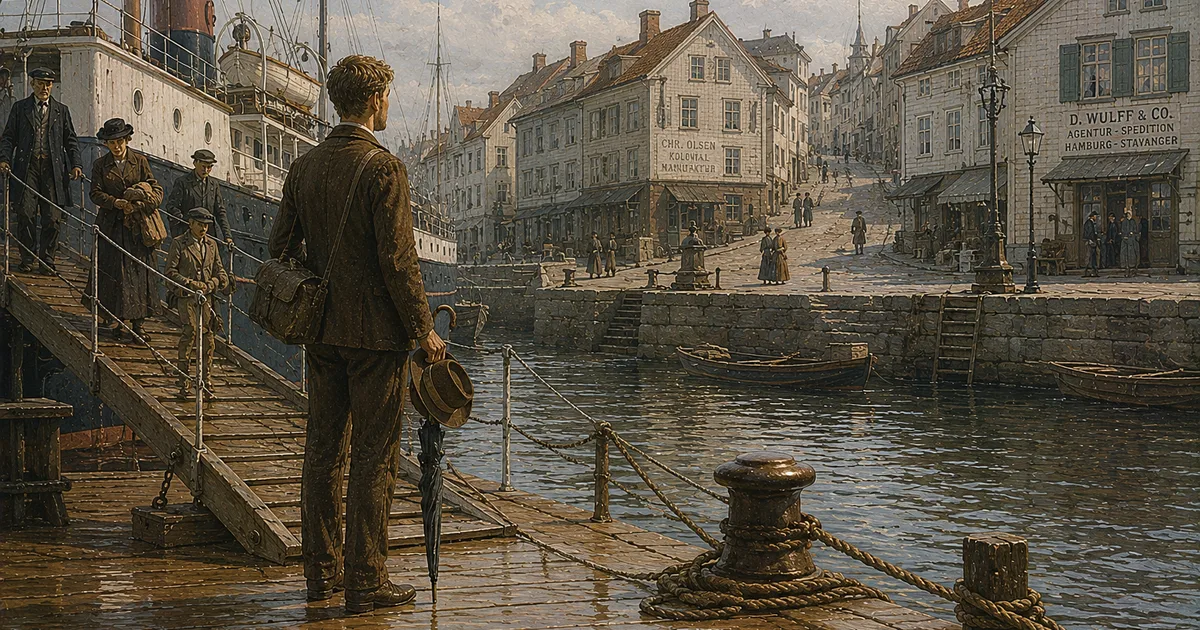
The coast-steamer from Sandefjord to Kristiansand sailed at the half past seven of the morning of the twenty-sixth of July of 1878.
Olav was at the upper deck at the larboard rail at the half past seven.
He had the small bag and the brown wool suit of the Bordeaux tailor at his shoulders and the brown hat at his head and the umbrella-as-cane at the hand. He had the inside-pocket of the coat with the francs and the kroner. He had Olava’s two letters at the breast-pocket. He had the parcel at the side-pocket. He had the carte-de-visite at the wallet at the other side-pocket. He had the bone-handled knife at the coat-pocket. He had the wooden rosary at the inside-pocket with the wages.
He had no chest.
The chest was at Vestbø at the foot of the bed of the small back room above the kitchen. It had come home to Norway without him. The Dronningen had carried it the whole of the long voyage, and had carried it still when she came home to Stavanger with the coal from Goole at the April of 1878; and John Stensøy had sent the word across to Vestbø at the discharge of her, and Jens Hestby had crossed to Stavanger at the second week of May to fetch the chest, and had brought it across to Judaberg and up the road to Vestbø. The chest had been at the foot of the bed of the small back room at Vestbø since the second week of May of 1878.
Olav had not seen the chest at Vestbø.
The chest was at Vestbø waiting.
The coast-steamer went south-west from Sandefjord at the wind from the south-west at three knots at the half past seven of the morning.
The body of Olav at the larboard rail at the upper deck of the coast-steamer at the half past seven of the morning of the twenty-sixth of July of 1878 was the body of a man of twenty-one at the deck of a passenger-vessel for the first time at the two years since the third leaving at Stavanger of the eighteenth of July of 1876.
The hands at the rail were the hands of a man who had been at the bars of a Kvik for forty-seven days and at the cat-falls of an American bark out of Hamburg for thirty-two days and at the cat-falls of an American bark out of Brooklyn for ninety-three days and at the cat-falls of a Sandefjord ship for fifteen days. The hands at the rail were not at a coil at the larboard rail of the coast-steamer at the upper deck. The hands were at the rail.
The shoulders at the brown wool of the Bordeaux suit were not at a brake-handle of the bilge-pumps of the Kvik at the six-and-two of the forty-seven days. The shoulders were at the brown wool of a Bordeaux tailor at the upper deck of a Norwegian coast-steamer at the late July of 1878 at the run from Sandefjord to Kristiansand.
The coast-steamer made the run to Kristiansand at the wind from the south-west at the day of the twenty-sixth.
She came to the wharf at the lower harbor at Kristiansand at the noon of the twenty-sixth.
Olav came down from the upper deck at the gangway at the noon.
Olav was at Kristiansand for the hours of the afternoon between the steamers.
The coast-steamer had set him at the wharf at the noon, and the mail-steamer for Stavanger would not have her gangway down before the half past two, and the hours between were the hours of a man ashore at a town with no work to be at and no ship to be aboard of. Olav had the small bag at his hand. He walked up from the wharf at the lower harbor into the streets of Kristiansand.
Kristiansand was a town of the south coast. It was a town of the straight streets, laid at the grid, with the timber houses at the streets and the people of the town at the business of an afternoon of the late July. Olav had not been at Kristiansand before. He had been at the ports of the world—at Archangel and the Atlantic ports, at Jamaica, at Wilmington, at Hamburg, at the New York of the Brooklyn anchorage, at Bordeaux—and he had not been at Kristiansand, which was a town of his own country a day’s steaming from the next town of his own country; and he walked the streets of it the way a man walked the streets of a town he had not been at and had no thing to do at.
The streets of Kristiansand were Norwegian streets. The signs at the shops were the Norwegian signs. The talk at the streets was the Norwegian talk. Olav had been at the English of the watch-bunks and the Bristol reading-room, and at the German of the Hamburg captain’s office, and at the French at the rail of the Bordeaux quay; and the Norwegian talk at the streets of Kristiansand went into him the way a man’s own language went into him, which was the way of a thing the body did not have to be at the work of. He walked the streets. He came back down to the harbor-edge and stood at it and looked at the shipping of the lower harbor—the coast-steamers and the small craft and a barque at the far wharf loading deals—and the looking at the shipping was the looking a sailor’s eye did at a harbor whether the sailor had a thing to do at the harbor or not. He bought bread and a piece of cheese at a shop of one of the streets and ate it at a bench at the harbor, and the hours of the afternoon went by, and at the two o’clock he walked to the wharf at the upper end of the lower harbor where the mail-steamer for Stavanger lay.
The mail-steamer from Hamburg for Stavanger was at the wharf at the upper end of the lower harbor at Kristiansand at the half past two of the afternoon of the twenty-sixth.
She was a steamer of about four hundred tons in the Hamburg-Stavanger trade of the European mail-and-passenger service of the year of 1878. She had the third-class passenger cabin at the lower end of the deck-house and the second-class and the first-class cabins at the upper end of the deck-house. She had four officers in the white-and-blue of a German mail-steamer at the wheel-box and the gangway and the deck.
Olav bought a third-class ticket at the wharf-end office at the half past two for the run from Kristiansand to Stavanger.
The third-class cabin at the lower deck was three rows of bunks at the larboard side of the deck-house and a long bench at the side wall. The cabin held the third-class passengers at the run from Kristiansand to Stavanger. The third-class passengers at the cabin at the half past three of the afternoon of the twenty-sixth were eleven men and four women and three children of the kind that travel third-class.
Olav sat at the bench at the side wall.
He held the small bag at his hand.
The third-class passengers were not a crew. They were the men and the women and the children the mail-steamer carried at the price of the third-class ticket—a family at the lower bunks of the one row, the children of it small; two old women at the bench at the far end from Olav; a man in the coat of a clerk; men of the south coast going up the coast to the work. They had their bags and their bundles at their feet. They did not have the watch, and they did not have the work. Olav had been at the forecastles of the ships, where the men were a crew and the crew had the watch and the work and the bunks were the watch’s bunks; and the third-class cabin of the mail-steamer was not a forecastle, and the eleven men at it were not a crew, and Olav sat at the bench at the side wall among them with the small bag at his hand and was a passenger. He had not been a passenger at a vessel before the July of 1878. It was a new thing, for the body of him, to be at a vessel at sea and have no thing at the vessel to be at, and Olav sat at the bench and was at the new thing.
The mail-steamer sailed at the half past three of the afternoon of the twenty-sixth from the wharf at the lower harbor at Kristiansand.
She went west at the wind from the south-west at four knots at the south coast of Norway.
The night came over the south coast at the eight of the evening.
The mail-steamer ran west through the night at the wind from the south-west. The third-class cabin at the night was the cabin at the lamp turned low—the passengers at the bunks and the bench, the children of the family asleep, the two old women asleep, the south coast of Norway going by in the dark off the larboard side. Olav lay at the bench at the side wall at the upper end of it beside the small bag. He had stood the night watches of the ships for the years of the voyages—the watch of the Kvik at the pumps, the watches of the barks at the cat-falls and the wheel—and at the night of the twenty-sixth of July there was no watch for the body of him to stand. The German officers had the steamer. The night was not Olav’s to keep. He lay at the bench, and the body of him, that had not slept a night through at sea without a watch set in it for the years of the voyages, slept the night through, and the mail-steamer ran west toward the Stavanger fjord.
The mail-steamer came to the Stavanger fjord at the morning watch of the twenty-seventh.
The Stavanger fjord at the morning watch of the twenty-seventh was the water Olav had been born at the side of. The islands of the Ryfylke stood at the two sides of the steamer’s way up the fjord—the low green islands of the inner coast, the farms at the slopes of them, the boats of the islands out at the morning water. One of the islands of the Ryfylke was Finnøy. Finnøy was not at the steamer’s way up to Stavanger, and the steamer did not pass it, and Olav at the rail did not see it; but Finnøy was at the fjord, off at the north, at the morning of the twenty-seventh, and Vestbø was at Finnøy, and the small back room was at the house at Vestbø, and the chest was at the foot of the bed of the small back room. The mail-steamer went up the fjord. Olav stood at the rail and the islands of the Ryfylke went by.
She came up the fjord at the wind from the south-west at three knots and came to the wharf at the lower end of the upper harbor at Stavanger at the half past eleven of the morning of the twenty-seventh of July of 1878.
Olav came up to the upper deck at the half past eleven.
He stood at the larboard rail at the upper deck as the mail-steamer came up to the wharf.
The wharf at Stavanger at the lower end of the upper harbor at the half past eleven of the morning of the twenty-seventh of July of 1878 was the wharf Olav had stood at at the eighteenth of July of 1876 at the day the Dronningen of Stavanger had sailed for Archangel at the noon tide. The wharf was at the same stones. The wharf-houses at the upper end of the wharf were at the same stones. The streets at the upper end of the wharf-houses at the upper end of the wharf rose at the upper city the way they had risen at the eighteenth of July of 1876.
The streets at the upper end of the upper city were the streets Olav had walked at the eighteenth of July of 1876 at the morning he had come down to the wharf for the Dronningen at the day the Dronningen had sailed.
The wharf was at the late July of 1878.
The mail-steamer tied up at the wharf at the noon of the twenty-seventh.
The gangway came down at the half past noon.
Olav came down at the gangway at the small bag at his hand.
He stood at the lower end of the gangway at the wharf at the half past noon of the twenty-seventh of July of 1878.
The wharf was the wharf at Stavanger.
The streets at the upper end of the wharf were the streets at Stavanger.
The upper city at the upper end of the streets was the upper city at Stavanger.
Olav had been gone for two years at the twenty-seventh of July of 1878.
He had gone out from this wharf on the Dronningen of Stavanger at the noon tide of a July, at the articles of her, bound for Archangel and wherever the Dronningen went after. He had not come back on the Dronningen. He had come back on a German mail-steamer at a third-class ticket, two years and nine days after, by the way of the Kvik and an American bark and a Sandefjord ship and a coast-steamer; and the wharf was the same wharf, and the man at the lower end of its gangway was not the man who had gone out from it. The stones of the wharf were the stones. Olav stood at the stones.
He stood at the wharf for some minutes at the lower end of the gangway with the francs and the kroner of the run from Wilmington through Hamburg through Brooklyn through Bordeaux through Sandefjord at the inside-pocket of the coat.
He had no chest.
He had Olava’s two letters at the breast-pocket.
He had the parcel at the side-pocket.
He had the carte-de-visite at the wallet.
He had the bone-handled knife at the coat-pocket.
He had the rosary at the inside-pocket.
The streets at the upper end of the wharf-houses rose at the upper city.
The wharf-end office where the Dronningen of Stavanger would have discharged if Olav had come home at her was at the lower side of the wharf at the same stones at the same shutters at the same lettering at the same door.
Olav looked at the upper city.
Olav lifted the small bag at his shoulder and walked up the wharf at the lower end of the upper harbor.