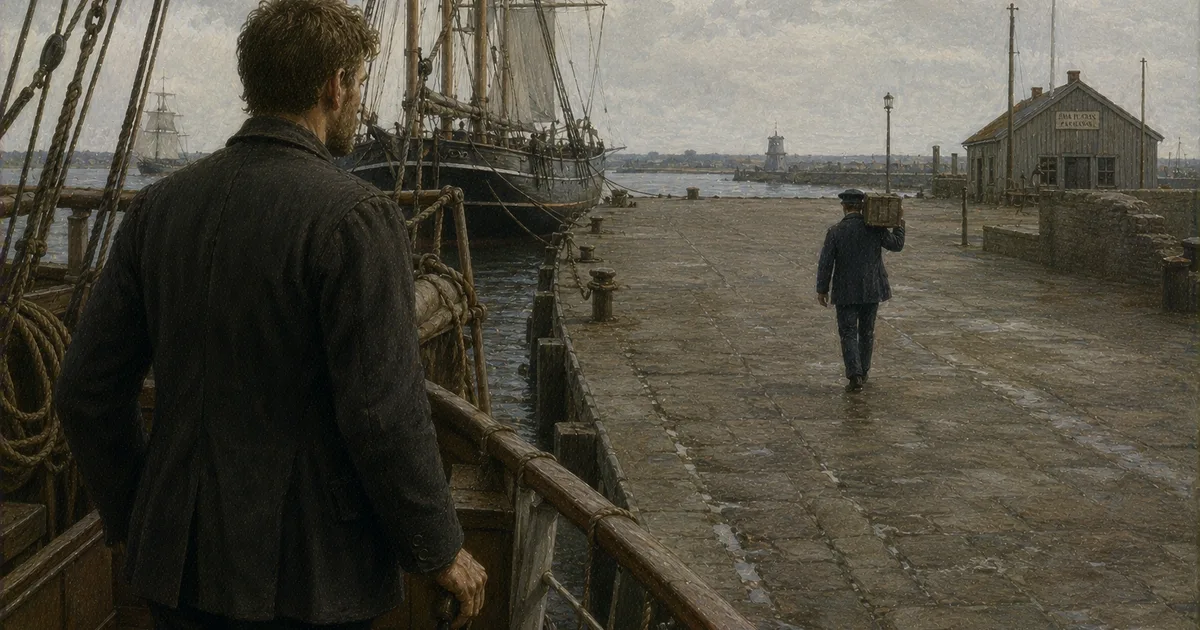
The Sandefjord ship cleared the bar of the Gironde mouth at the morning tide of the ninth of July of 1878.
She came out at the bar at the half past six of the morning at the wind from the south-west at five knots and came onto the starboard tack at the half hour after and went north into the Bay of Biscay at the run for the English Channel under topsails and topgallants and courses.
The captain was at the wheel-box at the upper end of the deck-house at the noon.
He was a man of about sixty in the wool coat of a Sandefjord cut with the full black beard at the chin that Olav had seen at the wharf-end office at Bordeaux at the morning of the seventh of July. He had a face the color of a man of sixty who had been at the wages of a ballast bark at the timber trade for the years of his fifties and his sixties. He had a jovial smile at the half hour of the noon at the wheel-box when he came to the deck for the watch.
He said in the Norwegian of a Sandefjord master at the morning of the tenth of July at the bay that the bark would be at the Channel at the fourth day and at the North Sea at the seventh day and at the port of Esbjerg at the ninth day for a half-day water-and-bread call and at Sandefjord at the morning of the second week of August. He said the watches at the bark would be the four-and-four of a Sandefjord bark in ballast for Norway. He said the food at the table would be the food of the Sandefjord steward at the galley.
Olav said yes.
The Dane said yes.
The watches at the Sandefjord ship were the four-and-four.
Olav had the starboard watch under the 1st mate, a Sandefjord man of about forty-five in a wool coat at the deck. The Dane had the starboard watch at Olav’s side at the foredeck. The 1st mate ran the watch at the run north at the wind from the south-west at five knots for the four days of the Biscay crossing.
The Biscay was at the calm of a midsummer at the latitude of forty-five to forty-seven north.
The bark held at the topsails and the topgallants and the courses through the Biscay at the wind that did not back or veer at the four days and the four days that did not bring weather at the bay. The 1st mate said at the deck at the four bells of the afternoon watch of the fourth day that the bay had been the kindest Biscay of the eight runs to Bordeaux as the 1st mate of the Sandefjord ship.
Olav said yes.
The Dane said yes.
The English Channel came at the morning of the fifteenth of July.
The bark came up the Channel at the wind from the south-west at six knots at the day of the fifteenth and the day of the sixteenth and came to the lower end of the Dover Strait at the morning of the seventeenth and through the strait at the noon and into the southern North Sea at the afternoon.
The North Sea at the seventeenth of July of 1878 was the North Sea of a midsummer of the European trade at the latitude of fifty-one to fifty-five north.
The bark went north at the wind from the south-west at five knots through the day of the eighteenth.
Esbjerg came at the morning of the nineteenth of July.
Esbjerg was a port at the west coast of Jutland at the lower end of the harbor at a wharf of stone of the kind a Danish working port of the year of 1878 had at the lower harbor. The Sandefjord ship came up to the wharf at the morning tide at the half past seven and tied up at the wharf for the half-day water-and-bread call the captain had said at the wharf-end at Bordeaux.
The crew came down to the deck at the change of the bells of the morning watch.
The Dane went to the bunk at the lower end of the forecastle.
He came up at the half past nine of the morning with the sea-chest at his shoulder.
The sea-chest was the small sea-chest the Dane had bought of the keeper of the boardinghouse at Atlantic Street at the morning of the second of April and had carried at the gangway to the American bark at the wharf at Brooklyn and had set at the foot of his bunk on the brotherhood-bark through the three months to Bordeaux, and again on the Sandefjord ship for the run to Esbjerg. The chest held at the bottom the dark blue suit and the dark blue waistcoat of the Bordeaux tailor at the brown paper of the tailor’s-room of the sixth of July, and above them the wool of the Dane’s coat and the spare shirt and the small leather case at his hand. The chest weighed the weight of a small sea-chest at a Danish able seaman at the run from Hamburg through Bordeaux to Esbjerg.
Olav was at the foredeck at the gangway.
He saw the Dane come up from the bunk at the half past nine of the morning of the nineteenth of July of 1878 at the wharf at the lower harbor at Esbjerg.
The Dane came along the foredeck to the gangway.
He stopped at the foredeck at the rail at the larboard side at the upper end of the gangway. He set the chest at the deck at his feet. He looked at Olav.
He said in Danish at the foredeck at the rail that he was going down to the wharf at Esbjerg at the half past nine of the morning of the nineteenth of July.
He said his mother was at a small town at the upper end of the Limfjord at the north of Jutland and he was going to see her at the first time since the autumn of 1875.
He said his name was Søren.
Olav said yes.
Olav said the name Olav had given at the bench at the office at the third quay at Hamburg at the morning of the Day Fifty-eight had been the name Olav had at the parish of Hesby at Finnøy, and that the name was Olav Hestby of Vestbø at the parish of Hesby on the island of Finnøy at the Boknafjord at the south-west of Norway, and that a letter at the post at Stavanger at Olav’s name and that address would come to Olav at the year of 1878 or 1879 or 1880 if a letter at the post at Stavanger were to come.
Søren said yes.
He did not say whether a letter at the post at Stavanger would come.
Olav did not say whether a letter at the post at Stavanger should come.
The two of them stood at the rail at the upper end of the gangway at the foredeck for the half minute after.
Then Søren took the sea-chest at his shoulder and went down the gangway.
Olav stood at the rail at the foredeck.
Søren went down the gangway at the steady pace of a Danish able seaman with a small sea-chest at the shoulder. He came to the wharf at the lower end of the gangway. He walked the wharf at the lower end of the lower harbor at the steady pace at the half past nine and the few minutes of the morning.
He did not look back at the bark at the wharf.
He went up at the wharf at the upper end. He turned at the corner of the wharf at the upper end where the wharf-house at the harbor-master’s was at the upper end. He went past the wharf-house at the corner.
He was at the corner at the half past nine and the few minutes more.
The corner held the man at the dark blue coat with the sea-chest at the shoulder at the few seconds before the corner took him.
Olav stood at the rail at the foredeck for the half minute after the corner had taken him.
The captain at the wheel-box at the upper end of the deck-house at the half past nine and the half hour more did not say anything at the deck. The Sandefjord 1st mate at the foot of the foremast did not say anything. The crew at the watch did not say anything.
Olav went forward at the foredeck.
He went forward at the foredeck to the cat-falls of the foremast at the larboard fife-rail. He laid his hand at the coil at the cat-falls. He laid the coil at the cat-falls in the figure-eight he had been laying at every Norwegian-flagged ship he had been on since the Asta in March of 1876.
He set the coil.
He went aft for the work the Sandefjord 1st mate would have at the half hour after the change of the bells.
The Sandefjord ship took on the water and the bread at Esbjerg at the half hour after the noon and dropped her lines at the wharf at the half past two of the afternoon of the nineteenth and went out at the lower harbor at the half past three for the run to the Skagerrak.
The North Sea at the night of the nineteenth was at the wind from the west at four knots at the run north-east.
The bark came to the Skagerrak at the morning of the twenty-second of July.
The Skagerrak at the morning of the twenty-second was at the wind from the south-west at three knots at the lower end of the strait between the north of Jutland and the south of Norway. The bark came up at the wind at the run east-north-east through the strait at the day of the twenty-second.
The captain at the wheel-box of the Sandefjord ship at the morning of the twenty-second was the jovial Sandefjord master Olav had been at the four-and-four under since the tenth of July.
He was not the master Captain Tollefson had been at the Dronningen at the run from Stavanger to Archangel of the summer of 1876 at the four hours of the noon-watch when the captain had stood at the wheel-box and had brought the small German organ-bellows up at the wheel-box and had played the Den signede dag at the second hour of the noon-watch for the bark and the crew. The Sandefjord captain did not bring an organ-bellows up at the wheel-box. He did not play any music. He stood at the wheel-box at the noon-watch of the twenty-second at the jovial smile of a Sandefjord master and said good day to the 1st mate and the steward and to Olav as Olav came past to the foredeck.
Olav said good day.
He went forward.
The bark went on at the Skagerrak through the day of the twenty-second and the twenty-third and into the Oslofjord at the morning of the twenty-fourth.
Sandefjord came at the noon of the twenty-fifth of July.
The Sandefjord ship tied up at the wharf at the lower harbor at Sandefjord at the morning tide of the twenty-fifth at the half past nine and the crew came down to the deck at the change of the bells of the morning watch.
The captain paid the wages at the wharf-end office at the half past two of the afternoon.
The wages of Olav at the run from Bordeaux to Sandefjord at the wages of thirty dollars at the month at the sixteen days at the run were at sixteen dollars converted to the kroner at the Sandefjord bank at the rate of the year of 1878. The wages of the Dane at the run from Bordeaux to Esbjerg at the wages of thirty dollars at the month at the ten days at the run were at the desk at the wharf-end office at Esbjerg at the half past one of the afternoon of the nineteenth and had been paid at Esbjerg.
Olav took the kroner at the desk at the half past two.
He put the kroner at the inside-pocket of the coat alongside the four hundred and fifty francs of the Bordeaux bank at the discharge of the fifth of July at the wharf-end office at Bordeaux less the cost at the Bordeaux tailor’s shop of the sixth of July and less the cost at the boardinghouse at the Cours du Chapeau-Rouge at the four days of the sixth and the seventh and the eighth at the room and at the food.
He signed off the articles of the Sandefjord ship at the ledger.
The captain said: that will do.
Olav took his small bag with the spare shirt and the wool of the second pair of trousers and the rest of his things. He went out of the wharf-end office at the wharf at Sandefjord at the four of the afternoon of the twenty-fifth of July of 1878.
The wharf at Sandefjord was at the lower harbor at the late July afternoon at the wind from the south-west at three knots.
Olav stood at the wharf for some minutes.
He had the inside-pocket of the coat with the francs and the kroner and the wages of the Kvik run and the Hamburg-to-Brooklyn run and the Brooklyn-to-Bordeaux run and the Bordeaux-to-Sandefjord run, less the boardinghouse and the tailor’s at Bordeaux and the post for the second Patrick letter Olav had sent at the post at the noon of the seventh of July at Bordeaux. He had Olava’s two letters at the breast-pocket. He had the parcel at the side-pocket. He had the carte-de-visite at the wallet at the other side-pocket. He had the bone-handled knife at the coat-pocket. He had the wooden rosary at the inside-pocket with the wages.
He had the brown wool suit of the Bordeaux tailor at his shoulders and the brown wool waistcoat at the chest and the brown hat at the head and the umbrella-as-cane at the hand.
He did not know what the run from Sandefjord to Stavanger would be at the coast-steamers of the European trade at the late July of 1878.
He did not know what Stavanger would be at the late July of 1878 at the wharf at the lower end of the upper streets at the four of the afternoon of a day Olav would come ashore at it for the first time in two years.
He did not know what Olava at Lindøy at the kitchen at the morning of the twenty-sixth of July of 1878 would be.
He did not know what the kitchen at Vestbø at the upper field at the back room at the chest at the foot of the bed in the back room at Vestbø at the afternoon of a day Olav had been at the Judaberg road at the flower garden of the late July of 1878 would be.
He did not know what a Danish corner at a wharf-house at the upper end of the lower harbor at Esbjerg at the morning of the nineteenth of July of 1878 had taken at the half minute after the man at the dark blue coat with the sea-chest at the shoulder had passed it.
The afternoon of the twenty-fifth went on at the wharf at Sandefjord.
Olav walked up at the wharf at the upper end at the half past four of the afternoon for the coast-steamer to Kristiansand at the morning of the twenty-sixth.