Olav walked up the wharf at the lower end of the upper harbor at the half past noon of the twenty-seventh of July of 1878.
The wharf at the lower end of the upper harbor was the wharf Olav had walked on the eighteenth of July of 1876 at the morning the Dronningen had loaded at the upper wharves before the noon-tide run for Archangel. The stones were the stones. The wharf-houses at the upper end were the wharf-houses. The streets at the upper end of the wharf-houses rose at the upper city.
The wharf-end office was at the lower side of the wharf at the upper end of the wharf at the corner of the street that rose to the upper city.
Olav came up to the wharf-end office at the noon and a few minutes.
The young woman at the upper end of the wharf was at the door of the wharf-end office at the noon and a few minutes.
She was at the door at the half past noon of the twenty-seventh of July of 1878 at a long dress of a Stavanger-summer cut in a fabric Olav did not know. The dress was not the green dress Olava had been at the parlor at the boardinghouse at Bredalmendingen at the second week of July of 1876 at the half past three of the Wednesday afternoon Olav had come to ask Bjørn Olsen Lindøy for the leave to write at the Dronningen voyage. The dress was a dress Olav had not seen at any of his letters or at any of the carte-de-visite at the wallet or in any of the interior at the watches of the bunk of the Kvik and the American bark and the Sandefjord ship at the two years since the eighteenth of July of 1876.
She turned at the door.
She saw Olav at the wharf at the upper end at the few paces from the door.
She did not move.
Olav stopped at the few paces.
She was the woman of nineteen Karoline of Rossøygate had told her about at the Lindøy kitchen at the morning of the twenty-fifth that the wharf-end office at Stavanger had a notice at the mail-steamer’s arrivals for the third week of July with the name Olav Hestby of Vestbø at the third-class manifest at the Kristiansand boarding of the twenty-sixth, and that Karoline had said Olava should come to Stavanger at the morning of the twenty-seventh and stand at the wharf-end office at the noon of the day the mail-steamer was set down at the manifest at the wharf-end of the upper harbor.
She had stood at the door at the half past eleven and at the noon and at the few minutes after.
Of the two years Olav had been at sea, she had not stood at the wharf-end office on any of them.
She was at the door at the half past noon.
Olav was at the few paces.
Neither of them spoke at the few paces.
Olava came down the wharf at the few steps. She stopped at the half a pace from Olav. She looked at his face. She looked at the brown wool of the Bordeaux suit at his shoulders. She looked at the brown hat at his head. She looked at the umbrella-as-cane at his hand. She looked at his face again.
She said in the Stavanger-Norwegian of a young woman of twenty at the wharf at Stavanger at the half past noon of the twenty-seventh of July of 1878 that the mail-steamer’s manifest had said the name. She said the wharf-end notice had said the name. She said Karoline had told her at the Lindøy kitchen.
Olav said yes.
He did not say anything else.
She did not say anything else.
The two of them stood at the wharf at the half pace at the half past noon and the few minutes more.
Olava said: There is a cafe at the upper end of Skagen-gata at the Sunday upper room above the wharf-house.
Olav said yes.
The two of them walked up the wharf at the upper end and along the street at the upper end of the wharf to the corner of Skagen-gata. Olava walked at his side at the right. Olav had the small bag at his left hand and the umbrella-as-cane at his right hand at the side of Olava’s hand. He did not take her hand. She did not take his.
They came to the cafe at the half past noon and the eight minutes.
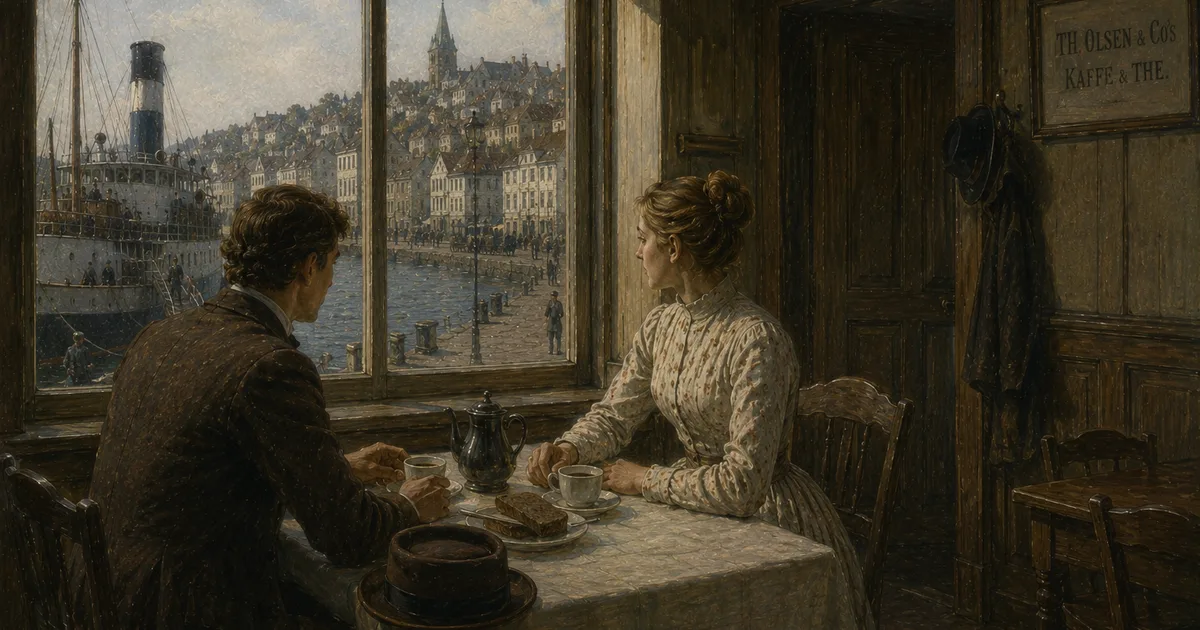
The cafe was at the upper room of a Sunday-room at the second floor of a wharf-house at the upper end of Skagen-gata. The cafe-keeper was a woman of about forty-five in a black dress of a Stavanger cut at the lower wall. The room had four small tables at the windows and two long benches at the long wall and a counter at the lower wall where the coffee-pot and the cups and the small loaves of bread of the Stavanger baker were at the counter.
Olava said in the Norwegian of a Lindøy young woman at a Stavanger cafe that they wanted two coffees and two slices of bread.
The cafe-keeper set the coffees and the bread at a small table at the window at the upper end of the room.
Olav and Olava sat at the small table.
The small table was at the window at the upper end of the room. The window looked at the upper harbor at the wharves at the lower end. The mail-steamer was at the wharf at the lower end of the upper harbor at the half past noon and the ten minutes. The Sandefjord coast-steamer had sailed at the noon of the twenty-sixth and was at the south coast somewhere. The Dronningen was not at the wharf because the Dronningen was at sea somewhere or at a port somewhere else.
Olav drank the coffee at the small table.
Olava drank the coffee at her side.
She set the cup at the small saucer at the table.
She said in the Stavanger-Norwegian at the small table that she had been at Stavanger since the morning of the twenty-sixth at Karoline at Rossøygate at the morning at the wharf-end notice. She said she had stood at the wharf at the half past eleven of the morning of the twenty-seventh and at the noon and at the few minutes after. She said the mail-steamer had come to the wharf at the half past eleven and the gangway had come down at the half past noon and the passengers had come down at the gangway at the few minutes after the gangway. She said Olav was the eleventh passenger at the third-class to come down.
Olav said yes.
She said the dress was a dress Bertha had made at the second week of June at the cloth Karoline’s cousin’s husband had brought from the wharf at Stavanger at the second week of May. She said the dress was the dress Bertha had made for her at her twentieth-year and at the spring of 1878 and at the wait at Lindøy of the spring.
Olav said yes.
She did not say what she had not said at the saying of the dress.
Olav did not say what he had not said at the hearing.
The body of Olav at the cafe at the half past noon and the eighteen minutes of the twenty-seventh of July of 1878 was the body of a man of twenty-one who had been at the parcelling of the bowsprit-shroud at the side of a man at the Asta in March of 1876 and at the long oak table at a Bristol Bethel reading-room at the first week of February of 1877 and at the bench at a captain’s office at Hamburg at the morning of the Day Fifty-eight at the body’s-knowing of the look of a Danish man with a patch over the left eye and at the foremast pin-rail of a brotherhood-bark at the Brooklyn anchorage at the few minutes a man held the standing at another man at the cables of the upper hundred and forty-five feet over the East River and at the rail at the upper end of the gangway at the foredeck of a Sandefjord ship at the half past nine of the morning at Esbjerg.
The body of Olav at the cafe at the small table at the half past noon and the eighteen minutes of the twenty-seventh of July of 1878 had a capacity to register the woman at the cafe at the small table at the window at his side as a thing of a kind the body had not at the wharf at Stavanger at the eighteenth of July of 1876 at the noon tide of the Dronningen sailing.
He did not name to himself, at the cafe at the small table at the window, what the body of him knew at the registering.
Olava said: I am glad you are home.
Olav said yes.
He set the cup at the saucer at the table.
He said in the Norwegian he had spoken at the parcel-wrapping at the Asta foretop and at the boardinghouse at Bredalmendingen at the half past three of the Wednesday afternoon at the Lindøy kitchen at the supper of the second-day-of-Olav-at-Lindøy at the Roda gate at the day of the Yes at the post Olav had handed to John Stensøy at every Stavanger crossing at the years at the letters Olav had written at the Dronningen and at Wilmington and at Hamburg and at Brooklyn and at Bordeaux that he was glad to be home.
Olava said yes.
The two of them sat at the small table for the half hour after.
The cafe-keeper brought a second pot of coffee at the half past one.
They drank the second coffee.
Olava said the Lindøy-bound steamer was at the wharf at the lower end of the upper harbor at the half past two of the afternoon. She said the steamer made the crossing to Lindøy at the half hour and would set them at the Lindøy boathouse at the four of the afternoon. She said Bertha was at the kitchen at Lindøy at the morning and was at the kitchen at the four of the afternoon at Bertha’s regular hour at the kitchen.
Olav said yes.
The two of them stood at the small table at the cafe at the quarter past two.
Olav paid the cafe-keeper the few kroner of the two pots and the two slices of bread.
The cafe-keeper said good day.
The two of them went down the stairs of the wharf-house and out at the street and along Skagen-gata to the wharf at the lower end of the upper harbor.
The Lindøy steamer was at the wharf at the half past two.
She was a small wharf-steamer of about sixty tons in the Stavanger-Finnøy mail-and-passenger service of the year of 1878. She had at the upper deck a small passenger-cabin at the upper end of the deck-house and at the lower deck the mail and the small cargo.
Olav bought two passenger-tickets at the wharf-end office at the wharf.
The steamer sailed at the half past two of the afternoon from the wharf at the lower end of the upper harbor at Stavanger.
She went west across the strait at the wind from the south-west at three knots.
Olav and Olava stood at the upper deck at the larboard rail at the run.
The Stavanger fjord at the late July afternoon was at the calm of a summer afternoon. The slopes at the north side of the fjord were at the green of a summer afternoon. The slopes at the south side of the fjord were at the green of a summer afternoon. The water at the larboard side of the steamer was at the green of the summer water of the Stavanger fjord at the late July of 1878.
Olava stood at the rail at Olav’s side.
She did not speak at the run.
Olav did not speak at the run.
The steamer came to the lower end of Finnøy at the half past three of the afternoon.
She came up the strait between Finnøy and Lindøy at the four less ten minutes of the afternoon.
She came to the Lindøy boathouse at the four less five minutes of the afternoon.
The boathouse at Lindøy at the four less five minutes of the afternoon of the twenty-seventh of July of 1878 was the boathouse Olav had seen at the Sunday afternoon of the second day of Olav at Lindøy at the second week of July of 1876 at the afternoon Olava and Bertha had walked Olav down to the boathouse at the parting before the steamer back to Stavanger.
The wharf at the lower end of the boathouse was at the same stones.
The boathouse at the upper end of the wharf was at the same wood.
The path at the upper end of the boathouse rose at the upper field of Lindøy at the upper end of the slopes.
Olav came down the gangway of the small steamer at the four less three minutes of the afternoon of the twenty-seventh of July of 1878.
Olava came down at his side.
The Lindøy steamer dropped the lines and went on to the next port at the four of the afternoon.
Olav stood at the wharf at the lower end of the boathouse at Lindøy at the four of the afternoon of the twenty-seventh of July of 1878.
He had the small bag at his hand. He had the brown wool suit of the Bordeaux tailor at his shoulders. He had the brown hat at his head. He had the umbrella-as-cane at his hand. He had Olava at his side.
The afternoon at Lindøy at the four of the twenty-seventh of July of 1878 was the afternoon Olav had been writing at since the eighteenth of July of 1876 at the noon tide of the Dronningen sailing.
Olav stepped at the wharf at the lower end of the boathouse at Lindøy.
The half-circle of the homecoming was at the foot at the wharf.
Olava stepped at the wharf at his side.
The two of them stood at the wharf for the half minute at the long afternoon light.
Then they walked up the path at the upper end of the boathouse for the slopes of Lindøy.