Olav came home to Vestbø at the first week of May of 1879.
He crossed from Stavanger to Judaberg at the coast-steamer and walked the road from Judaberg to Vestbø at the morning. The road in the first week of May was the road in the spring. The fields above the road had the new grass at them, and the ditches at the side of the road ran with the last of the snow-water from the high ground. Olav had walked this road at the late July of the year before, at the homecoming from the sea, through what a man at Vestbø knew as a flower garden. He walked it at the spring before the flowers, at the green coming up, and the body of him walked it.
He had the leather bag at his hand. He had the navigator’s certificate in the bag, folded in the oilcloth he had wrapped it in at Kindingstad’s. He had the leather purse at the inside pocket of the coat, and the purse was light.
He came to the kitchen at Vestbø at the noon.
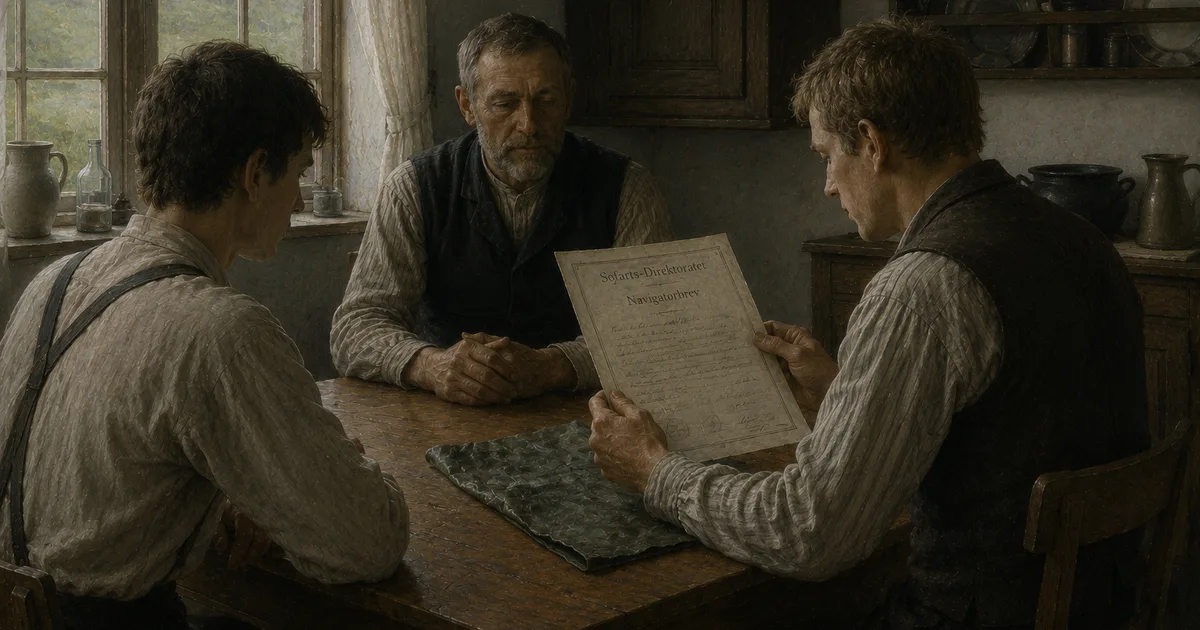
Jens was at the kitchen. Peder came in from the byre. The aunt was across the hill and would come at the Sunday. The three of them—Jens and Peder and Olav—were at the kitchen table at the noon meal of the day Olav had come home, and Olav set the leather bag at the chair at the side of the door, and after the meal he took the certificate out of the bag in the oilcloth and unwrapped the oilcloth and set the certificate at the kitchen table at the cloth.
The certificate was at the table.
Peder took it up. He read it. He read it aloud at the kitchen table—the navigator’s certificate of the kingdom, the inscription and the form of words and the name Olav Hestby and the seal of the school and the marks of the examiner and the censors—and Peder read it the way a man read aloud a thing he did not have the whole of the words of and read carefully for that reason, and he did not have the whole of the words of it, because the words of a navigator’s certificate were the words of a thing Peder had not been at; but he read it to its close, and at the close of the reading Peder set the certificate at the cloth and looked at his brother, and his face was the face of a younger brother who was proud of the thing his older brother had at the table.
“It is a navigator’s certificate,” Peder said.
“It is.”
“You are a navigator.”
“I have the certificate of one.”
Jens had not said anything during the reading. He sat at the head of the table. When Peder had set the certificate at the cloth, Jens looked at it for a moment, and then he looked at his son, and he said the one word.
“Good,” Jens said.
He did not say more than the one word. Olav heard the one word and heard what was in it, which was the whole of what Jens had to say at the kitchen table about the certificate—the taking of the certificate as a thing got and a thing good, and the not-saying of the other things, the body and the money and the marriage and the next ship, all of it held at the one word the way a man held a great deal at a small word when the small word was the word he had raised his sons to hear the whole of. Jens said Good, and the certificate was at the cloth, and the matter of the certificate at the kitchen table was done.
Olav put the certificate back in the oilcloth that evening and carried it to the back room and set it at the chest at the foot of the bed.
The chest was the chest that had come home from Goole at the spring of the year before. It had stood at the foot of the bed since. Olav set the oilcloth with the certificate in it at the top of the chest, and he did not open the chest, and the certificate was at the chest at the back room at Vestbø.
The Sunday came, and the household walked the road to Hesby for the service.
They walked it in the order they had walked it since Olav had been a boy—Jens in front, Peder half a step behind Jens, Olav half a step behind Peder—and they went into the church and sat at the Hestby pew at the third row. Rev. Lindbergen was at the pulpit. He read the first reading and the gospel and gave the sermon, and at the place in the service where the parish prayed for its people he read the prayer-list, and the prayer-list at a May Sunday at Hesby had the names of the sick of the parish and the names of the sailors of the parish at sea.
Olav Hestby was not at the prayer-list.
He had been at the prayer-list of the sailors at sea at every Sunday of the years he had been at sea. The parish had prayed for him at Hesby and the parish had prayed for him at Rossøy. He was not at the list at the May Sunday of 1879, because he was not at sea; he was at the third pew at the side of his father and his brother, a man home from the school with the certificate of a navigator at the chest at the back room at Vestbø, and the parish did not pray for a man who was at the third pew. Olav sat at the pew and the prayer-list was read and his name was not at it, and the not-being-at-it was the parish’s way of knowing that Olav was home.
After the service the household walked back to Vestbø.
On the Monday Olav crossed to Lindøy.
He took his father’s boat across the strait at the morning the way he had taken it across the strait at the summer before, and he came to the Lindøy boathouse and went up the path to the house at the lower side of the ridge. Bertha was at the kitchen. She was at the door when Olav came to it, and she let him in, and she did not say anything at the door about the body of the man who came in—she had said the thing she had to say at the door at the borrowed-boat-night of the first Sunday of the March, which had been a thing of the face and not of words, and she did not say it again at the May. She set the coffee. Bjørn was at the parlor and came to the kitchen door with the pipe at his hand and said Olav had the certificate now and was a navigator, and Olav said he had the certificate, and Bjørn said a certificate was a good thing for a young man to have and went back to the parlor.
Olava was at the kitchen.
She came to the table and sat at the place at the side of Olav. The certificate was not at the table—Olav had left it at the chest at the back room at Vestbø—and there was no object at the kitchen table at Lindøy at the Monday for the household to take up and read aloud. There was Olav at the chair, and Olava at the side of him, and the coffee, and the household at the noon.
Bertha set her hand at Olav’s shoulder once.
She did it at the kitchen at the going-by of the afternoon, at a moment Olav was at the chair and Bertha was crossing the kitchen at a thing of the household. She set her hand at his shoulder for the length of a breath, and she did not say anything at the setting of it, and she took the hand off and went on at the thing of the household she had been crossing the kitchen at. It was the thing a mother-of-the-bride did at the shoulder of the man her daughter was to marry, and it was the whole of what Bertha said to Olav at the May visit, and it was said.
Olav did not ask Olava for the date.
He was at Lindøy at the Monday with the certificate got. The certificate was the thing the engagement had waited at—the thing both households had understood the marriage waited for, the no-marriage-while-Olav-is-not-yet-a-real-navigator that had been the unspoken shape of the engagement across the school-year. The certificate was got. A man who had the certificate could, at a kitchen at Lindøy at a May afternoon, with the woman he was to marry at the side of him and her father at the parlor and her mother at the stove, say the thing the certificate had been the milestone of. He could ask for the date.
Olav did not ask for the date.
The certificate was at the chest at the back room at Vestbø, and the leather purse at the inside pocket of the coat was light, and the cough was at his chest—lighter at the May than it had been at the February, lighter than it had been at the March, but at the chest, a thing the body knew was at the chest. A man asked a woman for the date of the marriage when the man was the man who could promise the household the marriage made and the children the marriage would bring. Olav was not, at the May of 1879, that man. He had the certificate of a navigator and the empty hands of a man who had spent the four hundred crowns and had no berth and had a cough at his chest, and a man did not carry empty hands and a cough to a kitchen at Lindøy and ask a woman for a date. He sat at the table at the side of Olava and did not ask, and Olava sat at the side of him and did not ask why he did not ask, and the not-asking was at the kitchen the way the not-asking had been at the kitchen at the first Sunday of the March.
Olav crossed back to Vestbø at the evening.
He took his father’s boat across the strait at the long May evening, and the strait was at the calm of a May evening, and the slopes of the two islands were at the green of the spring. He came to the Vestbø landing at the dusk and walked up the path to the house.
Peder was at the kitchen.
Olav sat at the table with his brother. He said the thing he had decided at the boat at the strait, which was the thing a man said to a brother when the man had come home with empty hands and a cough and a certificate and no berth and a summer in front of him before he hired onto a ship.
“We will take the father’s boat to Vignesholmene,” Olav said. “Before I hire onto a ship. You and I. We will go for the fishing.”
“To Vignesholmene,” Peder said.
“For the fishing. The deep-sea lines and the witch-nets. We will ask Bjørn Olsen Lindøy for the loan of the lines and the nets.”
“When?”
“At the June. When the work at the farm is at the place it can be left.”
“Yes,” Peder said.
Olav went out of the kitchen at the late evening and went up the path to the upper field.
He came to the place at the top of the field where his father walked when his father had wanted to think a thing through to its end—the place at the wall, with the bay below and the hill above, the place his father’s father had walked to before his father. Olav had not stood at the place often. It was his father’s place. He stood at it now at the dusk of the Monday of the first week of May of 1879, with the certificate at the chest at the back room below, and the empty hands, and the cough at the chest, and the fishing-trip-to-Vignesholmene decided, and the summer ahead of him, and the hiring-onto-a-ship at the close of the summer.
He stood at the upper field until the last of the light had gone from the bay.