Olav and Peder took the father’s boat to Vignesholmene at the second week of June of 1879.
They had decided it at the May, at the kitchen at Vestbø, and they had set the day of it for the second week of June, when the work at the farm was at the place the work could be left to Jens and the aunt for the days of a fishing-trip. Peder had the boat ready at the landing at the morning of the day. It was the father’s boat, the small boat Olav had caulked at the boat-shed before the Asta in the March of 1876, and Peder had been at the seams of it in the spring and the seams were tight, and the boat was a sound boat for the fishing-grounds south-west of Finnøy.
They sailed from the Vestbø landing at the morning.
They went first across to Stavanger for the herring-bait. The fishmarket at the Stavanger wharf had the herring-bait at the barrels, and Olav and Peder bought the bait for the deep-sea lines, and they had the bait at the boat at the kegs at the forward thwart. Then they sailed from Stavanger and went up the strait to Lindøy, because the deep-sea lines and the witch-nets were at Lindøy, at Bjørn Olsen Lindøy, who had said at the May that he would loan Olav and Peder the lines and the five witch-nets for the fishing.
They came to the Lindøy boathouse at the noon.
Bjørn was at the boathouse. He had the deep-sea lines coiled and the five witch-nets folded, set out at the boathouse for the loan, and Olav and Peder loaded the lines and the nets into the father’s boat. Bjørn stood at the wharf and said the lines were good lines and the witch-nets had taken fish at the Vignesholmene grounds for the years he had loaned them out, and that the brothers were to bring them back when the fishing was done. Olav said they would bring them back.
Olava came down the path to the boathouse.
She came down at the noon while the brothers were at the loading of the lines and the nets. She stood at the door of the boathouse. She was not at a borrowed-boat-night and she was not at a Sunday; she was at the door of the boathouse at a noon of the June seeing Olav and Peder at the loading of a fishing-boat, and the moment was the moment of a man and his brother at a thing of the islands and not the moment of a man and the woman he was to marry. Olava looked at the two brothers at the boat. She said the Vignesholmene grounds were good grounds for the June. Olav said they were. She did not say what she had been at the not-asking-state for since the March. The brothers finished the loading, and Olav said they would be at Vignesholmene for the days of the fishing and would bring the lines and the nets back to Lindøy after, and the father’s boat went off the wharf at the early afternoon, and Olava stood at the door of the boathouse and watched it go.
The brothers sailed south-west from Lindøy at the afternoon and came to Vignesholmene at the evening.
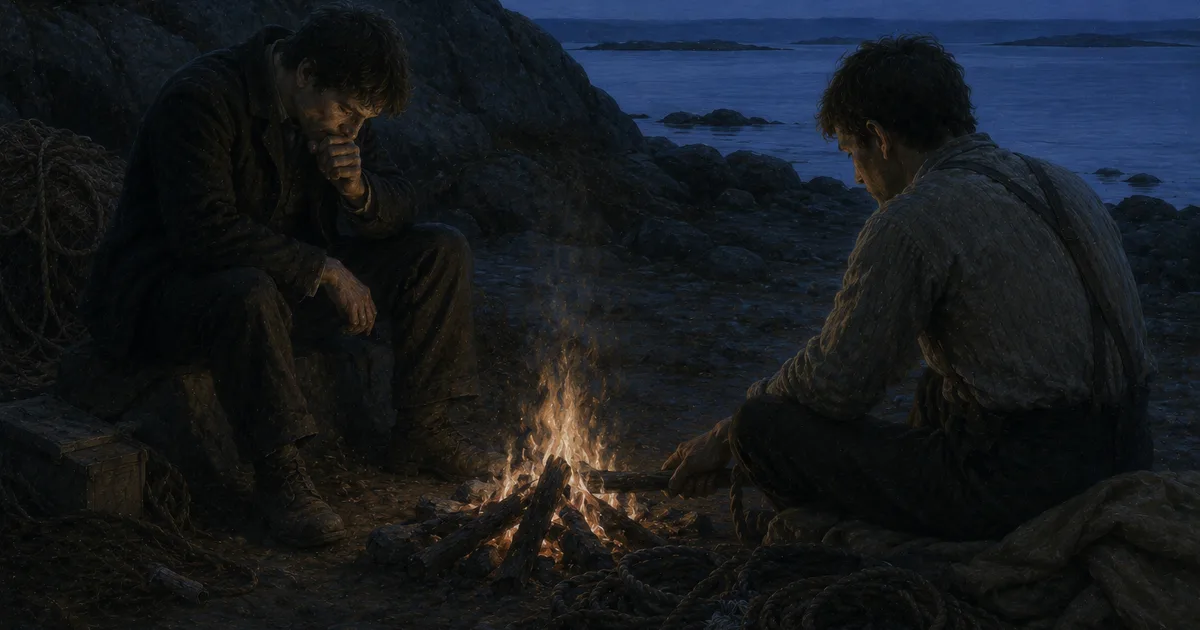
Vignesholmene was a cluster of small islands and skerries south-west of Finnøy at the open water, low islands of rock and the summer grass and the nesting-birds, with the fishing-grounds at the deep water at the outer side of them. Olav and Peder made the boat fast at the lee of one of the islands and made the camp at the island at the evening—a camp of the kind two brothers made at a fishing-island in the June, a shelter at the lee of a rock, the gear set out, a fire at the stones.
The fishing was the days at Vignesholmene.
The brothers set the deep-sea lines at the deep water at the mornings and ran them at the forenoons, and they set the five witch-nets at the inshore shallows at the skerries. The catch came up at the lines and the nets across the two days and the three days at the islands—sea bass and blue fish and red fish, and cod, and the deep-sea grayfish from the deep water, and the dog-fish a man took off the line and threw back or did not, and salmon, and trout from the inshore water, and the lobsters at the lobster-ground at the lee of the third island. The catch was a good catch. The witch-nets took the fish the way Bjørn Olsen Lindøy had said the witch-nets took the fish, and the deep-sea lines took the fish of the deep water, and Olav and Peder worked the lines and the nets at the mornings and the forenoons and laid the catch at the boat.
At the nesting-rocks the brothers gathered the eider-duck eggs.
The eggs of the eider-duck at the Vignesholmene rocks were eggs near the size of a goose’s egg, and Peder gathered them at the rocks for the egg-cakes, and Peder made the egg-cakes at the fire at the camp at the evenings. There was a seafowl at one of the witch-nets at the second morning, a seabird that had gone into the net at the shallows and tangled itself at the mesh, and Olav took the bird out of the net at the careful hand a man took a tangled bird out of a net with, and the bird went off across the water, and the witch-net was set again.
The two brothers were at Vignesholmene at the June light.
Olav was twenty-two. Peder was nineteen. They were two brothers at a small boat at a cluster of islands south-west of their own island at the long light of a Norwegian June, at the fishing, and the work of the fishing was a work the two of them did side by side at the boat and the lines and the nets, and the talk of the two of them at the boat and at the camp-fire was the easy talk of two brothers who had not been at a thing side by side for the years Olav had been at sea. Peder talked about the farm and the strake of the boat he had been talking of since the year before and the lambs and the things of Vestbø. Olav talked about the fishing-grounds and the lines. The two of them talked at the boat at the forenoons and at the fire at the evenings, and Olav was at more of the talk at Vignesholmene than he had been at any talk of the winter or the spring, because the fishing-island in the June with his brother was a place a man talked.
“You are easy here,” Peder said at the fire at the first evening.
“It is good to be at the islands.”
“You were not easy at the spring. At the homecoming from the school.”
“The school was a hard winter. The islands are not a hard winter.”
“No,” Peder said. “The islands are not.”
The first two days at Vignesholmene were the easeful days.
They were the days of the fishing and the eider-eggs and the egg-cakes at the fire and the talk of the two brothers, the days of the June light that held at the islands until the eleven and went to the blue that was not dark, the days of the body of a man of twenty-two at a small boat at the fishing-grounds at the open water with his brother at the other thwart. Olav had not had days of that kind in a long time. He had had the Kvik and the American bark and the Sandefjord ship and the school-year and the cough, and he had not had, in the years of those, days of two brothers at a fishing-island in the June. He had the days at Vignesholmene. He was easy at them, the way Peder had said he was easy.
The cough came back at the second night.
It came back at the camp at the lee of the rock at the night of the second day. The June night at the open water south-west of Finnøy was a cold night for all that the light did not go from it, and the cold of the night came up off the water and into the camp at the lee of the rock, and Olav was at the fire at the late hour of the second night when the cough came up at his chest. It came up the way it had come up at the school window at the February. It was the cough of the February. It had been lighter at the May and lighter again at the first days of June, and Olav had let himself be at the easeful days at Vignesholmene as a man let himself be at a thing he wanted to be at; and at the cold of the second night the cough came back up at his chest, and it was not lighter, and Olav coughed it at the fire.
Peder was at the other side of the fire.
Peder looked at his brother across the fire. Olav coughed the cough, and coughed it again, and the color went from his face at the coughing of it the way the color went from a face at a cough that was not the cough of a cold; and Peder, at the other side of the fire, saw the color go from his brother’s face.
Peder did not say you are coughing.
He did not say you are not well. He did not say the thing a younger brother might have said at a fire at a fishing-island when he had seen the color go from his older brother’s face. He set a piece of driftwood at the fire and looked at the fire and did not say anything, and Olav understood, at the fire at the second night, that Peder had seen, and that Peder had decided not to say.
Olav did not say I am sick.
He did not say what the cough was, or what the doctor at Stavanger had said the cough could become, or what the cough had been at the February. He sat at the fire at the lee of the rock and let the cough be at his chest and did not name it to his brother, and Peder set the driftwood at the fire and did not name it either, and the two brothers were at the fire at the second night at Vignesholmene at the not-naming of the thing the two of them had both seen.
Olav looked at his brother across the fire.
He saw that Peder had registered it—the color, the cough, the not-rightness of the body at the other side of the fire—and he saw that Peder was holding it the way a man held a thing he had decided not to set down between himself and another man. Olav did not know what was at the inside of Peder at the holding of it. He saw the outside of it: Peder at the fire, the driftwood set, the eyes at the flame and not at Olav. Olav saw that, and he did not ask Peder what was at the inside of the holding, the way Peder did not ask Olav what the cough was. The two of them were brothers at a fire at a fishing-island, and the cough was at the camp with them, and neither of them said the name of it, and the not-saying was the thing the two of them did at the fire at the second night.
The third day at Vignesholmene was a day of the fishing still.
The brothers ran the deep-sea lines at the morning of the third day and took the witch-nets up at the forenoon, and the catch of the third day went to the boat with the catch of the first two days. But the third day was not an easeful day the way the first two days had been easeful. The cough was at the camp now. It had come back at the second night and it did not go off at the third day, and the talk of the two brothers at the boat at the third day was not the easy talk of the first two days, because the talk of the first two days had been the talk of two brothers at a thing side by side and the talk of the third day was the talk of two brothers at a thing side by side with a thing at the camp neither of them was naming.
They sailed from Vignesholmene at the close of the third day.
They sailed back up toward Finnøy with the catch at the boat and the deep-sea lines and the five witch-nets coiled and folded for the return to Bjørn Olsen Lindøy. The June light was at the water. Olav was at the rudder and Peder was at the sheet, and the father’s boat ran north toward the lower end of Finnøy at the evening.
Olav coughed the cough at the run north, and Peder, at the sheet, did not look round at the coughing of it, and the not-looking-round was the thing Peder did with the cough at the boat the way the setting of the driftwood had been the thing he did with it at the fire.
The body of Olav at the rudder of the father’s boat at the run north from Vignesholmene at the evening of the third day was the body that had been at the easeful days of the islands and was at the cough now, and the easeful days were behind it, and Olav held the rudder and ran the boat north toward Finnøy.