The letter from Stavanger came down to Vestbø with Lars on a Wednesday in the second week of April.
Lars had brought it across from Judaberg in the morning with the post for the farms above the road, and he came down the track to Vestbø at the half past ten, and Jens took the letter from him at the door of the kitchen.
“That is the boy’s hand,” Lars said.
“It is.”
“He is at Stavanger still.”
“He is at the school at Stavanger.”
“The school will be near its close.”
“It will be near it.”
Lars did not stay. He had the farms above the road to do and the tide-state of the Wednesday to keep, and he went up the track. Jens stood at the door of the kitchen with the letter in his hand and looked at the inscription.
Olav had written the address in three lines, the way he wrote it—Jens Hestby, of the farm Vestbø, Finnøy—and the y of Hestby had the small flourish the boy had not had at his name in the year 1875 and had had since the office of registry in the March of 1876. Jens looked at it. He went into the kitchen.
Peder was not in the kitchen on a Wednesday in April because Peder was at the upper field at the fence-rail that the winter had loosened. The aunt was at her own house across the hill. Jens was alone in the kitchen with the letter in his hand, and he did the thing he had done with the letter from Archangel two years and a half before, which was that he set the letter at the head of the table where he sat at meals and did not open it, and he went to the stove and set the kettle on.
The kettle was the kettle his wife had brought to the house at her marriage. The making of the coffee was the small slow business a man put between the coming of a letter and the reading of it, so that the reading was done by a man who had had the few minutes to be ready to read. Jens had learned the use of those few minutes a long time ago. He made the coffee. He set the cup at his place beside the letter. He sat down. He opened the letter.
The letter was five lines.
It said that the examination of the navigators had been held at the school at Stavanger on the first of April. It said that Captain Knap of the Navy had been the examiner. It said that of the six men who had sat the examination, two had passed, and that Olav had been one of the two, and that the navigator’s certificate was now in his hand. It said that the school year was therefore at its close. It said that Olav would write again before he came home.
The letter was signed Olav Hestby in the hand the boy had signed his name in since the March of 1876, with the small flourish at the y.
Jens read the five lines once.
He read them a second time.
The boy had the navigator’s certificate. He had gone to the school in the October to get it, and the four hundred crowns of the drawer had gone with him for the getting of it, and the certificate was got. A father who set that out in a row would call it a good row and would be right to. The boy had been to sea three voyages and more and had come back and gone to the school and passed the examination, and the certificate in his hand was the thing the school had been for, and the thing the saved wages had been for, and the thing a young man got so that he could be a navigator on a ship and earn a navigator’s wage and marry the young woman he had been engaged to and keep a household. The row was a good row. Jens read the five lines a second time and set the row out and looked at it.
And then he read what the five lines did not say.
A father who had had a son at sea for years and at a school for a winter, and who had had four-line letters and five-line letters from that son from foreign ports and from the school, had learned to read the letter that was on the paper and also the letter that was not on the paper. The five lines said the examination and the examiner and the two who passed and the certificate and the close of the school year. The five lines did not say how the boy’s body was. They did not say what the four hundred crowns had left, or had not left, in the purse. They did not say when the boy would hire onto a ship, or what ship, or for what wage. They did not say a word about the wedding the certificate was supposed to have made possible, or about a date, or about Olava at Lindøy. The five lines said the certificate was got, and a man who had read his son’s letters for years knew that a letter which named the milestone and did not name what the milestone opened was a letter from a son for whom the milestone had not opened what it was to have opened.
Jens folded the letter and set it behind the almanac on the mantel.
There had been the other thing, since the early March.
A word had come to the aunt in the first part of the March—a word by the way the women of the parishes and the islands had of carrying a word, from the Lindøy household by some hand to some hand to the aunt’s hand—that the boy had not been crossing to Lindøy on the Sundays of the February that he had been crossing to Lindøy on for the autumn and the early winter. The aunt had said it to Jens at a noon meal in the first part of the March, in the few words a thing of that kind was said in. The boy was not crossing to Lindøy. The household at Lindøy had not said why, because the household at Lindøy did not know why, or knew and did not say. Jens had heard the aunt’s few words and had set them beside the things he had registered about the boy at the homecoming of the summer before, and he had said nothing, and the aunt had said nothing more.
Jens did not have a name for the thing the not-crossing was the sign of.
He did not look for one. He knew that a man did not stop crossing a strait to the kitchen of the young woman he was to marry, after he had crossed it through an autumn and an early winter, for a reason that was a small reason. He knew that a man stopped crossing a strait to that kitchen when there was a thing at the man the man did not want the young woman to see across a kitchen table. Jens had stopped crossing things himself, in his years, when there had been a thing at him he had not wanted seen. He did not have the name of the boy’s thing. He had the shape of it, which was the shape of a man holding something back from a kitchen, and the shape was enough for a father to be afraid with, and Jens was afraid.
He went up to the upper field in the afternoon.
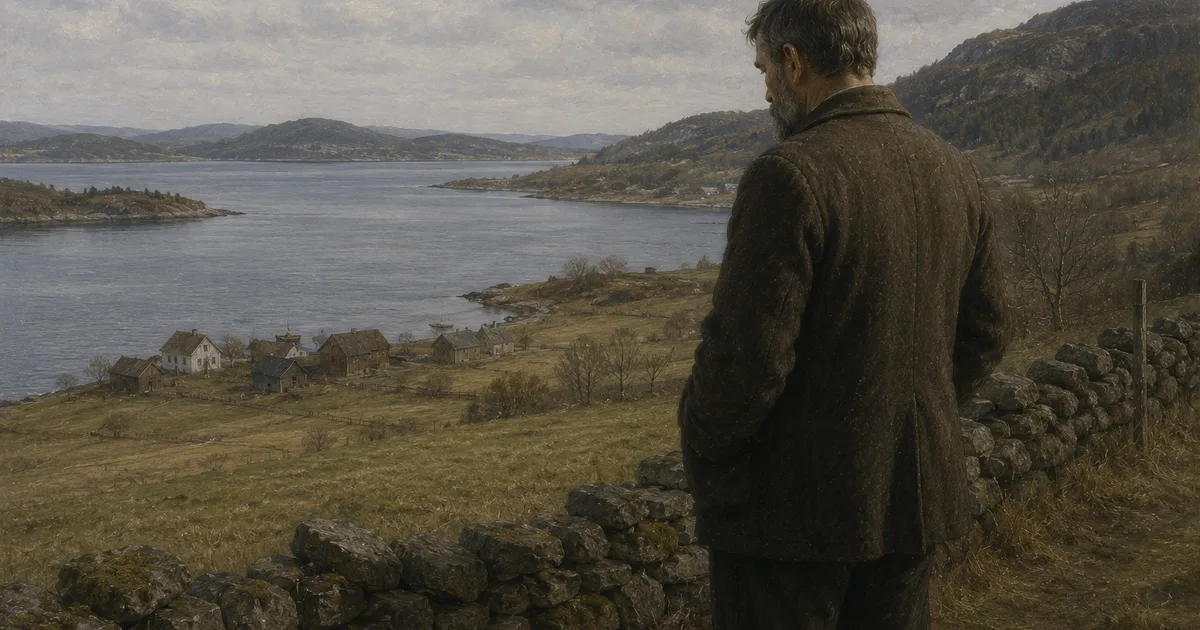
The fence-rail Peder had been at in the morning was mended; Jens saw the new wood of it at the upper end of the home-field as he came up the cart-track. He went past it and up to the place at the top of the field where his father had walked when his father had wanted to think a thing through to its end, and he stood at the wall with the bay below and the hill above, and the April light on the second-crop grass that would not be cut.
He thought about the row of children.
He and his wife had had children across the years of the marriage, and the children were not all of them living, and the ones who were not living were at the row of the small stones at the churchyard at Hesby at the lower end of the Hestby row, below the stone of Gunnar Hestby and below the stones of the older generations, at the small stones a man’s eye passed over quickly because a man’s eye did not want to be long at them. There were the names on the small stones. Jens had not spoken the names aloud in years. A man did not speak those names aloud; he carried them; the names were in him the way the cart-track was in him, a thing walked so many times the walking did not need the eyes. The children who had not lived had not lived for the reasons children at the islands did not live—the fevers, the coughs, the winters, the things that came to a small body and the small body could not put down. Olav had lived. Peder had lived. The older boy had lived to be a young man and then the cough had taken him at the back room at near the age Olav was now, and the older boy was at the row too, at the upper end of the small stones, at the stone that was cut for a young man and not for a child.
Jens stood at the wall and the row of names was in his head.
He did not say the fear to himself. He had stood at this wall and thought things through to their end for the most of his life, and he knew that there were things a man thought through to their end and things a man did not, and the fear that came up at the wall on the April afternoon with the boy’s five-line letter behind the almanac and the boy’s not-crossing-to-Lindøy in the aunt’s few words was a thing a man did not think through to its end, because the end of it was a place a man’s thinking did not need to go before the thing itself had gone there. Jens held the fear at the wall. He did not name it. He stood until the light had moved on the bay, and then he went down to the house.
The aunt came across the hill on the Sunday.
She came at the noon with the basket of bread and the jar of preserved plums, and she set the basket on the table and sat at the chair at the foot, and Peder came in from the byre at the noon, and the three of them ate the bread and the cured fish at the table. Jens did not bring out the letter before the meal. He brought it out at the coffee, the way a letter was brought out at the right moment of a meal.
He read the five lines aloud.
The aunt did not say anything during the reading. Peder did not say anything. When Jens had read the five lines and folded the letter, the aunt took it and looked at the inscription and at the five lines and at the signature with the flourish at the y, and she said, “He has the certificate in his hand.”
“He has,” Jens said.
“He went for it and he has it.”
“He has it.”
“He is a navigator now.”
“He is a navigator now,” Jens said.
The aunt set the letter on the table. She did not say more about it. She had a way, the aunt, of saying the thing that was good in a thing and then leaving the rest of the thing alone, and she had said the good thing—he has the certificate in his hand—and she left the rest alone, and Jens was grateful for the leaving-alone, because the rest of the thing was the thing he had stood at the wall with on the Wednesday afternoon and it was not a thing for the kitchen table at a Sunday coffee. Peder went back out to the byre. The aunt stayed a while and then crossed the hill.
Jens wrote back to the boy that evening.
He wrote the letter at the kitchen table at the lamplight. He did not write five lines. A father did not write five lines back to a son who had got the navigator’s certificate; a father wrote what the household and the season had given him to write. He wrote that the second crop of hay at the upper field would be a thin crop, the way the second crop had been thin the years past. He wrote that Peder had mended the fence-rail at the upper field that the winter had loosened, and had begun to talk of the strake of the boat that he had been talking of since the year before. He wrote that the lambs at the aunt’s farm had come well and that the lambs at the farms above the road had come well. He wrote that Lars had crossed every Wednesday through the winter and had said the inshore fishing in March had been a fair fishing.
He wrote that the household at Vestbø would be glad to have the boy home when the boy came home from the school.
He did not write the other thing.
He did not write come home if you are sick. He did not write the aunt has had a word that you have not been crossing to Lindøy. He did not write I have stood at the upper field and thought of the row of stones at Hesby. A father who wrote those things to a son would be a father who had set the fear loose on the paper and sent it across a strait and a road to a son who had a navigator’s examination behind him and a body that was carrying whatever it was carrying, and the setting-loose of the fear on the paper would do the son no good and would do the fear itself no good, because a fear on a paper was a fear made larger and not smaller. Jens did not write it. He wrote the hay and the fence-rail and the lambs and the Wednesday post, and the not-writing of the fear was the thing Jens did for his son that the writing of the hay and the lambs carried without naming.
He signed the letter Jens Hestby of Vestbø.
He folded it and laid it at the table to go up with Lars on the Wednesday, and he put out the lamp.
The kitchen was dark. The fire at the stove had gone to embers. Peder had gone up to the loft. The autumn cloth his wife had woven was at the table under Jens’s hand at the worn place, and Jens sat at the table for a few minutes in the dark, and then he went up the stairs.
He went up to the upper room, which was the room at the head of the stairs, the room he had slept in for the whole of the marriage and the years since. It was the room Olav had been born in, in the year 1857, and the room Peder had been born in, in the year 1860, and the room the children who had not lived had been born in, and the room his wife had died in, in the spring of 1867. A man’s house had a room like that in it. Jens slept in it because it was his, and a man did not ask his house to be a house without such a room. Jens lay down at the bed. The April night was at the window. The boy had the certificate in his hand and a thing in him the certificate had not reached, and the boy would come home from the school, and Jens would have him at the kitchen table again, and would not ask.