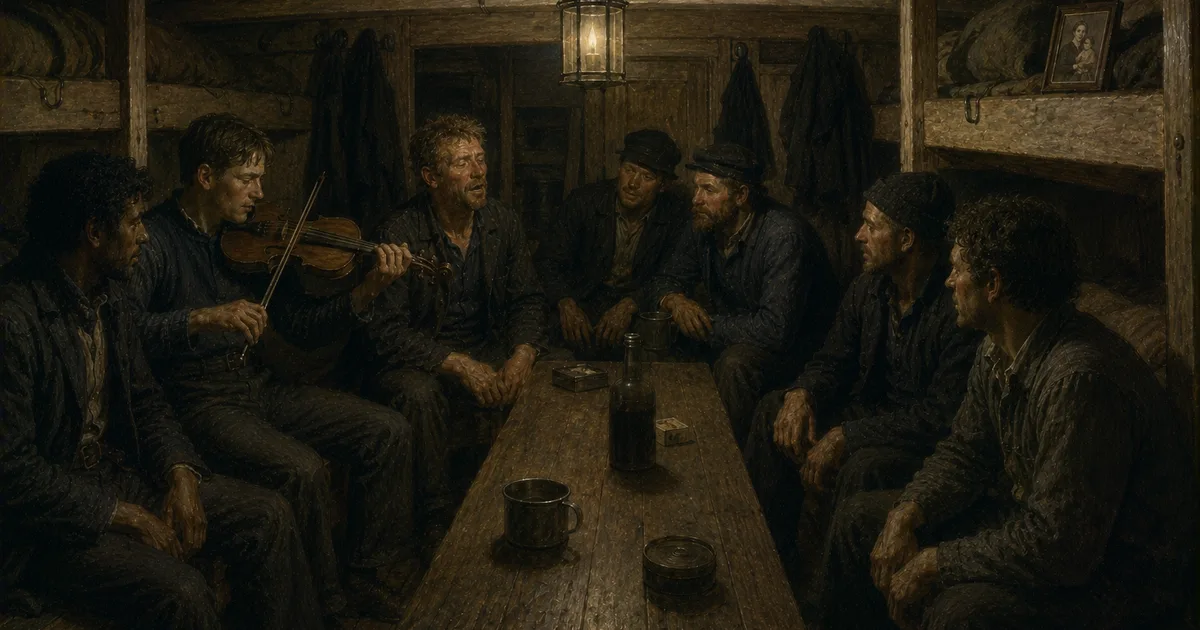
The boardinghouse at the upper end of Atlantic Street was a boardinghouse for sailors and wharf-men of the lower end of the East River.
It was a building of three floors with the keeper at the parlor at the lower floor and a kitchen at the back and rooms at the second and third floors. Olav and the Dane had taken a room at the second floor at the end of the hall at the evening of the thirty-fifth day of the run from Hamburg, which had been the twenty-seventh of March. The room was of two narrow beds at the side walls and a small writing-table at the window and a wash-stand at the corner. It cost a dollar a week for the two of them.
They had been at the room for six nights at the morning of the second day of April.
The keeper was at the parlor at the morning of the second day of April when Olav came down for the coffee at the seven. He said the bark at the Brooklyn anchorage had a new master, an American at the Boston home-port called Hollis. He said the new master had been at the wharf that morning with his own first mate and his own second mate and his own steward, and that the new master was looking for a forecastle of seven able seamen for the voyage to Bordeaux at the petroleum cargo at the Staten Island wharf.
Olav said yes.
The Dane came down at the half past seven.
The keeper said to the Dane what he had said to Olav. The Dane said yes. The two of them ate the bread and drank the coffee at the table at the back of the parlor and put their things at their small bags and at the Dane’s small sea-chest. They paid the keeper for the six nights. They walked down Atlantic Street to the wharf at the foot of Atlantic Street.
The bark had been brought to the wharf at the lower end of the Brooklyn waterfront at the morning of the first day of April for the ballast.
Olav had not seen the bark at the wharf at the lower end. He had seen the bark at the Brooklyn anchorage at the evening of the thirty-fifth day when he had been at the boat at the lee with the Dane and the wages. The bark was at the wharf at the lower end with her stern in and the lower hold open at the deck-hatch for the unloading of the salt cargo of Hamburg.
There were men at the deck Olav had not seen before.
The new captain was at the rail at the larboard side of the deck-house. He was a man of about forty-five in a wool coat of a Boston cut with a captain’s cap at the head and a small leather case at his hand. He had a face the color of a man of forty-five who had been at the sea for the years of his forties at the wages of a master of an American bark out of Boston. He saw Olav and the Dane come up the gangway. He came forward at the deck to the foredeck.
He said in the English of a Boston master that the two men had been on the bark at the run from Hamburg and that the boardinghouse keeper at Atlantic Street had said the two men would come to the wharf at the morning. He said his name was Captain Hollis and his home was at Boston and he was the master of the bark at the run from Brooklyn to Bordeaux at the petroleum cargo of the wharf at Staten Island. He said the wages would be thirty-five dollars at the month and the food would be the food of the bark’s table under the steward he had brought and the bunk would be the bunk at the forecastle.
He said the able seaman from Norway should sign at the articles at the cabin at the half past nine.
He said the Danish able seaman should sign at the line below.
Olav said yes.
The Dane said yes.
Captain Hollis went aft.
The new first mate was at the foredeck at the foot of the foremast. He was a Finn of about forty in a wool coat of a coast-trader cut with a knit cap at the head and a marlinespike at the belt. He looked at Olav and the Dane for the time it took a Finnish first mate of an American bark to look at a forecastle able seaman and a Danish able seaman who had been at the bark before him. He nodded.
The new second mate was at the upper end of the deck-house. He was a German of about thirty-five in a black coat of a Bremen cut. He did not come forward.
The new steward was at the galley.
He was a man of about fifty in a white apron at the waist of a galley coat. He had a face Olav saw at the galley door for half a second before the steward turned back to the work at the galley. The face was a face Olav had seen at the Stavanger wharves at the year of 1875 and the year of 1876, but the face Olav had seen at Stavanger had been a younger face at a different galley at a different bark and Olav did not know the man at the galley of the bark at the Brooklyn wharf at the morning of the second day of April of 1878.
Olav and the Dane signed at the cabin at the half past nine.
Captain Hollis sat at the desk at the cabin with the ledger at the open part at the place at the line where the wages of thirty-five dollars at the month were at the upper end. Olav signed his name at the line. The captain wrote Bill at the column at the side of the line where the captain wrote the name the bark would have for the able seaman.
He said: that will do, Bill.
The Dane signed at the line below.
Olav went out of the cabin to the foredeck.
The bark was at the wharf at the lower end of the Brooklyn waterfront at the morning of the second day of April of 1878 and Olav was an able seaman at the bark at the wages of thirty-five dollars at the month at the bark of Captain Hollis of Boston. He had a coat at his shoulders and the wages of the Kvik run and the wages of the Hamburg-to-Brooklyn run and the letter from Patrick and the rosary at the inside-pocket and the carte-de-visite at the wallet and Olava’s two letters at the breast-pocket and the parcel at the side-pocket and the bone-handled knife at the coat-pocket. He had the name Bill at the ledger at the captain’s desk at the cabin.
He went forward.
Captain Hollis had kept the little Swede of the prior regime at the cabin-boy’s berth at the small alcove at the upper end of the deck-house.
The new crew came aboard through the morning of the second day of April and the afternoon of the second day of April and the morning of the third day of April.
The first to come up the gangway after Olav and the Dane was an Englishman of about twenty-five in a wool coat with a small fiddle-case at his shoulder. He signed at the cabin and went to the forecastle. The second was a Scot of about forty in a wool coat that had been at many wharves of many ports. He signed and went to the forecastle. The third and the fourth were two Hollanders of about thirty and thirty-five in coats of the cut of an Amsterdam tailor and signed in turn and went to the forecastle. The fifth was a Norwegian of about thirty in a wool coat of a Bergen cut with a small framed carte-de-visite at the open of his coat at the breast-pocket where the small frame was the size of a man’s palm.
He came up to Olav at the foredeck.
He said in the Bergen-Norwegian of a Bergen sailor that his name was Sven Haugen of Sandviken at Bergen and that he had been at the boardinghouse at the upper end of Atlantic Street at the morning of the third day of April and the boardinghouse keeper had said the new captain was at the wharf at the lower end with the wages of thirty-five dollars at the month and the bark would be at Bordeaux at the midsummer.
Olav said in Norwegian that his name was Olav Hestby of Vestbø at Finnøy.
Sven said yes.
Olav said yes.
Sven went up the cabin gangway to sign at the cabin.
The forecastle of the bark was at the lower end of the foredeck under the deck-house at the lee of the larboard side.
It was the forecastle of the run from Hamburg with the same bunks and the same table and the same bench and the same bilge under the bunks. Olav had the lower bunk at the starboard side at the lower end. The Dane had the bunk above his. Across the row Sven took the bunk at the lower port side at the lower end. The Englishman took the bunk above Sven’s. The Scot took the bunk at the upper end of the starboard side and the two Hollanders took the bunks across.
Sven set the small framed carte-de-visite at the bunk-shelf above his head at the upper end of the bunk.
The frame was the size of a man’s palm and was of a dark wood, and the carte-de-visite was of a woman of about twenty-five at a chair at the side of a photographer’s stand at a Bergen photographer in the summer of 1877, with a newborn at her arm. The woman was Hanne and the child was Jonas and Sven Haugen had been at the run of the Trana out of Bergen at the autumn of 1877 and at a Hamburg-Atlantic bark at the winter, and was at the bark at the Brooklyn wharf at the second day of April of 1878.
Olav saw Sven set the frame at the shelf.
He saw Sven turn the frame at the angle the frame was to be at on the shelf. He saw Sven lay his hand at the frame for the time it took a Bergen sailor at a bunk-shelf at a forecastle of a bark at the Brooklyn wharf to lay a hand at a frame of his wife and his son at his own home. He saw Sven go up to the deck.
The bark went to the Staten Island wharf at the morning of the fifth day of April.
The Finnish first mate took her out of the Brooklyn wharf at the morning tide under tow and brought her up the harbor to the Staten Island wharf at the noon. The bark was at the Staten Island wharf for the ballast-out and the petroleum-loading from the fifth of April to the eighteenth of April. The work was the work of an American bark at the loading of a petroleum cargo for the European trade.
The forecastle of seven was at the table at the meals.
The meals were the meals of the Stavanger steward. The morning food was a coffee that was a coffee. The bread was a bread of a Stavanger steward who had been at the wharves of New York for fifteen years and knew where the good bread at Brooklyn and at Staten Island was bought. The noon food was a soup of fresh vegetables from the Staten Island wharf-stalls. The afternoon food was salt meat boiled in fresh water with potatoes that were not the potatoes of a kettle of pea-soup days old. The change of the dog-watches had a pudding at the table once a week and a cheese at the table the other days. The men at the table ate the food.
The Englishman at the bench at the bunk played the small fiddle at the change of the second dog-watch at the off-watch.
He played the airs of the south of England and an air or two of the north and an Irish air the Scot taught him at the fourth day. The Scot sang the words at the air at the air’s slow places. The two Hollanders did not sing but listened. The Dane listened. Sven listened. Olav listened. The forecastle of seven was at the music at the change of the second dog-watch every evening that the watches did not have a man too tired for the music.
Captain Hollis called Olav Bill at the deck at every watch.
The Finnish first mate called him Bill. The German second mate called him Bill. The Scot at the cat-falls called him Bill. The Englishman at the foretop called him Bill. The two Hollanders at the running gear called him Bill. Sven at the bench at the table called him Olav and Sven at the deck at the work called him Bill the way the watch called him Bill.
A man could be at Bill at the forecastle of an American bark for the days at the wharf at Staten Island and not be at himself at the days if no man at the bark and no man at the wharf was at his own language.
The first Sunday at the Staten Island wharf was at the seventh of April.
Olav was at the foredeck at the morning of the seventh of April at the work of the loading. The petroleum cargo came up the wharf from the petroleum depot at the upper end of Staten Island at barrels of the wharf-wagons, and the men of the wharf brought the barrels down the wharf to the gangway, and the men at the deck brought the barrels down the deck-hatch to the lower hold where the Finnish first mate and the German second mate were at the stowage. The work was the work of the loading of a petroleum cargo at a Sunday morning at the Staten Island wharf at the seventh of April of 1878.
The steward came forward at the half past eleven of the morning.
He came up from the galley with a kettle of fresh coffee at his hand for the men at the deck-work. He came along the main deck at the lee of the deck-house and came up to the foredeck at the upper end of the ladder. He set the kettle at the rail at the foot of the foremast.
He said to Olav at the foredeck in the Stavanger-Norwegian of a Stavanger steward who had been at the wharves of New York for fifteen years and who had not lost the Stavanger at the consonants or at the vowels: god morgon, min unge bjønn. He said the coffee was at the kettle at the foot of the foremast for the men at the loading and that the men at the foredeck should have a cup at the half hour.
Olav had not been at the Stavanger-Norwegian of a Stavanger steward at the seventh of April or at the morning of any day at the bark or at the boardinghouse at Atlantic Street or at the foredeck of the bark at the run from Hamburg.
He answered in the Stavanger-Norwegian of his own kitchen at Vestbø that he would take a cup at the half hour and that the coffee at the kettle at the rail was a coffee a Stavanger steward had made.
The steward said yes.
He said his name was Halvor.
He said he had been at the Stavanger wharf at the summer of 1863 at the bark Helga out of Stavanger before he came to New York at the autumn and had not been at Stavanger since the autumn of 1863, and that the Stavanger of the consonants and the vowels was the Stavanger of 1863 and was not the Stavanger of 1878 because a Stavanger of 1878 might be a Stavanger of a different sound at the upper streets and at the lower streets, but he had not been at the upper streets or at the lower streets at fifteen years and could not say what the difference was.
Olav said the Stavanger of 1878 at the upper streets and at the lower streets was a Stavanger Halvor would not have to think about being at because the Stavanger of 1878 at the consonants and at the vowels of Halvor of the Helga of Stavanger out of the summer of 1863 was a Stavanger a man at Vestbø at Finnøy at the year of 1878 would not have any trouble hearing.
Halvor said yes.
He went aft to the galley.
The half hour came at the eight bells of the forenoon watch. The men at the foredeck came to the kettle at the foot of the foremast. Olav had a cup. The Dane had a cup. Sven had a cup. The Englishman and the Scot and the two Hollanders had cups. The men drank the coffee at the foot of the foremast at the Sunday morning of the seventh of April of 1878 at the wharf at Staten Island at the upper end of the bark’s cargo of petroleum for Bordeaux.
The work went on at the noon.
Olav went below at the change of the bells of the afternoon watch.
He sat at the bunk at the lower end at the starboard side. He took the two letters out of the breast-pocket of the coat. The letters were the letter from Olava that had come to the Dronningen at Wilmington at the autumn of 1876 and the letter of the yes that had come to the Dronningen at Cape Verde at the spring of 1877. He had not taken the letters out at the bunk of the bark at the run from Hamburg. He had not taken them out at the boardinghouse at Atlantic Street.
He read the first letter at the bunk. He read the second letter at the bunk. He folded them at the folds the letters had been folded at since the spring of 1877 and put them back at the breast-pocket of the coat.
He went up to the deck for the afternoon watch.
The bark was at the wharf at Staten Island through the second week of April.
The petroleum cargo came up the wharf at the days of the loading. The men at the deck-work brought the barrels to the lower hold. The Finnish first mate and the German second mate stowed the barrels. Halvor made the coffee and the bread and the soup and the salt meat and the pudding once a week. The Englishman played the small fiddle at the change of the second dog-watch. The Scot sang the Irish air at the slow places. The two Hollanders listened. The Dane listened.
Sven set a sheet of letter-paper at the table at the bench at the off-watch and wrote a line and not more, and folded the sheet and laid it at the lower drawer of the small chest at the foot of his bunk.
He wrote a line at the sheet every day at the off-watch.
It was the routine of a forecastle of seven at the wharf at Staten Island at the second week of April of 1878 under Captain Hollis of Boston for the petroleum cargo for Bordeaux.
Olav slept at the bunk at the lower end at the starboard side. The Dane slept at the bunk above him. The Dane breathed at the bunk above the way the Dane had breathed at the bunk above on every night since the Day Fifty-nine of the run from Hamburg.
The bark would sail at the noon tide of the eighteenth of April.