The Saturday of the thirteenth of April was the second Saturday at the wharf at Staten Island.
Captain Hollis had given the larboard watch the ashore from the change of the bells of the second dog-watch to the morning watch of the Sunday of the fourteenth. The starboard watch had had the ashore at the Saturday of the sixth. The larboard watch was Olav and the Dane and the little Swede and the Englishman and one of the two Hollanders, with the Finnish first mate at the deck. The starboard watch was the Scot and the other Hollander and Sven Haugen and the German second mate.
The Englishman and the Hollander of the larboard watch went up the wharf at the change of the bells with two shore-coats and the wages at the inside-pocket each.
Olav and the Dane and the little Swede went to the lower ferry at the half hour after.
The lower ferry was the ferry from the Staten Island wharf at the Tompkinsville landing to the lower end of South Street at Manhattan. It was a steam ferry of the kind a New York harbor had at the year of 1878. The fare was five cents at a man each way. The three of them paid the fare at the ticket-office at the wharf. They went aboard the ferry at the upper deck.
The ferry left at the half past six of the evening.
It crossed the lower bay at the wind from the south-west and came to South Street at the seven. Olav and the Dane and the little Swede came off the upper deck at the gangway and walked up South Street to the lower end of Fulton Street and turned at Fulton Street toward the upper city. They had not been at the upper city. They walked along Fulton to Pearl and along Pearl toward the lights of the Bowery.
The Bowery at the Saturday evening of the thirteenth of April had its music.
It came out of the doors of the dance-halls along the upper end of the street and out of the doors of the German beer-houses and out of the doors of the smaller houses where there was a piano at the back room and a fiddle at the small bar at the front. The lights at the upper end of the street were the lights of the Bowery at the Saturday evening. The wharf-men and the shop-girls and the soldiers and the sailors and the Bowery-men of the upper end of the street were at the doors of the houses.
The Dane led them to a dance-hall at the second cross-street.
It was a hall of two floors with a long bar at the lower wall of the lower floor and a dance-floor at the middle and a small gallery at the upper end with a band of six men at the gallery. The band was a small Bowery band of two fiddles and an accordion and a cornet and a piano played by a man in his shirtsleeves and a bass played by a small man at the side. The bass was the loudest at the music.
They sat at a small table at the side of the hall at the lee of the bar.
The Dane ordered three beers at the half past seven. The Dane paid the five cents at the beer each at his own coin. The bar-girl set the three beers at the table. They drank the beers.
The Bowery hall at the Saturday evening of the thirteenth of April was a hall of about two hundred at the dance-floor and the bar at the seven of the evening. The dancers at the dance-floor held each other at the waist and at the shoulder and turned at the rate of the music. The Bowery dancers were not the Hamburg dancers. The shop-girls at the Bowery had hair pinned up at the back and dresses of the cut a shop-girl of New York had in 1878. The sailors at the Bowery had the suits of an American port and not of a German port.
Olav had a thought at the table at the side of the hall at the lee of the bar at the eight of the evening.
It was a thought he had had at a table at the side of a hall at the lee of a bar at the evening of the Saturday of the second week of February of 1878 at the casino dance pavilion at the second street north of the Steinweg at the upper end of the docks district of Hamburg.
He did not think the thought.
He held the second beer of the evening at his hand at the table.
The Dane ordered a third beer at the half past eight. The Dane ordered a fourth beer at the nine. The Dane drank the fourth beer at the rate of the beer at a Bowery hall at the Saturday evening of the thirteenth of April of 1878. The little Swede had not finished the first beer. Olav had finished the second and had not ordered a third.
The little Swede said in the Swedish of a Stockholm-Swedish that he had been at New York at the year of 1875 at his first voyage out of Stockholm and that he had been at a Bowery hall at the Saturday evening of his first voyage and had not been at the Bowery for two and a half years until the Saturday of the thirteenth of April of 1878. He said his name was Anton.
Olav said in Norwegian that his name was Olav Hestby of Vestbø at Finnøy.
The Dane said in Danish that his name was Søren.
Anton said yes.
Olav said yes.
The Dane drank the fourth beer. He ordered a fifth at the half past nine. He drank the fifth.
The dance-hall at the ten of the evening was a hall of three hundred at the dance-floor and the bar. The band at the gallery had set the music at the loud. The Bowery hall had the heat of three hundred men and women at the dance-floor and the bar at the lee of the bar.
The Dane stood up at the half past ten.
He stood up at the table and held the back of the chair. He said in Danish to Olav at the table that the Bowery hall was a hall that had nothing for him. Olav said yes. Anton said yes. The three of them stood up at the table. The Dane paid the bar-girl at the door for the beers. The bar-girl took the coin.
They walked out of the hall.
The Bowery at the eleven of the evening was the Bowery at the eleven of the evening. They walked down the Bowery to Park Row and down Park Row to Fulton and along Fulton to Pearl and along Pearl to the lower end of South Street.
The ferry-house at the lower end of South Street was at the dark.
The last ferry to Staten Island at the Saturday of the thirteenth of April had been at the ten of the evening. The next ferry was at the morning of the Sunday at the half past five. There were no more ferries at the night.
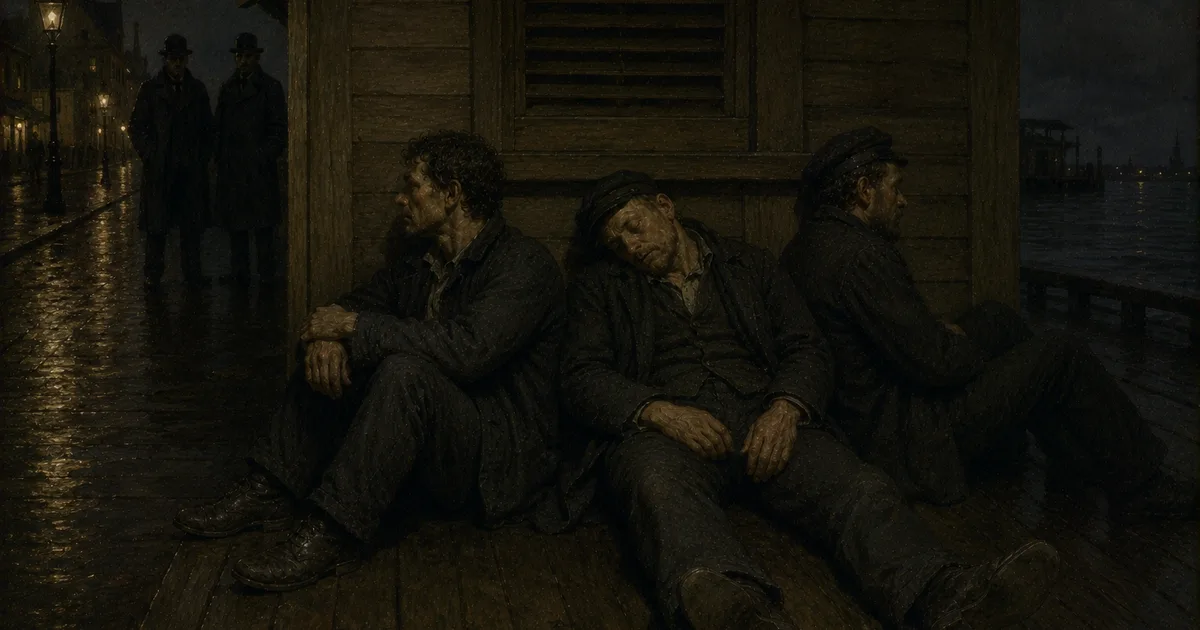
The Dane sat at the planks at the lee of the ferry-house.
He sat at the planks at the lee of the ferry-house with his back at the wood of the wall of the ferry-house. Olav sat at the planks at his side. Anton sat at the planks at Olav’s side. The three of them sat at the planks at the lee of the ferry-house at the lower end of South Street at the harbor at the Saturday night of the thirteenth of April of 1878.
The wind was at the south-west at three knots at the harbor.
The Dane laid his head at the wood of the wall.
Anton laid his head at the small bag at his hand at the planks. Olav had no bag. Olav laid his head at his coat at his arm. The three of them lay at the planks at the lee of the ferry-house at the half past eleven of the night.
It was the first hour of the Sunday of the fourteenth of April.
The two men came at the first hour at the corner of the ferry-house at the upper end.
They were two men in coats of the wharf at the night and hats of a kind a man wore at a New York wharf at the night. They stood at the corner of the ferry-house at the upper end and looked at the three men at the planks. They did not speak. They stood at the corner for a minute and then they came toward the planks at the lee of the ferry-house.
Olav sat up at the planks.
Anton sat up at the planks beside him. The Dane did not sit up at the planks; the Dane was at the sleep of the five beers and the heat of the hall and was at the lee of the ferry-house in a sleep of the lower bay.
The two men stopped at three paces from the planks.
They looked at the three men. They did not speak. Olav looked at the two men. Anton looked at the two men. The Dane was at the sleep. The lights at the upper end of South Street were at the lamps of the wharf. The wind was at the south-west.
The two men stood at the three paces for a minute.
Then they turned at the corner and went back along South Street at the upper end.
Olav stood up at the planks.
Anton stood up. Olav laid his hand at the Dane’s shoulder at the planks. The Dane opened the right eye and looked at Olav. Olav said in Danish at the planks that they should walk. The Dane said yes at Danish. The three of them stood up at the planks at the lee of the ferry-house at the corner of South Street at the first hour and the half hour of the morning of the Sunday of the fourteenth of April of 1878.
They walked.
They walked along South Street at the lee of the wharf-houses at the lower end of the East River. The Dane walked at the lee of Olav at the side. Anton walked at the lee of the Dane at the other side. The lights at the wharf-houses were the lamps of a Saturday night that had gone to a Sunday morning. The wharf-men were not at the wharf. The boardinghouse-runners were not at the wharf. The two men in the coats of the wharf and the hats of a kind a man wore at the wharf at the night were not at the wharf at the half hour after the first hour.
They walked to the lower end of South Street.
They walked up South Street to the upper end of Pearl. They walked along Pearl to the lower end of Fulton. They walked along Fulton to Broadway and stood at the corner of Broadway and Fulton at the second hour of the morning. The corner of Broadway and Fulton at the second hour of the morning of the Sunday of the fourteenth of April of 1878 was a corner of the lamps of Broadway at the upper end and the lamps of Fulton at the lower end and the wind from the south-west at three knots.
The Dane sat down at the curb at the corner.
He sat at the curb and the head was at the upper arm. Olav sat at the curb at his side. Anton sat at the curb at Olav’s side. The three of them were at the curb at Broadway and Fulton at the second hour of the morning of the Sunday of the fourteenth of April.
Olav had his hand at the side-pocket of the coat where the parcel was at the brown paper at the side-pocket.
He laid the hand at the side-pocket through the wool of the coat. He did not take the parcel out. He did not look at the parcel. He laid the hand at it through the wool at the curb at Broadway and Fulton at the second hour of the morning.
The Dane was at the curb at Olav’s side at the head at the upper arm.
The Dane was asleep again at the curb.
Anton was at the curb at the other side. Anton was not asleep.
Anton said in the Swedish of a Stockholm-Swedish at the curb to Olav that he had a sister at Stockholm and a mother at Stockholm and the father at Stockholm had been a wharf-man at the wharf at the upper end of Stockholm before he had died at the winter of 1873. He said the sister was nineteen and the mother was forty-eight. He said he sent the wages of the bark home to the mother at the post at every port where the post took an envelope to a Stockholm address.
Olav said yes.
Anton said the Dane was a man Anton had been at the bunk-row beside at the run from Hamburg and was a man Anton had not been at a Bowery hall with before the Saturday of the thirteenth of April.
Olav said yes.
The three of them sat at the curb at Broadway and Fulton at the second hour and the half hour of the morning.
Olav took his hand out of the side-pocket of the coat.
They got up at the third hour and walked back along Fulton to Pearl and along Pearl to South Street and along South Street to the ferry-house at the lower end. The ferry-house was at the dark. There were no men at the corners of the ferry-house at the upper end.
They sat at the planks at the lee of the ferry-house again.
The Dane lay at the planks at the lee of the wood of the wall. Anton lay at the planks at the lee of the Dane. Olav lay at the planks at the lee of Anton.
The wall of the ferry-house was at Anton’s back. Anton was at Olav’s back. Olav was at the Dane’s back.
The Dane was at the open end of the planks.
The three of them lay at the planks at the lee of the ferry-house at the third hour and the half hour of the morning of the Sunday of the fourteenth of April of 1878 at the lower end of South Street at the harbor of New York.
Olav did not sleep at the planks.
Anton did not sleep at the planks. The Dane was at the sleep again at the planks at the open end.
The two men came at the corner of the ferry-house at the lower end at the fourth hour of the morning.
They were not the two men of the first hour. They were two other men in coats of the wharf at the night and hats of a kind. They stood at the corner for a minute and looked at the three men at the planks. The Dane did not sit up. Olav sat up. Anton sat up. The two men stood at the corner for the minute and then they turned and went back along South Street at the lower end.
Olav stood up.
Anton stood up. Olav laid his hand at the Dane’s shoulder. The Dane opened the right eye. Olav said in Danish that they should walk again. The Dane said yes at Danish.
The three of them walked.
They walked along South Street at the lee of the wharf-houses at the lower end of the East River at the fourth hour and the half hour of the morning of the Sunday of the fourteenth of April of 1878. The Dane walked at the lee of Olav at the side. Anton walked at the lee of the Dane at the other side.
The light at the eastern sky at the upper end of the East River came up at the fifth hour.
The light came up at the harbor at the houses and the wharves and the cables of the great bridge at the upper end of the East River. The cables at the upper hundred and forty-five feet over the East River were lit at the underside by the coming of the light. Olav saw the cables. Anton saw the cables. The Dane did not see the cables.
They walked back to the ferry-house at the lower end of South Street.
The ferry to Staten Island at the morning of the Sunday of the fourteenth of April was at the half past five. They came to the ticket-office at the quarter past five and paid the fare at the ticket-office at the wharf. They went aboard the ferry at the upper deck.
The ferry left at the half past five of the morning.
It crossed the lower bay at the wind from the south-west at three knots and came to the Tompkinsville landing at the six. Olav and the Dane and Anton came off the upper deck at the gangway and walked along the lower bay to the wharf at the upper end where the bark was at the wharf at the petroleum cargo.
They came up the gangway at the seven of the morning.
The Finnish first mate was at the deck at the foot of the foremast. He looked at the three men at the gangway. He did not say anything. He looked at the Dane at the gangway and at Anton at the gangway and at Olav at the gangway and at the half hour till the change of the bells of the morning watch.
Olav went forward to the bunk at the forecastle.
The Dane went forward to the bunk at the forecastle.
Anton went forward to his bunk at the cabin-boy’s berth at the small alcove at the upper end of the deck-house.
Olav lay at the bunk at the lower end at the starboard side. The Dane lay at the bunk above. Olav did not sleep at the bunk because the watch was at the change of the bells at the half hour after. The Dane was at the sleep at the bunk above at the breath of a man asleep.
The change of the bells came at the eight bells of the morning watch.
Olav went up to the deck for the watch.
The Dane did not go up to the deck. The Finnish first mate did not call him.
Olav was at the foretop at the deck-work of the watch at the morning of the Sunday of the fourteenth of April of 1878 at the wharf at Staten Island at the petroleum cargo for Bordeaux.
The light at the eastern sky was at the cables of the great bridge at the upper end of the East River.
Olav did not look at the cables.