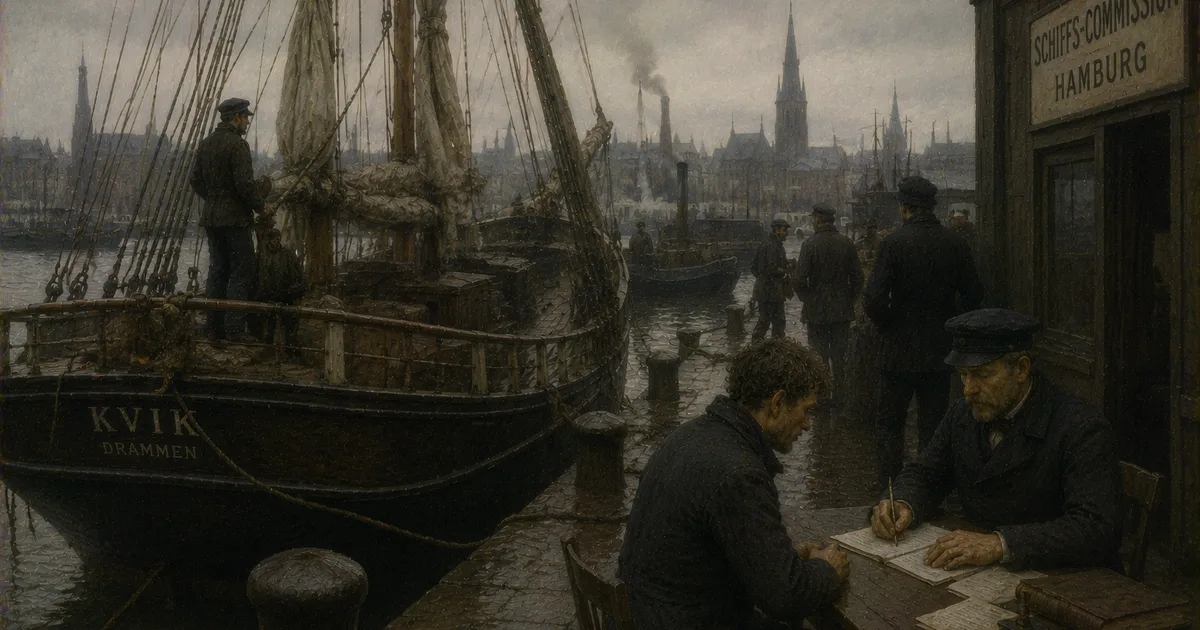
The Kvik of Drammen came to the Elbe at the morning of the Day Fifty-two.
The pilot came aboard at the half past eight of the morning at the pilot-station off Cuxhaven and took the bark up the river under the trade of a north-west wind and the flood of the morning tide. The pilot was a German of about forty who spoke English to the captain and Plattdeutsch to the boatswain and stood at the wheel-box for the four hours up to Hamburg. The bark came to the Hamburg roads at the noon. The pilot took her to the inner basin at the half past two of the afternoon.
The pumps stopped at the half past two.
The watch on deck had been at the bars for the morning watch and the forenoon watch and the first half of the afternoon watch at the rate the bars had been at for forty-seven days. The boatswain at the bilge-pump-hatch said at the half past two that the watch could come off the bars. The watch came off the bars. The boatswain laid the rod at the rail at the bilge-pump-hatch and did not take it up again.
The crew came ashore at the eight of the evening of the Day Fifty-two.
The captain paid the men at the wharf-end office at the seven of the evening at the wages of a Kvik hand for the run from Wilmington to Hamburg. Olav signed at the wages of an able seaman for the run. The wage was the wage Captain Salvesen had said it would be at the signing at Wilmington at the half past eleven of the Christmas Day of 1877. Olav put the wage at the inside-pocket of the coat with the rosary.
The Kvik of Drammen sank one foot at the anchor at the first night after the pumps stopped.
Olav heard at the boardinghouse at the second morning that the Kvik had been at the wharf at the morning watch with a list of three degrees at the starboard side and the deck-tank’s hatch a foot below the waterline. The boatswain of the Kvik had come down to the wharf at the morning of the Day Fifty-three and had hired four wharf-men with the second pump and the Kvik’s first pump to bring the bark back to her trim. The boatswain had been at the bars at the wharf with the wharf-men for four hours. The Kvik was at her trim by the noon.
The Stavanger carpenter had a home at Hamburg at the upper end of the docks at the Steinweg.
He had a wife of about forty whose name was Greta and who was of a Swedish family that had been at Hamburg since the year of 1810. He had two daughters of fourteen and eleven whose names were Anneliese and Helga. He had a small house of three rooms at the Steinweg that had a kitchen at the lower floor and a parlor at the lower floor and the bedrooms at the upper floor. He had been at the Kvik for two voyages and had been at the Hamburg-Stavanger trader for ten years before the Kvik.
He took Olav to the house at the evening of the Day Fifty-four.
Greta set the table at the parlor with the white linen for a Sunday dinner at the Saturday of the second week of February. The Sunday linen was the linen of a Hamburg household. She set the candles at the table. She set the cooked dinner of pork and red cabbage and potatoes at the table. The two daughters sat at the side of the table and did not say much. The carpenter sat at the head. Olav sat at the side opposite Greta.
Olav ate the pork. He ate the red cabbage. He ate the potatoes. He drank the glass of beer the carpenter set at his place. He thanked Greta in the German he had learned from the cook of the Sigrid at the Hebburn run of 1875 which was not much German.
Greta said in the German of a Hamburg wife that the carpenter had said Olav was a young man from Stavanger who had been at the bars of the Kvik at a six-and-two for forty-seven days. Olav said yes. Greta said the bars of a Drammen bark at a six-and-two for forty-seven days was a thing she had heard from the carpenter at every voyage he came home from. She said the bars were a thing the carpenter said but did not say much. Olav said yes.
Olav stayed at the house for the dinner and the coffee at the parlor after.
The carpenter took him back to the boardinghouse at the half past nine of the evening.
The casino dance pavilion was at the second street north of the Steinweg at the upper end of the docks district.
It was a hall of the year 1870 with a high ceiling and an arched musicians’ gallery at the upper end and a long bar at the side and a dance floor at the middle. The hall had fifty musicians at the gallery and three thousand people at the dance floor at the evening of the Saturday of the second week of February of 1878. The musicians were a Hamburg orchestra at fifty pieces. The three thousand were the wharfmen and the sailors and the shop-girls and the porters of Hamburg at that Saturday evening.
Olav sat at a small table at the side of the hall at the lee of the bar.
He had a glass of beer at the table. He had a second glass of beer at the table at the half hour after the first. He watched the dance floor at the middle of the hall.
The dance at the dance floor was a German dance the orchestra played for the dancers, and the dancers held each other at the waist and at the shoulder and turned at the rate of the music. The shop-girls had hair pinned up at the back and dresses of the cut a shop-girl of Hamburg had in 1878. The wharfmen had wool coats and the boots of a wharfman at the evening. The sailors had the suits the sailors had bought at the upper end of the docks district at the second day after the ships had paid them.
Never having learned to dance, Olav thought it was something of the most useless a person could do.
He had the thought at the second glass of beer at the small table at the side of the hall. He did not say the thought. He held the thought and went on watching the dance floor for the half hour after.
He went back to the boardinghouse at the half past ten.
He wrote at the small writing-table at the boardinghouse at the morning of the Day Fifty-six.
He wrote to Patrick O’Brien at the parish of Saint Mary’s at the upper end of Front Street at Wilmington in the slow English he had learned at the back room of the O’Briens’ house through the seven weeks of November and December of 1877. He said the Kvik of Drammen had come to Hamburg at the second week of February of 1878 with the springs at the bow leaking and the six-and-two for forty-seven days at the bars and the deck cargo of resin gone overboard at the night of the Day Twenty-four. He said the parish at the second Sunday of January and the second Sunday of February would have carried as Patrick had said the parish would carry. He said the bark would not sail again from Hamburg with Olav at her crew because Olav was hiring onto an American bark at the docks at Hamburg at the next week.
He said he would remember the back room.
He said he hoped Margit was well.
He sealed the letter at the wax of the boardinghouse seal and addressed the envelope to Patrick O’Brien at Saint Mary’s Mission at the upper end of Front Street at Wilmington in the State of North Carolina in the United States of America. He took the letter to the post-office at the upper end of the docks district at the noon.
The post-office said the letter would be at Wilmington by the third week of March if the packet to New York and the packet to Wilmington from New York held.
Olav said yes.
He paid the post and walked back to the boardinghouse.
The Swedish first mate of the American bark came to the boardinghouse at the evening of the Day Fifty-seven.
He was a man of about forty-five with a big brown full beard and the shoulders of a man who had been at the foretop of the bark he was the first mate of for the four voyages he had been at her. He sat at the bench at the boardinghouse parlor and said in the Swedish of a Gothenburg first mate that the bark was wanting a hand of the able-seaman rate for the run from Hamburg to New York at the wages of thirty dollars and the food of the bark’s table and the bunk of the bark’s forecastle. He had heard from the boardinghouse keeper that there was a Norwegian able seaman at the second floor who had come off the Kvik of Drammen at the Day Fifty-two and was at the looking for a ship.
Olav came down to the parlor.
The Swedish first mate looked at Olav and at the boardinghouse keeper. He said the able seaman should sign the articles at the captain’s office at the wharf at the nine of the morning of the Day Fifty-eight. He said the bark would sail at the noon tide of the Day Fifty-nine. He said the able seaman’s name was at the articles at the captain’s office. He said the able seaman should be at the wharf at the nine of the morning with his chest and his oilskins.
Olav said his chest was at Goole.
The Swedish first mate said yes.
The Swedish first mate said the able seaman should be at the wharf at the nine of the morning with whatever he had at Hamburg.
Olav said yes.
The Swedish first mate stood up at the bench and looked at Olav for a moment.
It was the look of a Gothenburg first mate of an American bark out of Hamburg at the second week of February of 1878 at a Norwegian able seaman of twenty who had come off a Drammen bark with a leak-with-the-sea at the bow at the run from Wilmington. It was not a look that said what the first mate thought at the looking. It was a look the boardinghouse keeper at the upper end of the parlor saw and did not say anything at the saying.
The Swedish first mate said good evening.
He went out at the door of the boardinghouse.
The boardinghouse keeper said to Olav at the bench that the bark was a bark the keeper had not heard a good word at the docks at. He said the captain of the bark was an American of about fifty who had a cough that did not sound well at a man’s chest. He said the first mate was a grobian.
Olav said yes.
He went up to the second floor at the room he was at.
He sat at the chair at the small writing-table for some minutes at the half past nine of the evening.
He had Olava’s two letters in the breast-pocket of the coat at the back of the chair. He had the thing wrapped in the piece of brown paper in the side-pocket. He had the carte-de-visite in the wallet in the other side-pocket. He had the bone-handled knife in the coat-pocket. He had the wooden rosary in the inside-pocket of the coat where the spare shirt’s button-pocket had been at the side. He had the wages of the Kvik run in the inside-pocket with the rosary, less the post for the letter to Patrick and the boardinghouse rent for the five nights at Hamburg.
He did not know what the American bark would do at the run from Hamburg to New York.
He did not know what the captain of the American bark would be at the second day of the run.
He did not know what the grobian first mate would be at the first day.
He did not know what the bunk of the forecastle of the American bark would be at the first night.
He blew out the candle at the writing-table at the quarter to ten.
He lay at the bed in the dark of the boardinghouse room at the upper end of the docks district of Hamburg at the night of the Day Fifty-seven of the run from Wilmington that had begun at the noon tide of the Christmas Day of 1877.
The night went to the morning.