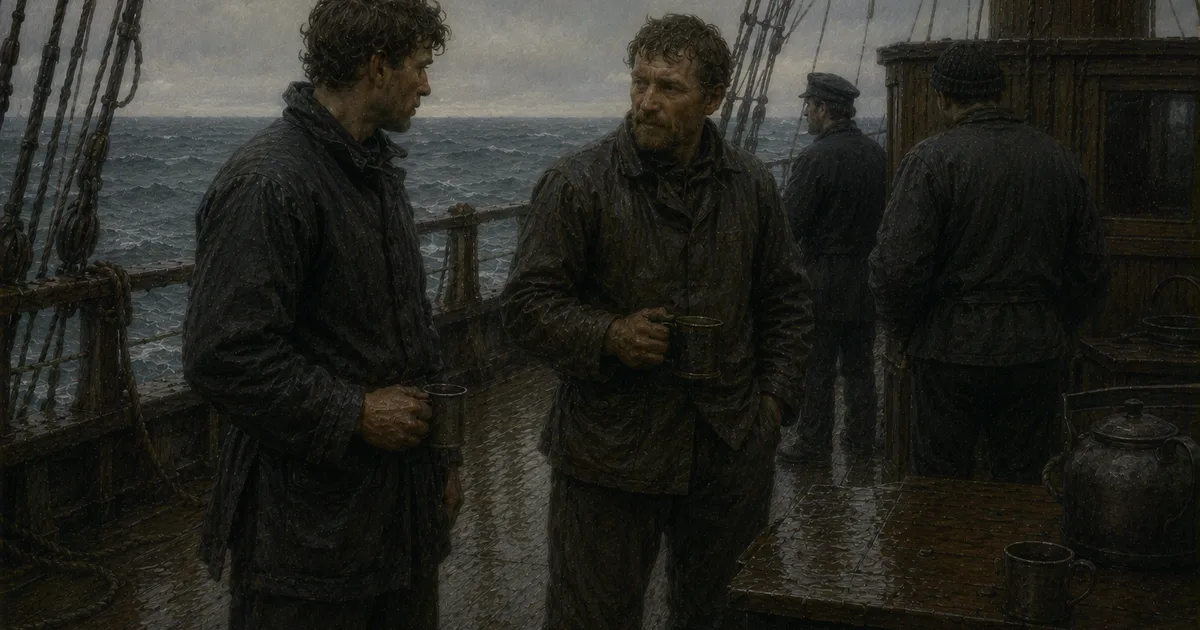
The Hamar man’s name was Ole.
Olav had not asked his name at the foremast pin-rail of the Day Two or at the bars of the first morning of the six-and-two or at the brake handle of the night of the gale. He had not asked at the lift under the elbows of the first watch of the Day Twenty-six or at the lift under the elbows of any of the lifts before the Day Forty-two. He asked at the coffee at the change of the bells of the morning watch of the Day Forty-two.
Ole said his name was Ole. He said he was Ole Persen of Vang outside Hamar.
Olav said his name was Olav Hestby of Vestbø at Finnøy.
It was at the change of the bells of the morning watch that the two names were said at the bilge-pump-hatch of the Kvik of Drammen in the latitude of the trades.
The bark had been at the easterly run for twenty-four days and had been at the six-and-two for thirty-seven days and had been at the windlass-prayer for six nights at the second hour of the bunk of the middle watch, which was a thing Ole did not know about Olav and Olav did not say. The bilge-rod was at four and a quarter inches above the noon-marking at the six bells of the morning watch. The bilge-rod had been at four and a quarter inches above the noon-marking at the six bells of every morning watch since the rain had filled the tanks at the Day Thirty-five and the rations had come back to the full at the Day Thirty-six.
Ole said his farm at Vang was the small farm at the upper end of the village at the bend of the road that went up to the lake.
He said the farm had one cow at the byre at the winter and three cows at the byre at the summer, and that his older brother Knut had the farm at the right of the eldest, and that his mother Marit had been at the upper room at the farm for the eight years since the death of his father in the cough of the November of 1869.
He said he had gone to the coaster on the Trondheim run at the summer of his twenty-fifth year because the farm had not been a farm for two sons and the older brother had married and the mother had said Ole should go.
Olav said yes.
Ole said he had not gone to the open Atlantic before the Kvik of Drammen at the November of 1877. He said the coaster on the Trondheim run had been five summers, three Bergen runs at the off-season, one Stavanger-Bergen run at the spring of his twenty-ninth year. He said he had not been at the bars of a six-and-two before. He said the coaster on the Trondheim run had not had a six-and-two.
Olav said the Sigrid had not had a six-and-two.
Olav said the Asta had not had a six-and-two.
Olav said the Dronningen had not had a six-and-two.
Ole said yes.
The cup of coffee at the bilge-pump-hatch was the cup of the change of the bells. They drank the coffee. Olav set his cup at the rail at the upper end of the bilge-pump-hatch. Ole set his cup at the rail at the lower end. The two cups were at the rail of the bilge-pump-hatch at the change of the bells of the morning watch.
The watch went on.
Ole was at the bars of the second pump at the forenoon watch with the Stavanger carpenter. Olav was at the bars of the first pump with Thomas. The bars went up and the bars went down. The bilge-rod read four and a quarter inches above the noon-marking at the six bells of the forenoon watch.
Ole went to his knees at the bars of the second pump at the four bells of the afternoon watch.
He had been at the bars for two hours of the afternoon watch and was at the second hour of the second half of his six-hour watch on. He had gone to his knees five times before the Day Forty-two. He went to his knees at the four bells of the afternoon watch the sixth time.
Olav came across from the first pump.
He laid his hands at Ole’s arms under the elbows and lifted. Ole came up. Olav stood him at the bar and gave the strokes Ole’s arms could not give. Ole kept his hands at the bar. Ole came to the rhythm at the third quarter hour and held it for the rest of the change.
It was the work the watch did at the bars of a Drammen bark with a leak-with-the-sea at the bow.
Olav had been at sea nearly three years.
He had been at the bowsprit-cap of the Asta at the March of 1876 with Haakon Berg of Hogganvik at his side, and Haakon had laid his hands beside Olav’s at the parcelling of the bowsprit-shroud, not on his hands but beside them. Olav had learned at the bowsprit-cap of the Asta a way of working at another man’s side that the body knew. Olav had not had a name for the way of working at the bowsprit-cap of the Asta at the March of 1876.
He had a way of laying his hand at the arms of Ole at the elbows at the sixth lift that the body of Olav at the Kvik in the latitude of the trades knew without the head of Olav telling the body to know.
The body of Olav at the laying of the hand at Ole’s elbow was the body of Olav at the bars and the bunk and the windlass at the foredeck at the second hour of the night, and the body of Olav at the laying of the hand was a body that had been at the work of a man at the bars of a Kvik for thirty-six days.
He did not name to himself the hands-beside-not-on at the bowsprit-cap of the Asta at the March of 1876.
The Hamar man at the bar at the rhythm of the third quarter hour of the four bells of the afternoon watch was a man Olav had laid his hands at the arms of for the sixth time at the bilge-pump-hatch of the Kvik of Drammen.
He took his hands off the bar.
He went back to the first pump at the change of the half hour.
The bars went up and the bars went down.
The wind came around to the north-east at the four bells of the first watch of the Day Forty-three.
The wind had been at the east in the trade for twenty-five days and had come around to the north-east at the four bells of the first watch at the latitude where the trade ends and the westerlies begin. The captain had set the bark on the larboard tack at the change of the wind and the bark had come up to the north at six knots through the night.
The Day Forty-four came at the change of the four bells of the morning watch.
The bark was on the north-easterly run for the Bay of Biscay at the wind from the north-west at fourteen knots. The water at the side of the bark was the dark water of the north Atlantic that was not the blue water of the trade. The sky at the morning was the gray sky of the north Atlantic that was not the sky of the trade.
Ole was at the bars of the second pump at the morning watch.
Olav was at the bars of the first pump.
Ole said at the cup of coffee at the change of the bells of the morning watch that Marit at the upper room of the farm at Vang at the bend of the road that went up to the lake would have his next letter from Hamburg if the Kvik came to Hamburg, and that the next letter would be the third letter Marit would have from Ole since the sailing from Stavanger of the autumn of 1877.
Olav said yes.
Ole said the third letter would say that he had been at the bars of the Kvik at the six-and-two for the run from Wilmington to Hamburg and that he had been to his knees at the bars six times and had been lifted at the elbows by the Vestbø-mannen at the bars six times, and that the Vestbø-mannen was Olav Hestby of Vestbø at Finnøy.
Olav said yes.
He did not say what he did not say at the saying.
The bars went up and the bars went down.
The Day Forty-four went to the Day Forty-five.
The Day Forty-five went to the Day Forty-six.
The bark went north-east at six knots for the Bay of Biscay at the trade-that-was-no-longer-the-trade.
The Kvik of Drammen came to the Bay of Biscay at the night of the Day Forty-seven and turned to the north at the change of the bells of the first watch under reefed topsails for the English Channel and Hamburg.