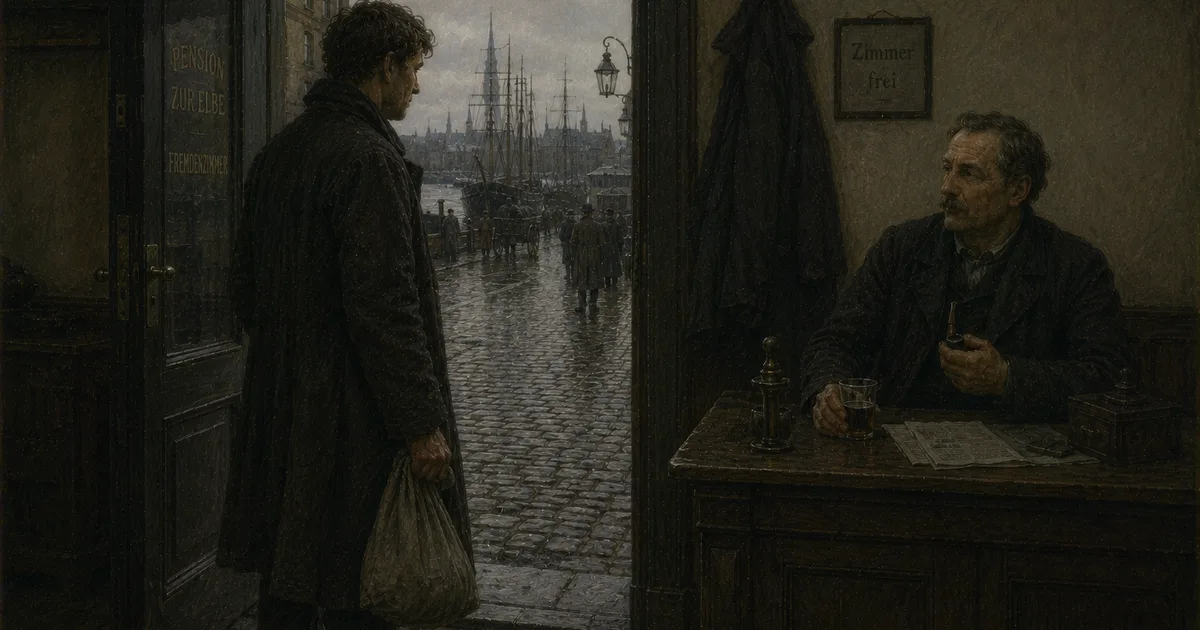
The morning of the Day Fifty-eight came up at the docks district of Hamburg at a gray wind from the north-west and a wet at the cobbles of the streets that ran down to the river.
Olav was at the door of the boardinghouse at the half past eight of the morning. He had his coat at his shoulders. He had the small bag with the spare shirt at his hand. He had what was at the pockets of the coat where it had been at the inside-pocket and the side-pocket and the other side-pocket and the breast-pocket and the coat-pocket since the morning of the Christmas Day of 1877 at the back room at the upper end of Front Street at Wilmington.
The keeper was at the bench at the parlor.
He looked at Olav at the door. He did not say anything. He had said at the evening of the Day Fifty-seven what he was going to say about the bark and the captain and the first mate, and he did not say it again that morning. He had a small clay pipe at his hand and a glass at the bench at his elbow and the look of a Hamburg boardinghouse keeper at the morning a Norwegian sailor was going down to the wharf to sign onto an American bark. He nodded at Olav.
Olav nodded.
He went out of the door of the boardinghouse and walked down the Steinweg toward the river.
The captain’s office of the American bark was at the upper end of the third quay at the lower side of the docks district. It was a long low building of red Hamburg brick with a roof of gray slate. The bark was at the wharf at the end of the building. Her mainmast was at the second window of the office.
Olav came to the door of the office at the five before the 9 of the morning.
The door was half open. He went in.
The office was a single long room with a writing-table at the upper end and a bench against the long wall and a stove at the corner that was not lit. The Swedish first mate was at the writing-table. The captain was at the writing-table beside him. There was a man at the bench.
The captain looked up.
He was about fifty. He had the hair gray at the temples and a coat of black wool that did not fit at the shoulders the way the coat of a captain at fifty had fit in the year a coat had been made. He had a face the color of a January river that has not yet gone to ice and that is not going to. He had a cough at the second sentence he said, and it came at his hand at his mouth and went away at the breath after, and his face did not show it. He had a ledger open at the table and a pen at the side of the ledger.
He said in the English of a Massachusetts master that the able seaman from the Kvik was at the office on the time the first mate had said the seaman would be at the office on. He said the wage was thirty dollars at the month and the food was the food of the bark’s table and the bunk was at the forecastle and the articles were at the table in the open part of the ledger. He said the bark sailed at the noon tide of the Day Fifty-nine and the able seaman should be aboard at the 9 of the morning with whatever he had at Hamburg.
He held the pen out to Olav.
Olav came to the table. The pen was at the place at the open ledger where the captain had laid his finger. Olav read the line. He signed his name. The Swedish first mate signed at the line below as witness.
The captain said: that will do.
He laid the pen at the side of the ledger and closed the ledger and looked at Olav for a moment over the ledger and looked past Olav at the door. The cough came at his hand again. His face did not show it.
Olav stepped back from the table.
The Swedish first mate said in the Gothenburg-Swedish of a Gothenburg first mate that the able seaman should be at the gangway of the bark at the 9 of the morning of the Day Fifty-nine with his oilskins and his other gear, and that the bark would be making ready at the wharf through the morning and the forenoon. He said the second mate of the bark was a man of Lillesand who had resided in New York for twelve years and was called the Red Shirts at the bark and at the wharf and at the houses of the wharf and that the second mate was at the deck already and would be at the deck through the day. He said the boatswain was a German and was at the gangway through the morning and was a reserved man. He said the steward was an Austrian and was at the galley already and should be let to the galley by a new hand until the steward had had the new hand under him for a day or two. He said the bark was the bark of the master at the table.
Olav said yes.
The Swedish first mate said the able seaman could go.
Olav turned at the table to the bench.
He saw the man at the bench. He was a man of about thirty in a Danish coat with a patch over the left eye. The patch was of black leather and was held by a leather cord at the back of the head under the cap. The right eye was open. The shoulders were the shoulders of a man who had been at the foretop and the bowsprit and the cat-falls of a Danish coaster and after the coaster a bark or two for the years before he came to the office at Hamburg. He was sitting at the bench with his hands at his knees and his cap at the bench beside him.
Olav came past the bench to the door.
The Dane looked up at him as he came past. He did not nod or smile or say anything at the looking. He looked at Olav as a man at a bench at a captain’s office at Hamburg looked at a Norwegian able seaman who had come off the Kvik of Drammen six days before and was going to be a man at the bunk at the forecastle beside him for the run to New York. The look was not a look of welcome and was not a look of dread. The look was a look of I see who has come.
Olav looked back.
It was the looking the body of Olav at the bench at the office at the third quay at Hamburg knew the shape of without telling the head of Olav that it knew it. The body had been at the foremast pin-rail of the Asta in March of 1876 at the side of a man whose hands had been beside Olav’s at the parcelling of the bowsprit-shroud. The body had been at the change of the half hour at the long oak table at the reading-room of a Bristol Bethel at the first week of February of 1877. The body of Olav at the bench at the office at the Day Fifty-eight had a capacity to register the look of a Danish man with a patch over the left eye that the body had not had at the Sigrid in 1875 and had not had at the foremast pin-rail of the Asta in March of 1876 and had not had at the Dronningen before the second week of February of 1877.
He did not name to himself, at the bench at the office, what the body of him knew at the looking.
The Swedish first mate at the writing-table said: that will do.
Olav went out of the office.
The wharf was at the door of the office at the lower end. The bark was at the wharf with her mainmast against the gray sky and her yards squared and her bowsprit out over the river. She was a bark of about three hundred and fifty tons with a black hull and a white waist-stripe at the bulwark and a red trim at the rail. The men at the deck were rigging the running gear at the forenoon. There was a man at the gangway at the lower end of the wharf who was a man of about forty in a wool coat with the cap of a German boatswain at the head and a marlinespike at the belt. He looked at Olav as Olav came up the wharf. He did not say anything. He looked at Olav for the time the wharf took to come up from the office to the gangway and then he looked at the man at the deck whose work the boatswain was watching.
Olav passed the gangway without going aboard. He had said he would be at the gangway at the 9 of the morning of the Day Fifty-nine. He was at the wharf at the Day Fifty-eight and was walking back to the boardinghouse. He went up the cobbled street that ran from the third quay to the Steinweg.
The man in the red shirt was at the upper end of the street.
He was at the upper end of the street with two other men in wool coats. The red shirt was at the open of his coat at the throat. He was a tall man. Olav was a man of average Norwegian height and the man in the red shirt was a head and shoulders past Olav. The two men with him were of the wharf, of the kind a man hires on a wharf at a German port to move salt or coal or whatever the cargo of the wharf is at that morning. He was speaking to the two men in an English with a Lillesand-Norwegian accent at the consonants and a New York accent at the vowels. The English was loud at the upper end of the street.
Olav came past the three men.
The man in the red shirt did not look at him. The two wool-coats did not look at him. He passed them and went on to the Steinweg.
He came to the door of the boardinghouse at the half past ten of the morning.
The keeper was at the bench. The clay pipe was at his hand. The glass was empty. The keeper looked at Olav at the door. He nodded.
Olav nodded.
He went up to the second floor at the room he was at.
He took off his coat and laid it at the back of the chair at the small writing-table. He took the rosary out of the inside-pocket where it was at with the wages of the Kvik run and laid the rosary at the writing-table. The beads were the beads of the wooden rosary Margit O’Brien had given him at the back room at the upper end of Front Street at the morning of the Christmas Day. The small wooden cross at the lower end was at the cord. He looked at it for some seconds. He laid his hand at it. He did not say anything to it or for it. He picked it up and put it back at the inside-pocket of the coat.
He sat at the chair at the writing-table.
The keeper brought the dinner up at the noon. The dinner was at the table at the other side of the room. Olav ate the dinner.
It was pork and bread and a piece of cheese. He ate the pork and the bread and the cheese and drank the water in the glass beside the plate.
The afternoon went to the evening of the Day Fifty-eight.
The keeper came up at the half past seven of the evening.
He came to the door of the room and stood at the door with his cap in his hand. He looked at Olav at the chair at the writing-table. He said in the German of a Hamburg boardinghouse keeper at the evening before a sailor went to a bark that the sailor should know that the man at the writing-table of the office at the third quay was the captain of the bark and that the captain was a man whose cough did not sound well at a man’s chest. He said the sailor should know that the Swedish first mate had spoken at the parlor of the boardinghouse at the evening of the Day Fifty-seven and that the speaking had been the speaking of a grobian. He said the sailor should know that the second mate of the bark was the man called the Red Shirts at the docks at Hamburg and that the man called the Red Shirts was a man the boardinghouse keeper would not have at the parlor.
The keeper said he had said what he had said.
Olav said yes.
The keeper said good evening.
He went out of the room and closed the door behind him.
Olav sat at the chair at the writing-table for some minutes at the evening.
He blew out the candle.
He lay at the bed in the dark of the boardinghouse room at the upper end of the docks district of Hamburg at the night of the Day Fifty-eight of the run from Wilmington that had begun at the noon tide of the Christmas Day of 1877 and that would end at the noon tide of the Day Fifty-nine when the American bark dropped her lines and went out to the Elbe.
The night went to the morning.