The morning of the first of April of 1879 came at the third-floor room at Kindingstad’s at the light of a spring morning at Stavanger.
Olav was at the small table at the window at the seven of the morning. He had the chart-work materials of the six months of the school set in order at the table—the parallel-rule, the dividers, the pencils, the small ruled tables. The examination of the navigators was at the nine of the morning at the navigation school. Olav had been at the chart-work of the six months and the chart-work was at his hands the way the work of a thing came to be at a man’s hands across six months, and the examination was the day the chart-work was set down and signed and made a certificate of.
The cough was at his chest at the morning of the first of April.
It was lighter than it had been at the February. The thaw had come to the city at the March and the cough at the thaw was lighter than the cough at the cold, and the cod-liver oil at the brown bottle at the small table at the side of the bed had gone down at the spoonfuls of the mornings and the evenings since the third week of the February. The cough was lighter. It was at the chest. Olav took the cod-liver oil at the spoon at the morning of the first of April, and he took the coffee at Kindingstad’s kitchen, and he walked to the navigation school at the streets the body had walked at every school-day of the winter.
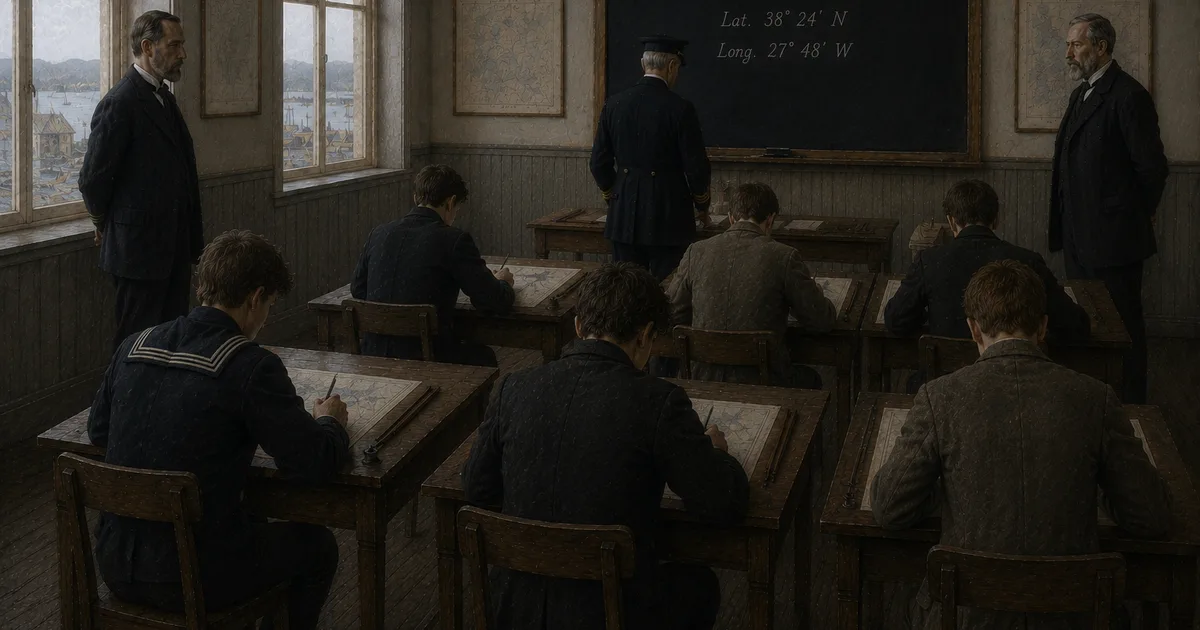
The examination was at a room of the navigation school building at the nine of the morning.
There were six applicants for the navigator’s certificate at the room. Olav was the one of the six. Hamre was the one of the six—Hamre of Professor Nilson’s room, at the desk two places from Olav’s at the winter, dark-haired, quick at the talk of the corridor and slow at the chart-paper. The other four were men of the other rooms of the school, men Olav knew at the face and not at the name.
The examiner was a Captain Knap of the Navy.
He was a man at the front of the room in the coat of a Navy captain. The two censors were at the side—a Captain Paderson and a man called Hillieson—and Dean Gabrielson was at the side wall, and Professor Nilson was at the side wall at the other end. Captain Knap named the examination and the form of it. The applicants would be at the desks. The questions would be the questions of the chart-work and the celestial-navigation tables and the instruments. Each applicant would be at the questions in his turn, and the censors would mark, and the certificate would go at the close to the applicants the examination passed.
The six applicants took the desks.
The examination went at the morning the way an examination went. Captain Knap put the questions. The applicants worked the chart-work at the desks. Olav worked the questions at his desk the way the body worked the chart-work—the parallel-rule and the dividers at his hands, the reckoning laid down on the paper, the position fixed. He had laid down a position at the chart-table of the Dronningen under Tollefson at the dead-reckoning watches; he had laid it down at the school across the winter; he laid it down at the examination at the desk on the first of April. The chart-work was not the hard part of the day for Olav. It had not been the hard part of the winter.
It was at the chart-measuring question that Hamre stopped.
Captain Knap had put the question of the measuring of a distance on the chart. It was a question of the instruments and the chart—the measuring of a distance between two positions on a Mercator chart, where the scale of the chart was not the one scale at the top and the side, and where a man took the distance from the scale that gave the true measure and not from the scale that did not. The answer was the latitude scale. A man measured the distance by the latitude scale at the side of the chart, at the latitude of the place the distance was at, because the latitude scale gave the sea-mile true and the longitude scale at the top did not.
Hamre was at the desk at the chart with the dividers at his hand and did not set them to the chart.
Olav saw it from his own desk. Hamre’s hand was at the dividers and the dividers were at the air above the chart and not at the chart, and Hamre’s face was the face of a man who had the question in front of him and did not have the answer at his hand—a man at a desk at an examination at the question that the six months of the chart-paper had not put at his hands the way the months at sea had put the work at the hands of the men whose hands had been at a bark’s chart-table.
Captain Knap was at the desk of one of the other four applicants at the far side of the room.
Olav set his own dividers to the latitude scale at the side of his own chart. He did it at the ordinary motion of a man working his own chart-question. He did not look at Hamre at the doing of it. He said, at the low voice of a man at a desk at an examination, at a voice that went the two desks to Hamre and did not go to the front of the room, “By the latitude scale. At the side.”
Hamre heard it.
Hamre set the dividers to the latitude scale at the side of his chart. He took the distance off the latitude scale at the latitude of the place. He laid the measure down. The dividers were at the chart now, and Hamre worked the rest of the question at the chart with the answer at his hand.
Captain Knap did not see it. The two censors did not see it. Dean Gabrielson at the side wall did not see it, and Professor Nilson at the side wall did not see it.
The examination went to its close at the noon.
The six applicants were at the desks and the corridor while the censors conferred. Captain Knap and Captain Paderson and Hillieson were at the front room with the marked papers, and the six applicants were at the wait of a thing that was at the conferring of three men behind a door.
The result was read at the half past noon.
Of the six applicants, two passed the examination of the navigators of the first of April of 1879. Olav Hestby passed. Hamre passed. The other four did not pass, and would be at the examination again at a later sitting, or would not, the way men were at a thing they had not passed at the first sitting of it.
The certificate came to Olav’s hand at the front room.
It was the navigator’s certificate—the paper of it, the navigator’s certificate of the kingdom, with the name Olav Hestby at the inscription and the seal of the school and the marks of Captain Knap and the two censors. Olav had the certificate at his hand at the front room of the navigation school building at the half past noon of the first of April of 1879. He had come back from the sea to the school for the certificate, and the certificate was at his hand.
Hamre came to Olav outside the school building.
It was at the street of the upper town at the corner of the school-courtyard. Hamre had the certificate at his own hand. He stood at the street with Olav, and he said the thing a man said when another man had given him the answer that had been the difference between the certificate and the not-certificate.
“You gave me the latitude scale,” Hamre said.
“It was a small thing.”
“It was not a small thing to me. My mother paid the school-year. She is at a town at the upper coast and she paid the school-year out of what a widow at an upper-coast town has, and if I had gone back to her without the certificate she would not have said a word of it and she would have been disappointed the whole of the rest of her life and not said a word of it.” Hamre said it at the quick voice he had at the corridor, and then he stopped the quick voice, and he said, at a slower voice, “I will not forget that you gave it to me.”
“You worked the rest of the question yourself,” Olav said. “The latitude scale was the one thing.”
“The one thing was the thing I did not have.” Hamre put out his hand. Olav took it. “I am going up the coast at the steamer of the Thursday. To my mother. With the certificate.” He said it, and the two of them stood at the corner for the moment a thing was at the close of, and then Hamre went up the street toward the upper town, and Olav did not see him again.
Olav stood at the street with the certificate in his coat.
The four hundred crowns of the leather purse were near to spent. They had gone at the rent of the room at Kindingstad’s at the six months, and at the meals, and at the cod-liver oil at the brown bottle, and at the few kroner of the winter’s borrowing of the boat, and at the small costs of a man at a city at a school-year. The leather purse at the inside pocket of the coat was light at the first of April the way a purse was light at the close of the thing the purse had been filled for. The certificate was at the coat. The cough was at the chest.
Olav had the certificate that said he was a navigator.
He did not have the wages of a navigator, because the wages were at a ship and Olav had not hired onto a ship. He did not have the health of a navigator, because the cough was at the chest and the cough was lighter than it had been at the February but was not gone. He did not have the thing the certificate had been the milestone of—the marriage, the date a man set with the woman he was to marry when the man was a real navigator with a navigator’s berth and a navigator’s wage and a body that could promise a household and the children of a household. The certificate was the milestone, and the milestone was passed, and the passing of it had not made Olav the man the passing of it was to have made.
He walked back to Kindingstad’s at the streets at the afternoon.
He came to the third-floor room. He set the certificate at the small table at the window. The window looked at the wharf at the lower end of the upper harbor where the Lindøy boats came in, and a man who had passed the navigator’s examination at the noon and had the certificate at the small table might have gone down to the wharf at the afternoon and taken the Lindøy steamer or the borrowed boat across the strait to Lindøy, to the household where Olava and her father and her mother had been at the engagement that waited on the certificate for the school-year, and put the certificate at the kitchen table at Lindøy and said the milestone was passed.
Olav did not go down to the wharf.
He stayed at the third-floor room at the evening. He lit the lamp at the small table at the going of the light. He took the wallet from the side pocket of the coat and took the carte-de-visite of Olava from the wallet—the carte-de-visite of the sitting Olava had made at Augustsen’s at Pedersgate at the July of 1876—and he set it at the small table propped at the lamp, the way the photographer’s lamp had been at the side of Olava at the sitting.
The carte-de-visite of Olava was at the lamp at the small table.
The certificate was at the small table at the side of it.
Olav sat at the chair at the small table at the evening of the first of April of 1879 with the certificate and the carte-de-visite at the lamplight, and he did not cross the strait to Lindøy. He could not cross the strait to Lindøy at the evening of the day the certificate had come to his hand and put the certificate at the kitchen table at Lindøy, because the putting of the certificate at the kitchen table would have been the saying that the milestone was passed, and the saying that the milestone was passed would have been the asking for the date, and Olav was not, at the first of April of 1879, the man who could ask Olava for the date. The certificate said he was a navigator. The cough said the other thing, and the light purse said the other thing, and the body said the other thing, and Olav did not have a word he could carry across a strait to a kitchen at Lindøy and set at the table beside the certificate.
He sat at the small table with the carte-de-visite of Olava at the lamp.
He looked at it for a while. The carte-de-visite was the photograph of a woman of eighteen at a photographer’s chair at Pedersgate at the July of 1876, and the woman at the photograph was the woman Olava had been before the two years and the letters and the homecoming and the borrowed-boat-nights and the winter. Olav did not have a word for the woman at the photograph that he did not also have for the woman at the kitchen at Lindøy across the strait at the evening of the first of April. He had the carte-de-visite at the lamp. He had the certificate at the table. He had the strait between the room at Kindingstad’s and the kitchen at Lindøy, and he did not cross it.
He sat at the small table until the late hour.
Then he put the carte-de-visite of Olava back at the wallet, and the wallet back at the side pocket of the coat, and he set the certificate at the small table at the side of the bed at the place the brown bottle of the cod-liver oil was, and he put the lamp out.