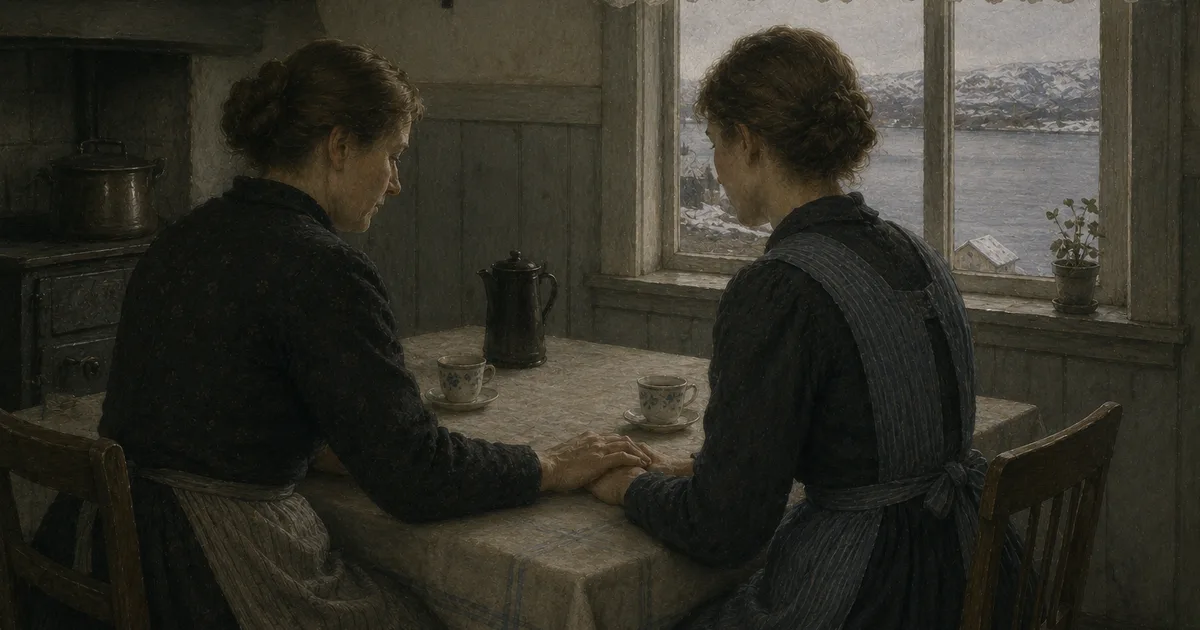
The morning of the thirteenth of March came at the kitchen at Lindøy at the half past six.
Olava had been at the kitchen since the quarter past six. She had brought down the wood from the upper end of the woodshed the way she had brought down the wood from the upper end of the woodshed on every morning of the March, and on every morning of the February before the March, and on every morning of the winter before the February. She had set the wood at the firebox. She had set the kettle at the stove. The window at the side of the stove showed the morning of a March that had not yet turned—the snow at the slopes still at the snow, the strait still at the gray of a winter strait, the light at the window come a little earlier than it had come in February.
She set the loaf at the table at the quarter to seven.
She set the butter at the small dish at the side. She set the milk at the pitcher at the other side. She set the four cups at the four places for her father and her mother and Gustav and herself. The four places were the morning places at the kitchen at Lindøy in the March, the way they had been the morning places in the January and the February.
Bertha came into the kitchen at the half past six.
Bjørn was at the upper room. The winter cough had been at him in the January the way it had been every January, and the cough had eased at the February, and Bjørn was at the kitchen at the noon meals now and would be at the breakfast by the end of the March the way he had been at the breakfast by the end of the April the year before. Bertha said the lambing at the lower byre would begin at the third week of the March. Olava said yes.
Gustav came in from the byre with the milk-pail. He set the pail at the cool corner. He sat at his place and ate the bread and drank the coffee and did not say much, and went back to the byre, the way he was at the morning kitchen in the winter.
Olava set the kitchen at the half past seven.
She set the dishes at the dish-rack and the cups at the cup-rack and wiped the table with the cloth. She took the iron from the chair at the side of the stove and ironed the shirts of Bjørn for the week. The shirts were three. She set them at the linen-press in the parlor at the half past eight and came back to the kitchen.
She made the coffee at the ten for the half-time of the morning.
Bertha sat at the table with the coffee. Olava sat at the table with the coffee. Bjørn was at the upper room. Gustav was at the byre.
The two of them sat at the table at the kitchen at Lindøy at the ten of the morning of the thirteenth of March.
Bertha did not say anything about Olav.
Olava did not say anything about Olav.
The two of them sat at the table and drank the coffee, and the not-saying-about-Olav was at the table the way a thing was at a table that two women had decided, without the deciding being said, was a thing that would not be said at the table. Bertha had been to Stavanger in the February at a household-thing of Karoline’s at Rossøygate, and had been at the city for the three days of it, and had been at the Bethania at the Sunday-evening with Olav and Olava at the pew. Olava had been at the pew at Olav’s side at the hymn. Bertha had been at the pew at Olava’s other side. The two of them had been at the pew at the same hymn at the same Sunday-evening, and the two of them had heard the same thing at the chest of the man at the pew between them, and neither of them had said anything about it at the steamer back to Lindøy or at the kitchen at Lindøy in the three weeks since.
Bertha set her hand at Olava’s hand at the cloth.
She set it there at the coffee-table at the ten of the morning, and she held it there, and she held it there for the length of time that was longer than the length of time a mother’s hand was set at a daughter’s hand at a coffee-table at a winter morning. She did not say anything at the hand-laid. Olava did not say anything. The hand at the hand at the cloth was the thing the two of them said to each other at the morning of the thirteenth of March, and it was said, and Bertha took the hand off and finished the coffee, and Olava finished the coffee, and the morning went on.
Olava went up to the upper room at the eleven.
The room was the room she had had since the eighth year of her life. The bed was at the wall. The chest of drawers was at the inner wall with the carte-de-visite of Olav at the upper end propped at the lamp. The writing-table was at the window that looked east toward Roalsdyret across the strait. The candle of the upper window was at the sill. The small wool rug was at the foot of the bed.
She did not set a sheet of letter-paper at the writing-table.
She had set a sheet at the writing-table at the mornings of the spring of 1878, at the eleventh of April and the eighteenth and the twenty-second and the twenty-fourth, and had not lifted the pen, and had put the sheet back at the small drawer. She did not set the sheet out at the morning of the thirteenth of March of 1879. The winter had not been a winter of letters. Olav had crossed the strait at the borrowed boat at the evenings the strait had let him cross, and the crossing had been the thing the letter had been at the years of the voyages, and a woman did not write a letter to a man who crossed a strait to her kitchen. The lower drawer of the chest of drawers held the four letters from Olav at the bundle tied with the brown twine, the four letters of the voyages, and the bundle had been at the lower drawer since the evening of the twentieth of January of 1878, and Olava had not lifted it from the drawer in the winter.
She sat at the chair at the side of the chest of drawers.
She looked at the strait at the window. The strait at the morning of the thirteenth of March was at the gray of a winter strait. The slopes of Roalsdyret were at the snow. There was no boat at the strait at the eleven of the morning.
She had known for three weeks.
She did not set the day to the knowing. She had not set the day to it at the time of it and she did not set the day to it now. She knew that it had been at the February—at a Sunday at the Bethania at the hymn, or at a borrowed-boat-night at the kitchen at Lindøy when she had seen the body of him at the chair at the table, or at the Sunday after the Sunday after that, when he had not crossed, and the not-crossing had been the strait’s reason at the saying of it and had not been the strait’s reason. She knew it had been at the February. She did not know the day. The knowing had not come at a day; it had come the way a thing came that a person had been at the slow approach of for a long time without the approach being a thing the person let herself call an approach.
She had been at the watching of Olav since the borrowed-boat winter.
She had been at it without the calling-of-it-watching. She had been at the kitchen at the evenings he crossed, and at the door when he came up from the boathouse, and at the chair at the side of the stove with the household-mending at her hands while he was at the table, and at the boathouse-side at the partings; and at all of it she had been at the watching of the body of him, the way the body came up the path and the way it was at the chair and the way it was at the eating of the soup and the way it crossed back to the boat at the late hour. She had watched it across the October and the November and the December, and the body had been the body of a man who had been at the school and the city and the strait. She had watched it across the January, and the body had been at a tiredness the school-and-the-strait could account for. She had watched it across the February. And at some morning or some evening of the February the watching had stopped being a watching that the school-and-the-strait could account for, and had become the other watching, and the other watching was a watching Olava had been at before.
She had been at it before at the small back room of the house at Lindøy in the February and the March of 1875.
Tore had been at the bed of the small back room. He had been twenty-one. He had been at the bed for the weeks of the February and the March, and the household had been at the household-work around the bed the way a household was at the household-work around a bed that a son was in, and Olava had been seventeen.
Bertha had been at the bedside at the third week.
That had been the week Tore had still been at the speaking. He had spoken at the third week—a little, at the low voice of a man at a bed at the third week, the small things a man at a bed said—and Bertha had been at the chair at the side of the bed at the third week and had heard the small things and had said the small things back. And then the third week had gone to the fourth week, and at the fourth week Tore had stopped the speaking, and Olava had been at the chair at the side of the bed at the fourth week.
She had been seventeen at the chair at the side of the bed at the fourth week.
She had read to him from the gospel of John when he had asked, at the third week, when the asking had still been a thing he could do; and at the fourth week the asking had stopped, and Olava had read to him without the asking, because the reading was a thing she could do at the chair at the side of the bed and the not-reading was not. She had watched him at the fourth week. She had watched the breathing of him and the color of him and the sleep of him and the waking of him, and she had learned, at the fourth week, at seventeen, at the chair at the side of the bed, the thing a person learned at the side of a bed at a fourth week—which was the inside of the knowing of what the watching was the watching of. It was a knowing she had not had a word for at seventeen and did not have a word for at twenty-one. It was the knowing that the watching was the thing she could do, and that the watching was also the thing that did not change what the watching was the watching of, and that a person at the chair at the side of a bed held the both of those at the one body at the one time and did not set either of them down.
Tore had died at the close of the fourth week, at the March of 1875.
Olava sat at the chair at the side of the chest of drawers at the upper room at the morning of the thirteenth of March of 1879, and the strait was at the window at the gray of the winter, and the lambing was at the third week of the March ahead, and she did not set out the sheet of letter-paper, and she did not lift the pen.
She did not let the head go on at the thing the head had come to.
Olav was not Tore. Olav was at the school at Stavanger and at the chart-work and at the borrowed boat at the strait; he was not at a bed at a back room. Olav was twenty-one and would be twenty-two at the spring; Tore had been twenty-one and had not been twenty-two. Olav was the man she was to marry; Tore had been the brother she had loved best. The watching at the small back room in 1875 and the watching at the Lindøy kitchen in the winter of 1879 were not the one watching. Tore had been dying. Olav was coughing.
But the shape of the watching was a shape Olava knew.
She had been at the shape of it before. She knew the shape of it the way a hand knew the shape of a tool the hand had held. And the knowing of the shape was the thing she had had for three weeks, and the having-of-it was a thing she did not say to Bertha at the coffee-table and did not say to Olav at the kitchen and did not write at a sheet of letter-paper at the writing-table; and the not-saying-of-it was a choice, and the choice was the choice she had made at the chair at the side of the bed at the fourth week at seventeen and had not unmade since: that the watching was the thing she could do, and that she would do the watching, and that she would not turn the watching into a thing of words at a kitchen or a sheet of paper, because the words would not change what the watching was the watching of, and the not-asking was the form her care had taken at a bedside at seventeen and was the form her care took at a kitchen at twenty-one.
She would not ask Olav.
She had asked him a question once, at a ravine on Finnøy in the June of 1876, and had heard the answer, and the asking that time had been a thing the asking had been right for. This was not that. This was a thing she had the knowing of without the asking, the way she had had the knowing of the fourth week without anyone at the household saying the word of it to her. She would carry the knowing. She would be at the kitchen at the evenings he crossed. She would be at the watching. She would not ask.
She sat at the chair at the upper room until the noon was near.
Then she stood from the chair. She did not set out the sheet of letter-paper. She looked at the strait at the window once more—the gray strait, the snow at the slopes of Roalsdyret, the light of a March that had not turned—and she went down to the kitchen to set the noon meal for her father and her mother and Gustav and herself.