Haakon Berg paid off a Stavanger bark at Hebburn on the morning of the twenty-third of April of 1878.
The bark had been on the timber-trade out of Bergen and Newcastle and Hebburn through the autumn and the winter and the spring, and Haakon had been the boatswain of the bark for the run since the second week of November of 1877. He had paid off at the office at the wharf-end at Hebburn at the eight of the morning of the twenty-third with the wages of the boatswain for the five and a half months at the rate of a Stavanger bark at the timber-trade, less the slop-account and the steward’s-account, in pounds at the Newcastle bank. He had put the wages into the inside-pocket of the coat. He had carried the sea-chest from the bark up the wharf to the boardinghouse at the upper end of Ellison Street, where the boardinghouse keeper had a room for a Norwegian boatswain between berths for five shillings a week.
He had been in the room for nine days on the morning of the second of May.
The room was on the second floor of the boardinghouse at the upper end of Ellison Street at Hebburn, at the south bank of the Tyne, opposite Newcastle. It had a bed and a chair and a wash-stand and a small grate. It had a window in the side wall that looked toward the lower end of Ellison Street and out to the Tyne beyond, at the wharves and the cranes and the colliers at the loading at the south bank. The window did not look toward the north bank where Newcastle was. The window had a curtain of plain wool.
Haakon had walked the south bank of the Tyne each of the nine days.
He had walked the wharves from the upper end of the Bill Quay coal-staithes at the upper end of Hebburn to the lower end of the Palmer shipyard at the lower end of Hebburn, and he had stopped at the boards at the upper ends of the wharves at the ships in the loading and the ships in the discharge. He had read the boards at the seven of the morning every day. He had been at the Norwegian agent at the wharf-end office at the upper end of the High Street at the half past nine of the third and the sixth and the ninth days. The Norwegian agent had said the next Norwegian-flagged bark at Hebburn for a boatswain would be the Astrid of Tønsberg at the second week of May for a run of timber to the lower Baltic.
Haakon had said he would sign at the Astrid at the morning the Astrid came to the agent.
He had been at the boardinghouse at the upper end of Ellison Street through the days for the work of a boatswain between berths.
He had washed the shirts of his sea-chest at the wash-stand and had hung them on the line in the small yard at the back of the boardinghouse. He had taken the coat to the boardinghouse-tailor at the lower end of Ellison Street at the third day for the brushing and the small mending at the cuff. He had taken the boots to the boardinghouse-bootmaker at the fifth day for the soling. He had read the papers at the Mission of the Norwegian Bethel at the upper end of Howard Street at Newcastle at the change of the morning watch at every day, having crossed the river by the steam-ferry at the half past nine and walked up from the ferry-landing at the Newcastle quayside through the streets to the upper end.
The Mission was at the long room at the second floor of the Bethel at the upper end of Howard Street.
The papers at the Mission were the Bergen Tidende and the Aftenbladet of Stavanger and the Trondhjems Adresseavis and the Morgenbladet of Christiania. The papers came up the Tyne by the steamers of the Norwegian post at the second week of every month, four weeks behind the date of the issue. The Aftenbladet of Stavanger of the first week of April of 1878 came to the Mission at the morning of the first day of May.
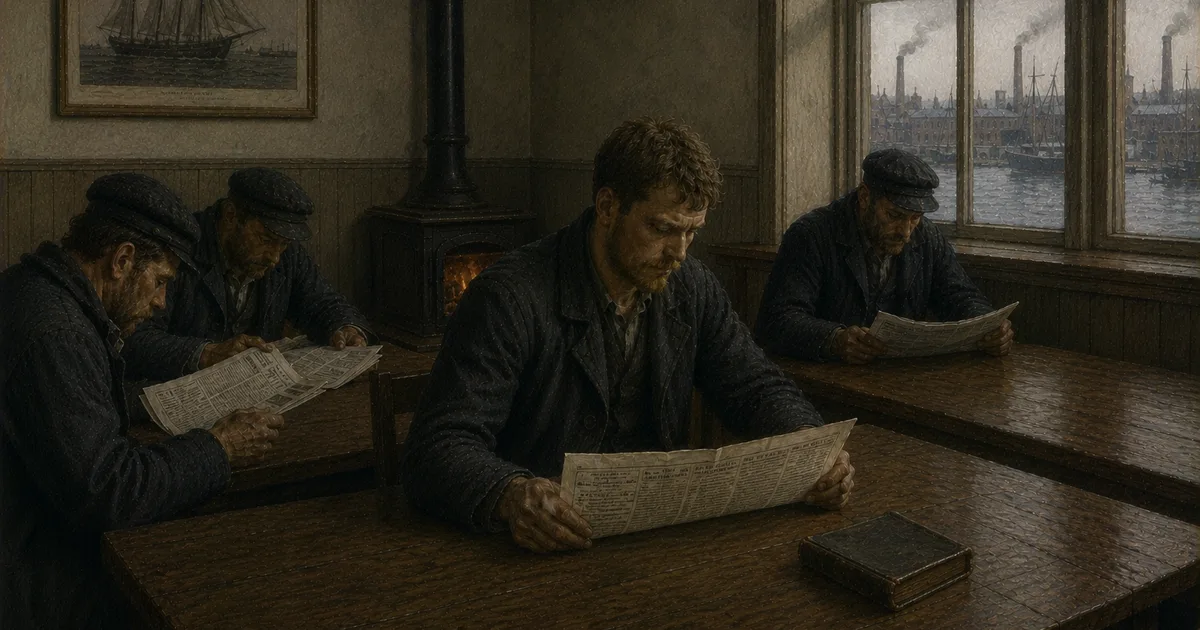
Haakon read the Aftenbladet at the long oak table at the south wall at the morning of the second of May.
He had read the Aftenbladet at the long oak table at the south wall at every day the Mission had an Aftenbladet that he had not read. He read the news of the wharves of Stavanger and the news of the parish of Hesby and the news of the parish of Domkirken and the wires of the Norwegian consuls at the Continental ports that the Aftenbladet reprinted at the third page from the second column to the lower column.
The wire of the Hamburg consul of the second week of March was at the third page at the lower column.
The wire reported the Norwegian sailors who had signed onto other-flag barks at the wharves of Hamburg through the months of February and the first week of March of 1878. The wire said that Olav Hestby of Vestbø at Finnøy had signed off the articles of the Kvik of Drammen at the wharf-end office at Hamburg on the evening of the fourteenth of February at the wages of the run from Wilmington of the Christmas Day of 1877 to Hamburg, at a six-and-two of the pumps for forty-seven days. The wire said that Olav Hestby had signed onto an American bark at the captain’s office at the third quay at Hamburg at the morning of the twentieth of February for the run from Hamburg to New York at the wages of an able seaman, and that the American bark had sailed at the noon tide of the twenty-first of February.
The wire did not give the name of the American bark.
The wire said the American bark was the bark of a Boston-home master of a kind that ran the Hamburg-New-York trade at the year of 1878.
Haakon read the line at the long oak table at the south wall at the morning of the second of May.
He read it twice. He read it a third time. He did not say anything at the reading. He laid the Aftenbladet at the long oak table at the place at the table where the Aftenbladet had been. He sat at the long oak table at the south wall at the Mission of the Norwegian Bethel at the upper end of Howard Street at Newcastle at the morning of the second of May of 1878 for some minutes.
The light at the south wall of the Mission came through the windows at the south wall at the morning of the second of May. The wood-stove at the north wall was lit at the small at the spring. A framed engraving of a Stavanger schooner hung above the wood-stove. The reading-room had three other men at the long oak table at the morning of the second of May. They were two Bergen sailors at the lower end and a Trondheim sailor at the upper end. None of them looked at Haakon at the reading.
Haakon stood up at the long oak table.
He went out of the reading-room. He went down the stairs of the Bethel. He came out at the door of the Bethel at the upper end of Howard Street. He walked down Howard Street to the Newcastle quayside and along the quayside to the steam-ferry landing.
The ferry to Hebburn was at the half past eleven.
He went aboard. He paid the fare at the ticket-office at the landing. He stood at the upper deck at the run across the river from the Newcastle quayside to the Hebburn ferry-landing.
The Tyne at the morning of the second of May was at the wind from the south-west at four knots.
The colliers at the south bank were at the loading at the Bill Quay coal-staithes. The cranes at the Palmer shipyard at the lower end of Hebburn were at the work of the shipyard at the morning of a Thursday in May of 1878. The light at the south bank was the brown of the Tyne and the gray of the smoke of the colliers.
Haakon came off the ferry at the Hebburn landing.
He walked up from the ferry-landing along the river-path to the upper end of Ellison Street and along Ellison Street to the boardinghouse. He came to the boardinghouse at the noon. The boardinghouse keeper was at the parlor at the lower floor. The keeper said good day. Haakon said good day. He went up to the room at the second floor and closed the door.
The room at the second floor of the boardinghouse at the upper end of Ellison Street at Hebburn at the south bank of the Tyne opposite Newcastle was the room of a Hogganvik boatswain between berths at the spring of 1878.
He sat at the chair at the small writing-table at the side wall.
The writing-table had a small inkstand at the upper end and a piece of letter-paper at the lower end. The letter-paper was paper Haakon had taken from the small drawer of the writing-table at the second day at the boardinghouse for a letter he was going to write to his mother at Hogganvik at the second week at the boardinghouse and had not yet written. The letter-paper was at the lower end of the writing-table at the morning of the second of May.
He laid his hand at the letter-paper.
He did not lift the pen. The pen was at the inkstand at the upper end. He did not lift the pen at the morning of the second of May.
He thought about the boy from Vestbø.
He had thought about the boy from Vestbø at certain hours of certain nights through the months from the second week of February of 1877 to the second week of April of 1878 the way a man at sea thinks about a man he has parted from at an upper room at a Bristol boardinghouse and has not seen since. He had not thought about the boy from Vestbø at every hour. He had thought about him at the hours the work of a boatswain at sea did not have at the front of the head of a boatswain at sea. He had thought about him at the watches of the night and at the bunk and at the foretop at the long runs.
He had not written.
The not-writing had been the work of a man at twenty-four who had decided at a bed in the dark of a Bristol Friday evening that once would have to be enough.
The not-writing had been the same work for fifteen months.
He thought at the chair at the small writing-table at the morning of the second of May that the boy from Vestbø was at the run from Hamburg to New York at the wages of an American master of the Boston home, and that the run from Hamburg to New York was a run of about a month for an American bark of the kind that ran the trade. He thought the bark would have come to New York at the second half of March or the first half of April. He thought the boy from Vestbø was at New York at the morning of the second of May or had signed onto an American bark out of New York for the run east at the second half of April for the European trade. He did not know.
He thought the not-writing was the same work at the morning of the second of May at the chair at the boardinghouse room at Hebburn that the not-writing had been at the boardinghouse at Queen Square at Bristol at the bed in the dark of the Bristol Friday evening of the first week of February of 1877.
He thought the same once had to be enough at the second of May of 1878 that it had had to be at the bed in the dark of the Bristol Friday evening.
He decided again, at the chair at the small writing-table at the boardinghouse room at Hebburn at the morning of the second of May of 1878, that once would have to be enough.
He set the letter-paper back at the small drawer of the writing-table.
He did not write to his mother at Hogganvik at the morning of the second of May.
The Astrid of Tønsberg came to the Norwegian agent at the upper end of the High Street at the morning of the fifth of May.
Haakon signed at the agent at the half past nine. The Astrid was at the wharf at the lower end of Hebburn at the loading of timber for Stettin. The Astrid’s master was a man of about fifty in a wool coat of a Tønsberg cut. The master said the boatswain should be aboard at the morning of the seventh of May with the chest and the gear.
Haakon was aboard at the morning of the seventh of May.
The Astrid sailed at the noon tide of the eighth of May for the run to Stettin in the lower Baltic.
Haakon was at the foremast pin-rail at the run down the Tyne.
He laid the coil at the cat-falls in the figure-eight he had been laying at every Norwegian-flagged ship since his first voyage as a deckhand. He set it. He went forward to the work the Astrid’s boatswain had next.
The not-writing was the same work at the foremast pin-rail of the Astrid of Tønsberg at the noon tide of the eighth of May of 1878 that it had been at the bed in the dark of the Bristol Friday evening of the first week of February of 1877.