Sven Haugen was at the foretop of the American bark at the second hour of the morning watch of the eleventh day of the run from New York.
The bark was at the run east at the wind from the south-west at seven knots at the latitude of forty-one north and the longitude of forty west of Greenwich. The trade had set in at the second day and had held since. The bark went east at the trade—an American bark of about three hundred and fifty tons with a petroleum cargo for the European trade at the spring of 1878.
Sven had the foretop watch at the morning.
He had been at the foretop for the first hour and the half hour of the morning watch and would be at the foretop for the second hour and the half hour after. The wind held at the south-west. The sea held at the eastbound. The bark held at the topsails and the topgallants and the courses, with the running gear at the cat-falls and the fife-rails laid in the figure-eight at the change of the watch.
The figure-eight at the cat-falls was the figure-eight Olav Hestby of Vestbø at Finnøy laid at every change of the watch at the cat-falls.
Sven had seen Olav lay the figure-eight at the cat-falls at the Staten Island wharf at the morning of the third day of April when the two of them had come aboard for the new regime, and at the cat-falls of the wharf at the loading of the petroleum cargo through the ten days at Staten Island, and at the cat-falls of the foredeck at the run down the lower bay of New York at the noon tide of the eighteenth of April, and at every change of the watch at the run east since. The figure-eight at the cat-falls was the figure-eight of a Norwegian sailor at a Norwegian-flagged ship of the kind a Bergen sailor had been on since the year he had been at the foretop of a coaster at the run from Bergen to Trondheim at his fifteenth year. The American bark was not a Norwegian-flagged ship.
Sven laid the figure-eight at the cat-falls of the foretop the way Olav laid it at the cat-falls of the foredeck.
The Finnish first mate had the deck at the morning watch.
He was a Finn of about forty in the wool coat of a coast-trader cut he had been at since the regime change. He stood at the foot of the foremast at the deck and watched the running gear at the four bells of the morning watch and did not say much at the deck and did not say much at the cabin and did not say much at the table at the dinner. The Finn was a 1st mate of a kind that did not say much.
The Scot was at the wheel at the morning watch.
The two Hollanders were at the running gear at the foredeck.
The Englishman was at the foretop at Sven’s side.
Olav was at the cat-falls of the foredeck at the change of the bells.
The Dane was at the running gear at the larboard fife-rail.
Sven came down from the foretop at the change of the watch at the eight bells.
The off-watch came down to the forecastle.
The forecastle of the American bark at the second week of the run from New York was the forecastle of the brotherhood-bark Sven had come aboard at the morning of the third of April. The Englishman had the bunk above Sven’s at the lower end of the larboard side. The Scot had the bunk at the upper end of the starboard side. The two Hollanders had the bunks across. Olav had the lower bunk at the lower end of the starboard side. The Dane had the bunk above Olav’s. The seventh bunk at the upper end of the larboard side was the bunk of one of the two Hollanders’ brother who was not at the bark and was vacant.
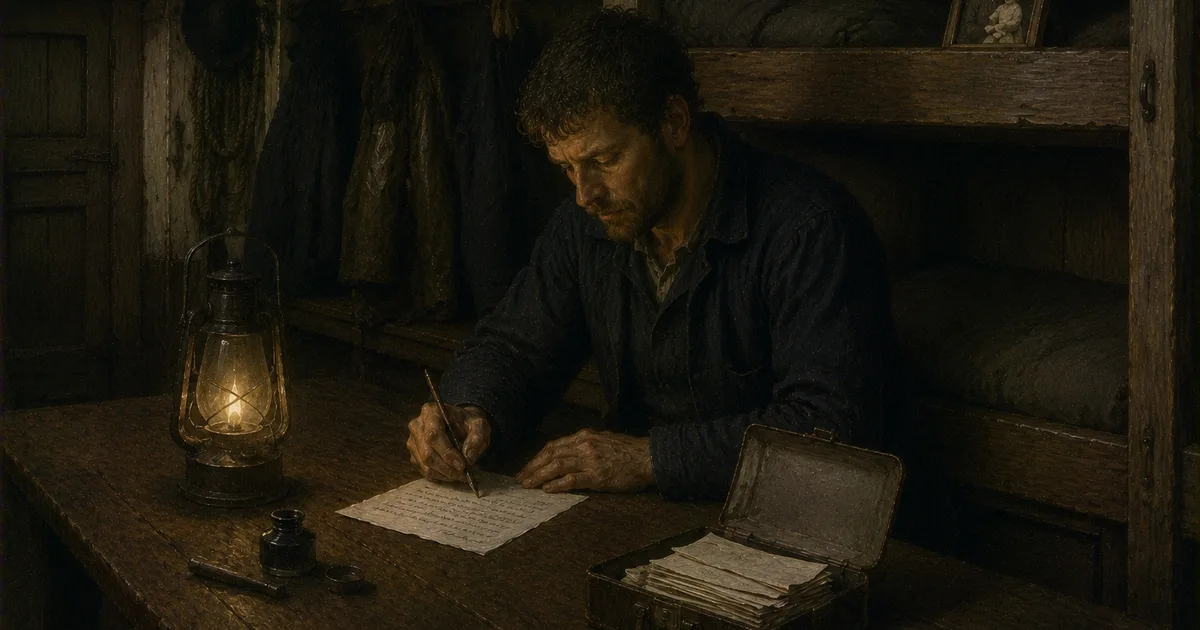
Sven sat at the bench at the forecastle table at the change of the watch.
He took the letter-paper out of the small leather case at the lower drawer of the small chest at the foot of his bunk. The small leather case was the case Hanne had set the letter-paper at on the evening of the eleventh of November of 1877 at the kitchen at Sandviken at the eve of his sailing on the Trana of Bergen. The letter-paper was the same paper. The case was the same case. Sven had set the case at the lower drawer of the small chest at the foot of his bunk on the morning of the third of April at the brotherhood-bark and had taken a sheet of letter-paper out at every off-watch since.
He set the sheet at the table.
He wrote at the sheet at the half hour of the off-watch after the morning watch.
He wrote: Sandviken at the lat 41 N at the long 40 W at the eastbound run of the second week. The trade holds at the south-west at seven knots. The bark goes east at the cargo for Bordeaux. Hanne at Sandviken at the half past nine of the morning is at the dish-rack at the cleaning after the breakfast. Jonas at the second tooth at the front lower jaw at the eleventh of April per the letter that came to me at the Brooklyn anchorage at the second of April from the Stavanger-Bergen packet of the second of March.
He folded the sheet.
He set the sheet at the case.
He had set a sheet at the leather case at every off-watch since the morning of the third of April.
The leather case at the eleventh day of the eastbound run had the sheets of the run from the third of April to the eleventh day at the lower side and the sheets of the run from Hamburg-to-Atlantic at the Trana-cousin-ship and the sheets of the Trana run from Bergen to the Mediterranean at the upper side. The case was nearly full. The case would be full at Bordeaux. Sven would take a new case at the post at Bordeaux.
Olav came down to the forecastle at the change of the bells of the off-watch.
The Dane came down at Olav’s shoulder.
They sat at the bench at the table at the off-watch.
The Dane had the patch over the left eye that Sven had seen at every off-watch since the morning of the third of April. The right eye was a clear gray. The shoulders were the shoulders of a Danish able seaman who had been at a coaster and a bark or two and an American bark out of Hamburg before the American bark out of Brooklyn for the run east. The Dane did not say much at the bench. The Dane was at Olav’s shoulder at the bench.
Sven knew at the bench at the off-watch at the second week of the run east at the lat 41 N at the long 40 W at the trade at the south-west that the Dane at Olav’s shoulder was at Olav’s shoulder for a reason Sven did not say at the bench and the Dane did not say at the bench and Olav did not say at the bench. Sven did not say what he knew. The Dane did not say what he knew. Olav did not say what he knew. The three of them sat at the bench at the table at the off-watch the way three men sat at a bench at a table at the off-watch at the brotherhood-bark out of Brooklyn at the run east.
Sven looked at the letter-paper at the case.
He did not write a second sheet at the off-watch.
The Englishman came down to the forecastle at the change of the bells.
He took the small fiddle out of the leather case at the upper bunk-shelf of the bunk above Sven’s and sat at the bench at the lower end of the table. He played the air of the south of England slow at the second dog-watch.
The Scot came down at the change of the bells.
The Scot sang at the slow places of the air. The air was the Irish air of the upper end of Ulster the Scot had taught the Englishman in the second week at the wharf at Staten Island at the days of the loading of the petroleum cargo. The Englishman played at the slow rate and the Scot sang the words at the slow places.
The two Hollanders came down at the change of the bells.
The two Hollanders did not sing at the air. The two Hollanders sat at the bench at the table at the side of the Englishman and listened.
Olav listened.
The Dane listened.
Sven listened.
The little Swede came at the door of the forecastle at the change of the second dog-watch and listened from the door because the cabin-boy did not sit at the forecastle table at the off-watch but stayed at the small alcove at the upper end of the deck-house with the steward Halvor.
The six men at the forecastle and the one at the door listened to the fiddle and the singing at the second dog-watch at the eastbound run at the lat 41 N at the long 40 W at the spring of 1878.
Halvor brought the supper at the change of the bells.
The supper was the supper of a Stavanger steward at a brotherhood-bark. Fresh bread; salt meat boiled in fresh water; potatoes; coffee that was coffee.
Sven ate the supper at the bench at the off-watch.
Olav ate the supper. The Dane ate the supper. The Englishman ate. The Scot ate. The two Hollanders ate.
Halvor said at the door of the forecastle at the morning Halvor brought the coffee that the Stavanger-Bergen packet at the second of March had had a letter for Sven at Sandviken via Stavanger via the New York consul, which Halvor had taken at the Stavanger consul’s wire at the New York consul’s office at the third week of March before the regime change. Halvor said the letter had been at Halvor’s hand from the third week of March to the second of April when the regime change had brought Halvor to the bark and the letter to Sven’s case.
Sven had said yes.
Sven had read the letter at the second of April at the small alcove at the upper end of the deck-house at the half hour after Halvor had given it to him.
The letter at the second of April had been a letter from Hanne at Sandviken of the eleventh of February of 1878. The letter said Jonas at the sixth month had had a fever at the first week of February and had come through the fever at the second week. The letter said Jonas’s first tooth had come at the lower jaw at the front at the night of the seventh of January and the second tooth was nearly through at the right of the first.
Sven had not said anything at the alcove at the upper end of the deck-house at the half hour after Halvor had given the letter.
He had set the letter at the case.
He had taken the case down to the bench at the off-watch of the eight bells of the second dog-watch of the second of April and had written a sheet at the table.
He had written: Sandviken at the noon. Jonas’s first tooth and the second tooth at the right of the first. Hanne at the kitchen at Sandviken at the morning of the eleventh of February of 1878. The bark at the Brooklyn anchorage at the second of April of 1878 with the regime change at the morning of the third.
He had folded the sheet and set it at the case.
The case had carried the letter at Hanne’s hand at the eleventh of February from the second of April to the second day of the run east. The case carried the letter still.
The Englishman put the fiddle at the upper bunk-shelf at the second hour of the second dog-watch.
The Scot went up to the deck for the watch.
The two Hollanders went up to the deck for the watch.
Olav went up. The Dane went up. The Finnish 1st mate had set the watches at the eight bells of the second dog-watch.
Sven stayed at the bench at the off-watch for the half hour after the change of the bells.
He took the small framed carte-de-visite out of the upper bunk-shelf above his head at the upper end of the bunk.
The frame was the size of a man’s palm. The carte-de-visite was the photograph the photographer at Bergen had taken of Hanne and Jonas at the summer of 1877 at the photographer’s at the upper end of Vågsallmenningen. Hanne was at the chair at the side of the photographer’s stand. Jonas was at her arm. The carte-de-visite had come to Sven at the post at Bergen at the autumn of 1877 at the eve of his sailing on the Trana. He had set the carte at the small leather case at the Trana and at the Hamburg-Atlantic bark and at the brotherhood-bark.
He laid the carte at the bench at the table.
He looked at the photograph.
The photograph was the photograph of a woman at a chair at a Bergen photographer’s at the summer of 1877. The woman was Hanne Haugen of Sandviken who had been Hanne Strand of Sandviken before the marriage of the second of August of 1876. The child at her arm was Jonas Haugen who had been at her body since the November of 1876 and at the world since the morning of the eighth of August of 1877 at the kitchen at Sandviken with the midwife at the door and Hanne’s mother at the bed.
Sven set the carte back at the upper bunk-shelf above his head.
He went up to the deck for the watch.
The watch was the first watch of the night.
The bark was at the eastbound run at the second hour of the night at the wind from the south-west at six knots at the lat 41 N at the long 40 W at the trade at the second week of the run from New York.
Sven was at the foretop at the second hour of the night.
The watch went on at the foretop. The bark went east. The trade held at the south-west.
The ten weeks of the eastbound run went on.
The lat went south as the longitude went east. The trade carried the bark through the south Atlantic at the latitudes of the trade. The bark crossed the longitude of twenty west of Greenwich at the fifth week. The bark crossed the longitude of ten west at the eighth week. The Bay of Biscay opened at the bark at the ninth week. The Gironde mouth opened at the bark at the tenth week.
Sven was at the foretop at the midnight watch of the eve of the Gironde.
The night was the night of the last week of June of 1878.
The wind was at the north-east at four knots. The Bay of Biscay was at the calm of a midsummer night. The sky was at the clear of a midsummer night at the latitude of forty-five north and a longitude of one west of Greenwich.
Sven was at the foretop at the midnight watch.
He had the half hour of the watch at the foretop before the change of the bells at the four bells of the midnight watch. The bark below was at the topsails and the topgallants and the courses at the wind from the north-east at four knots. The cargo was the petroleum at the hold at the lower side. The men below were the men of the brotherhood-bark at the ninth and the tenth week of the run from Brooklyn at the wages and the food and the bunk of the bark.
The Bergen-Sandviken was at the longitude of about five east of Greenwich at the latitude of about sixty north at the midnight watch of the last week of June at Sven’s foretop. Sandviken was at the other end of the line of east-to-west the bark had been reversing for ten weeks.
Sven looked east toward the Gironde.
The Gironde was at the lower end of the eastward-night. The light of the Gironde lighthouses was at the four bells of the midnight watch of the eve of the tenth week of the run from Brooklyn.
He did not say at the foretop what he was at the foretop for at the half hour before the change of the bells.
He laid the coil at the cat-falls of the foretop in the figure-eight he had been laying at every Norwegian-flagged ship and at every American bark and at every Hamburg-Atlantic bark he had been on since the fifteenth year of his life.
The change of the bells came at the four bells of the midnight watch.
Sven came down from the foretop at the change of the bells.
The bark went on at the eastbound run at the night of the eve of the Gironde mouth of the last week of June of 1878.